
Just For the Fun of It
Bill Winter
Over the Rainbow
OVER THE RAINBOW. This month, everyone is in an escape mood. With the teasing fade-out of Indian Summer and the present chill breezes, the hibernation and "building season" is upon us. I have been hounded (desist!) for months by guys wanting Pronto plans (MAN, 1972). And for you guys who went Purple Plan I nuts, the composer just rewrote the music. If you wish to be reborn, not rekitted, pick a simple project. There must be a danged near 200 pieces in the wing of my old Rookie. Clue: total pieces, divided by days, equals pieces per day (which equates with total time). If your eyes are bigger than your stomach, you'll end up with a "Dolor de la Cabeza" (sorrow of the head). In 110 days, I have a rough frame—well, almost! Escape? Right now.
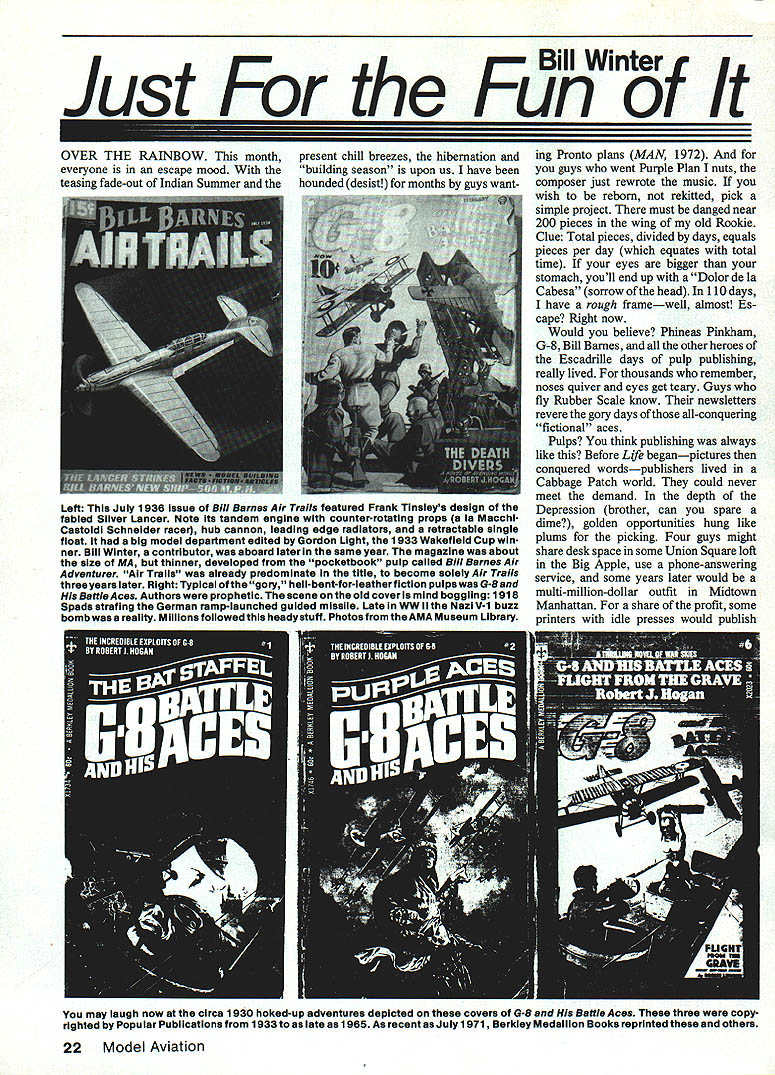
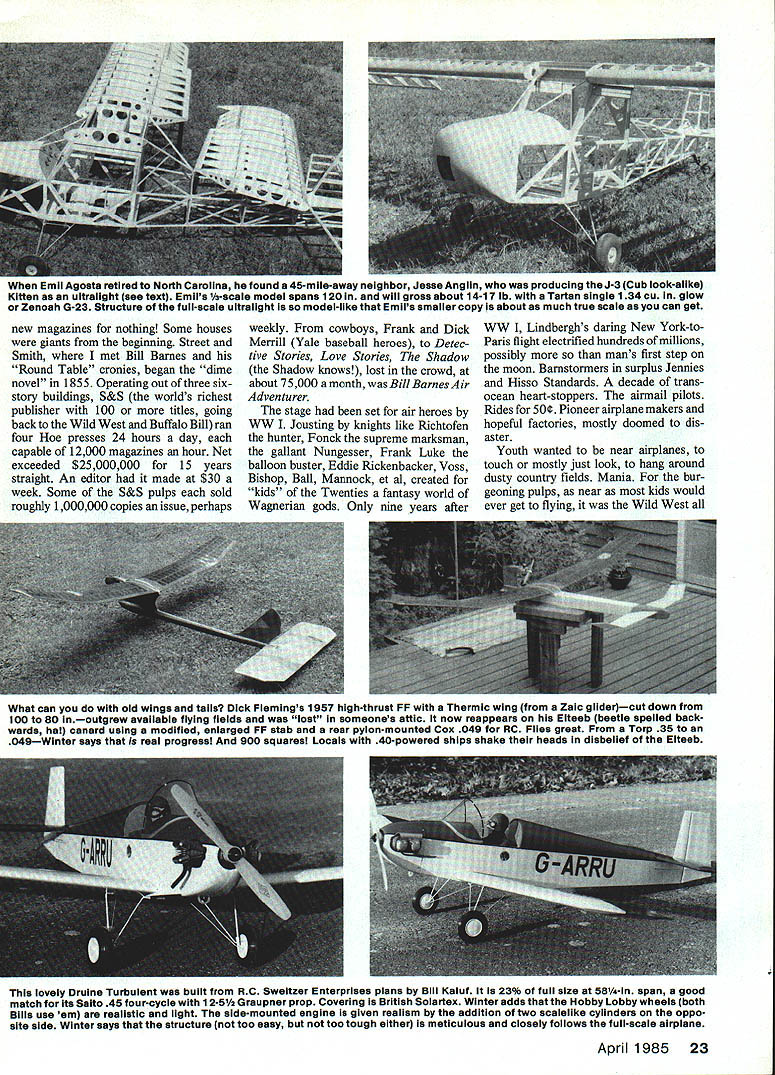
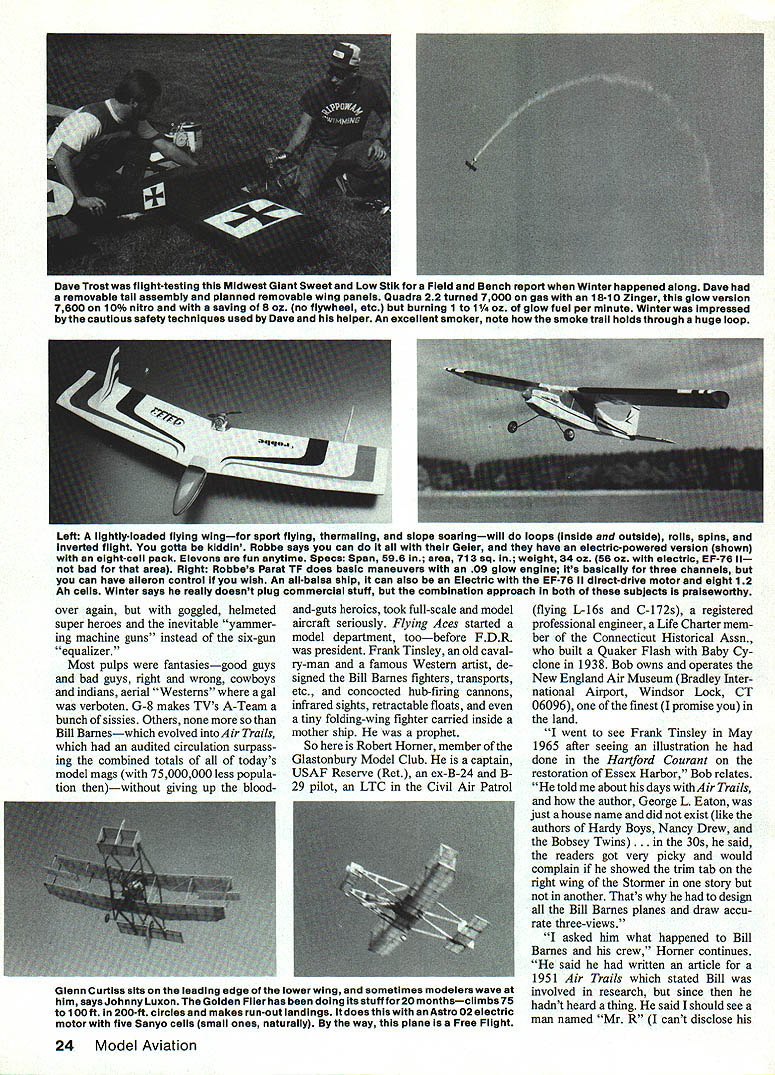
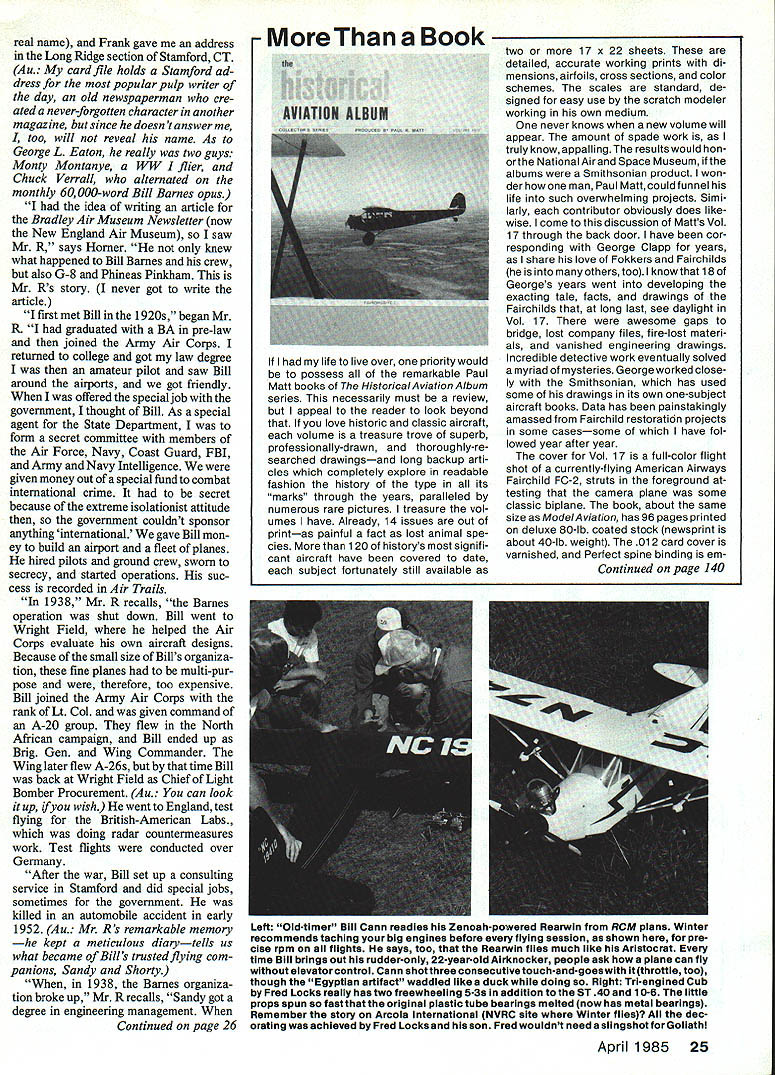
Would you believe? Phineas Pinkham, G-8, Bill Barnes, and all the other heroes of the Escadrille days of pulp publishing really lived. For thousands who remember, noses quiver and eyes get teary. Guys who fly Rubber Scale know. Their newsletters revere the gory days of those all-conquering "fictional" aces.
Pulps? You think publishing was always like this? Before Life began—pictures then conquered words—publishers lived in a Cabbage Patch world. They could never meet the demand. In the depth of the Depression (brother, can you spare a dime?), golden opportunities hung like plums for the picking.
Four guys might share desk space in some Union Square loft in the Big Apple, use a phone-answering service, and some years later be a multi‑million‑dollar outfit in Midtown Manhattan. For a share of the profit, some printers with idle presses would publish. Some operations ran four Hoe presses 24 hours a day, each capable of 12,000 magazines an hour. Net exceeded $25,000,000 for 15 years straight. An editor made $30 a week. Some of the S&S pulps sold roughly 1,000,000 copies an issue, perhaps weekly. From cowboys and Frank and Dick Merrill (Yale baseball heroes), to Detective Stories, Love Stories, The Shadow (the Shadow knows!), lost in the crowd, at about 75,000 a month, was Bill Barnes' Air Adventurer.
The stage had been set for air heroes by WW I. Jousting by knights like Richtofen the hunter, Fonck the supreme marksman, the gallant Nungesser, Frank Luke, the balloon buster, Eddie Rickenbacker, Voss, Bishop, Ball, Mannock, et al., created for "kids" of the Twenties a fantasy world of Wagnerian gods. Only nine years after WW I, Lindbergh's daring New York-to-Paris flight electrified hundreds of millions, possibly man's first step on the moon. Barnstormers in surplus Jennies and Hisso Standards. A decade of trans-ocean heart-stoppers. The airmail pilots. Rides for 50¢. Pioneer airplane makers and hopeful factories, mostly doomed to disaster.
Youth wanted to be near airplanes, to touch or mostly just look, to hang around dusty country fields. Mania. For the burgeoning pulps, as near as most kids would ever get to flying, it was the Wild West all over again — but with goggled, helmeted super-heroes and the inevitable "yammering machine guns" instead of the six-gun "equalizer."
"Most pulps were fantasies—good guys and bad guys, right and wrong, cowboys and Indians, aerial 'Westerns' where a gal was verboten. G-8 makes TV's A-Team a bunch of sissies. Others, none more so than Bill Barnes—who evolved into Air Trails, which had an audited circulation surpassing the combined totals of all of today's model mags (with 75,000,000 less population then)—without giving up the blood-and-guts heroics. Those full-scale and model aircraft were taken seriously. Flying Aces started a model department, too—before F.D.R. was president. Frank Tinsley, an old cavalryman and a famous Western artist, designed the Bill Barnes fighters, transports, etc., and concocted hub-firing cannons, infrared sights, retractable floats, and even a tiny folding-wing fighter carried inside a mother ship. He was a prophet."
Bill Barnes and Air Trails
So here is Robert Horner, member of the Glastonbury Model Club. He is a captain, USAF Reserve (Ret.), an ex‑B‑24 and B‑29 pilot, an LTC in the Civil Air Patrol (flying L‑16s and C‑172s), a registered professional engineer, a Life Charter member of the Connecticut Historical Assn., who built a Quaker Flash with a baby Cyclone in 1938. Bob owns and operates the New England Air Museum (Bradley International Airport, Windsor Locks, CT 06096), one of the finest in the land.
"I went to see Frank Tinsley in May 1965 after seeing an illustration he had done in the Hartford Courant on the restoration of Essex Harbor," Horner relates. "He told me about his days with Air Trails, and how the author, George L. Eaton, was just a house name and did not exist (like the authors of the Hardy Boys, Nancy Drew, and the Bobbsey Twins)... In the '30s, he said, the readers were very picky and would complain if he showed the trim tab on the right wing of the Stormer in one story but left it off in another. That's why he had to design all the Bill Barnes planes and draw accurate three-views."
"I asked him what happened to Bill Barnes and his crew," Horner continues. "He said he had written an article for a 1951 Air Trails which stated Bill was involved in research, but since then he hadn't heard a thing. He said I should see a man named 'Mr. R.' I can't disclose his name."
Mr. R.'s Account
"I first met Bill in the 1920s," began Mr. R. "I had graduated with a BA in pre-law and then joined the Army Air Corps. I returned to college and got my law degree. I was then an amateur pilot and saw Bill around the airports, and we got friendly. When I was offered the special job with the government, I thought of Bill. As a special agent for the State Department, I was to form a secret committee with members of:
- the Air Force
- the Navy
- the Coast Guard
- the FBI
- Army and Navy Intelligence
We were given money out of a special fund to combat international crime. I had to be secret because of the extreme isolationist attitude then, so the government couldn't sponsor anything 'international.' We gave Bill the job of maintaining an airport and a fleet of planes. He hired pilots and ground crew, sworn to secrecy, and started operations. His success is recorded in Air Trails.
"In 1938," Mr. R. recalls, "the Barnes operation was shut down. Bill went to Wright Field, where he helped the Air Corps evaluate his own aircraft designs. Because of the small size of Bill's organization, these fine planes had to be multi-purpose and were, therefore, too expensive. Bill joined the Army Air Corps with the rank of Lt. Col. and was given command of an A-20 group. They flew in the North African campaign, and Bill ended up as Brig. Gen. and Wing Commander. The Wing later flew A-26s, but by that time Bill was back at Wright Field as Chief of Light Bomber Procurement. He went to England, testing for the British‑American Labs, which was doing radar countermeasures work. Test flights were conducted over Germany.
"After the war, Bill set up a consulting service in Stamford and did special jobs, sometimes for the government. He was killed in an automobile accident in early 1952. (Author's note: Mr. R.'s remarkable memory—he kept a meticulous diary—tells us what became of Bill's trusted flying companions, Sandy and Shorty.)
"When, in 1938, the Barnes organization broke up," Mr. R. recalls, "Sandy got a degree in engineering management. When he was 60, he wrote a book about Bill Barnes and the early days; he also kept files and drawings. Shorty, who was Bill's chief mechanic and test pilot, worked for Northeast Airlines. He retired and lived in Connecticut. The rest of the story I can't tell. I promised not to write names."
He joined the Air Force, was given a direct commission as 1st Lt., and went direct to P-40 transition. He went to England with a P-47 squadron, which later changed to P-51s. He shot down six German planes and returned as Major. After several jobs did not pan out, he decided to restart the Bill Barnes Squadron. He came to me," Mr. R. continues, "and I got him some surplus two-place Tigercats. (I was retired but still knew some people.) The old Barnes field was now covered by near towns of Cape Cod houses (Levittown or Plainview, probably), so he found a field farther out on the island. Sandy was financed by money inherited from Bill and by a family inheritance. There was no longer government money. Old Squadron members were now too old for this duty, and he recruited friends from the WWII Air Force and Navy.
"The situation soon bogged down on legal problems," Mr. R. sadly relates. "He had to get special permission from the government (which I helped him on) to carry automatic weapons in aircraft. He had to get private policeman licenses for all his men from all states where they expected to operate, but the clincher was when he found he had to notify each state 10 days in advance whenever he was bringing armed aircraft into their jurisdictions. He decided he couldn't operate this way and went out of business. He sold the Tigercats for fire-bombers and went into the engineering consultant business. He has since retired and is living in Hicksville, N.Y.
"Shorty," Mr. R. is emphatic, "went into the Army as a Capt., assigned to Kelly Army Air Base, San Antonio, TX, where he helped organize the Army's expanding aircraft maintenance system. He retired as Lt. Col. and eventually ended up as president of a Connecticut company which modified Air Force aircraft under contract. He retired from that in 1976 and died in 1981."
Now, back to Mr. Horner, who writes, "Mr. R. was not sure what happened to the rest of the crew, but he had heard they had gotten jobs as production test pilots, Army and Navy instructors, and airline pilots. He then went on to tell me of other aviation heroes."
(Author's note: Mr. R. was unable, apparently, to supply Mr. Horner with the whereabouts of various family members, but the Flying Aces Club Newsletter has unearthed some promising leads.)
Next month, Mr. Horner narrates Mr. R.'s remarkable recollections of the later-day careers of "G-8" and his buddies—Nippy, Bull, and "Battle." And, as you'll see, Phineas Pinkham found success in his unique way—something even the Flying Aces crowd would not possibly dream of.
Emil Agosta and the Miss America
The first time I heard the name Emil Agosta was upon his submission of a K&B-powered Miss America (February 1978 Model Aviation). Sometimes there is an undefinable symphony of man and machine, each telling us much about the other. There are lots of builder/machine combinations I never forget, probably because they signal the subconscious that "something" is ahead.
Emil, retired in 1983, built a small house in Weaverville, NC. I see mountains—far, far away, in the fullest sense of the word, from Long Island (Brooklyn perhaps) where he had ground out, like most of us, what I think of as indentured servitude. His first priority was the basement workshop. (Free at last, free at last!) New machinery, benches, drafting table, etc. Very hard, he says. A one-man show. "Living and teaching on Long Island was a lot easier, but I enjoy this more. Am I masochistic?"
Emil built another Miss America, possibly the most beautiful machine to come out of the mid-30s, then drew plans for a large vintage biplane, got its bare bones almost ready, and when he wrote, was finishing the bare bones of an unusual project—the reason for his delightful letters, and this item.
"Last night I was perusing the magazines while watching TV (very poor)," Emil began, "and I caught your letter to Clarence Lee on the Tartan. I know the engine because Sig. Giuseppe Fantini had asked me to distribute it. I did not want to get involved with business, so I asked Dick Phillips to help... he put Fantini in touch with someone. Your discourse to Lee was most informative. I know that Norm Rosenstock (who proves to be a common friend) has your Aristocrat, and I am familiar with its configuration. What gets me is that you stated its weight as being 28 lb. Most guys would go to a Quadra-type engine. Yet your claims are truly mind-boggling! Now, what does this have to do with me?"
Can we talk? The Aristocrat has a 10 ft., 4 in. wing with 18-in. chord, modeled after a circa-1930 generous-area three-place craft—no flaps, hence more area, and a lighter loading. In that size, scale-effect (Reynolds number), a 35–38-oz. loading or more equates with a 20–25-oz. loading on a 5-ft. plane. I make no claims. On the 1.32 Tartan glow single, it cruises at 1/2 throttle, and in no sense is it power lacking. The fact is that it tachs an 18‑6 at 7,000 rpm. It equates with the old Quadra of 2 cu. in. at nearly so, but is incomparably lighter.
Think of a tiny Eaglet, blown up to 10 ft. On all that area, typical off-full-size vintage planes, massive machinery is trouble-making overkill, but perfect for usually-needed nose weight! But if you want vertical performance—rolls going straight up—then you have smaller wing area and weights from 12 to 15 lb., maybe 18 or 20. On the other hand, a big engine. Think of a Falcon . . . . 55, 115—let's very well, even does good aerobatics on a nice .25. Yet you sometimes see them with piped .40s! At least, you can go with what the full-size plane was supposed to do (Aristocrat or P-40), and we should, of course, fly in the way that satisfies us most. That compels an appropriate subject choice. There are no definitive answers.
Sailplane folks (I do oversimplify here) settle on virtually infinite aspect ratios and thin Eppler airfoils and the like. Way to go! But along comes a few groups flying 15%-thick foils—they, too, say "way to go!" One becomes a cynic or runs with the crowd.
When Agosta took to the hills, he landed smack dab in Heaven. He stumbled on Jesse Anglin, who designed and built a most amazing ultralight aircraft. It is a Cub look-alike called the J-3 Kitten. It has a model-like, easy-to-build frame. The factory was only a "piece" away—45 miles down the road from Emil—thus he was able to study factory methods of construction. "I knew he had a winner," Emil says. "In fact, he took first place in Lakeland, Fla., and his latest open cockpit took first place at Oshkosh (EAA Fly-In)."
For Agosta, the light went on. A 1/2-scale version for R/C beginners, employing ordinary model-building techniques. "I feel," states Emil, "that large-scale builders (I'm guilty) often resort to welding, brazing, machine shop work, etc., which is not within the skill ability of the average sport flier. I feel this thing will top out at less than 15 lb. If I use one of the smaller engines like the G-23, I wrote Paul Kinney for information on this engine. Then I read your report."
Wingspan is 10 ft., chord 17.25 in., area 2,070 sq. in. The airplane should top out at about 12 lb. without power plant. And, of course, it is not an aerobatic plane. The airfoil is an NAS 64, perhaps modified. It took until 1 a.m. to plot from factory ordinates. My Kitten is not to exact scale. I did not feel like shelling out $75.00 for factory drawings for a fun airplane. I worked from a three-view, sketches, and photographs. If I needed a dimension, I drove to the factory. The engineer saw the bare bones and was impressed. Now, he will give me most anything. They are cautious down here about 'Yankees,' but when they see results, it softens them up. It helps that he is exactly my age, and we talk about some of the planes we used to fly."
Agosta was discouraged by what he thought was an aileron problem. "I can milk only a 1‑in. travel, up and down—total of 2 in. The full-scale J-3 Kitten has a 6‑in. travel—total 12. To be scale, Emil needed 4 in. total travel, possibly crucial because an ultralight flits slowly and could require proportionately larger movements. There is a vast underground of folks who don't find things like this in mags, and we all seek out others who may have suggestions."
I both wrote Bob Wischner many times when I built the Aristocrat because I had no experience with large horns, hinges, etc., even some basics, and eight years ago, special supplies had not appeared. My same-specs Aristocrat weighs almost double Emil's J-3 Kitten, but we had clues. The Aristocrat could be slow-flown with solid responses at just above idle. On the 'A,' aileron control alone was delayed due to the small vertical tail and down-aileron drag. On climb-out, you waited for 100 ft. or so before it broke into a mild turn. Using CAR—rudder travel 20% of aileron movement in this case—it was perfect. (If you use CAR, switch it off during takeoffs and on late final, so the rudder alone handles flare and roll-out.) Using CAR, we decided—and with high rate—Emil's Kitten should be OK with his less-than-scale aileron travel. He now advises he has differential with 1‑1/2 in. up, and 3/4 in. down, using large Kraft output wheels.
"Every now and then you mention something that jars my memory, like Lou Garami's workbench," Emil concludes. "Honestly, I laughed out loud. You reminded me of Eddie Webster, my former crew chief at TWA. I don't know how I ever built anything on that ping-pong table. It was loaded with auto accessories, plumbing parts, and just heaps of undefinable junk. When he laid out a new plane, he would fold over a strong-arm, the contents to the back of the table. You could not walk anywhere near the back of the table, as the fallen debris resembled the county landfill. I truly miss him. Of course, I cannot forget Lou. He was a fixture at Holmes Airport (then across from what is now LaGuardia Airport). We learned so much from him."
Continued on page 134.
Old Wings, Canards, and Rediscoveries
What can old wings and tails do? Dick Fleming's 1957 high-thrust FF "Thermic" wing, Zaic gliders cut down to 100% or 80% span, grew out of available flying fields, were lost in someone's attic, and now reappear. Elteeb (beetle spelled backwards), a canard using a modified enlarged FF stab with a rear pylon-mounted Cox .049 for RC, flies great. Torp .35 and .049s—Winter says real progress. 900-square-inch models and locals' .40-powered ships shake heads in disbelief. Elteeb is lovely. Drums' Turbulent, built from RC Sweitzer Enterprises plans. Bill Kaluf's 23% full-size, 58‑1/4‑in span, is a good match for its Saito .45.
We still save wings and tails from soggy, worn-out fuselages. Flying surfaces don't make good stuffed "mooseheads." Astrological influences command us to do something.
"Perhaps readers would like to know what to do with old wings they find in the attic—like I did with a Thermic 100 wing," says Richard Fleming, a returned-to-the-hobby guy. "About 1957, I built a large Free Flight original, except for the wing from a Thermic 100 kit, which I clipped to 80 in. It went up fast with a .23, glide was magnificent. So fine that available fields were simply too small, so the craft was stored in my parent's garage attic. Two summers ago, I got the wing back and built a Sailplane so I could learn about modern RC. Both high-start and Cox .049 launch methods were used. At one time, this wing was flown up on a .35, and now with an .049. Who would have thunk it possible?"
"This year I built another plane for the old Thermic wing—a canard," Dick goes on. "At first it wasn't entirely successful. Under power, the Elteeb flew quite well while the engine ran, and was easy to control. But it would glide fine for a time, and then the nose would drop sharply. I reasoned that the front surface was not sufficient at low speed, and it would lose lift before the hind surface (main wing). I needed a much larger and more slow-lifting-efficient front surface. (That requires more canard surface at less incidence.) Actually, it is a modified lifting tail of the Free Flight mentioned above.
"Interestingly enough, I built this craft without knowledge of the Lazy Duck published in MA some months ago. Results are similar. Elteeb is powered by a Cox 'parts' engine, made up of a TD shaft and case, with piston and cylinder from a mid-'60s reed-valve something. The result is an unusually powerful engine which hauls the canard really well. Total lifting surface is 900 sq. in. An .049 taking up over 900 sq. in? Those guys with their roaring .40s shake their heads in wonder. I have used this Thermic wing on two other craft, but that is another story."
"Don't some people still make wing kits? Have you guys seen them? I keep looking at a spare G.t.-lightweight Spitfire frame that Don Breuß has in his rafters. The wing gets me; I resist hinting. If I allude to it, he gets visions of his own. Do you have old wings? There's gold in them thar hills. (Don't send me a wing, please! You could bust my Purple Plan I project.)"
Golden Flier and Free-Flight Electrics
"Glenn Curtiss sits on the leading edge of the lower wing, and sometimes modelers wave at him as he flies low over their heads," Johnny Luxon tells us. Johnny belongs to the Flightmasters of Southern California, and he took up gliding after a pelican soared by him at the beach. He has a Free Flight 1909 Curtiss pusher Golden Flier. This apparition of struts, wires, ailerons between the biplane wings, a triple-finned biplane canard out front, and a generous stabilizer with single fin and booms all over the place, flies almost every weekend—for the last 20 months, says the Aliso Square Park club.
Trivia: the flying site is in Fountain Valley, 31 miles north of San Clemente. Johnny's tribute to Glenn Curtiss has a 34‑in. span and was developed from a 3‑in. two-view drawing which gave dimensions of the full-size airplane in feet. The model is about 1:16 scale and will only fly with the nose slightly high, but this makes for excellent landings. He hand-launches it in a slight breeze. It usually sinks some, then starts climbing in approx. 200‑ft. diameter circles until it reaches an altitude of 75 to 100 ft. Then it starts a gradual descent, making as many as 10 circles, comes in for a perfect landing, and runs along the ground. Early flights were not so successful; he had to make modifications and add a fifth cell in order to get it to climb above 25 or 30 ft. altitude.
Cell? Yes, believe it or not, this historic vision is powered by an Astro 02 and five Sanyo Ni-Cds. One doesn't need much of a motor power supply for Free Flight electrics. For realistic hops, just change from a small battery (only a few minutes) that fits in your shoe-box field equipment. No more fuss than CO2, if you like little FF scale models, and just as much fun.
Old-Timer Stunt (OTS) and Reno
That small world, again. In the January column, I ran an item about a 1948–49 CL Stunter of mine (published in the Fawcett 1950 Model Builder's Annual), saying it was an Old-Timer no one knew about. Wrong!
"Your comments about the 1949 Stunt King fit closely with a large and growing segment of CL activity. I was 'allowed' to run the Unofficial Nats event this year, Old-Timer Stunt, of course," advises Lou Crane. "Here's a packet prepared for the OTS fliers at Reno. Notice that your Stunt King is a 'certified-eligible OTS design,' and is so listed by the inventor(s) of the current event, the Garden State Circle Burners (John Miske, in particular)."
(Author's note: A 15-page booklet including the Official 1951–52 AMA rules pertaining to CL Precision Aerobatics Regulations, and illustrated maneuvers. There's a complete list of designs published in advertisers' magazine articles prior to December 31, 1952, with magazine title sources.)
"I am a bit surprised that you had said so little about a thriving activity which centers so close by," Lou remarks. "The attendance at Reno OTS was fairly small, due to time-slotting (first event Monday morning) and separation from John Pond's SAM events. Both courses of action were followed to try to avoid conflicts with the official Precision Aerobatics events, fliers of which were seen as the major pool of probable OTS entrants. That turned out to be the case."
CompuServe, E‑Mail, and AMA
I've heard via E‑Mail from PAMPA's assistant newsletter editor, Doug Figgs, that your flying buddy, Doug Pratt, is using CompuServe, a computer-link electronic mail and bulletin board service, in some relationship to his AMA position.
"Here's a strong endorsement for such 'E‑Mail,'" Lou offers. "After I was 'volunteered' for the OTS thing, Doug Figgs was able to advise me quickly, and in hardcopy, of things I needed to know about... via E‑Mail. It is second only in versatility to a voice phone call—perhaps better, as my 11 p.m. best time for phone rates is 2 to 3 a.m. eastern time. E‑Mail waits until the addressee picks it up. CompuServe also has a free national bulletin board facility, and several 'dedicated' services called Special Interest Groups, which might find use for us."
"A few computations/applications articles and flight simulator programs have already appeared in the mags and at trade shows. CompuServe has the advantage that any computer can be set up to 'work' it. The various computer brands, otherwise, are harder to link together, as their central processor dialects differ. With the number of home computers around today, so many with modems and terminal programs, it might only need mention in a forum such as 'Just For the Fun of It'..."
Doug Pratt of the AMA HQ staff has been hooked into the two major information services, CompuServe and The Source, for a few months. He is maintaining information on all sorts of modeling stuff, printing news bulletins, running conferences, and answering electronic mail. He finds many modelers who don't know about AMA. Anyone who owns a home computer and subscribes to either of these outfits can reach AMA through them. The AMA address is 70020,224 on CompuServe and STG232 on The Source.
Me? Right now, I'm in the year 2001—or is it 2010? You can reach me in the old-fashioned way. Pencil, ball-point, typewriter—I'm fully equipped (pre solid-state) to interpret anything. Some names are squiggles. Perhaps writers should print those.
Anyone for ROGs?
Bill Winter 4432 Altura Ct., Fairfax, VA 22030
Transcribed from original scans by AI. Minor OCR errors may remain.

