



Just For the Fun of It
Bill Winter
January weather and flying memories
This January 10th is a shambles. Sleet. The Hermes balks. The first words were to be: "The ankle bone is connected to the leg bone" — the first law of aerodynamics. The Hermes mutters that two months ago I described a wonderful seaplane flight as the last of the season. It wasn't. The strangest weather in generations blessed the entire East Coast with unending, almost windless days and 75° approaching Christmas. Flying went on until New Year's Day. The last flight? Another. And another. For two months!
Actually, I am staring at the new Sig calendar. There's a closeup flight shot of a Quarter Scale Cub — all yellow with silver floats — against a background of blue water and green trees. It reminds me of the pleasures of flying the full-size Cub on New York's East River from a base nestled close to the Throggs Neck Bridge. Wind streaks on the water, an infallible nautical windsock. But water often is glassy, especially on inland lakes, and it can be difficult to know just where the surface is, especially near twilight.
They teach you a special technique so you won't fly into it. Don't just sit there after a skip, stick back, waiting to plop down as you might do with a wheeled Cub; if you did, the results could be rude. You set up an approach that looks good, then never move the stick. Play the throttle to reach out or to increase sink. That's the same as RC stuff. Elevator corrections on an RC landing approach brew trouble, so it pays to learn to play the throttle — and not in desperation power bursts.
I want to fly on floats, but there's no convenient water. If there were, I'd probably forget wheels. I drool over photos from Brimfield Dam, Lake Elsinore, and other places — Garden of Eden spots. An Old-Timer cabin model would be Seventh Heaven. Or if hulls and amphibians appeal, it is too easy to install a wheeled gear that pivots up out of the way. Then you could fly wherever the mood of the moment dictates. I would never build it, but I keep seeing visions (for years!) of a Short Sunderland, in the prewar Empire boat class (with four engines!). I can't fulfill this dream, but I can see it each year because of George Clapp, who visits a daughter and her family in Canada. He takes airplanes, as all good guys do. (One note: Walter Lawrence, in George's report, makes darn good floats, and we'll be talking about them, too.)
Float Fun Fly at Sand Lake
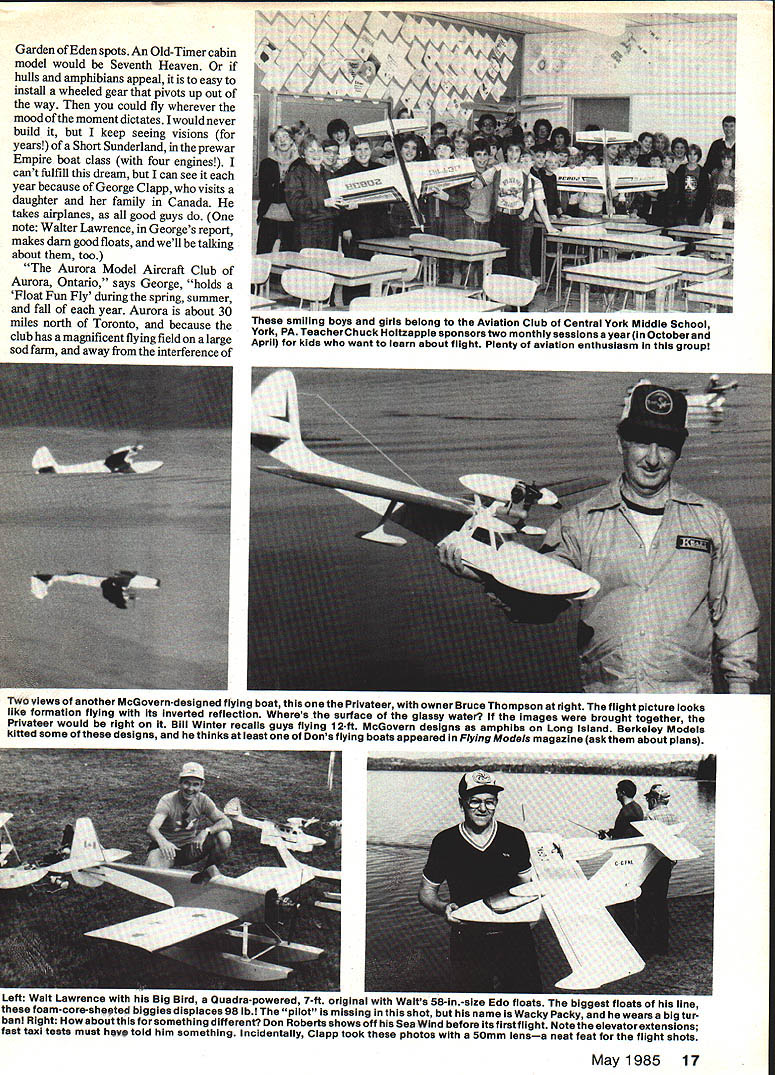
"The Aurora Model Aircraft Club of Aurora, Ontario," says George, "holds a 'Float Fun Fly' during the spring, summer, and fall of each year. Aurora is about 30 miles north of Toronto, and because the club has a magnificent flying field on a large sod farm, and away from the interference of the big city, many members are from Toronto.
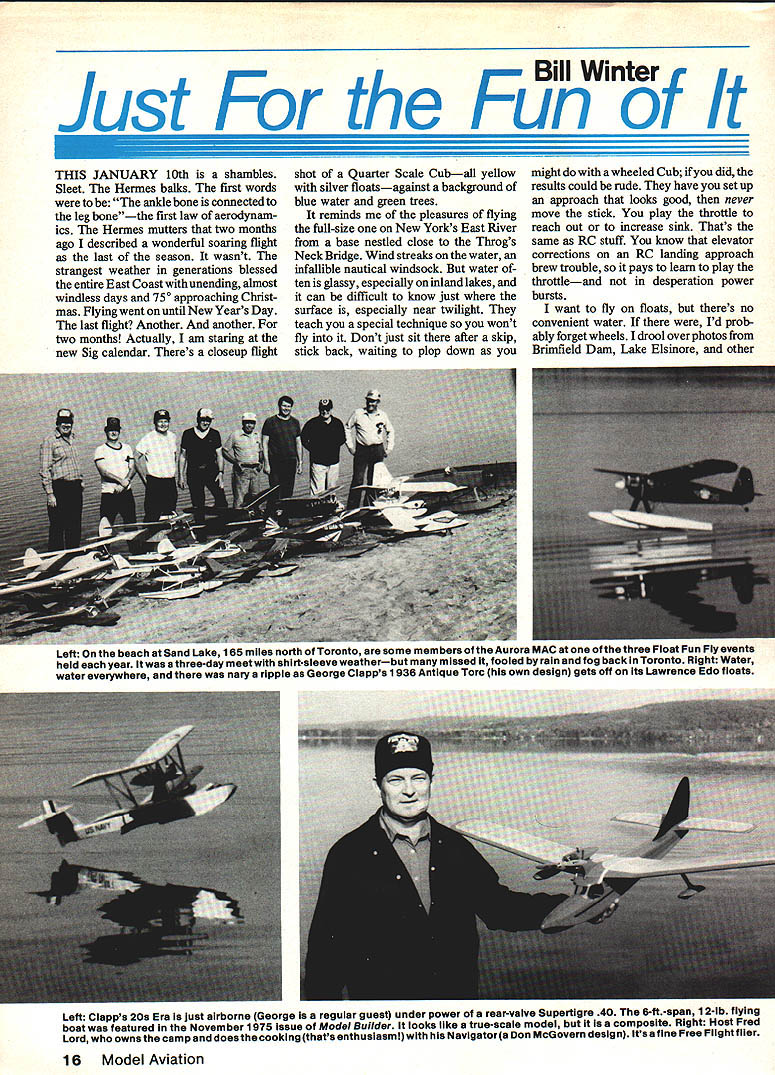
"I have been invited to participate in this event for the last few years at Sand Lake, near Muskoka, Ont., some 165 miles north of Toronto. Of the three seasonal events, I decided that the one on October 13–15 would be the one to plan on. On the Friday evening," Clapp continues, "club members Walter Lawrence, Al Walton, Bruce Thompson, and I met at Walt's home to consolidate models, etc., and to pack them in Walt's van and my wagon. All of these models, with the exception of my big '20s-era flying boat, have foam-core floats designed by Walt. Other club members, Don and Jim Roberts, and Allan Brooks, also came up that evening. Fred Lord, who owns the camp, was a super host who cooks great meals. Great weather. Clear skies, no wind to speak of, and shirt-sleeve temperatures. Other fellows didn't show, but we learned later that the weekend in Toronto had been foggy with rain."
The eight of us who did make it had a total of 24 RC models and one free-flight (FF) boat. The sand beach was shallow a good way out, making it easy to retrieve a model with a stalled engine near the shore, although the water was icy cold — I know, because I upset my Torc upon landing and had to wade to get it. The days passed quickly. Hangar flying in Fred's model shop each night. The fellowship will not be forgotten.
Walt Lawrence's foam floats
About those floats. They are scale Edo. There's a picture of Walt Lawrence with his could-be 3/4-scale original on floats. Walt (an engineer for Avion Industries in Toronto) hates to write, but thanks to George I have a copy of a spec sheet of Walt's float products — under the label "Walt's Foam & Things Float Cores." I suggest you ask for this sheet by name and include a pre-addressed envelope. He doesn't list prices, but if you are serious about any that are listed, I expect he'd quote.
Float details (from the spec sheet):
- Nine sizes listed (Walt makes 16 total).
- Designed to handle specific plane weights from 10.4 to 98 lb.
- Core lengths vary from 22½ in. to 55 in.; when finished, the floats are 1½ to 3 in. longer.
- He also sells copies of Edo 1320 in 1:1 ft. drawings.
- Four float sets are precisely correct for J-3 Cubs in 96 and 105 in. span and 1/4- and 1/5-scale sizes.
- Walt also has (but did not list) new floats for a 4-in.-scale D.H. Beaver, single-engined Otter, and Noorduyn Norseman.
Walt Lawrence — Walt's Foam & Things Float Cores 189 Lloyd Ave., Newmarket, Ont., L3Y 5L4, Canada Phone: 416/895-6252 (probably evenings)
The "air ocean" — models vs. full-scale
"Physics. Or was it momentum, inertia?" — whatever those few words were, they were the clue to my puzzlement about model behavior in wind. More recently, Ron diagrammed flight paths in moving air that correspond with, say, a perfect figure eight (and etc.) as seen from the ground. I am amazed that anyone could argue with him, and some readers evidently were amazed that an "old hand" like myself would appear to be among the disbelievers. Wind causes a model to weathervane, I'd said. Not so — and yet...
When I learned to fly on a J-3, I was told to practice crosswind "S-turns-on-a-road," and then figure eights with the intersection on that road. Brother, in a strong wind blowing at 90° to that road, the maneuvers done in the air, "perfect" when viewed from the ground, were eye-openers to a student pilot. If you began by intersecting the road and headed into the wind, you flew a straight line for what seemed to be forever. When you turned to complete the first half of the S to intersect the road going downwind, the ship swept around and reached that point so quickly it would take your breath away. That upwind leg seemed like a short cross-country, and the downwind leg gave precious little time to complete the second half of the S as I crossed the road. Because of wind drift, that second turn-and-bank was literally horsed around, at a steeper angle and rapidity (forced) to prevent drifting far downwind of the road. Any pilot knows that Ron is absolutely correct — and yet...
Is a model part of that air ocean? Sometimes it seems yes, sometimes no. Things are harder to understand because the 50-mph speed of a model is far less in relation to, say, a 35-mph wind than a J-3 — or an F-15. If that F-15 was setting a speed record, it would make turned runs both upwind and downwind, and you expect to see it go 35 miles per hour faster over the ground downwind, and 35 miles less upwind. Does a model establish itself at an airspeed that blends into that air ocean with its own speed relative to the wind so much that it loses the ratio of a full-scale plane's speed to the same wind? I strongly suspect that inertia (Ron's reference to physics) plays a significant part in a model's performance in wind. That physics is strongly involved with models.
Examples and observations:
- Gordon D. (an early Wakefield Cup winner) published a look-alike "Commercial" design in MAN in the early 1930s. I built two. Lightweight floaters, they flew beautifully. Yet in a wind, when circling, the lower-side wing would not recover, and a spiral dive always developed until impact. A modest increase in dihedral cured that, and the plane then flew 360s repeatedly.
- Rubber models do that today. (A dihedral-less Lacey is a 100% exception — why?)
- My Wakefield, the Eureka, had a high-pitch prop. Going downwind, that big prop (somewhat underpowered) looked like slow motion. It keened plop, plop, plop, and the true airspeed dropped.
- Shallow-dihedral models live on the edge of a cliff in a turn starting out of the wind. Scaled down, a big J-3 wing that behaves benignly full-size will balloon on a 4-ft model. Flat-bottom wings sometimes actually slow and stall in the same condition if the rate of turn is rapid.
- Any rudder-only RC flier who remembers knows that a tiny rudder movement when going into the wind produces a quick turn. The rudder has bite. Yet that same model flying downwind will barely come around even with full rudder held for many seconds.
- My RC jobs that can free-fly and perform hands-off 360s and 720s will always display a slight loss of altitude going downwind and regain the original altitude on the upwind side.
Downthrust, ballast and trimming:
- Experts can prove downthrust causes a loop in FF models with a high wing and low thrust line. It does — up to a point. Adding some downthrust trims the ship to fly faster on its wing, which generates more lift, hence the loop. But add more downthrust, and the same ship will not loop.
- The famous Ram-rod had tons of downthrust, yet it beat everything in its day. Downthrust is inefficient, but in the overall context, the configuration can be more efficient. Why argue with success? The Hellcat had 6° down. The Turbo Grumman (Schweizer) Ag-Cat has 16° down relative to its top wing!
- I've had RC rudder-only jobs with so much downthrust that the prop was at 90° to the ground in a three-point attitude. Those models went like the hammers of Hades.
- We often use excess area in combination with excess power; if a free flighter had a 200-mph J-3 Cub, he'd add an 18-ft stab with 40% of the wing area and give it a lifting airfoil.
- In calm air where a dead-stick (RC) glide was a hair slow, I've added a pencil-cell battery ballast weight to the nose and seen these changes: a trace-stall with one cell, a partial stall with two, a stall with recovery on the horizon with three, and a firm, fast glide with four. Each progressive change trimmed the plane to fly faster, creating more lift until the forward CG held the wing at an airspeed matched to the area.
Moments, drag and the elusive CG:
- Designers calculate moments about the CG for thrust line, and compare that with moments about the center of pressure/resistance (very great in the case of a severe parasol). For me, the center of drag is a far greater trouble-maker than the CG moment.
- The CG (weight or mass) is not anchored firmly to the center of the earth. To lift that mass vertically requires a force in pounds greater than the weight. But to slide that object in a horizontal plane by thrust requires much less force than to lift it. Drag puts up a heck of a fight at high speeds.
- Pattern fliers do not want their Centers of Drag high or low. High drag spells slow flight. We seldom know precisely where the center of drag is located, but its location is potent and can drive us to distraction while flying.
- We seldom know precisely where the CG is either. It is never exactly where the plans indicate. A common field method: suspend the plane from a point behind its fore-and-aft CG location and extend the supporting line across the fuselage; then suspend it from a point forward of the designated CG position on the plan and extend that line. Where the two lines cross is the true CG position — or so they say. Engineers fix axle points at a certain forward angle to the CG (let's guess 14°). If the CG is high, as on a high wing, or low as on a bottom wing, what is sauce for the goose is not necessarily sauce for the gander.
Yeah, I have trouble with the "air ocean."
Phineas Pinkham and pulp reprints
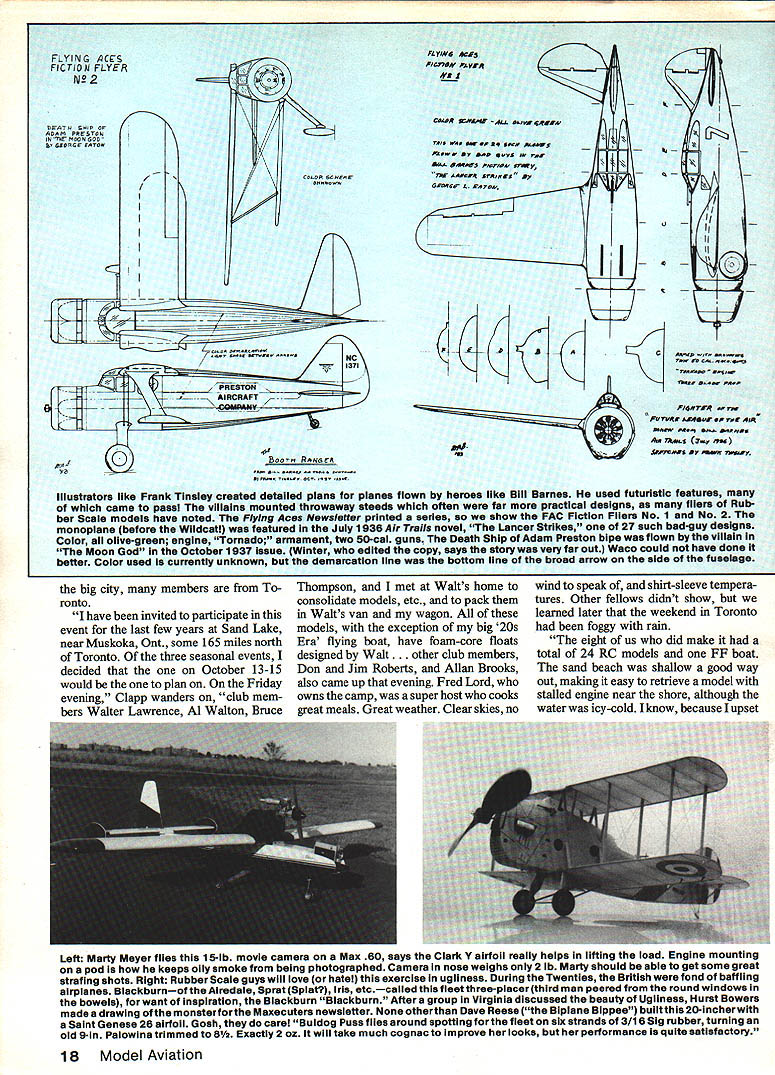
Thanks to Bob Horner's remarkable reprints of the old pulp magazines, I recently dug out a couple of yarns and reread them with giggles. The characters were usually ordinary men with a fresh slant, a "whoopee" attitude, and a knack for getting into trouble. The aviator/villain romance was in full bloom. Illustrators like Frank Tinsley created detailed plans; planes flown by heroes like Bill Barnes used futuristic features that later came to pass; villains mounted throwaway steeds often far from practical designs.
Rubber-scale modelers have noted these influences. The Flying Aces Newsletter printed a series showing "FAC Fiction Fliers No. 1" and "No. 2." A monoplane before the Wildcat featured in a July 1936 Air Trails novel, "Lancer Strikes." Many such bad-guy designs appeared. In one, an olive-green engine Tornado with armament of two .50-cal. guns, the "Death Ship," was flown by Adam Preston, the baddie in "Moon God" (October 1937). Winter's edited copy says the story was very far out; a Waco could have done better.
Final notes
Marty Meyer flies a 15-lb movie-camera ship with a Max 60. He says the Clark Y airfoil really helps lift the load. The engine-mounting pod keeps oily smoke away from the camera.
Transcribed from original scans by AI. Minor OCR errors may remain.

