
Just for the Fun of it
Bill Winter
Telling this story is like pinning the tail on the party donkey while blindfolded. In the September 1980 issue was published an account by Luther Hux of his work with an RC parafoil. For us, the beginning was seeing Luther put it all on paper.
For Luther, the beginning was a picture in an article by Dr. Nicolaides in Mechanics Illustrated magazine. For Don Lowe, we know not when it began, but he was deeply involved at Wright-Patterson in flight-testing the feasibility of a small-scale, remotely controlled, powered parafoil vehicle. The report from the Air Force Flight Dynamics Laboratory is dated Oct. 1, 1974, so Don's beginning was before that date. For G. Robert Veazey, manager of Aerial Recovery & RPV Programs at All American Engineering Co., whose final engineering report on "Parafoil Deployment Demonstration" is dated February 1979, the work began in 1977.
Luther's project is a unique small-area, highly maneuverable machine for demo flying with the Virginia Air Show Squadron Radio Control Team. The other projects involved, on a grander scale, an industrial approach to the problem of retrieving remotely piloted vehicles (RPVs).
What follows developed from a by-mail interview with Bob Veazey, who also is an extremely talented modeler and RC flier. Our imaginary camera picks up Dr. John D. Nicolaides of Cal Poly University, the parafoil authority, with whom All American had a working agreement.
Nicolaides and the N-Flyer
Nicolaides had demonstrated parafoil flight with model airplanes flown by his students. The design was called the N-Flyer and had been demonstrated on TV's Sixty Minutes.
In August 1973, when Dr. Nicolaides was chairman of Notre Dame's Department of Aerospace Engineering, the new flyer began life. With a 15-hp engine it flew but would not climb. Under an escalated contract, jointly funded by the Air Force, Navy and Coast Guard—after he had succeeded in December 1973 with a 25-hp engine—the doctor came up with a 400 sq. ft. parafoil that could carry a pilot.
A promising offshoot was recovery of an RPV that cruised at 75 to 100 mph, to be slowed to about 10 mph by cutting power and deploying the foil (the doctor had demonstrated it on land and sea with small RPVs).
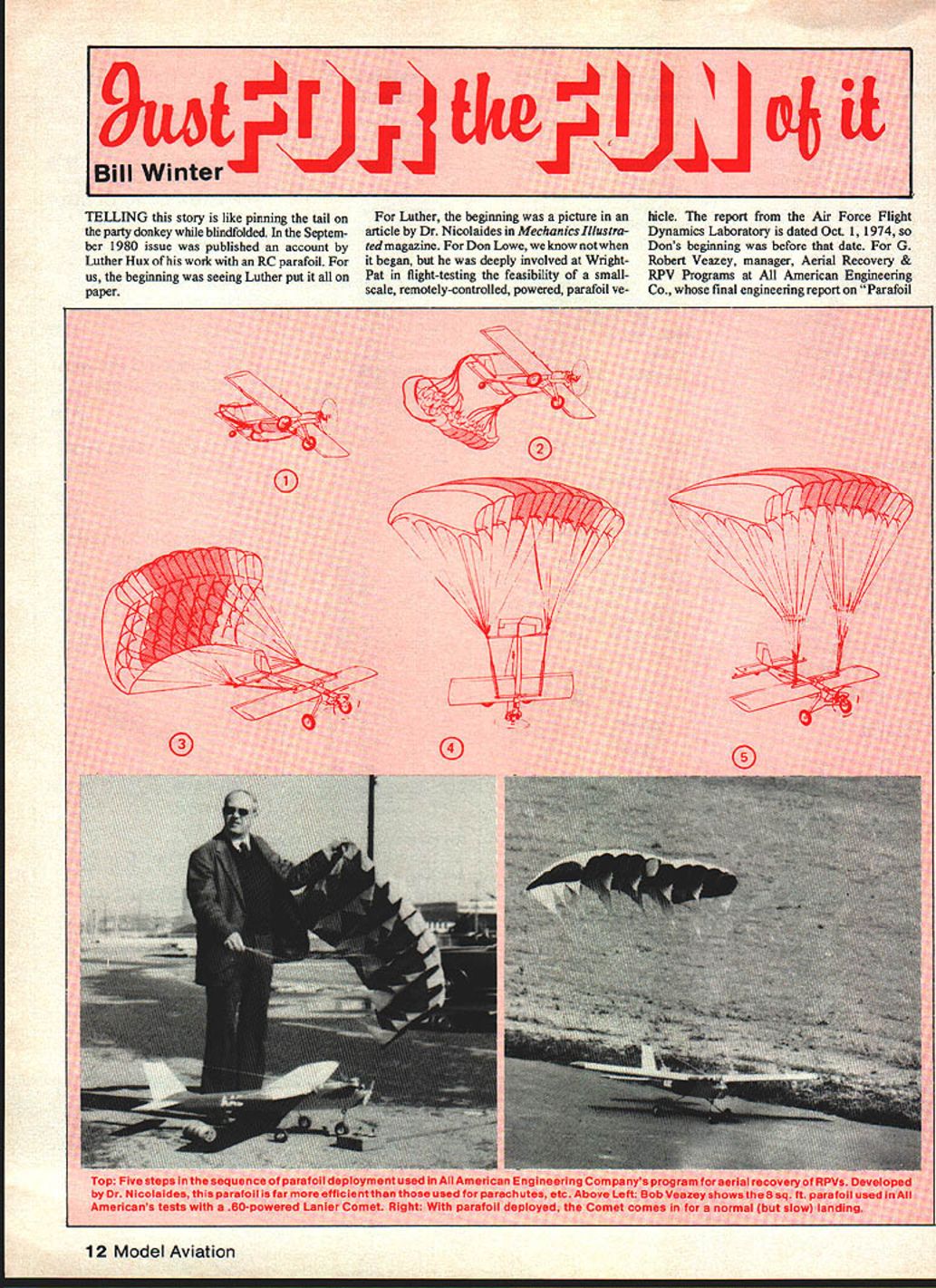
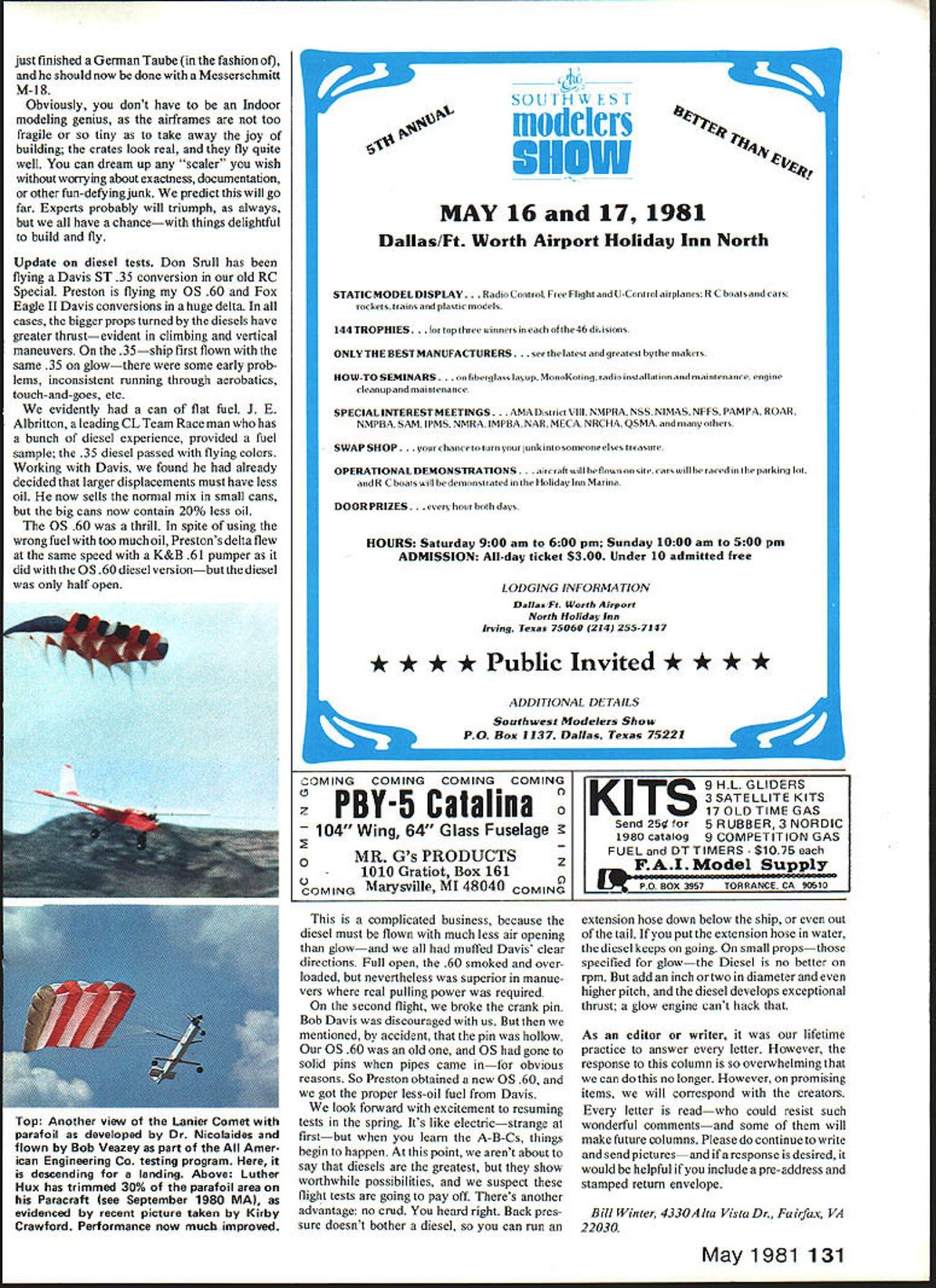
To augment the doctor's work with them, All American fitted an 8 sq. ft. parafoil on a Lanier Comet (the pic Luther saw). Now the "camera" cuts to Bob Veazey.
All American demonstrations — the Comet
"The Comet," Bob tells us, "was powered by a somewhat worn Supertigre .60 turning a 12x6 prop. In a slight breeze, takeoff run was perhaps 5 ft., and very precise maneuvering was achieved using throttle, elevator, and rudder. Numerous flights were made from our company parking lot."
"We took the Comet on a tour of various air bases and companies involved in the RPV business," Bob continues, "and flew demonstration flights from parking lots, vacant fields, city streets, as well as from the Pioneer Field at the Great American in Sunnyvale, CA, and from the Northrop Field at Thousand Oaks, CA."
The U.S. Navy, having conducted an in-house Parafoil Program, contracted with All American and Dr. Nicolaides to demonstrate mid-air deployment of a parafoil from an RPV. Veazey described key findings:
- "Nicolaides claims that his design has a much higher lift-to-drag ratio than parafoils used as kites or for parachute jumping."
- "At a given elevator setting, we could control the model's climb, descent or level flight by use of power."
- "At full power we could control the model's climb and descend or maintain level flight by using elevator."
- "Ensure that adequate tail control surfaces are available."
- "Important is the location of the attaching points for the parafoil risers with respect to the aircraft CG and distance between risers. Since the aircraft is turned by inducing yaw using the rudder, an adequate moment arm to the risers above the CG must be achieved."
- "No difficulty with ground control using the normal nose-wheel steering of the Comet. Takeoffs and landings were easily accomplished, and touch-and-gos were a joy."
- "Also important to optimum parafoil performance is keeping the porosity of the material used very low. Constructed of low-porosity calendered ripstop nylon."
- "Rigging is somewhat critical, but we were able to obtain very stable flight with only a small displacement of the parafoil canopy aft of vertical over the attachment points."
There was a mild critique of Luther's published project, but Luther was already flying later—he found the same answers. Having removed 30% of the area, his parafoil's performance at the July 4 show was fantastic. It jumps off at a scary 45-degree angle and turns firmly whether the wind is on course or at right angles to it. It is to his everlasting credit that he achieved success in model-plane form which cost less than $50 in materials, minus radio.
Rocket-assist: Mark Murdock and John
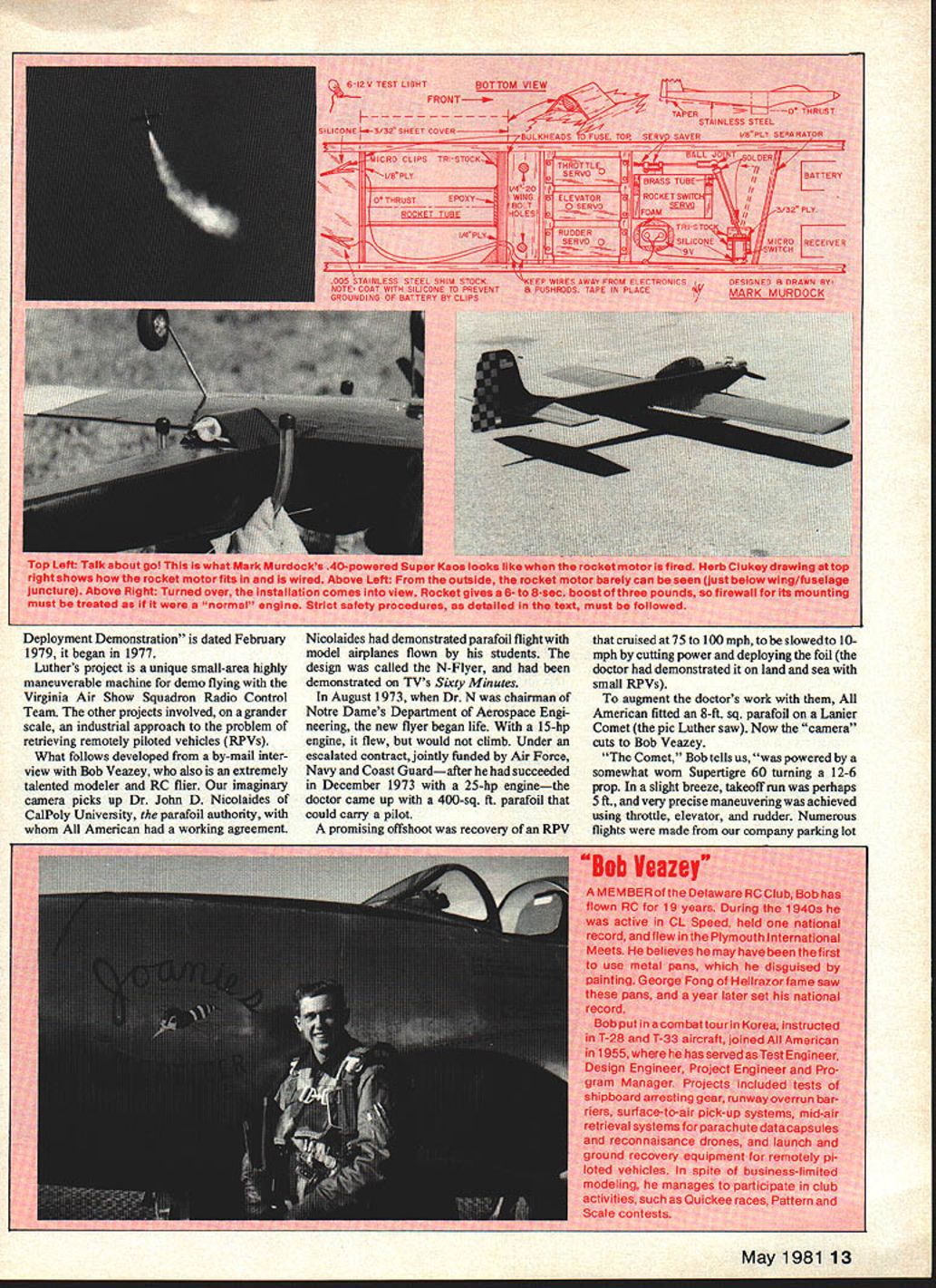
Just for the fun of it, says Mark Murdock (130 Jonathan Rd., Riverdale, GA 30274), he modified an OS .40-powered Bridi Super Kaos for spectacular in-flight JATO (rocket assist) by adding a pod for Estes "D" rocket engines. The 3-lb.-thrust "afterburner" makes a straight-up climb something to behold. With five servos, the ship weighs about 5 lbs. Ignition is a 9-volt transistor battery, the fifth servo flipping a microswitch to fire off the rocket. Naturally, there are many "musts" both as to proper installation and for safety.
The rocket pod must be treated as an engine, with well-reinforced mounting, firewall, etc. The bottom of the fuselage is protected by .005 in. stainless-steel shim stock, contact-cemented in place and silicone coated to prevent grounding the igniter clips. Even heavy aluminum foil will burn through. You must be a competent pilot, able to fly at fast Pattern ship, and you must have a good working knowledge of rocketry.
The rocket pod is right behind the wing, with thrust at zero incidence to avoid nose-up or nose-down moments, or a tail-heavy ship. The 3/16 to 1/4 in. pod firewall is protected with epoxy, and the rear fuselage is sloped upward to clear the blast. A high-quality microswitch is a must; the servo must be dependable and not glitchy. If the system is not perfect, a premature firing could result. Ignition wires are as short as possible and routed away from servos.
Check balance with rocket engine in pod, fuel tank empty. Remove rocket, and make a few test flights for proper trim.
Before flight, be sure frequency is clear (you have the proper color pin). Invert the model on the field box, and make a demanding range check. John then turns off his transmitter and listens for glitches; if none, he turns the transmitter on. There are six steps to follow:
- Put a test light on the rocket clips.
- Throw the switch to fire—the light should come on.
- Flip the switch to off—the light should go off.
- Set engine throttle for best cranking.
- Turn receiver off, then transmitter.
- Slide rocket engine into tube with igniter taped in—put microswitch clips onto igniter.
You must have a helper trained to handle the model (John's dad helps him). The radio must be kept off. The helper holds the plane by the left wing and upper front fuselage—away from the rocket, just in case. When the engine is started, helper carries plane to runway, points it into wind—it is not taxied out. Check that the transmitter 5th servo switch is in off, then turn on transmitter. Helper turns on receiver, and gets off the runway. After the usual control-surface check and takeoff, plane makes a high fly-by at 250 to 350 ft. Kick in the rocket—it takes 3 to 4 sec. to operate. After a 6- to 8-sec. boost, the spent rocket falls away harmlessly. Turn the extra-function switch to off—essential if the rocket fails to fire.
Murdock emphasizes caution and that a safety procedure must be followed faithfully. The outlined procedure was part of the preliminary engineering, and the Murdocks have made numerous rocket-assist flights. Although thoroughly thought out and proven, such a project should not be attempted by novices.
John is a 23-year-old machinist for Delta Airlines. His dad got him started in modeling 13 years ago with a Cox PT-19. Numerous Guillows stick models and umpteen control-line jobs followed. Without help, John and his dad began RC with a Falcon .56; they "managed" to destroy a model, John only 14 at the time. After building a new fuselage, he went on to an AAMCO A-Ray, then many sport and Pattern types. RC Sport Scale is his goal. He wishes to thank his dad and the "rest of you old-timers." "Us" old-timers owe you young guys, John, for keeping us intrigued by your ideas and inspiration.
Bostonian — California's rubber event
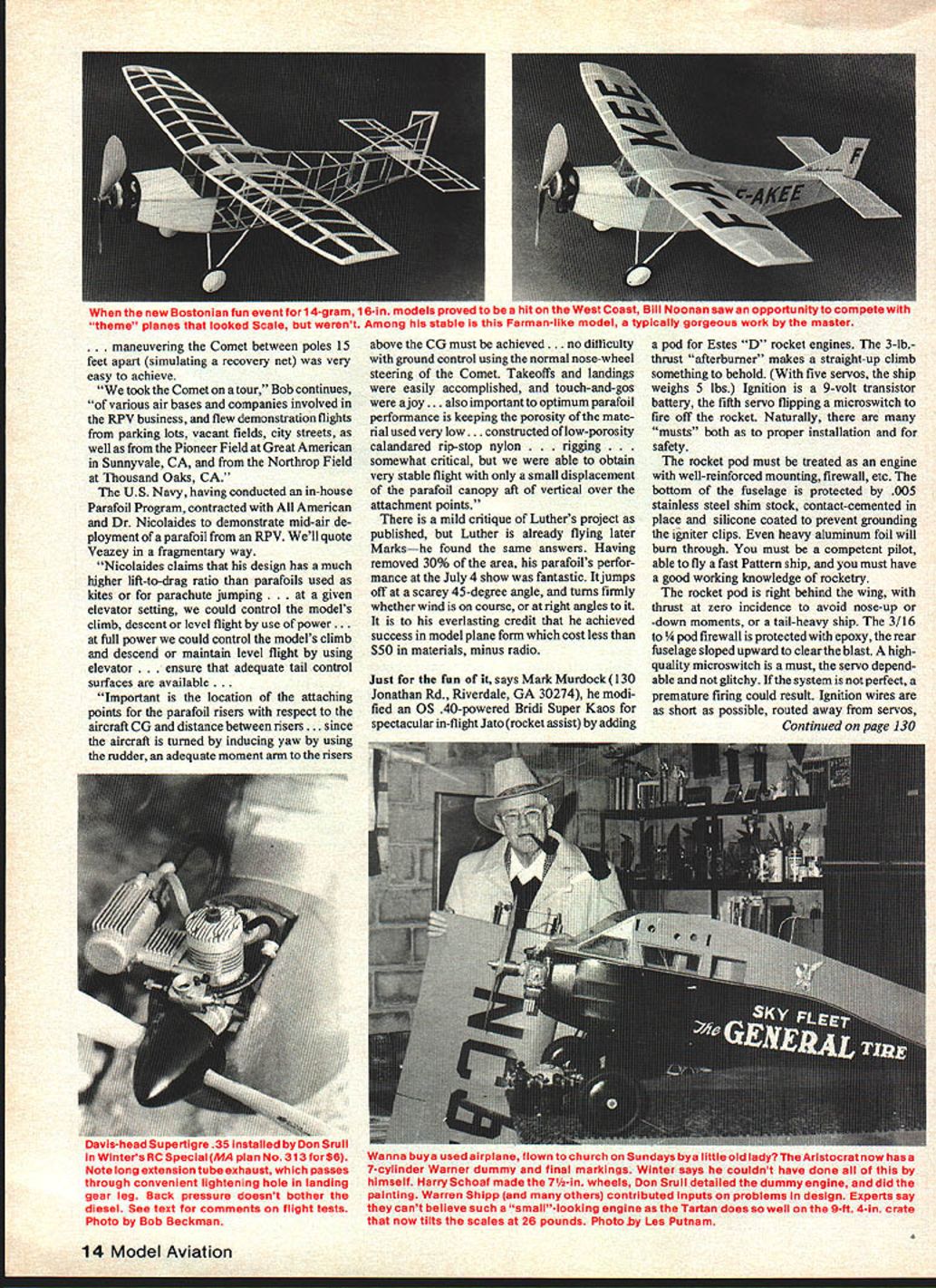
California has gone bananas over a rubber event (a just-for-the-fun-of-it kind of thing) called Bostonian. It's big with the Scale Staffell in San Diego and the Flightmasters in L.A. We love it. The main purpose is the construction of a craft that has some semblance to full-scale—not only in appearance, but in structural integrity as well.
Oversimplified here, the rules allow:
- A 16-in. wingspan with maximum chord of 3 in.—monoplanes only.
- Maximum prop diameter 6 in.
- ROG (rise off ground) must be from the same position the model lands after a hand-launched glide from at least 5 ft. off the floor—so flimsy landing gears are kaput.
- Maximum length, 14 in. from thrust button to extreme opposite point.
- Minimum weight, 1/2 oz. without rubber.
- Minimum two wheels, at least 3/16 in. diameter.
- Fuselage must contain a minimum "box" of 1.5 x 2.5 x 3 in.
- Minimum nose moment projected forward visibility, same on each side.
- The 14-gram weight limit eliminates ghost ships and encourages more detail.
The first time they tried it, 21 entries showed up (indoor); best flight was by Dick Baxter at 64 seconds. He used a low-wing poly configuration with the required "box" on its side, giving center width that depth, presumably for a lift advantage. The late Bill Noonan got me to thinking—there must be a number of designs that lend themselves to Bostonian rules. The Farnam was one, and a Fokker Universal would be good. Bill has just finished a German Taube (in the fashion of), and he should now be done with a Messerschmitt M-18.
Obviously, you don't have to be an indoor modeling genius, as the airframes are not too fragile or so tiny as to take away the joy of building; the crates look real, and they fly quite well. You can dream up any "scaler" you wish without worrying about exactness, documentation, or other fun-defying junk. We predict this will go far. Experts probably will triumph, as always, but we all have a chance—with things delightful to build and fly.
Update on diesel tests
Don Srull has been flying a Davis .35 conversion in our old RC Special. Preston is flying my OS .60 and Fox Eagle II Davis conversions in a huge delta. In all cases, the bigger props turned by the diesels have greater thrust—evident in climbing and vertical maneuvers. On the .35—ship first flown with the same .35 on glow—there were some early problems, inconsistent running through acrobatics, touch-and-goes, etc.
We evidently had a can of flat fuel. J. E. Albritton, a leading CL Team Raceman who has a bunch of diesel experience, provided a fuel sample; the .35 diesel passed with flying colors. Working with Davis, we found he had already decided that larger displacements must have less oil. He now sells the normal mix in small cans, but the big cans now contain 20% less oil.
The OS .60 was a thrill. In spite of using the wrong fuel with too much oil, Preston's delta flew at the same speed with a K&B .61 pumper as it did with the OS .60 diesel version—but the diesel was only half open.
This is a complicated business, because the diesel must be flown with much less air opening than glow—and we all had muffed Davis' clear directions. Full open, the .60 smoked and overloaded, but nevertheless was superior in maneuvers where real pulling power was required.
On the second flight, we broke the crank pin. Bob Davis was discouraged with us. But then we mentioned, by accident, that the pin was hollow. Our OS .60 was an old one, and OS had gone to solid pins when pipes came in—for obvious reasons. So Preston obtained a new OS .60, and we got the proper less-oil fuel from Davis.
We look forward with excitement to resuming tests in the spring. It's like electric—strange at first—but when you learn the A-B-Cs, things begin to happen. At this point, we aren't about to say that diesels are the greatest, but they show worthwhile possibilities, and we suspect these flight tests are going to pay off. There's another advantage: no crud. You heard right. Back pressure doesn't bother a diesel, so you can run an extension hose down below the ship, or even out of the tail. If you put the extension hose in water, the diesel keeps on going. On small props—those specified for glow—the diesel is no better on rpm. But add an inch or two in diameter and even higher pitch, and the diesel develops exceptional thrust; a glow engine can't hack that.
Letters and contact
As an editor or writer, it was our lifetime practice to answer every letter. However, the response to this column is so overwhelming that we can do this no longer. However, on promising items, we will correspond with the senders. Every letter is read—who could resist such wonderful comments—and some of them will make future columns. Please do continue to write and send pictures—and if a response is desired, it would be helpful if you include a pre-addressed and stamped return envelope.
Bill Winter 4330 Alta Vista Dr. Fairfax, VA 22030
Transcribed from original scans by AI. Minor OCR errors may remain.

