
Just For the Fun of it
Bill Winter
Journey to the center of the earth
For more years than we can remember, ingenious modelers have been toying with camera planes. Long before modern miniature aircraft, people used kites to support cameras high in the air. A novelty at first, aerial photography using RC jobs has demonstrated scientific worth to the public in a stunning variety of ways. You can even make money at it. Aerial model photography is richly rewarding to anyone who combines the twin hobbies of photography and RC flying, especially when meaningful and business-like objectives are coordinated.
One of the few who have put it all together is Bob Munn, of Orem, UT. As you read this, he probably will be off to archaeological digs in Greece and North Africa, or he might be out capturing film of some local ruin or a spanking-new shopping center. What really drives lens-wizards like Hux, Peter Miller, and Bob Munn?
"The gap in perspectives between tall ladders and low-flying normal aircraft is an interesting one for photographers," Munn tells us. "Hawkeye is an RC miniature aircraft carrying sophisticated Nikon 35mm still-camera equipment which can capture those images that would otherwise go unappreciated. Operating at altitudes as low as 20 feet to as high as 1,000, and making during a single flight both vertical area-search and oblique exposures at varying altitudes and ranges, Hawkeye can provide fresh perspectives. They often reveal interesting relationships between a subject and the surroundings, as well as new aspects of the subject itself."
"Hawkeye has a wide variety of applications," Bob continues. "Business and industrial location or publicity photographs from a different angle, real estate survey and sales programs, advertising materials in a variety of forms, and the satisfaction of personal objectives are among them. The system is useful in nature photography as well. In construction and in archaeology, periodic photography of this kind produces a useful and interesting documentation of progress as well as demonstrating the relationship of site to surroundings."
Bob's "business" aircraft gets airborne in less than 75 feet and requires 150 feet of smooth, clear space for landing due to the sheer inertia of the 20-lb. aircraft moving at 30 mph. It operates off the average rural dirt road. Ideal is a large, paved parking lot or smooth grass playing field, free of obstructions at opposite ends. Fuel lasts 20 minutes, and the camera operates at speeds of up to four exposures a second. A typical flight produces 30–36 B&W or color negatives — of which 60–70% will be useful.
"Top quality images suitable for full-page magazine presentation are produced. Detail depends in large part on the lens-to-object distance. A high-altitude vertical area photo covering over 1,000 linear feet on the ground will not have the detail of one taken from a lower altitude covering a much smaller area. Because of the moving platform, one cannot use the slow, super-fine-grain films, but any material with an ASA rating of 100 or more will reproduce excellent results under normal lighting conditions. When using B&W negative material and working at remote locations, the film can be processed on the spot so negatives can be assessed, and additional flights made if necessary to obtain the desired results."
What of for-hire missions? "Objectives relate primarily to the production of images of particular interest and high quality. A thorough discussion of the kind of images desired from the specific flight is essential, as is a survey of the subject, its relationship to light sources, and the nearby area.
"The cost of a project can range considerably, since so many variables are involved," Bob explains. "As a starting point, one flight producing 30–36 exposures on any type film, conducted under average conditions, would cost about one hundred dollars. This would include one visit for survey and discussion, one operational flight on a second visit, and the processing and delivery of slide or negative material. If B&W, a contact sheet is furnished. All other prints, services, etc., involve additional costs.
"The purchaser obtains one-time use rights to the materials produced, which otherwise remain the property of the operator. Exclusive rights are subject to individual negotiations. In project packages, costs are based on the number and type of acceptable images to be produced, and not necessarily on the number of flights required to produce them."
Author's Note: For legitimate firms writing on company letterheads, Munn has a typical portfolio available for instruction. Address him in care of Model Aviation.
Personal projects and plans
After I finish my 1/4-scale Piper Vagabond, my big 1981/82 winter project will be an electric 4-engined Constellation. I confess to a long, unrequited love affair with "Connie," and having witnessed the quiet magic of Srull's 6-ft. Spitfire to be published in MA (very much lightened over the prototype), you might say my passion for Connie is rekindled.
I am in regular correspondence with Bob Boucher, Mitch Polling (who sometimes calls), Bob Kopski, and an innovative genius, Heinz Koerner. Bob Boucher, for example, has provided laborious notes on every combination of every size motor he makes — belt-drive and direct — along with loadings, plane sizes, performance, batteries, etc. Some of these combinations are a job for Superman, or Convair—some are spectacular beyond dreams.
I might go with four direct-drive .075s at about 7-ft. span. If this excites you, please wait, because you'll need to see essential frame techniques.
Electric Fly — Koerner's report and Q&A
At last year's Electric Fly (this year, Sept. 20, rain date Sept. 27; Bob Kopski, 25 West End Dr., Lansdale, PA 19446) Koerner found visiting modelers' comments interesting, to say the least. We asked him for a summary of questions and answers, and hit the jackpot. Here is Heinz:
- Comment: Electric is only good for gliders.
Answer: Our aerobatics and my twin .075 with 22-oz. wing loading proved otherwise.
- Comment: The flying time is short. You zoom across the sky for 2 1/2 minutes and then wait until the battery is charged again.
Answer: Kopski built a fast aerobatic plane with semi-symmetrical airfoil, Astro 10 motor, 8 x 6 prop, and twelve 1.2 Ah cells. Running time is 6–7 min., depending on aerobatics. I have an .02-powered glider with four 1.2 Ah cells and 6 1/2 minutes running time. Gross 24 oz., area 360 sq. in., three Ace Midget servos. Twenty-minute flights from the back yard are common, depending on lift. To fly all day with 20-min. waits, I use three battery packs in all my planes. Packs are easy to remove through hatch or canopy. To charge, I use a 115 Ah marine battery (it powers a 28-lb-thrust trolling motor — another good electric combination!). I also have two Astro Rapid Chargers. On the way to the field, I charge two batteries; at the field I install one battery while charging the third, then exchange charged battery for discharged one. Rotating batteries permits steady all-day flying. I also rapid-charge Rx and Tx batteries.
(Author: Have read directions advising against charging with a car battery with engine running, so suppose Heinz doesn't do it that way.)
- Comment: I tried electric, but after 10 flights the battery failed. I bought another, and it went under after eight flights. Too expensive.
Answer: NiCad battery takes less charge when cold. It warms up with the first flight, takes a good charge the second time. During the second flight the battery warms up more. After several charge/discharge cycles, the battery can get so hot it can be damaged. Provide good cooling. Venting holes in Astro cases are not enough for such heavy use. Open up considerably; when battery feels too hot, cool it with a small fan before and during charging. Don't throw a damaged pack away; usually there is only one bad cell. Measure voltage across each cell with the help of a 5-ohm load resistor. The bad cell drops faster than the good one. Replace the bad cell; don't short out the battery, because it can start a fire or burn your hands.
(Author: On "our" Spitfire, we have the pack supported by tabs, very well exposed for cooling, does not get hot to touch, only warm ... but we are content to wait for recharge, because we have other models to fly.)
- Comment: They will not take off from a grass field.
Answer: Small models will not. (Author: True of gas too; our Spitfire takes off with beautiful realism on grass.) Most light wing-loading jobs with geared motors (geared 15 in Spit) take off easily. No problem with Twin 15, either. With 25, you need light wing loading when loading, and a 10 x 4 prop. (Author: Spitfire has the 14-oz. loading these guys call for, but gross was high; all tell us that it will perform brilliantly with geared 25; Heinz has flown 24-oz. loading.)
- Comment (many): Have electric, left it at home, I'm not that good. Or, have glider in car but never flew in contest.
Answer: This is fun-fly, not contest.
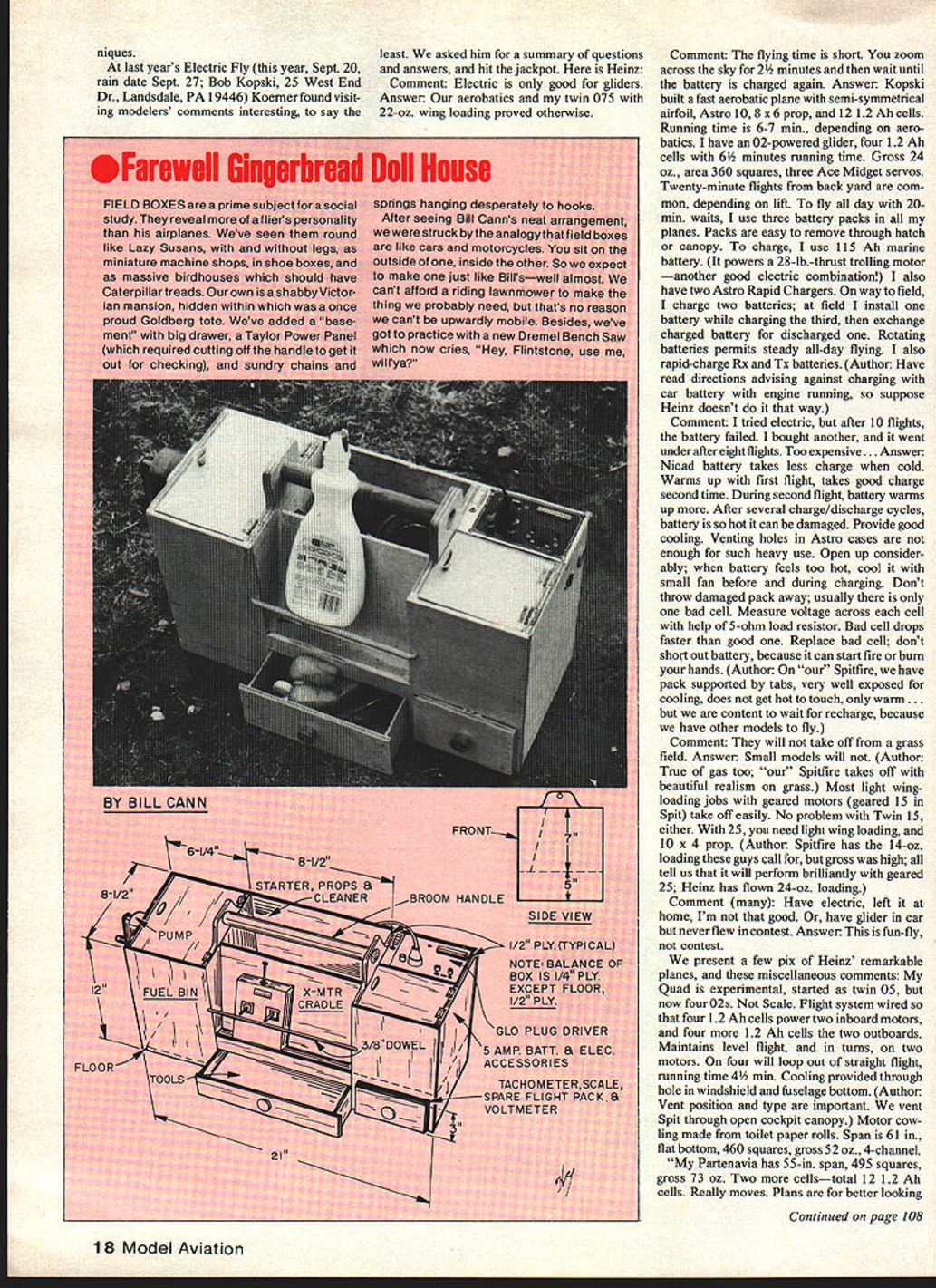
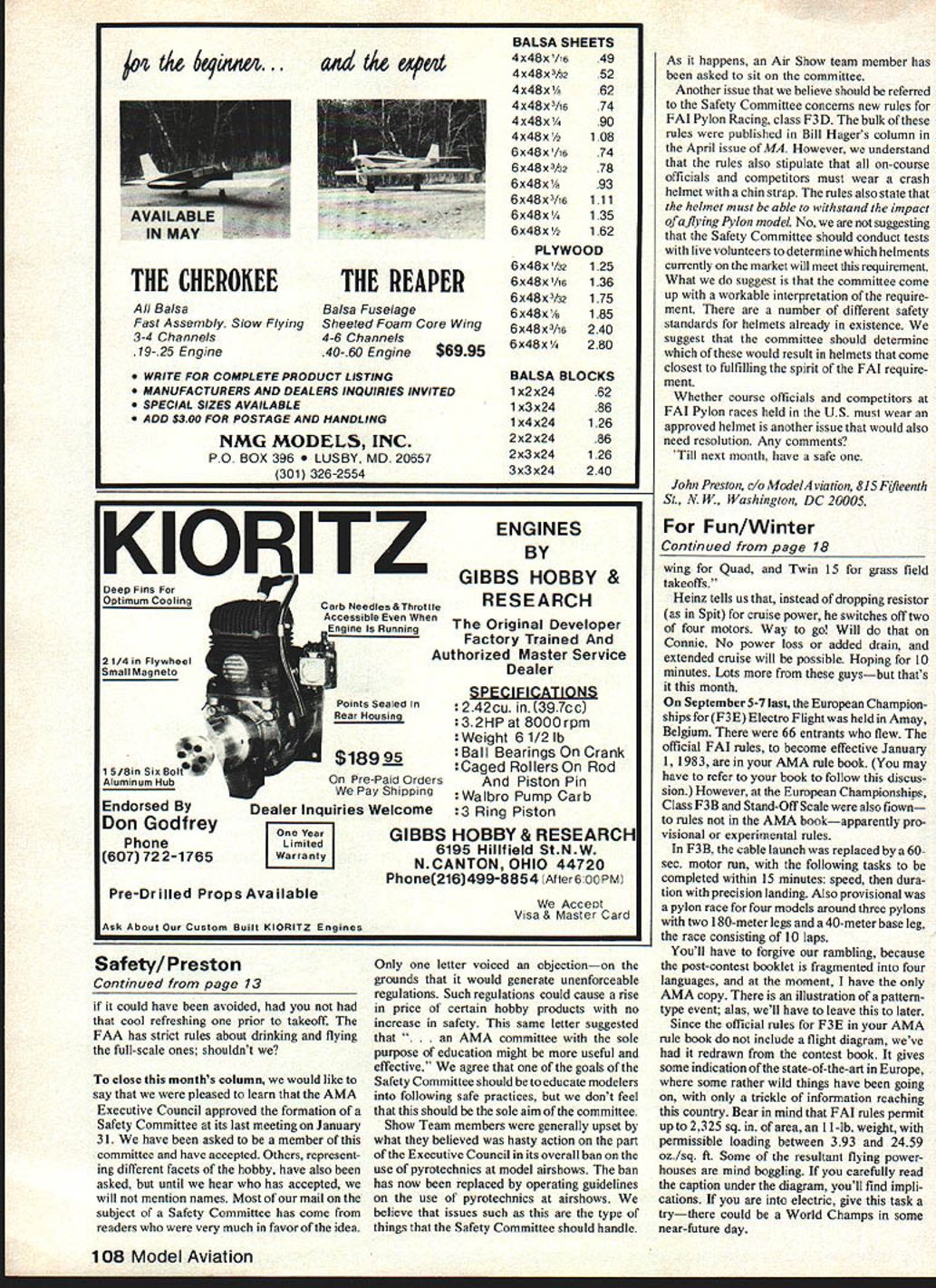
We present a few photos of Heinz' remarkable planes, and these miscellaneous comments: My Quad is experimental, started as twin .02s, but now four .02s. Not scale. Flight system built so that four 1.2 Ah cells power two inboard motors, and four more 1.2 Ah cells the two outboards. Maintains level flight, and in turns, on two motors. On four it will loop out of straight flight, with running time 4 1/2 min. Cooling is provided through a hole in the windshield and fuselage bottom. (Author: Vent position and type are important. We vent Spit through the open cockpit canopy.) Motor cowling made from toilet paper rolls. Span is 61 in., flat bottom, area 460 sq. in., gross 52 oz., 4-channel.
"My Partenavia has 55-in. span, 495 sq. in., gross 73 oz. Two more cells — total twelve 1.2 Ah cells. Really moves. Plans are for a better-looking wing for the Quad, and a Twin 15 for grass field takeoffs."
Heinz tells us that, instead of dropping a resistor (as in Spit) for cruise power, he switches off two of four motors. Way to go! Will do that on Connie. No power loss or added drain, and extended cruise will be possible. Hoping for 10 minutes.
Competitions and international events
On September 5–7 last, the European Championships for (F3E) Electro Flight were held in Amay, Belgium. There were 66 entrants who flew. The official FAI rules, to become effective January 1, 1983, are in your AMA rule book. (You may have to refer to your book to follow this discussion.) However, at the European Championships, Class F3B and Stand-Off Scale were also flown—to rules not in the AMA book—apparently provisional or experimental rules.
In F3B, the cable launch was replaced by a 60-sec. motor run, with the following tasks to be completed within 15 minutes: speed, then duration with precision landing. Also provisional was a pylon race for four models around three pylons with two 180-meter legs and a 40-meter base leg; the race consisted of 10 laps.
You'll have to forgive our rambling, because the post-contest booklet is fragmented into four languages, and at the moment, I have only the AMA copy. There is an illustration of a pattern-type event; alas, we'll have to leave this to later.
Since the official rules for F3E in your AMA rule book do not include a flight diagram, we've had it redrawn from the contest book. It gives some indication of the state-of-the-art in Europe, where some rather wild things have been going on, with only a trickle of information leaking into this country. Bear in mind that FAI rules permit up to 2,325 sq. in. of area, an 11-lb. weight, with permissible loading between 3.93 and 24.59 oz./sq. ft. Some of the resultant flying powerhouses are mind-boggling. If you carefully read the caption under the diagram, you'll find implications. If you are into electric, give this task a try—there could be a World Champs in some near-future day.
Miscellaneous projects and builders
But then there are new problems, and you get sucked into improvements that lead you on, and on.
Dave Henderson's motivations were mixed. He also wanted something different to do, which doesn't surprise us. Golly, when you whip out the same thing by the dozens, combat can chain you to the bench.
Dave's just-for-the-fun-of-it thing was sparked by the idea that, if he could get the motor weight back far enough, the turn ratio would increase. But, not surprisingly, he ended up with 5 oz. of nose weight. It flies, shows promise, but is not competitive in Fast. Any advantage may (he underscores "may" three times) have been lost.
There was another problem: the spray bar was directly over the lower wing. So, to forestall possible burning, he added a section of aluminum under the spray bar. His next Bi-Bat will have the nose extended. While this seems to scotch the original brainstorm, who knows what the strange craft might do?
The drawing shows a one-inch nose extension. The plywood at the center section will be reduced in weight. He has mixed emotions; mentions that it flies like a "dog" when compared to top-ranking ships, yet says it does have good performance. He feels that the weight disadvantage can be overcome. Dave thinks his Combat brethren would be interested in his cut-and-try experiments—so here we are.
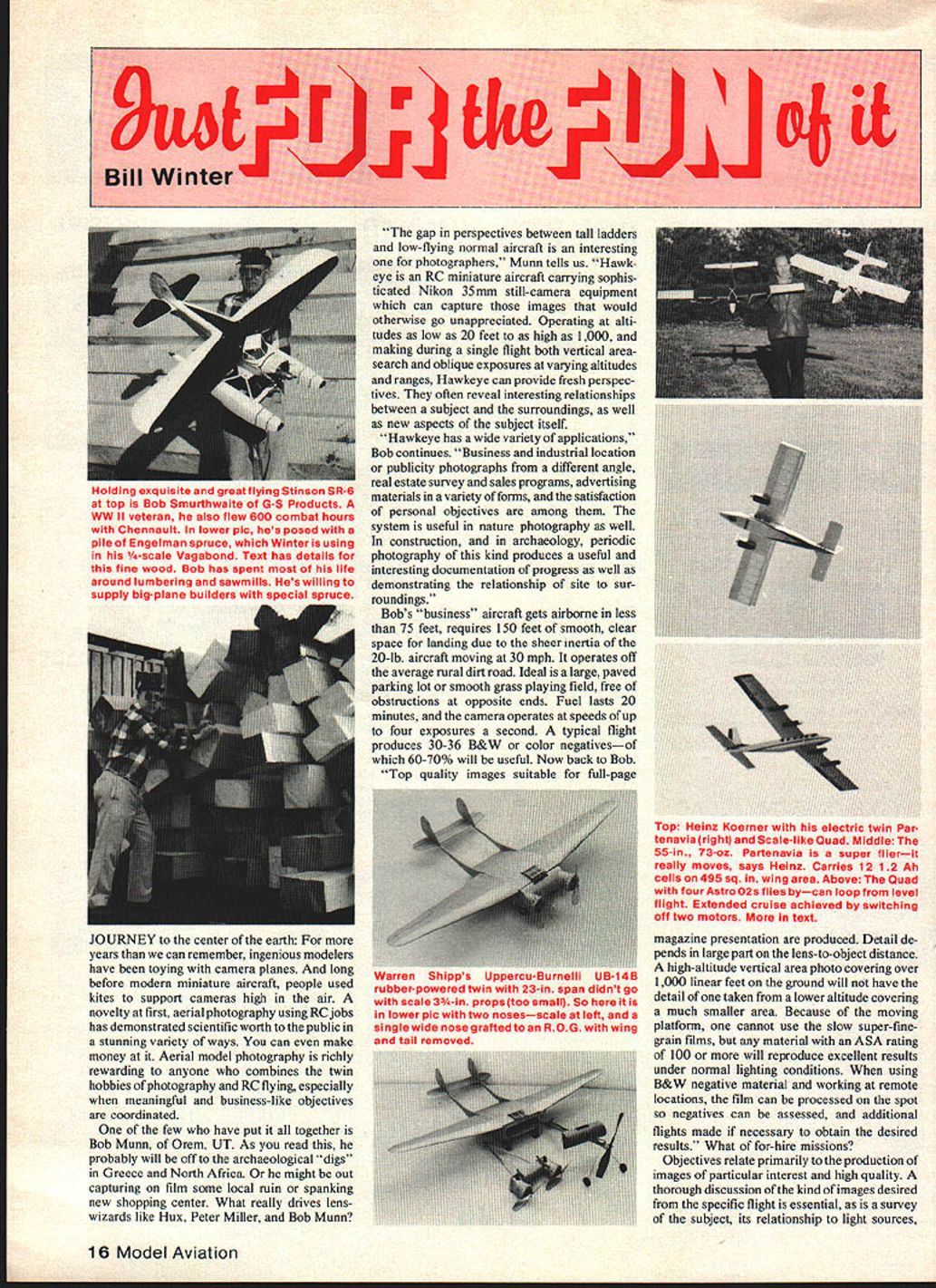
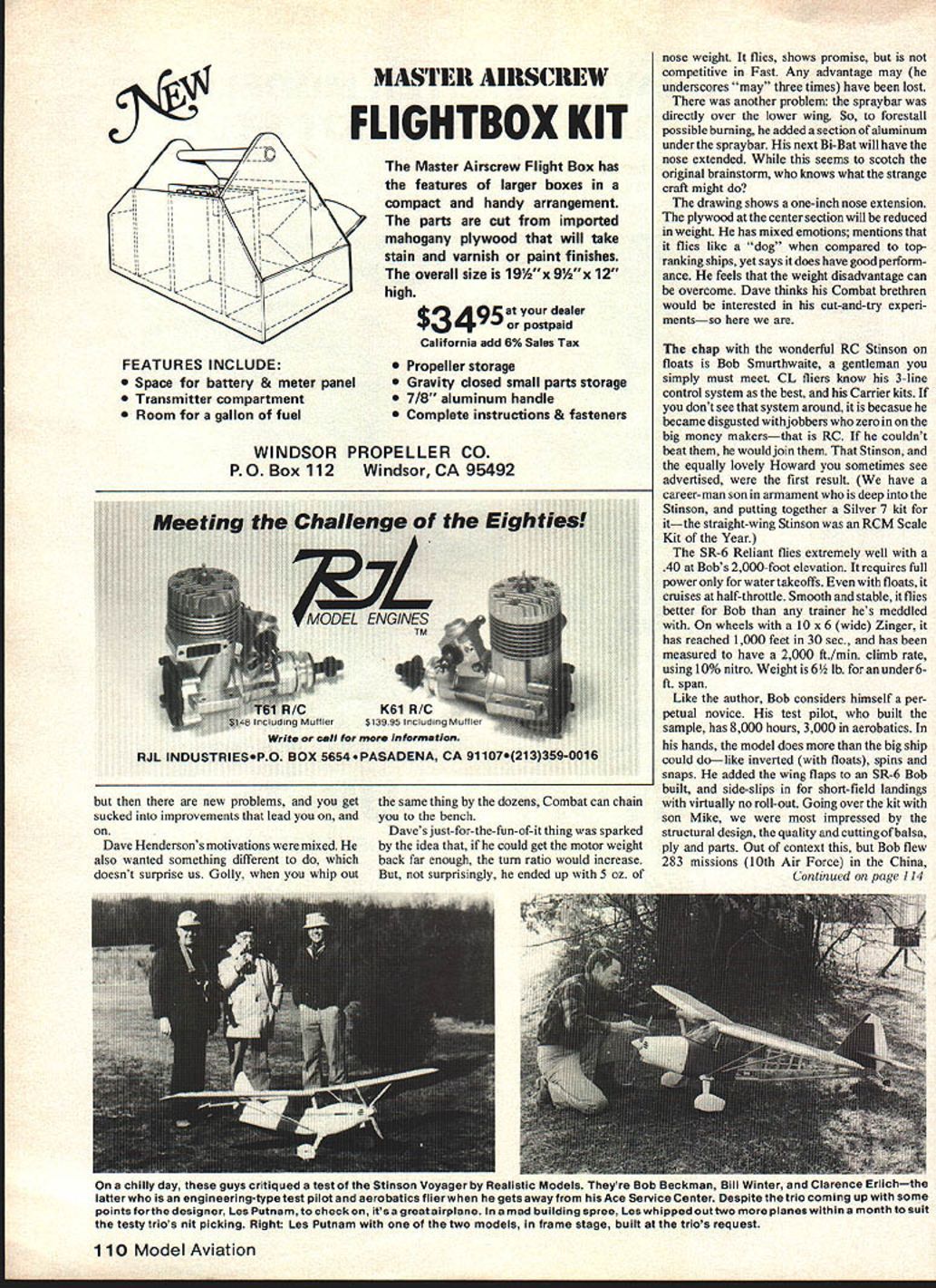
The chap with the wonderful RC Stinson on floats is Bob Smurthwaite, a gentleman you simply must meet. CL fliers know his 3-line control system as the best, and his Carrier kits. If you don't see that system around, it is because he became disgusted with jobbers who zero in on the big money makers—that is RC. If he couldn't beat them, he would join them. That Stinson, and the equally lovely Howard you sometimes see advertised, were the first result. (We have a career-man son in armament who is deep into the Stinson, and putting together a Silver 7 kit for it—the straight-wing Stinson was an RCM Scale Kit of the Year.)
The SR-6 Reliant flies extremely well with a .40 at Bob's 2,000-foot elevation. It requires full power only for water takeoffs. Even with floats, it cruises at half-throttle. Smooth and stable, it flies better for Bob than any trainer he's meddled with. On wheels with a 10 x 6 (wide) Zinger, it has reached 1,000 feet in 30 sec., and has been measured to have a 2,000 ft./min. climb rate, using 10% nitro. Weight is 6½ lb. for an under-6-ft. span.
Like the author, Bob considers himself a perpetual novice. His test pilot, who built the sample, has 8,000 hours, 3,000 in aerobatics. In his hands, the model does more than the big ship could do—like inverted (with floats), spins and snaps. He added wing flaps to an SR-6 Bob built, and side-slips it for short-field landings with virtually no roll-out. Going over the kit with Jon Mike, we were most impressed by the structural design, the quality and cutting of balsa, ply and parts.
Bob flew 283 missions (10th Air Force) in the China-Burma-India theater, and he also was one of Chennault's boys (sent home in bad shape after 600 combat hours).
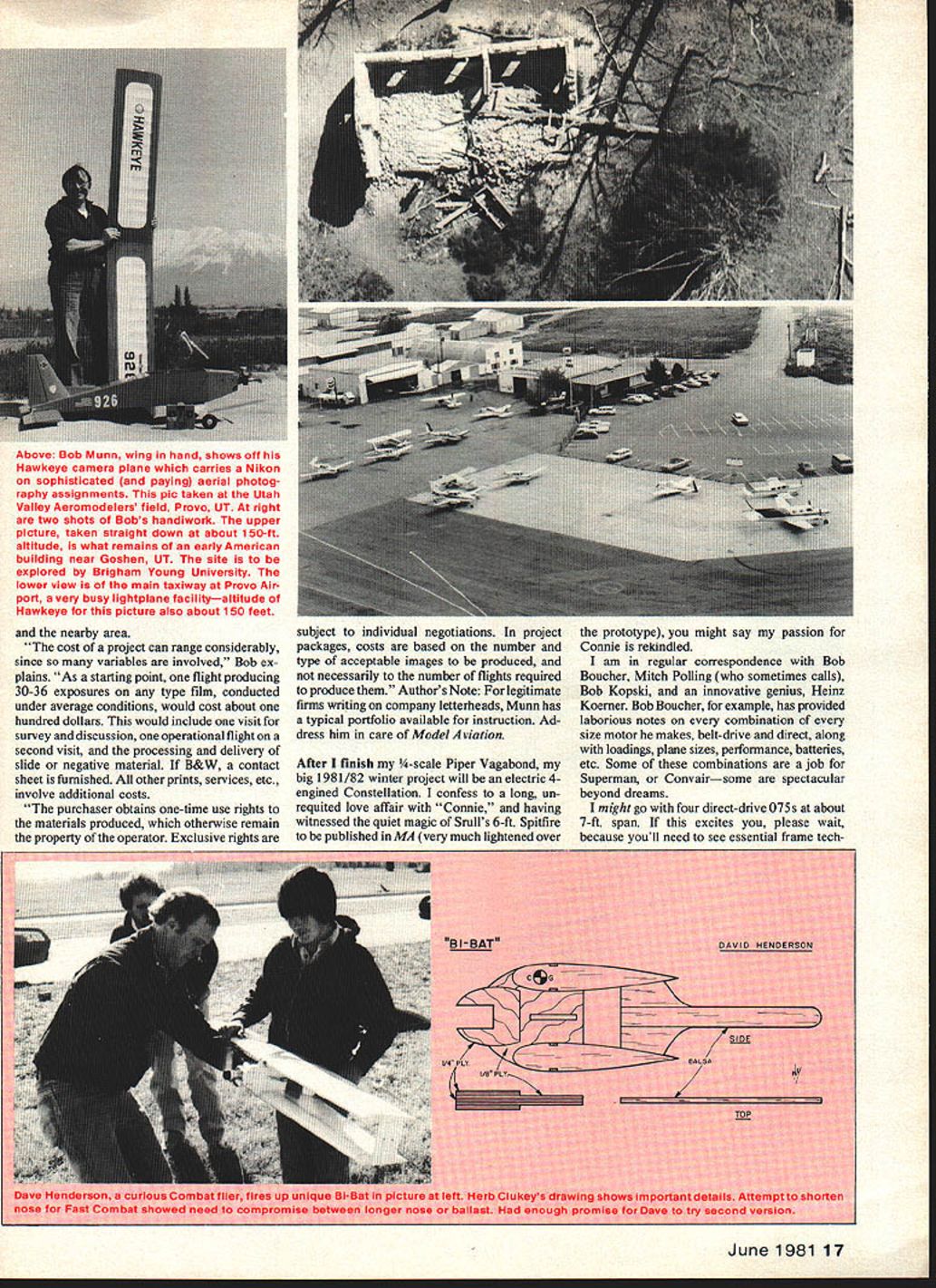
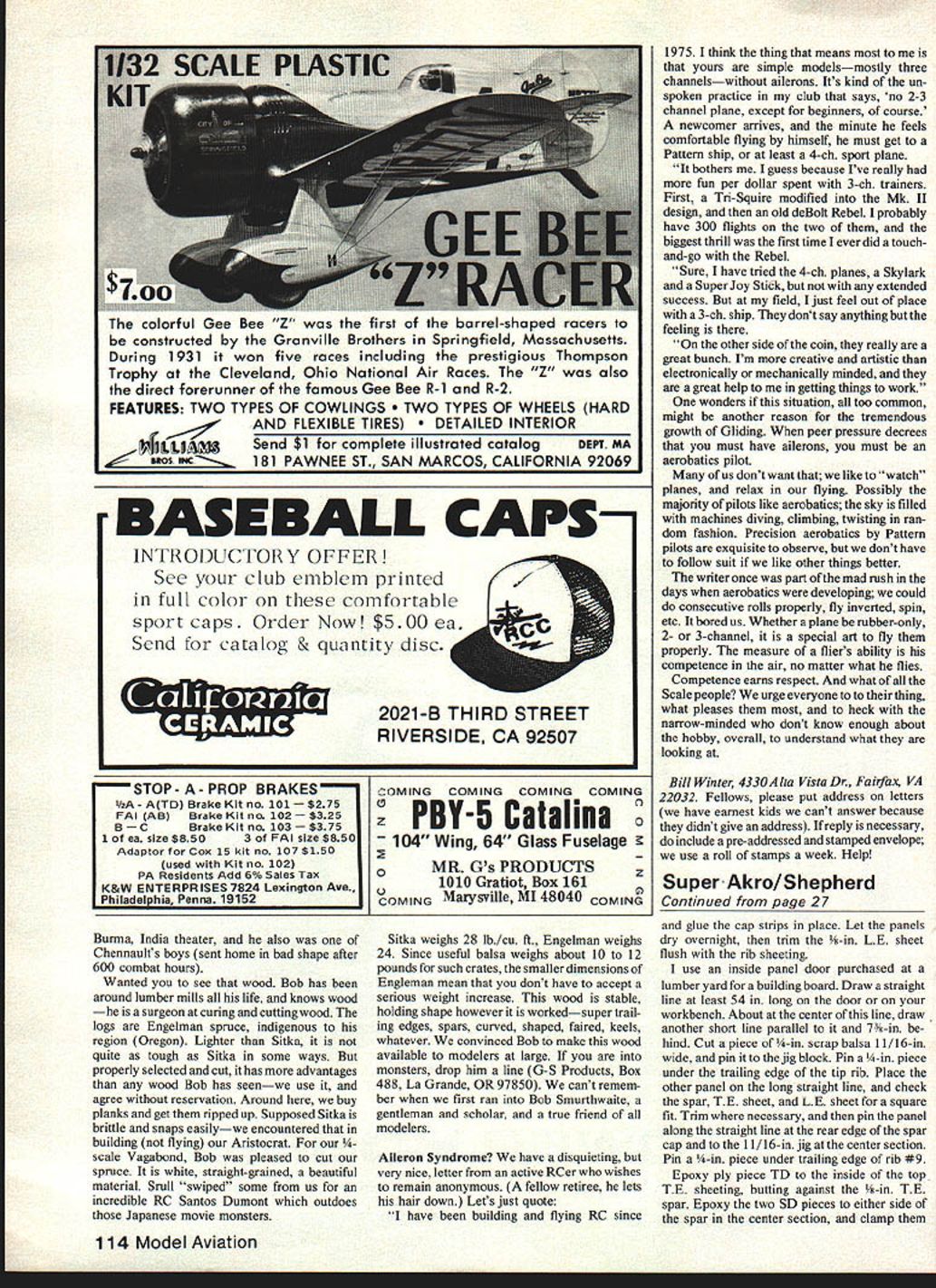
Wanted you to see that wood. Bob has been around lumber mills all his life and knows wood—he is a surgeon at curing and cutting wood. The logs are Engelmann spruce, indigenous to his region (Oregon). Lighter than Sitka, it is not quite as tough as Sitka in some ways. But properly selected and cut, it has more advantages than any wood Bob has seen—we use it, and agree without reservation. Around here, we buy planks and get them ripped up. Supposed Sitka is brittle and snaps easily—we even encountered that in building (not flying) our Aristocrat. For our 1/4-scale Vagabond, Bob was pleased to cut our spruce. It is white, straight-grained, a beautiful material. Snell "swiped" some from us for an incredible RC Santos Dumont which outruns those Japanese movie monsters.
Sitka weighs 28 lb./cu. ft., Engelmann weighs 24. Since useful balsa weighs about 10 to 12 lb./cu. ft., the smaller dimensions of Engelmann mean that you don't have to accept a serious weight increase. This wood is stable, holding shape however it is worked—superb in edges, spars, carved, shaped, faired, keels, whatever. We convinced Bob to make this wood available to modelers at large. If you are into monsters, drop him a line (G-S Products, Box 488, La Grande, OR 97850). We can't remember when we first ran into Bob Smurthwaite, a gentleman and scholar, and a true friend of all modelers.
Aileron Syndrome?
We have a disquieting, but very nice, letter from an active RC'er who wishes to remain anonymous. (A fellow retiree, he lets his hair down.) Let's just quote:
"I have been building and flying RC since 1975. I think the thing that means most to me is that yours are simple models—mostly three channels—without ailerons. It's kind of the unspoken practice in my club that says, 'no 2–3 channel plane, except for beginners, of course.' A newcomer arrives, and the minute he feels comfortable flying by himself, he must get to a Pattern ship, or at least a 4-ch. sport plane.
"It bothers me. I guess because I've really had more fun per dollar spent with 3-ch. trainers. First, a Tri-Squire modified into the Mk. II design, and then an old deBolt Rebel. I probably have 300 flights on the two of them, and the biggest thrill was the first time I ever did a touch-and-go with the Rebel.
"Sure, I have tried the 4-ch. planes, a Skylark and a Super Joy Stick, but not with any extended success. But at my field, I just feel out of place with a 3-ch. ship. They don't say anything but the feeling is there.
"On the other side of the coin, they really are a great bunch. I'm more creative and artistic than electronically or mechanically minded, and they are a great help to me in getting things to work."
One wonders if this situation, all too common, might be another reason for the tremendous growth of gliding. When peer pressure decrees that you must have ailerons, you must be an aerobatics pilot.
Many of us don't want that; we like to "watch" planes and relax in our flying. Possibly the majority of pilots like aerobatics; the sky is filled with machines diving, climbing, twisting in random fashion. Precision aerobatics by Pattern pilots are exquisite to observe, but we don't have to follow suit if we like other things better.
The writer once was part of the mad rush in the days when aerobatics were developing; we could do consecutive rolls properly, fly inverted, spin, etc. It bored us. Whether a plane be rubber-only, 2- or 3-channel, it is a special art to fly them properly. The measure of a flier's ability is his competence in the air, no matter what he flies.
Competence earns respect. And what of all the Scale people? We urge everyone to do their thing, what pleases them most, and to heck with the narrow-minded who don't know enough about the hobby, overall, to understand what they are looking at.
Bill Winter 4330 Alta Vista Dr., Fairfax, VA 22032.
Fellows, please put an address on letters (we have earnest kids we can't answer because they didn't give an address). If reply is necessary, do include a pre-addressed and stamped envelope; we use a roll of stamps a week. Help!
Transcribed from original scans by AI. Minor OCR errors may remain.

