
Just for the Fun of it
Bill Winter
Bob Hyde
If there were a banquet, the guest of honor would be Bob Hyde, the same age as the author, who began modeling before the Lindbergh year of 1927. In 1925 he set the world Twin-Pusher record, later bought out a hobby shop in Endicott, NY, and ran it as a hobby while he was an IBM engineer. In 1929 he started the Elmira Glider Club. Our primary glider now hangs in that holy-of-holies, the Harris Hill Museum in Elmira. He was that group's first pilot, having taught himself to fly—there were no glider pilots then—and obtained an instructor's license.
Always maintaining his interest in modeling, Bob designed instruments for Pioneer during the war, and developed several, including the flight recorder for B-29s. In 1946 he bought an Aeronca Chief and flew it for 10 years. With two boys fascinated by planes, he pursued Free Flight, got into Control Line, and in the early Fifties he had a go at race cars and boats.
In 1972 Bob became interested in RC when he designed a lightplane he wished to test in model form—so much fun he never gave it up. Now, with 26 RC projects, he has a thing for biplanes—13 of them! He is flying a 1/5-scale Jungmann, a 1/4-scale Curtiss-Wright Junior pusher (circa 1930). A Marquart Charger—similar to the Steen Skybolt—is his favorite. With 10 degrees sweep in both wings, it is a fantastic flier.
He flies several times a week at his own field (by his own permission!), and as of a year ago had used up seven drums of fuel. He has a Bluehead in a .48-in. Tiger Moth with 500 hours' time.
When last heard from, he was about to sell out his manufacturing line of six RC racing hydroplanes. With son Jim, Bob won first and third in mono in Tunnel Hulls Racing (with their own Scat Cat hulls, produced by Hyde Engineering, Crystal River, FL). Bob is a versatile inventor (Hyde Power Systems, Inc.).
Innovations and inventing
Bob developed a revolutionary wheel-hub engine for cars. It is steam-driven, has five cylinders with a built-in wobble plate—eliminating clutch, flywheel, transmission, drive shaft, universal differential, and rear axle unit. It gets full power from a cold start in 15 seconds even in zero weather. It can be used for one-wheel, all-wheel, or front-wheel drive. At 500 rpm he gets 40 mph with a VW 26-in. tire. Units vary from 10 to 100 hp, and 20 such cars pollute less than one standard auto. It uses no oil either—G.E. silicone grease has ten times the lubricity of conventional greases. Pictures are fascinating. This could go on forever, but this is a model plane magazine!
Bill Barnes nostalgia
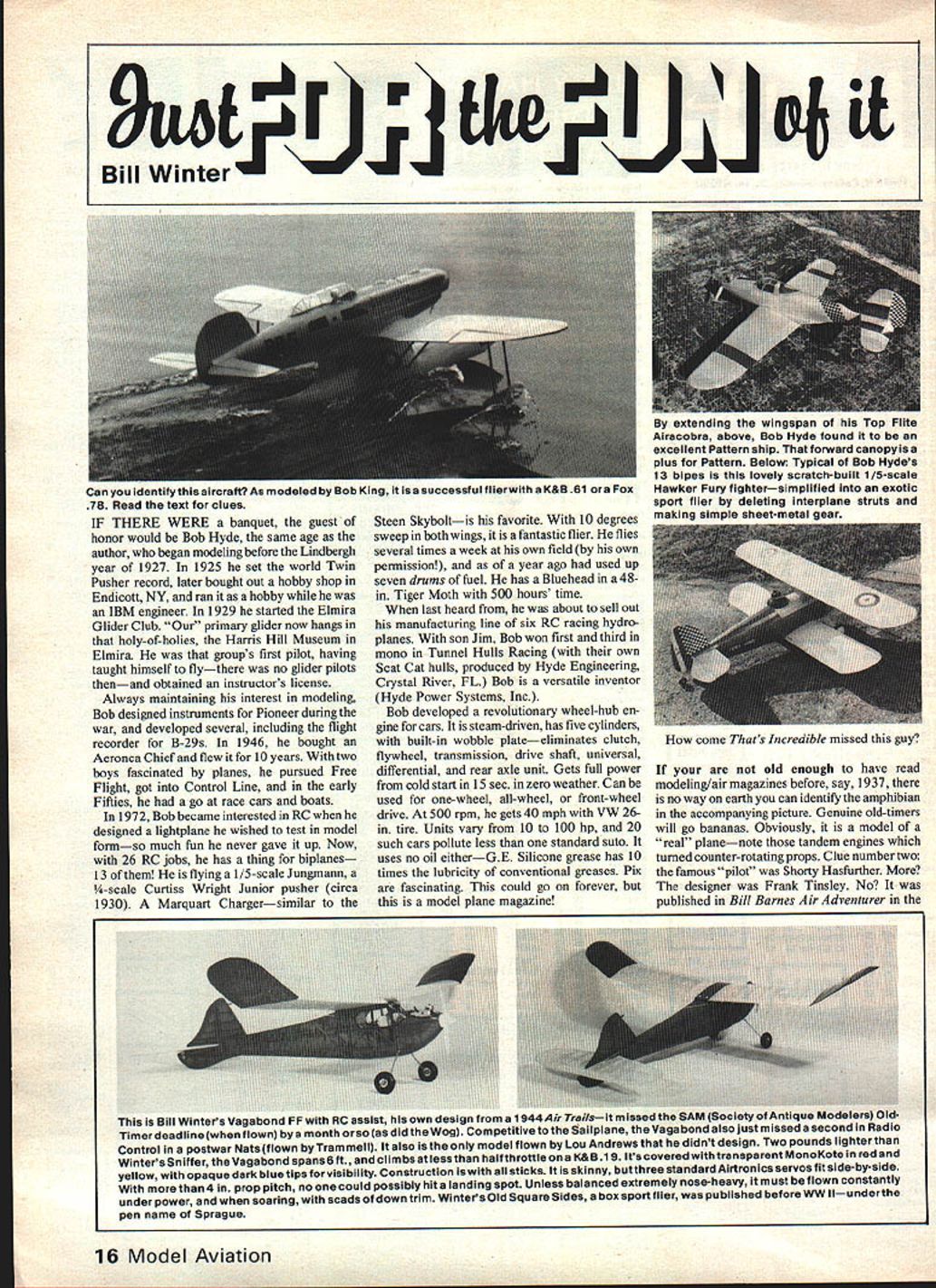
If you are not old enough to have read modeling/air magazines before, say, 1937, there is no way on earth you can identify the amphibian in the accompanying picture. Genuine old-timers will go bananas. Obviously, it is a model of a "real" plane—note those tandem engines which turned counter-rotating props. Clue number two: the famous "pilot" was Shorty Hasfurther. More? The designer was Frank Tinsley. No? It was published in Bill Barnes' Air Adventurer in the early Thirties, the mag that became Air Trails, then American Modeler, and then a disaster area. Let's run our imaginary film backwards.
"So you want pictures of something different," said Bob King of Granger, IN. "How about an RC Bill Barnes Snorter? That ought to bring back memories." Bob's model is pattern-size, and has been flown off water with both a Fox .78 and a K&B Veco .61. On the .78 it would not take off on a 14-in. prop, but did so with the Veco. However, the two finest flights came with the Fox turning a 12-in. prop. Bob now is building the later, and the ultimate Bill Barnes plane, the famous Lancer—which has a single retracting float. He cites just such a model plane which used two Goldberg nose-gear retracts to swing the float snug to the belly, but can't find it. (Published in about 1974–75 in American Modeler — Bob Kendall of Indiana dreamed up the mechanism.) The plot thickens.
The Bill Barnes researchers
"My friend Bob King tells me you are interested in the old Bill Barnes airplanes," writes Gordon Codding, Kingman, AZ. "Bob is a valued member of my Bill Barnes Research Staff." So the camera closes in on Codding. You've heard of the Baker Street Irregulars, the international "association" of thousands dedicated to Sherlock Holmes? This is the same thing in miniature. A group of guys scattered throughout the U.S. have this thing about Bill Barnes.
From roughly 1931–32 to about 1938–39 the Bill Barnes Air Adventurer novels were written by George E. Eaton, in reality two guys: Harold B. Montanye (a WW I pilot) and Chuck Verall, who alternated months.
Do hang on; characters appear a mile a minute. F. Orlin Tremain—there was an editor—turned to Frank Tinsley, an old cavalry man who illustrated westerns for the publisher Street & Smith, which dominated the world in the pulp days (Western Stories, Detective Stories, Astounding Stories—now Analog), and some hundred others. Like Jules Verne, Frank was a generation ahead of his time.
We were not aware of anything that could tip off Frank's meteoric career as an aeronautics illustrator. He painted many Air Trails covers, and he designed an incredible fleet of machines for the Bill Barnes characters to fly in. The Lancer was in being when the writer came aboard on January 1, 1937 as an editor. We found ourselves in the middle of Richthofen's Flying Circus. Tremain fathered science fiction, too, and if you are of the same thinking some John Campbell is a saint—he was on the other side of our office partition—do honor Tremain who, wearing gray spats and a Franklin Roosevelt long cigarette holder, explained the fourth dimension to us on our first day at an ancient roll-top desk.
In our shop, Frank T. was known as "the man on the street with his head in the clouds." At Mechanix Illustrated he was "Doomsday Tinsley." They had him illustrating things like the end of the world. He wowed the Jack Paar show—before Johnny Carson. Masterminding the artistic warfare was Joe Lawlor, whose huge hooked nose made him the model who posed for the Shadow, another company fictitious hero. You know: "Who knows what evil lurks in the hearts of men?"
Well, back at the ranch (tarmac in Bill Barnes), Tinsley designed roughly 15 flying machines, and his vivid imagination conjured up cannons firing through prop hubs, retracting floats, bombers or motherships carrying folding-wing fighters, transports, infrared sights, and on and on. Amazingly, they were viable aircraft, which caught the attention of the aeronautical world. We were late on the scene, but got to edit this fantasy copy in a kind of Walt Disney World.
Gordon Codding
"During WWII, when I was a pilot in the AAF," Gordon Codding relates, "I carried with me several pages torn from Air Trails with the Bill Barnes planes in them three-view. As a mental exercise I would try to figure out ways to make them work in real life. I had the advantage of having the best 'state of the art' around me in AAF planes. The task was to find a workable item, while still retaining the B-B features shown in the magazine drawings. In later years, I hoped to build one or more, and fly them full-scale."
Gordon is doing just that; he is into home-builts ala Bill Barnes, and modeling—he has three views for sale, also some of the Barnes fleet structured as models (hence the Snorter built by Bob King). He also has a plans list of old-time models, full-size prints of many WW I aircraft as they came from the factory, and much more. (Gordon Codding, 3724 John L. Ave., Kingman, AZ 86401.)
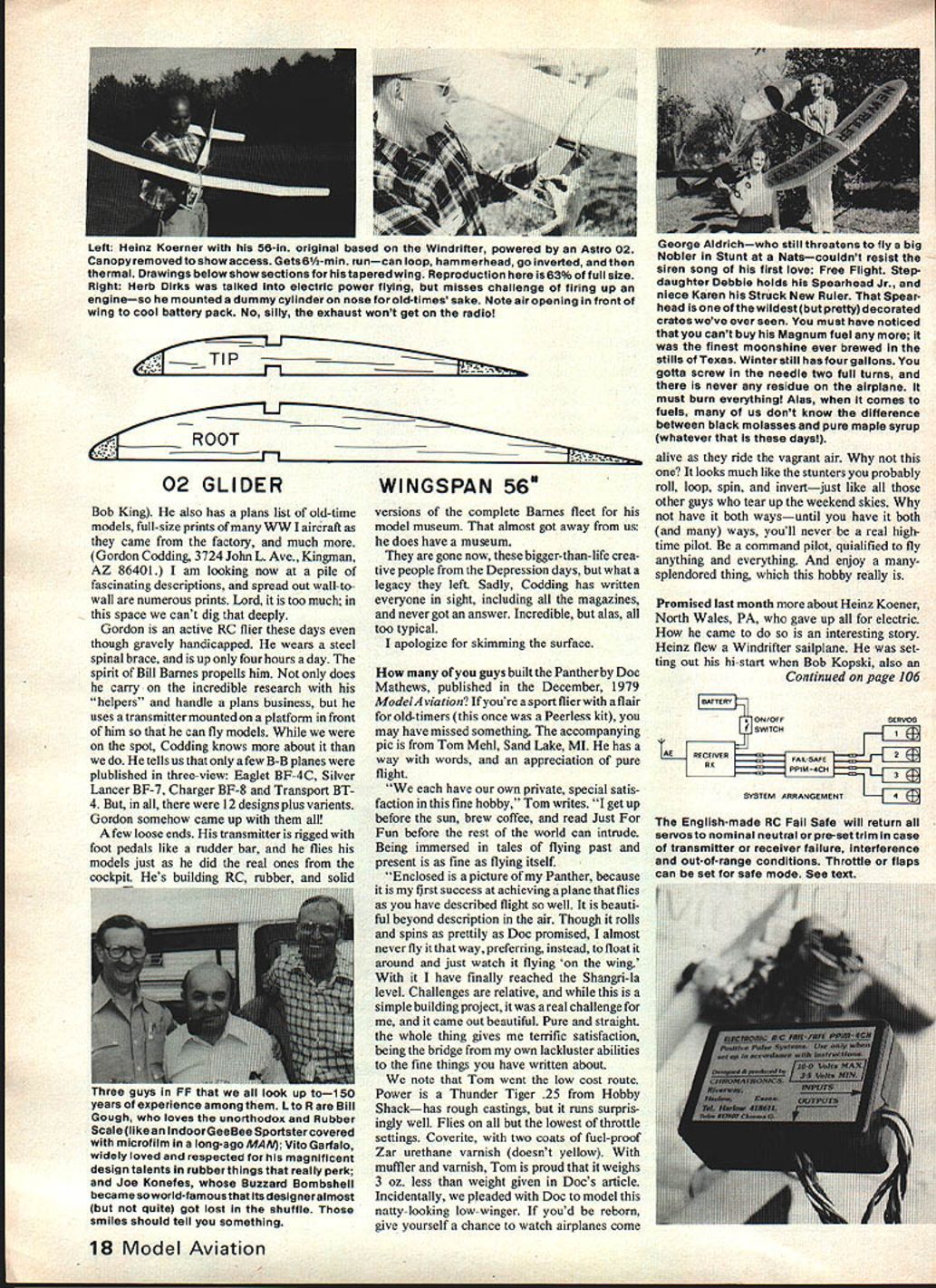
Gordon is an active RC flier these days even though gravely handicapped. He wears a steel spinal brace, and is up only four hours a day. The spirit of Bill Barnes propels him. Not only does he carry on the incredible research with his "helpers" and handle a plans business, but he uses a transmitter mounted on a platform in front of him so that he can fly models.
Codding tells us that only a few B-B planes were published in three-view:
- Eaglet BF-4C
- Silver Lancer BF-7
- Charger BF-8
- Transport BT-4
But, in all, there were 12 designs plus variants. Gordon somehow came up with them all!
His transmitter is rigged with foot pedals like a rudder bar, and he flies his models just as he did the real ones from the cockpit. He's building RC, rubber, and solid versions of the complete Barnes fleet for his model museum. That almost got away from us: he does have a museum.
They are gone now, these bigger-than-life creative people from the Depression days, but what a legacy they left. Sadly, Codding has written everyone in sight, including all the magazines, and never got an answer. Incredible, but alas, all too typical.
I apologize for skimming the surface.
Tom Mehl and the Panther
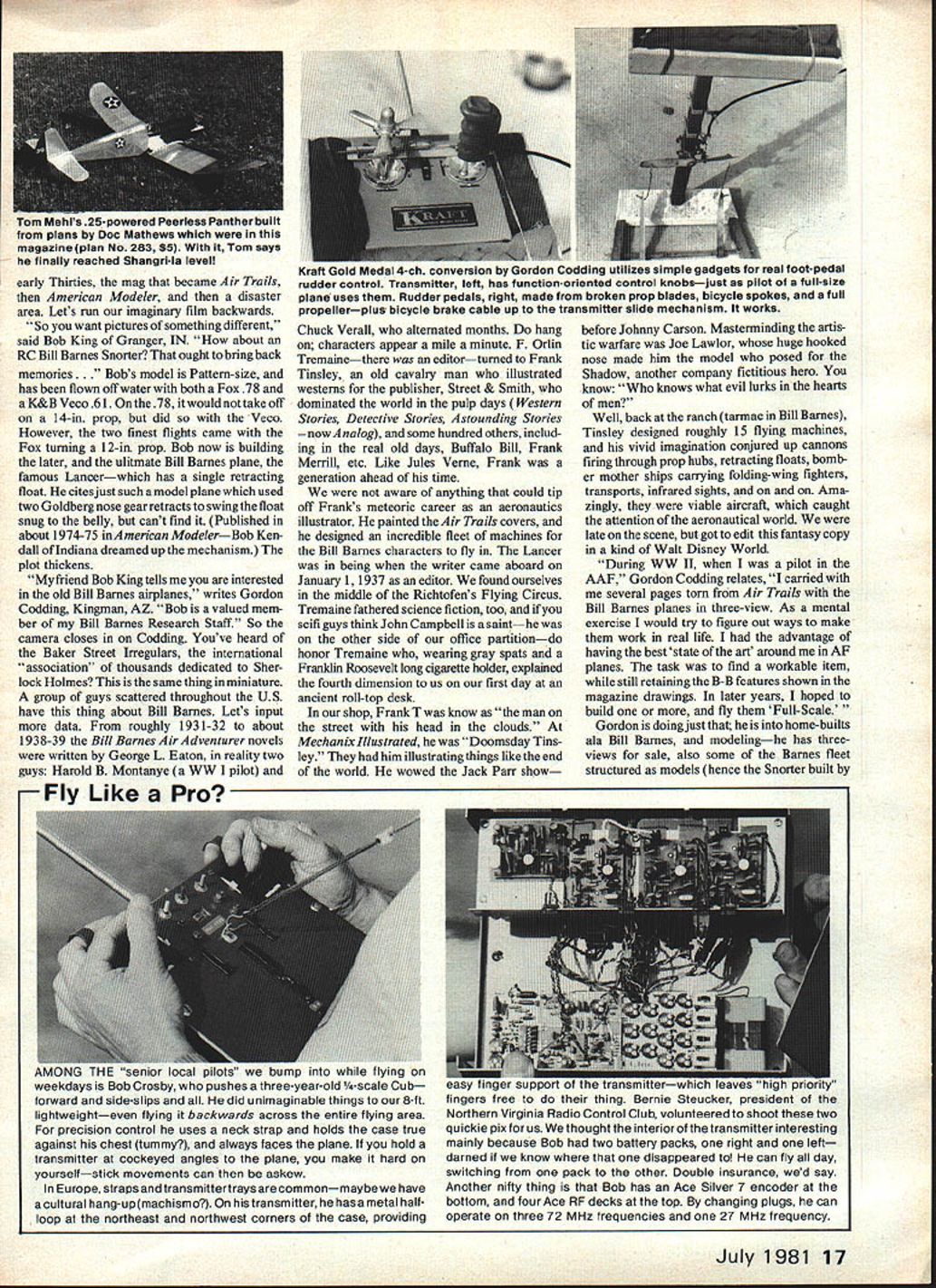
How many of you guys built the Panther by Doc Mathews, published in the December 1979 Model Aviation? If you're a sport flier with a flair for old-timers (this once was a Peerless kit), you may have missed something. The accompanying picture is from Tom Mehl, Sand Lake, MI. He has a way with words, and an appreciation of pure flight.
"We each have our own private, special satisfaction in this fine hobby," Tom writes. "I get up before the sun, brew coffee, and read Just For The Fun before the rest of the world can intrude. Being immersed in tales of flying past and present is as fine as flying itself.
"Enclosed is a picture of my Panther, because it is my first success at achieving a plane that flies as you have described flight so well. It is beautiful beyond description in the air. Though it rolls and spins as prettily as Doc promised, I almost never fly it that way, preferring, instead, to float it around and just watch it flying on the wing. With it I have finally reached the Shangri-la level. Challenges are relative, and while this is a simple building project, it was a real challenge for me, and it came out beautifully. Pure and straight, the whole thing gives me terrific satisfaction, being the bridge from my own lackluster abilities to the fine things you have written about."
Tom went the low-cost route. Power is a Thunder Tiger .25 from Hobby Shack—has rough castings, but it runs surprisingly well. It flies on all but the lowest of throttle settings. Cover it with two coats of Aeon urethane (doesn't yellow). With muffler and varnish, Tom is proud that it weighs 3 oz. less than the weight given in Doc's article.
Incidentally, we pleaded with Doc to model this natty-looking low-winger. If you'd be reborn, give yourself a chance to watch airplanes come alive as they ride the vagrant air. Why not this one? It looks much like the stunter you probably roll, loop, spin, and invert—just like all those other guys who tear up the weekend skies. Why not have it both ways—until you have it both (and many) ways, you'll never be a real high-time pilot. Be a command pilot, qualified to fly anything and everything. And enjoy a many-splendored thing, which this hobby really is.
Heinz Koerner and electric flight
Promised last month more about Heinz Koerner, North Wales, PA, who gave up all for electric. How he came to do so is an interesting story. Heinz flew a Windrider sailplane. He was setting out his hi-start when Bob Kopski, also an electric specialist, showed up. Kopski had a 15‑min. flight on his electric glider before Heinz released and reached max altitude. Bob was already in the air a second time, and got 300 to 400 ft. higher than Heinz's Windrider, and was airborne 10 minutes longer.
This went on all morning. The wind shifted. Heinz plodded out to relocate the hi-start stake. Now Heinz had to launch from the lift area (plowed field), then maneuver back over the field, losing considerable altitude. Bob just flew into the lift, over and over again. The day grew hot. After another 1,600‑ft. hike to retrieve the hi-start, huffing and puffing and red in the face, he found Bob sitting in the shade of his car flying the electric glider. Without taking his eye off the glider, Bob asked Heinz why he didn't fly electric. After leg cramps that night from all the running, Heinz decided that if you can't beat 'em, you join 'em. He and Bob built aerobatic jobs—Bob has 460 flights on his with an Astro 05.
With Don Srull, I have had a picnic with his 6‑ft. Spitfire using my Astro 05 prop drive and a .12 or .13. Asking Heinz for a recommendation on a good place to start (so many people already are building the four‑motor Connie I mentioned that I have switched to a mysterious tri‑motor—sssh), here's Heinz:
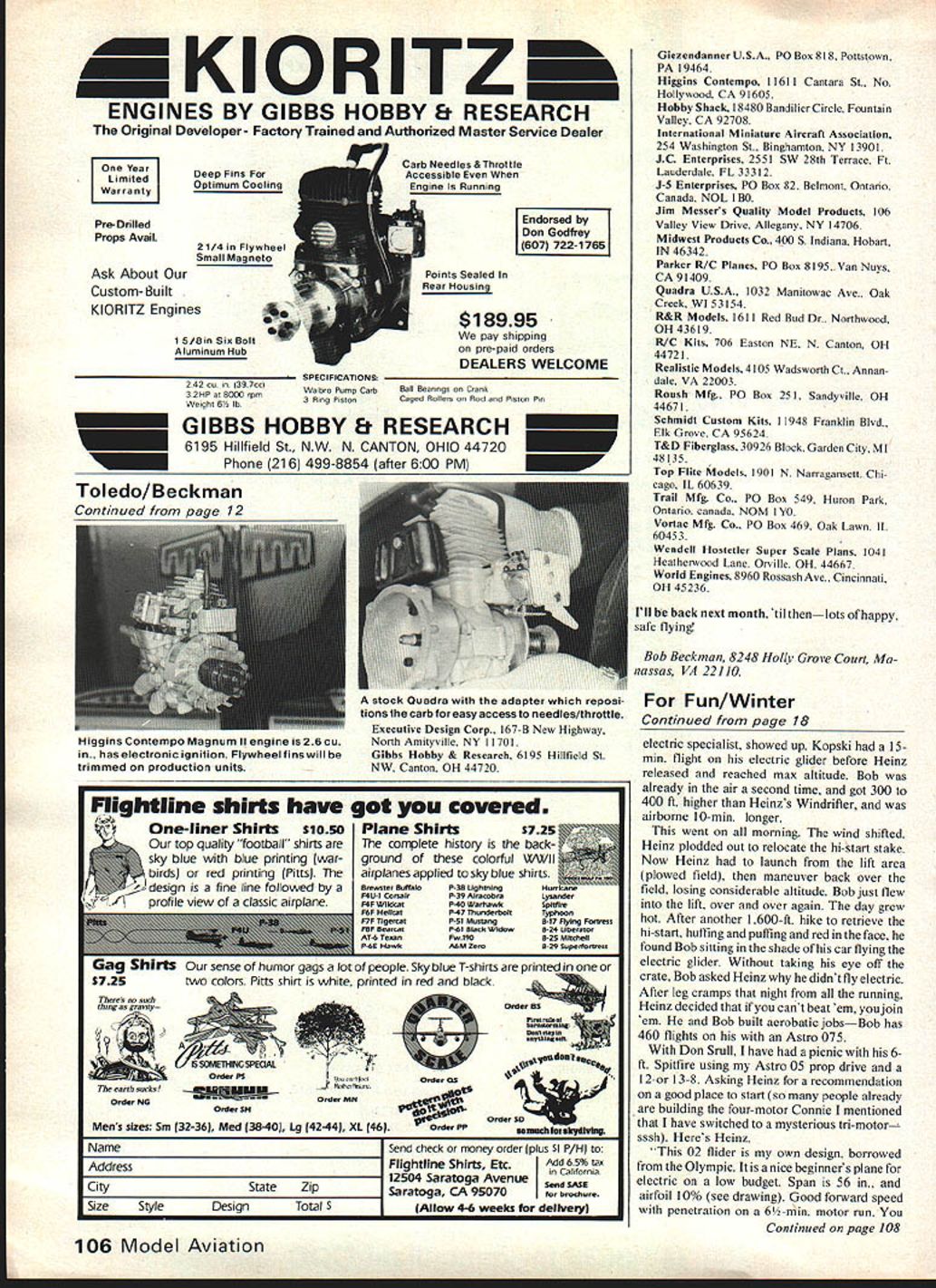
"This 02 glider is my own design, borrowed from the Olympic. It is a nice beginner's plane for electric or on a low budget. Span is 56 in., airfoil 10% (see drawing). Good forward speed with penetration on a 6½‑min. motor run. You can horse it around for 3 min., doing consecutive loops, hammerheads, and inverted—and still have time to gain altitude for a good thermal flight. When you come down and are short of the field, you can switch on again, and the plane purrs right in by your feet.
"The Ace three-channel fits like a glove," Heinz goes on. "You need only two battery packs to 'stay up all day long.' Data: Astro 02, 5¼ x 3 prop, 4 x 1.2 Ah cells, span 56 (same as Falcon 56), area 360 sq in, weight 24 oz., loading 9.6 oz., length 31 in. Controls are on-off, rudder, and elevator."
Electronic Fail-Safe Unit
There is no fun at all in fly-away RC jobs, or interference, or unexplained crashes. It would be so nice if nothing happened (more or less) when a transmitter quits, some goof-ball invades your frequency, strange things in the ether take over, or a plane gets too far downwind, or away, to be saved. Believe it or not, there is a device on the market that can save your airplane! However, when we talked to name experts, they all said, "Oh, just something more to go wrong." We came to the conclusion that if this were true, we'd still be flying our Good brothers vacuum-tube single-channel from 1948—and escapements! We'll tell you about it, and you are on your own to investigate.
This "miracle" device is manufactured by CEL Electronics (Harlow) Ltd., Coachworks House, River Way, Harlow, Essex CM20P, England. It is called the "Electronic Fail-Safe Unit." It plugs in between the receiver and servos. Since it works off the receiver decoder, it passes all normal signals through to the servos. Should signals be disrupted, causing servos to throw the model out of control or to cease functioning, the device switches out receiver outputs and switches on preset control signals to move the servos to "safe" positions.
As made, it functions with most three-wire servos with a positive pulse of one to two milliseconds. Being British, we recognize only two familiar radio systems listed—Futaba and Sanwa. In its sane mode of handling, it copes with transmitter and receiver failures, out-of-range, interference from another transmitter, speech interference, and severe impulse (ignition) interference. It handles up to four channels. (More channels require a second unit.) All that CEL claims is that, whatever the circumstances, the device will at least give additional time to seek recovery of the aircraft. (Address Miss Pamela Lee, and tell her we sent you.)
Radios, materials, and companies
Before we get ourselves in Dutch by that recent description of Bob Smurthwaite's excellent Engelmann spruce, we should give equal time to Sig who also has good stuff (we use it, too) and now to Midwest Products who announced two days ago their new spruce. Samples look good indeed.
Also, we had just received a letter from Tom Runge (Ace) discussing his firm's acquisition of Pro Line. Ace will continue the fine tradition of Pro Line Electronics, once the favorite of experts—a select line of systems. Ace has a most versatile radio in their Silver 7 which, however, is in kit form, and now they will offer both a first-line kit and a top-quality ready-to-use system as well. For Pro Line owners, Ace will provide a network of approved service centers throughout the world—we presume existing Ace centers provide the base. But no warranty work can be done on systems manufactured by the last corporate owner.
For info, address: Pro Line Division, Ace R/C, Inc., 203 W. 19th St., Box 735, Higginsville, MO 64037.
Bill Winter 4330 Alta Vista Dr., Fairfax, VA 22030.
Transcribed from original scans by AI. Minor OCR errors may remain.

