
Just for the Fun of it
Bill Winter
IF YOU THINK your Kadet, Headmaster, Falcon, etc., are the end of the line, you've been too busy flying to note that progress in all forms of modeling is faster than inflation. Never have the troops been so restless. Take, for example, Tony Naccarato; Guillow; free-flight scale kits; control line; electric power; the indoor scene—and stir.
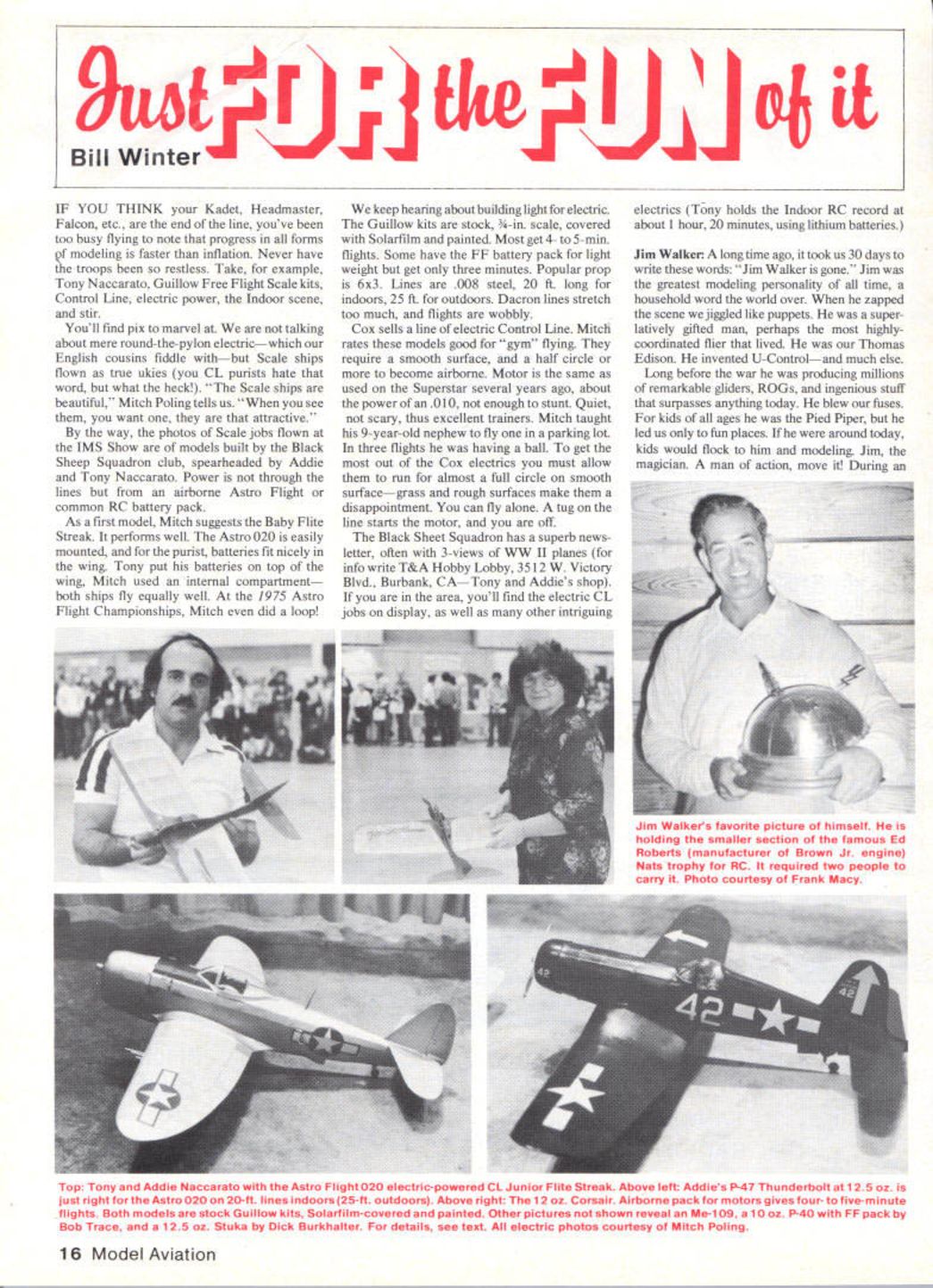
You'll find pix to marvel at. We are not talking about mere round-the-pylon electric — which our English cousins fiddle with — but scale ships flown as true scale jobs (you CL purists hate that word, but what the heck!). "The scale ships are beautiful," Mitch Poling tells us. "When you see them, you want one, they are that attractive."
By the way, the photos of scale jobs flown at the IMS Show are of models built by the Black Sheep Squadron club, spearheaded by Addie and Tony Naccarato. Power is not through the lines but from an airborne Astro Flight or common RC battery pack.
As a first model, Mitch suggests the Baby Flite Streak. It performs well. The Astro 020 is easily mounted, and for the purist, batteries fit nicely in the wing. Tony put his batteries on top of the wing. Mitch used an internal compartment—both ships fly equally well. At the 1975 Astro Flight Championships, Mitch even did a loop!
We keep hearing about building light for electric. The Guillow kits are stock, 3/4-scale, covered with Solarfilm and painted. Most get 4- to 5-minute flights. Some have the free-flight (FF) battery pack for light weight but get only three minutes. A popular prop is 6x3. Lines are .008 steel, 20 ft. long for indoors, 25 ft. for outdoors. Dacron lines stretch too much; flights are wobbly.
Cox sells a line of electric control-line models. Mitch rates these models good for "gym" flying. They require a smooth surface, and a half circle or more to become airborne. The motor is the same as used on the Superstar several years ago, about the power of an .010—not enough to stunt. Quiet, not scary, thus excellent trainers. Mitch taught his nine-year-old nephew to fly one in a parking lot. In three flights he was having a ball. To get the most out of the Cox electrics you must allow them to run for almost a full circle on a smooth surface—grass and rough surfaces make them a disappointment. You can fly alone. A tug on the line starts the motor, and you are off.
Black Sheep Squadron and T&A Hobby Lobby
The Black Sheep Squadron has a superb newsletter, often with 3-views of WWII planes. For info write T&A Hobby Lobby, 3512 W. Victory Blvd., Burbank, CA — Tony and Addie's shop. If you are in the area, you'll find the electric CL jobs on display, as well as many other intriguing electrics (Tony holds the indoor RC record at about 1 hour 20 minutes, using lithium batteries).
Jim Walker
Jim Walker is gone. Jim was the greatest modeling personality of all time, a household word the world over. When he zapped the scene we jiggled like puppets. He was a superlatively gifted man, perhaps the most highly coordinated flier that lived. He was our Thomas Edison. He invented U-Control—and much else.
Long before the war he was producing millions of remarkable gliders, R.O.G.s, and ingenious stuff that still surpasses much of what we see today. He blew our fuses. For kids of all ages he was the Pied Piper, but he led us only to fun places. If he were around today, kids would flock to him and to modeling. Jim, the magician. A man of action—move it!
It circled the building corner, came in the other window, and whizzed in front of the buyer. Jim could make a glider loop over his head, then zoom between his knees and back to his hand. He'd toss it in any direction, and it always alighted in his hand. He never missed.
Older readers remember best his Fireball demonstrations. Jim flew three at once, in trail formation. We can still see those three guys desperately flipping the McCoy .29 Redheads to life. Jim snapping the verbal whip. He could make a congressman roll over and play dead. (How about that, Keith Storey?) Jim had a three-line U-Reeley handle in each hand, with the lines from the third ship attached to a pylon on a special helmet. The third motor control? A clip clenched in his teeth. He even tried a PA system in his helmet so he could emcee his mind-boggling act. (He must have been a ventriloquist, with a switch in his mouth!)
A wilder act used a two-speed O&R .23 and his newly invented Remoto, which replaced the mechanical third-line trigger with a switch, battery, relay, and insulated lines. Jim would pull the Fireball straight up and hang it there, maintaining line tension without seeming to move. Slowly the crate would sink till a pin on the tail punctured a tethered balloon at ground level, or one held in a pretty gal's hand. And then the ship would accelerate straight up, push over, and resume aerobatics. He could rig his lines so that the Fireball would hang like a kite, off diagonally in the wind, at an immense distance.
He'd step out of a crowd at the Nats (they had banned him because he disrupted the show—he made it a circus) with a Fireball in hand, engine singing, then release it at arm's length, slowly paying out lines as he ran into the open, until it seemed to free flight on 200-ft. lines. To see that thing going around a 400-ft. diameter circle was to talk to yourself. Jim dominated radio control, winning the Nats at least once—we forget how many times.
We saw him at a prewar Nats with an RC trike-geared modern-looking little crate that taxied out and maneuvered on the ground, then zipped off pretty as you please. (Siegfried won that Nats with a 15-ft. monster that did the first loop.) Jim had rudder, elevator and engine control, all done with a single rotary actuator which traveled to any desired pickup point. It was the greatest (though Rockwood already had reeds for 3- and 5-channel before the war) but, since Nicads were in the future, falling voltage tended to cross up Jim's timed actuator.
Jim had a phone in his special Chrysler Imperial with heavy springs to pull a huge trailer, with which he wandered the land. He'd summon New York's swankiest department store buyer down to the street, call us down from MAIN, and fly the Ceiling Walker helicopters on 45th St. around the high buildings. During a night-time victory parade up Broadway, he slipped a searchlight operator a fiver and climbed on the float from which he catapulted Interceptor gliders up the bright beam—as thousands cheered (to heck with the war!). (He had this RC lawnmower which followed behind the horses in a parade on the West Coast; we'll leave it to you to decide why he removed the reel from the lawnmower.)
That Interceptor—nothing ever remotely approached it for ingenuity or flyability. It had wings which pivoted back, rotating so that the top chords met in the fingers of your release hand. When it was catapulted up by a rubber band, it pierced the sky like a javelin, and then—whap—the wings would rotate and swing forward for long soaring flights. We've got bald-headed sons who as kids had the damn things fly away, though our Pop. The Army bought Interceptors by the thousands for machine-gun practice. We can testify that the kids' 16-gauge shotgun never downed one; they'd glide on and on, full of holes.
Jim invented whip-control. You held this fish pole in your left hand (ok, you are left-handed!), whipped the model like mad in counterclockwise circles, and stunned it by means of a handle held in the other hand. In the mid-thirties he sold millions of camber-winged hand-launched gliders, color-printed, selected balsa (on every dang one!). His Hornet R.O.G. was better than anything today. Before the war, it had a plastic prop and nose bearing with necessary offset. He'd nick a prop and snap it on a landing gear leg, then glide the thing; when it touched ground, the prop would spring free, and it would take off. And his 1/2A Firebaby, his low wing with cambered sheet-balsa wings. Jim would appear at the Nats, let down a station-wagon tailgate, and unload a mountain of Firebabies in boxes (they went together as quickly as gliders). He had three doorbell batteries taped together for a booster. If a kid could start an engine, Jim gave him the airplane. Now that's incentive. You'd be surprised how kids start engines when they want to!
Jim actually started riots with his flying. Once, in front of the Central Post Office in New York, he flew a Fireball. A Brazilian traffic jam ensued. People climbed on top of buses. Riot squad wagons came out to deal with the panic. Klaxons blared their slow progress up the avenue. In Chicago he was insulted when only one cop showed up—on a motorcycle. He got the cop to fly the thing and died laughing when the poor chap wrapped himself in the flying wires.
At the Sportsman Pier in Chicago, Jim did his three-Fireball act on a tankbar circle. He had three orange Fireballs sitting tail to tail. Jim strode on, followed by his lawnmower (still with reel), responding to a hidden switch on his belt. Unknown to Jim the switch snagged. The lawnmower was on its own—he didn't see it. It waddled over to the Fireballs, eating them one by one, spewing out a cloud of orange dust. The crowd screamed "Encore! Encore!" For once, Jim was stumped.
He was into sound control. A glider soaring overhead, responding to vocal signals through a megaphone, had to be seen to be believed. He chased seagulls with it. (Problem: covering had to be loose so it would not act as a drum.) To test noise-source controls, Jim emerged from his basement in the dead of night, equipped with whistles, a drum, noise-makers, and even a pistol, which he shot into the air. The neighbors called the police. The cop was so fascinated by Jim's explanation that he said, "Here, I'll shoot my revolver; it makes more noise than yours."
Jim's nerves became jumpy. The industry was cheating on his U-Control system. He had a lock on it by patent, just as if one guy today had control of the entire RC industry. There were court fights. Many kits appeared with an "X" on the wing with a notation: "Install your favorite control system here." By weight of numbers they beat him down. The doctor said, "Jim, you have to get a hobby." Good grief! So Jim took up, briefly, model railroading. He had one of the most elaborate systems man could conceive. He even had a derrick which lowered him into the middle of it—or so the rumor went.
Jim was at war with the industry and with all the editors. He thought we dragged our feet. We did, given such standards. Ole Bill was a novelty, the only guy Jim never got cross with. Beyond understanding. But we have a clue. We once had a regional high school math teacher known beforehand by every kid within miles of North Jersey, a terror. He was reputed to read the Congressional Record. When we fell into his hands, he conducted classes with Prussian-like discipline. He'd point at you, then at the board, and up you went to display your ignorance. The Paper Chase—in sign language. He never called us, but named me "The Professor." I knew absolutely nothing, and he evidently knew that. I suspect dear Jim looked at a mere editor in the same way. Go easy on the clod. But we sat up with him many times, spellbound by his mental gymnastics, as would Cal Smith. Jim sent many of us, at least once a year, a huge carton containing dozens of all his unique models, and the family would fly them for weeks. The "terrible" Jim was a benevolent Santa Claus.
Notable inventions and acts
- U-Control system
- Fireball demonstrations (three at once)
- Remoto (electrical third-line control)
- Interceptor gliders with pivoting wings
- Whip-control launch methods
- Hornet R.O.G., Firebaby and millions of hand-launched gliders
- Early experiments with sound and noise-triggered control
We have marvelous letters from Frank D. Macy, who is a MECA and SAM member. We know his book on Walker will be a delight. From Bob Smurthwaite, who shared in the Walker manufacturing story, we hear of a recent reunion of family members and the now-scattered people who were close to Jim. Macy was privileged to visit with Mrs. Walker, who gave him a large collection of old photos, articles, trophies and two boxes of 16mm movies and tapes. The Oregon Historical Society offers their services to review, splice, edit and salvage the old movies.
Macy is putting together a program entitled "An Evening with Jim Walker." It consists of a display of kits, built-up models, products, photos and other memorabilia of American Junior and Jim Walker. He will show a movie about Jim, and then explain the museum exhibit effort, winding up with a Q&A period and how to help.
"Jim Walker was my boyhood hero," Frank tells us. "I never took the opportunity to thank him for all he had given me. Writing a book or two is one way of saying belatedly, 'Thanks Jim.'"
"There is another reason. To share and teach those that never knew him. Their hopes and dreams are not in the 'promise of a bright tomorrow,' or the 'skies of success' like ours were. Yet I see the yearning within them.
"I thrill to look into the eyes of the young people who have viewed the collection in my home. As they first file in, I see that look that says 'Let's hurry up and get out of here.' Ninety minutes later, those kids have a chore. Sad that he is gone, glad that he was here. They always ask, 'Why isn't this being done today?'
They always leave reluctantly, full of interest, enthusiasm, quality questions — and with much more than what they had when they walked in. Truly, the American Junior theme still lives: Wings for Young America. I see it in their eyes."
The American Junior collection (still far from complete) will be donated to a museum for permanent exhibit, hopefully in Portland; if not, then somewhere here in the Northwest.
To Jim, these were the Hills of Home.
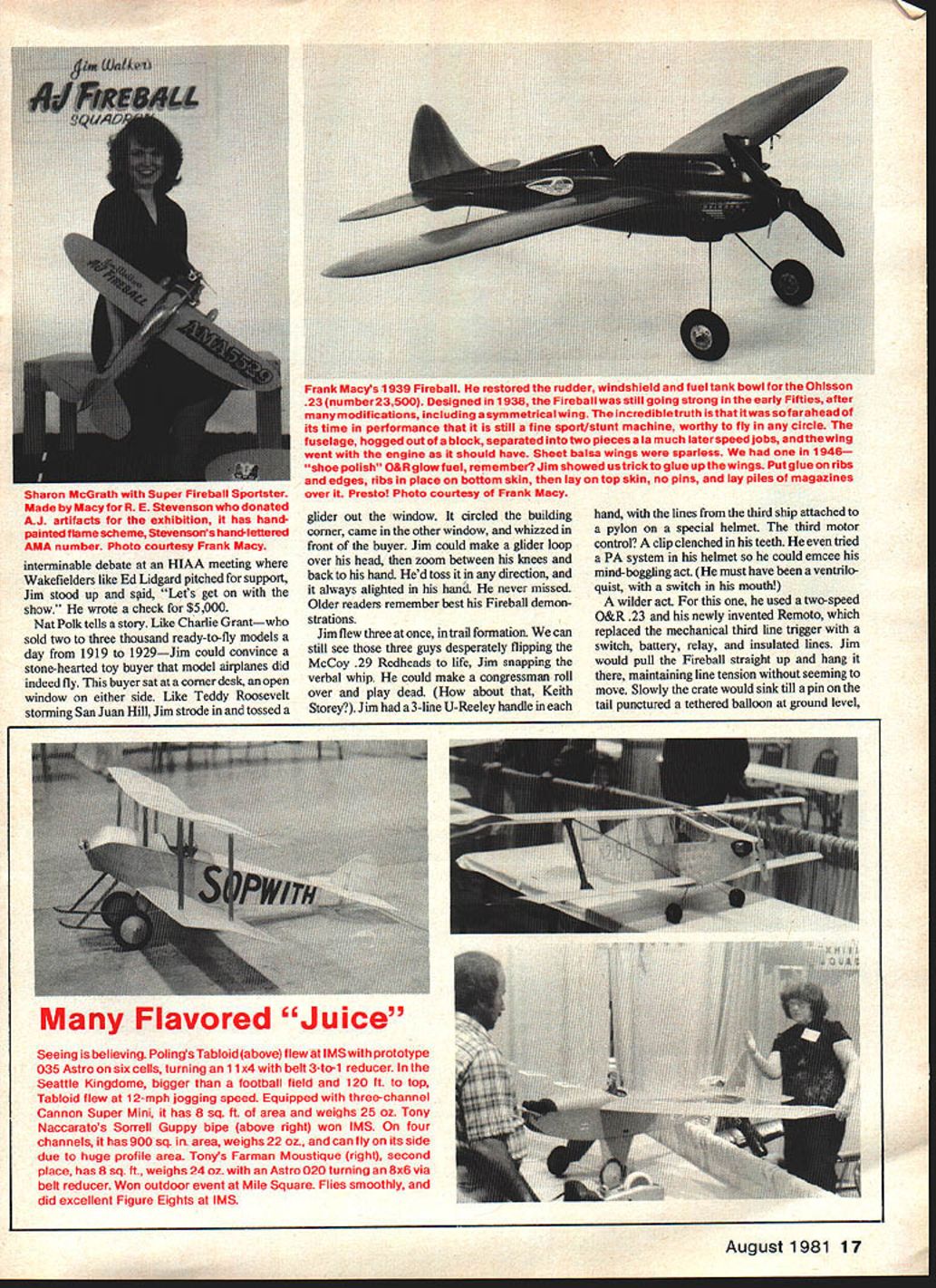
We are all too busy doing rolls and loops to be aware of kids. Much of the industry says there isn't enough money in it. It is too easy to say kids are indifferent. Betty Boyle, at Sterling Models (if this be era, we give three cheers) is not too busy doing rolls and loops. It's quite possible that, like Charlie Grant who sold two, three thousand ready-to-fly models a day, 1919–1929, Jim could convince the stone-hearted toy buyer that model airplanes did indeed fly. Buyer sat at a corner desk, open window either side. Like Teddy Roosevelt storming San Juan Hill, Jim strode, tossed Frank Macy's 1939 Fireball — restored rudder, windshield, fuel tank, bowl — to the Ohlsson .23 number 23500. Designed 1938, the Fireball kept going strong into the early Fifties after modifications including a symmetrical wing. The incredible truth is that kids are good business for Sterling. There's Guillow, Peck, Comet, and others.
Not all kids will build models. Perhaps just a small percentage. That small percentage is a mighty big head count—and they, or some of them, would become RC'ers too, and they could have had something many of us have missed. If we can't find the handle, there is one thing we can do: keep an open mind. There are many who, like Jim Walker, have this thing with youth, work at it silently, for the only reward that counts. Jim, wherever you are, let's go fly.
Down to the Sea in Ships
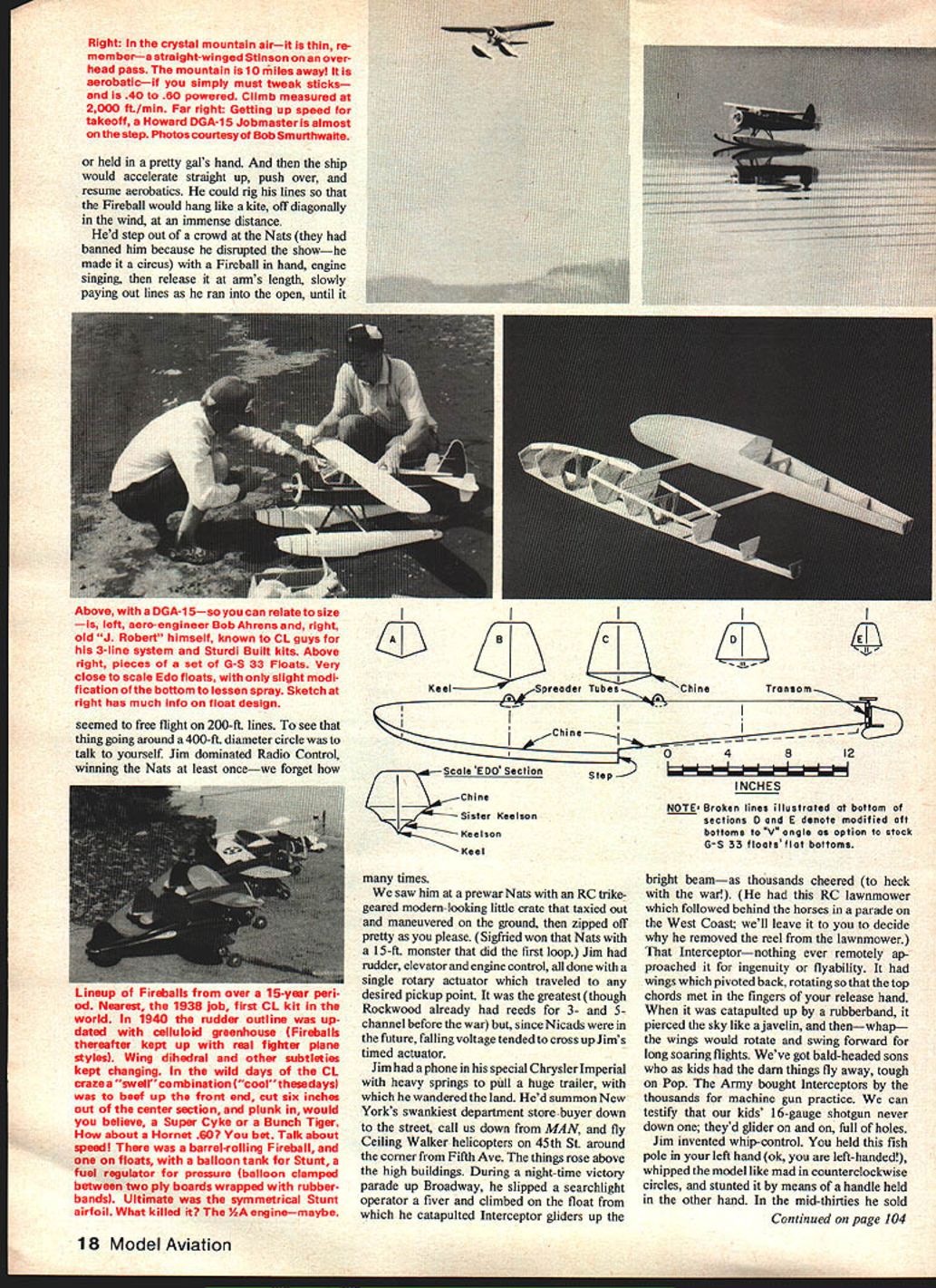
Our Air Force-type son Mike has his G-S Stinson framed up—on wheels. Meanwhile, our dialogue with Bob Smurthwaite has reached biblical proportions—with dozens of spectacular color photos of Howards and Stinsons skimming off the smooth mountain lakes, landing like ducks, and even flying in formation. These seaplanes fly better than one could suppose. Bob will be doing a major article for Model Aviation, but we asked him for a sneak-preview drawing of his highly successful floats. They are scale EDO, but bottoms are modified.
A deep "V" bottom will spray water toward the prop and fuselage, and beats the prop to pieces (boy, how we remember that from Cub takeoffs on Etch?). The shallow "V" bottom lessens that inward spray. Also, the traditional deep "V" creates enormous drag. On the drawing by Herb Clukey you'll find a scale EDO cross section. The reason for the triple-sharp "keelsons" is to ease the people-carrying plane into the water. The "keel" is the outer wearing surface on the bottom, forward of the step, for sliding on ramps. In view of the article which tells all, we resist spilling the beans. We've included several pix which hint at the glorious stuff you will be seeing. Suffice it to say that Bob has never known any model to flip, swamp, or water-loop with these floats. They have handled many models of up to 10 pounds with ease and realism. We should say, however, that the deeper "V" aft of the step is more buoyant, and improves still- or idle-speed setting on the water. Coming up at G-S are movies for a float-flying show, to be available to clubs and other users.
Errata
Last month, we mentioned having a good time with Don Srull, his Spitfire, and an Astro Flight 05 electric prop drive system. There's a mistake in there. Not the good time part—the 05 part. That's a 15 motor and prop drive Don uses on the Spit. Please don't try it with an OS—the experts claim it shouldn't work with the 15. It does, though, and it runs beautifully.
Contact
Bill Winter 4330 Alta Vista Dr. Fairfax, VA 22032
Fellows, please put an address on letters (we have earnest kids we can't answer because they didn't give an address). If a reply is necessary, include a pre-addressed and stamped envelope; we use a roll of stamps a week. Help!
Transcribed from original scans by AI. Minor OCR errors may remain.

