
Just for the Fun of It: Plane Talk
Bill Winter
ALL OF THE KING'S MEN hope to put Humpty Dumpty together again. I'm the victim of a benevolent sting. I can see the jump-start cables. Taking away "For Fun" is as heinous as murder by axe. For every guy into all that high-tech "in" stuff, there is one or more who want no-pressure enjoyment. Roses to smell are hard to find. Just For the Fun of It began in carefree innocence, but it grew to such awesome proportions that the author became the Dutch boy with his finger in the dike.
In the future we plan to talk about reader-built fun craft, with nice pictures, your data (Control Line and Free Flight), and roughly 120 Radio Control ships. Trainers: what a joke! Prior to 1950 one learned to swim — not to build and fly RC — by himself. Belly whoppers and tidal waves, endless flyaways and splintered sticks! (My own drop-out excuse was incessant editing.) The modeling bug, like lightning, can strike twice — in the same place. I had dreams about a gleaming white firewall. Once I had flown the aerobatics pattern or needed. Now I was a hapless beginner again, intimidated by aces and high-tech jazz. When I finally flew, I had head-to-toe flutter. I mixed up right and left, tore up weeds and bushes, and dug unsightly divots.
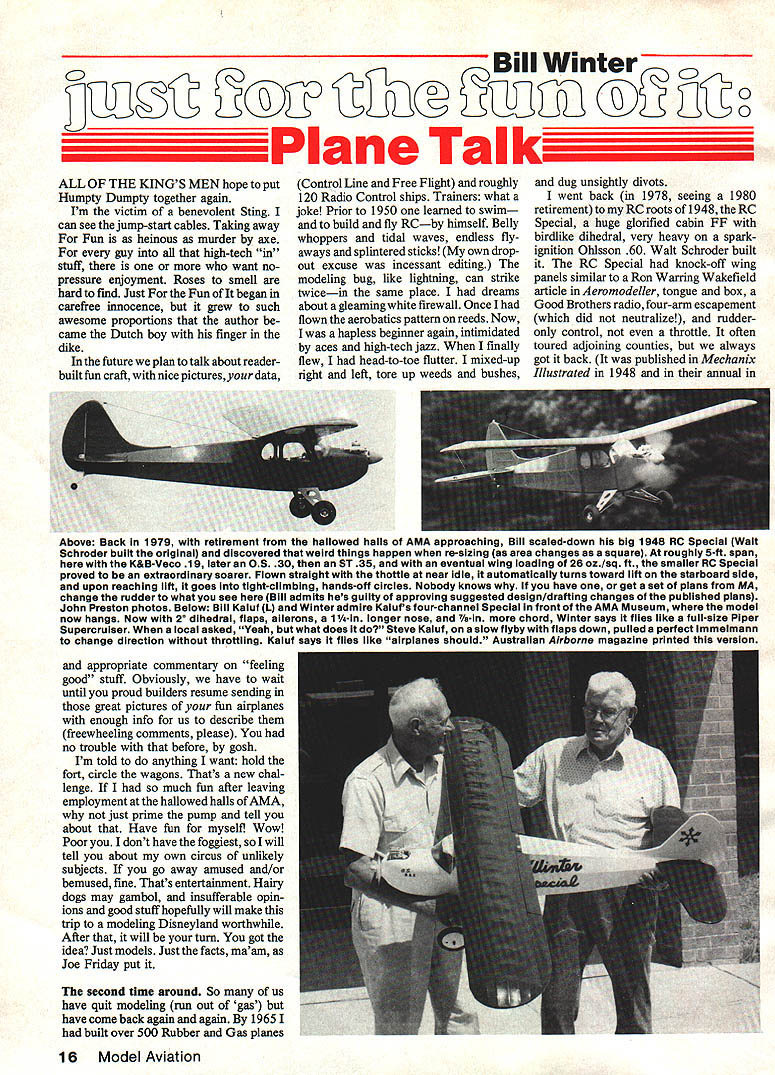
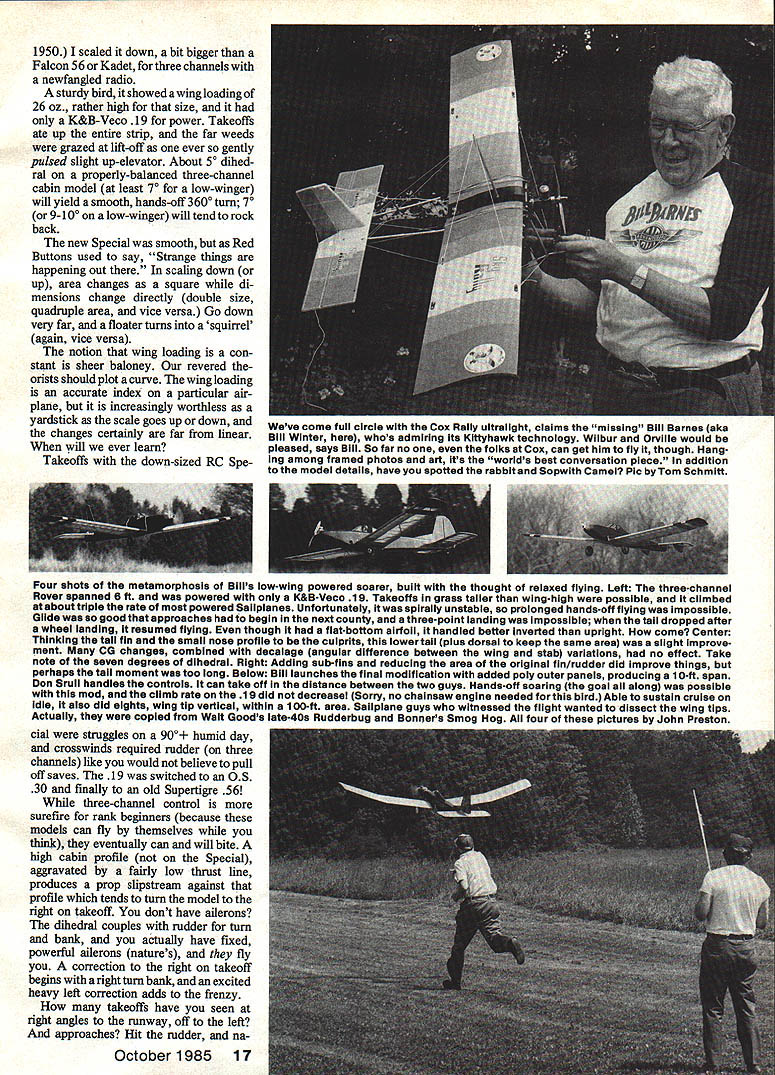
I went back (in 1978, seeing a 1980 retirement) to my RC roots of 1948, the RC Special, a huge glorified cabin FF, birdlike dihedral, very heavy on a spark-ignition Ohlsson .60. Walt Schroder built it. The RC Special had knock-off wing panels similar to a Ron Warring Wakefield article in Aeromodeller: tongue and box, a Good Brothers radio, four-arm escapement (which did not neutralize lateral control), and rudder-only control, not even a throttle. It often toured adjoining counties, but we always got it back. It was published in Mechanix Illustrated in 1948 and in their annual, and appropriate commentary on "feeling good" stuff. Obviously, we have to wait until you proud builders resume sending in those great pictures of your fun airplanes with enough info for us to describe them (freewheeling comments, please). You had no trouble with that before, by gosh.
I'm told to do anything I want: hold the fort, circle the wagons. That's a new challenge. If I had so much fun after leaving employment at the hallowed halls of AMA, why not just prime the pump and tell you about that. Have fun for myself! Wow! Poor you. I don't have the foggiest, so I will tell you about my own circus of unlikely subjects. If you go away amused and/or bemused, fine. That's entertainment. Hairy dogs may gambol, insufferable opinions and good stuff hopefully will make this trip to a modeling Disneyland worthwhile. After that, it will be your turn. You got the idea? Just models. Just the facts, ma'am, as Joe Friday put it.
The second time around
So many of us have quit modeling (run out of "gas") but have come back again and again. By 1965 I had built over 500 rubber and gas planes.
In 1950 I scaled it down, a bit bigger than a Falcon 56 or Kadet, for three channels with a newfangled radio. A sturdy bird, it showed a wing loading of 26 oz., rather high for that size, and it had only a K&B-Veco .19 for power. Takeoffs ate up the entire strip, and the far weeds were grazed at lift-off as one ever so gently pulsed slight up-elevator. About 5° dihedral on a properly balanced three-channel cabin model (at least 7° for a low-winger) will yield a smooth, hands-off 360° turn; 7° (or 9–10° on a low-winger) will tend to rock back.
The new Special was smooth, but as Red Buttons used to say, "Strange things are happening out there." In scaling down (or up), area changes as a square while dimensions change directly (double size, quadruple area, and vice versa). Go down very far, and a floater turns into a "squirrel" (again, vice versa).
The notion that wing loading is a constant is sheer baloney. Our revered theorists should plot a curve. The wing loading is an accurate index on a particular airplane, but it is increasingly worthless as a yardstick as the scale goes up or down, and the changes certainly are far from linear. When will we ever learn?
Takeoffs with the down-sized RC Special were struggles on a 90°+ humid day, and crosswinds required rudder (on three channels) like you would not believe to pull off saves. The .19 was switched to an O.S. .30 and finally to an old Super Tigre .56!
While three-channel control is more surefire for rank beginners (because these models can fly by themselves while you think), they eventually can and will bite. A high cabin profile (not on the Special), aggravated by a fairly low thrust line, produces a prop slipstream against the profile which tends to turn the model to the right on takeoff. You don't have ailerons? The dihedral couples with rudder for turn and bank, and you actually have fixed, powerful ailerons (nature's), and they fly you. A correction to the right on takeoff begins with a right-turn bank, and an excited heavy left correction adds to the frenzy.
How many takeoffs have you seen at right angles to the runway, off to the left? And approaches? Hit the rudder, and nature's ailerons impose turn and bank—left, right, left—and if a flat-bottomed airfoil, some nifty up-and-down gyrations mixed in.
I'd take an Eaglet any time for a rank beginner. Aileron trainers? The aces beat you over the head with that! You need a good instructor, long on patience, and he mentions junk like cobra rolls after a few flights, change doctors before you become terminal. These guys must create you in their own image. What was their first airplane 20–30 years ago? Ha!
Another thing: symmetrical-winged trainers. They're fine if you are almost ready to tackle Pattern. They are hot. For advanced aerobatics, these airfoils are great because the plane "goes where it is pointed." If that is a tree, car, or ground, it sure does! With your little .40 "bomb," the dust has settled before you (a beginner) can begin to think. A 3/4-in. airfoil, the 1/8-in. a convex bottom, may be okay. The ideal compromise is on the Falcon 56 (you would argue with Carl Goldberg).
Scaled down, the Special didn't fly like its monster forefather. Rather, it was like a modern "sport" airplane, whatever that is.
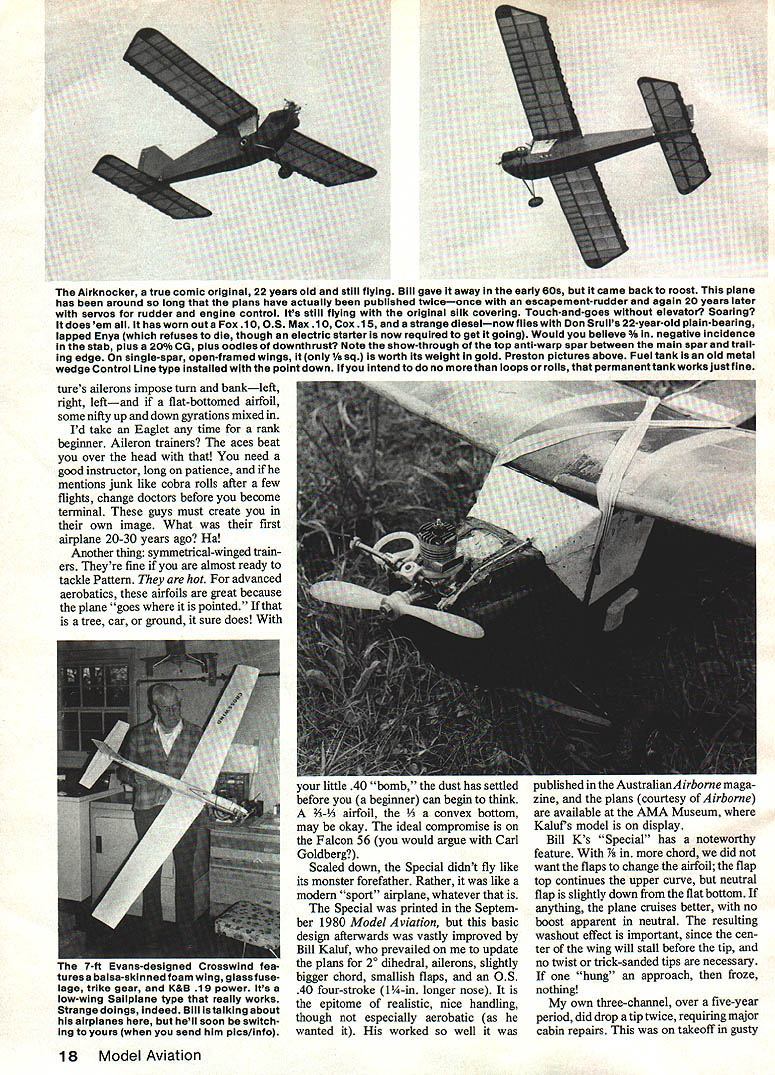
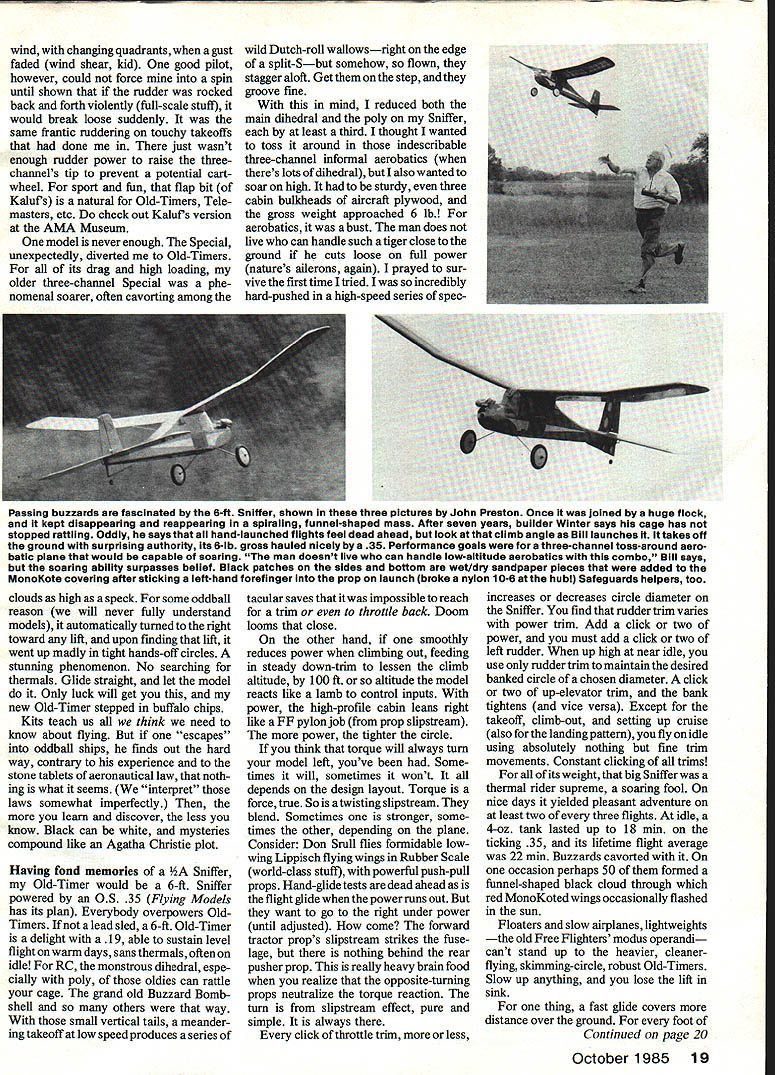
The Special was printed in the September 1980 Model Aviation, but this basic design afterwards was vastly improved by Bill Kaluf, who prevailed on me to update the plans for 2° dihedral, ailerons, slightly bigger chord, smallish flaps, and an O.S. .40 four-stroke (1-1/4-in. longer nose). It is the epitome of realistic, nice handling, though not especially aerobatic (as he wanted it). His worked so well it was published in the Australian Airborne magazine, and the plans (courtesy of Airborne) are available at the AMA Museum, where Kaluf's model is on display.
Bill K.'s "Special" has a noteworthy feature. With 7/8 in. more chord, we did not want the flaps to change the airfoil; the flap top continues the upper curve, but neutral flap is slightly down from the flat bottom. If anything, the plane cruises better, with no boost apparent in neutral. The resulting washoff effect is important, since the center of the flap is well aft and will stall before the tip, and this is the twist that keeps the tip from stalling. Even near the approach, then frozen, nothing.
My own three-channel, over a five-year period, did crop a tip twice, requiring minor cabin repairs. This was on takeoff in gusty conditions, and both times the repairs were simple. In short, the Special is forgiving, pleasant to fly, and a good example of how scaling and sensible modifications can produce a fine sport model.
One good pilot, however, could not force mine into a spin until shown that if the rudder was rocked back and forth violently (full-scale stuff), it would break loose suddenly. It was the same frantic ruddering on touchy takeoffs that had done me in. There just wasn't enough rudder power to raise the three-channel's tip to prevent a potential cartwheel. For sport and fun, that flap bit (of Kaluf's) is a natural for Old-Timers, Telemasters, etc. Do check out Kaluf's version at the AMA Museum.
One model is never enough. The Special, unexpectedly, diverted me to Old-Timers. For all of its drag and high loading, my older three-channel Special was a phenomenal soarer, often cavorting among the wild Dutch-roll wallows—right on the edge of a split-S—but somehow, so flown, they stagger aloft. Get them on the step, and they groove fine.
With this in mind, I reduced both the main dihedral and the poly on my Sniffer, each by at least a third. I thought I wanted to toss it around in those indescribable three-channel informal aerobatics (when there's lots of dihedral), but I also wanted to soar on high. It had to be sturdy, even three thin bulkheads of aircraft plywood, and the gross weight approached 6 lb.! For aerobatics, it was a bust. The man does not live who can handle such a tiger close to the ground (he cuts loose on full power—nature's ailerons, again). I prayed to survive the first time I tried. I was so incredibly hard-pushed in a high-speed series of spectacular saves that it was impossible to reach for a trim or even to throttle back. Doom looms that close.
On the other hand, if one smoothly noses down when climbing out, feeding in steady down-trim to lessen the climb attitude, by 100 ft. or so altitude the model reacts like a lamb to control inputs. With power, the high-profile cabin leans right like a FF pylon job (from prop slipstream). The more power, the tighter the circle. If you think that torque will always turn your model left, you've been had. Sometimes it will, sometimes it won't. It all depends on the design layout. Torque is a force, true. So is a twisting slipstream. They blend. Sometimes one is stronger, sometimes the other, depending on the plane. Consider: Don Srull flies formidable low-wing Lipschiff flying wings in Rubber Scale (world-class stuff), with powerful push-pull props. Hand-glide tests are dead ahead as is the flight glide when the power runs out. But they want to go to the right under power (until adjusted). How come? The forward tractor prop's slipstream strikes the fuselage, but there is nothing behind the rear pusher prop. This is really heavy brain food when you realize that the opposite-turning props neutralize the torque reaction. The turn is from slipstream effect, pure and simple. It is always there.
Every click of throttle trim, more or less, increases or decreases circle diameter on the Sniffer. You find that rudder trim varies with power trim. Add a click or two of power, and you must add a click or two of left rudder. When up high at near idle, you use only rudder trim to maintain the desired banked circle, a choice of chosen diameter. A click or two of up-elevator trim, and the bank tightens (and vice versa). Except for the takeoff, climb-out, and setting up cruise (also for the landing pattern), you fly on idle using absolutely nothing but fine trim movements. Constant clicking of all trims!
For all of its weight, that big Sniffer was a thermal rider supreme, a soaring fool. On nice days it yielded pleasant adventure on at least two of every three flights. At idle, a 4-oz. tank lasted up to 18 min. on the stick-back test, and its lifetime flight average was 22 min. Buzzards cavorted with it. On one occasion perhaps 50 of them formed a funnel-shaped black cloud through which Red MonoKoted wings occasionally flashed in the sun.
Floaters and slow airplanes, lightweight—the old Free Flighters' modus operandi—can't stand up to the heavier, cleaner-flying, skimming-circle, robust Old-Timers. Slow up anything, and you lose the lift in the sink.
For one thing, a fast glide covers more distance over the ground. For every foot of altitude it loses, it may glide 20 feet (say 20 to 1). A slow glide, with greater sink, covers less distance, say 10 to 1. If lift/drag ratios matter, then we are flying, in these examples, at L/Ds of 20 to 1 and 10 to 1. Or even only 5 to 1? Less?
If one learns fascinating things from "fooling around," that Sniffer utterly destroyed my faith in what we nonchalantly believe. Right thrust makes a model go right, compensates for torque, etc.? Sometimes. The slipstream of a big prop against the Sniffer's high fuselage profile is far more powerful than torque.
The Sniffer had right thrust. Since it always leaned right with power, I removed the right thrust—resulting in the hair-raising flight described previously. The ship then went viciously to the right. That is contrary to our solemn beliefs. The only possible explanation is that changes in thrust offsets also alter the angle at which the slipstream strikes a cabin. When I removed the right thrust, I increased the angle of the upstream stream striking the cabin on the left side. What might more right offset have done? Have you ever heard that before? I think not. Of course, a low cabin profile, a shoulder wing or low wing—and things like minimal dihedral, vertical tail area and its location relative to the rolling axes—behave differently.
My Old-Timer Vagabond RC-assist FF (MAN has the plans) is the precise opposite of the Sniffer. It rolls sharply left on torque, and right thrust does what it is supposed to do. The Sniffer ROGs with 1/4 in. of left rudder trim, the Vagabond with 1/4 in. of right rudder trim. The ugly event they both are high-wing cabin layouts. Find one with a happy thrust line, relative to the profile, and it will go straight. Changes from small to large props have tremendous slipstream variations. With a little prop, the right-turning plane may opt to go left. And so on. Modeling is loaded with such contradictions—another story.
Hopeless doodlers get carried away. We build the doodles. The Rover was a Sunday morning doodle, and I have letters requesting plans for it. A 6-ft. low-winger on only a K&B-Veco .19, tail-dragger, cockpit deck and pilot, and on the whole a fine flier, it has one bug I cannot kill. "Only a .19," you say, "Why not a .60 or a .90?" Go away! It ROGs through grass so tall that one can hear the grass slapping the wing (holding up-elevator, of course). Climb is fine. With a flat-bottom foil it inverts after a half outside, and daring pilots tell me it flies better inverted than upright. And it soars.
The first thing I look for in an airplane is an ability to do a hands-off 360° circle once laid over in a shallow bank. I want a ship to keep its nose up when turning and banking. After all, why can't a model turn and bank like a full-scale one? If it won't, how on earth can one soar on automatic pilot at very high altitudes? It must not spiral down. I'll accept a slight loss of altitude in a hands-off 360, or a 720, provided the ship glides and recovers dead ahead and in level flight. (I have many that won't, alas.)
The low-wing Rover had 7° dihedral, which should have done the job but didn't. Spirally unstable, one had to constantly use the rudder (a three-channel ship). It had a tall, pretty fin and not much nose profile. Such layouts are known to wind down in a spiral when laid over, or even when left hands-off. In a bank, the big fin/rudder holds up the tail as the nose drops.
We went to a low-profile vertical tail, then a still lower one with a dorsal to maintain the area. Finally, two sub-rudders were added. Almost there, but not quite, ever. We changed the CG position and angular differences, and both together. The glide, incidentally, is what you see on a clear day: forever. Power landings were almost impossible; if you couldn't get the idle low enough to tick-tock, then impossible. I recall John Preston coming in low and flat from far out with the Rover to make a wheel landing. As soon as he tried to drop the tail, the plane resumed flying (and he was told to fly into the weeds).
I should add spoilers. Rubber Scale fliers find that low wings, like the Keith-Rider racer, are reliable if the wing tip is raised in line with the bottom line of the cockpit canopy. Why not just add more dihedral? Dave Robellen's three-channel Pronto is loaded with dihedral, perhaps 10°. But there also was a long tail moment on the Rover; if it were more short-coupled, maybe the thing would behave like a good sailplane.
The screwball solution was to insert another foot of span on each side—bringing it to 8 ft., still on the .19—and give it poly, like an Old Free Flight. Effectively, I then had a short-coupled plane with scads of "dihedral." Takeoffs were immediate—roll and go. The climb was as good as ever. Magazines I showed this to were shocked. The old boy had lost his marbles. Fly on the wing; what's that?
I allow everybody to fly my airplanes. Doug Pratt, Don Srull, and Bob Crosby (an airline pilot whose modeling love is Quarter Scale) were among the "fortunate" who eased the Rover. You really learn about your planes when you watch. Srull began doing crazy 8s, wing vertical to the ground with about 5 ft. clearance, and he kept it within a 100-ft.-dia. frame—on and on, endlessly. That, then, the sailplane pilots wanted to dissect the tips. In about 1950 Walt Good (on the Rudderbug), afterwards Howard Bonner (on the Smog Hog), simply cut a forward slant in the sheet trailing edge near the tip and sanded undercamber for washout. So the sailplane pilots were in a tizzy about Good's 45-year-old trick. One keeps a straight face.
A high, choppy crosswind, Crosby wanted to take off 90° to the wind. In front of certain destruction (all that dihedral, huge wing, low power, no ailerons), he went ahead and did it—on rails. Then in slow flight into the wind, he kept raising the nose to the stall point, and then he flew it backwards almost out of sight. Afterwards, he dropped the nose and flew back for a perfect power landing. Remember how we had to land it dead-stick when it had a smaller, 6-ft. span?
I was living in a tiny townhouse (while still on the MA staff). Bench rash heaven, I bought a door to work on. Obviously a 4-in. scale ship was a sensible project: the 10-ft., 4-in. Aristocrat! (Come back next month for information on this one.) Thirty months and two houses later, the long, long trail would end. What fools we mortals be! Oh Lord, it flew! It now hangs in the AMA Museum. What it was to prove (and disprove) became a staggering learning experience—new worlds, worlds within worlds, wheels within wheels. Tell me why an airplane flies, and I won't hear you. Say the moon is made of green cheese, and I'll cry, "Yeah, yeah!"
Before leaving this month, here are a few things straight from Alice in Wonderland. Strange birds had roosted. I'm always giving away airplanes. The Sniffer, Rover, Aristocrat, the big Krackerjack, a 1/4-scale Vagabond are gone. In 1966 there was an abandoned fleet of old escapement things, including a Lou Andrews Beam, a deBolt Rebel, and my old .09 Airknocker (published in FM in 1963 and a second time a few years ago). The Beam and Airknocker came back to haunt me. I still fly the latter. Now there's a throttle on the Airknocker, but all those early birds were rudder-only. Guys at the field keep asking me how a plane can fly without elevators! (That is true.) You adjust for level flight at cruise, add power to go up, and take it off to come down. (It is so much like full-scale flying.) These rudder-only ships will do touch-and-goes (time the power a tad before touching down), rolls, spirals, and loops (after a spiral). Norm Rosenstock flew the Beam and Airknocker for laughs at his own club field, and he got the same brilliant questions. They now have a servo instead of an escapement.
In 1963 I lost the Beam on Long Island. It landed miles away in Grumman's parking lot (choosy crate!). In 1978 Norm hand-launched the Beam from Mt. Sinai on Long Island, from cliffs over the sound. He forgot to flip the switch. In Virginia I received a card (Norm had left my ancient address and phone number on the identification, which the finder, a postman, and an old neighbor traced). The card said, "I found your airplane." I called Norm 250 miles away to tell him I found his airplane. Silence. "How is that possible?" He had to believe it flew to Virginia. I had "proof."
"Just call this number, and you can pick it up," I told him. It had been floating in salt water, warped beyond imagination. A cabin cruiser spotted it far offshore. Norm brought it back to me.
The prehistoric Kraft of Norm's had high rate added for rudder, and one could do corkscrew snaps and other weird gyrations faster than the eye. You know those curvy approaches on three-channel rudder? High rate makes them string straight. With oodles of rudder power, you can fine-tune the approach through the eye of a needle.
Warps? As Free Fighters used to joke, "They cancel out each other."
RC tanks did not exist when the Airknocker first flew. It was a CL wedge tank with the point down and the top 1/2 in. below the needle valve. The feed line runs into the bowels of the earth for pickup, winds around the cylinder from the front, then loops forward to the body. No draw? It runs for 18 min. on a 2-oz. tank and varies almost imperceptibly from beginning to end, through sustained idle or high power. The 21-year-old Enya has the typical small venturi. The Airknocker thermals. It took better eyes than mine to save it on a dull gray late afternoon winter sky. There are always thermals—some like vacuum cleaners, the famous glider-boy "hauksuckers."
You scoff at no elevators? I've pulled this trick twice. Put the airplane up very high, and hand the controls over to the victim, not telling him he has no elevators. A world-famous sailplane pilot from abroad had it soaring for 30 min., all the time working the elevator trim lever like mad. He said he was proud of the way he flew it, but wondered why it was slow to flare on landing. When told it had no elevators, he groaned, "I am mortally embarrassed." For good fuel draw, reliable running, and long engine life, you'll love small venturis. If you expect no aerobatics beyond loops and rolls, why not bury a metal tank forever? It works for eternity.
The Airknocker, after many repairs, now carries a 1/4-in. shim of negative incidence in the stab, which gives it 20% more drag and 4° of downthrust. You don't want that on an aerobatic ship, naturally. You think it is easy? Some full-size planes will try "worse" setups than that. The Piper Vagabond (I later built a 1/4-scale version) calls for 4° negative in the stab, wing on flat with 3° of twist in the full span. The Vag has a chunky side-by-side with a huge piece of span cut back from a Cub wing. No modeler in his right mind would go with that. I did. The proof existed in that crazy business with the old Airknocker model. I knew it would work. The CG lies at about 17–18% on my Vag. The full-size Vag has a spring-loaded stick to enable raising the nose for landing without high stick loads. Empty, they set around with flippers sticking up. Incidentally, downthrust is most effective with low-pitch props. My Airknocker doesn't like to climb out with a 7-4, but it behaves fine with a 7-5.
There's a picture of the Evans Crosswind. You know him mostly for the Simitar. He's an old-timer, a showman. When I put him on fast, and I try to make him go slow—fly on power, not on wing compromises. You saw pictures not long ago, in my old column, of the Slow Motion which we cocked up together. It is the finest airplane I have ever flown, bar none. People who fly it think I have a "tight" radio. I wouldn't know "tight" if I met it at midday. Planes, too, can be "tight" apparently. Mine, in the column, has a K&B-Veco .19 on a 3-ft. wing (it's a flying wing). I really wanted a 6-ft. wing, but Evans said that would be overkill. After seeing mine, Kaluf built the 6-ft. version, but with only an O.S. .15. Tom Runge at Ace RC got to fly it, including inverted flybys, and he marveled that such a low-powered model could possibly go so fast. Many people built the Crosswind. Evans sent me that kit in 1980. It is one of a kind.
The configuration is based on Evans' Seville low-wing sailplane. I saw a letter by a famous soaring columnist (not Dan Pruss) that his Seville outperformed the finest sailplane of the time—but you'll never hear that. Bill's plan was in Model Aviation, but somehow I got a one-of-a-kind wing. Possibly I was supposed to round the leading edge, but it came partially assembled with a knife-edge. We all regard that as still happy, a no-no. On a flat-bottom wing, with the pointed edge at the exact bottom, it is out of this world. It won't stall. This airplane had three oversized wheels for tall grass, and its performance far outstripped any famous sailplane with a power pod I ever encountered. Once soaring high, Don Srull did a rolling 360 while climbing. This "goof" (the sharp leading edge) works only with flat bottoms; it will stall anything else in a flash, unflyable.
That Crosswind shattered all my gospel truths acquired over half a century. If you try it, you may be amazed. I certainly was. As to all those K&B-Veco .19s I use, they are out of production, but Johnny Brodbeck pigeon-holed a dozen for me. You can idle stinking rich for 10 min. or so, and response is right there. Never a dead engine. In fact, after flying the RC-assist FF Vagabond, I hold it nose down, and raw fuel pours out of the nose compartment. A 9-4 or 9-5 prop is great, and I have used the same nylon 9-4 (doesn't want to come down with 5-in pitch) for five seasons. That's economy.
The Crosswind handles pleasantly, and when making sweeping turns out of final in the distance, it gives an illusion of being a Boeing 747. Some guys fly it on floats. I used mine to survive the death-throe struggles with the huge Aristocrat (saw-horses and crawling around to build it). Same place, same time, next month . . .
Bill Winter, 4432 Altura Ct., Fairfax, VA 22030.
Transcribed from original scans by AI. Minor OCR errors may remain.

