

Just for the Fun of It: Plane Talk
Bill Winter
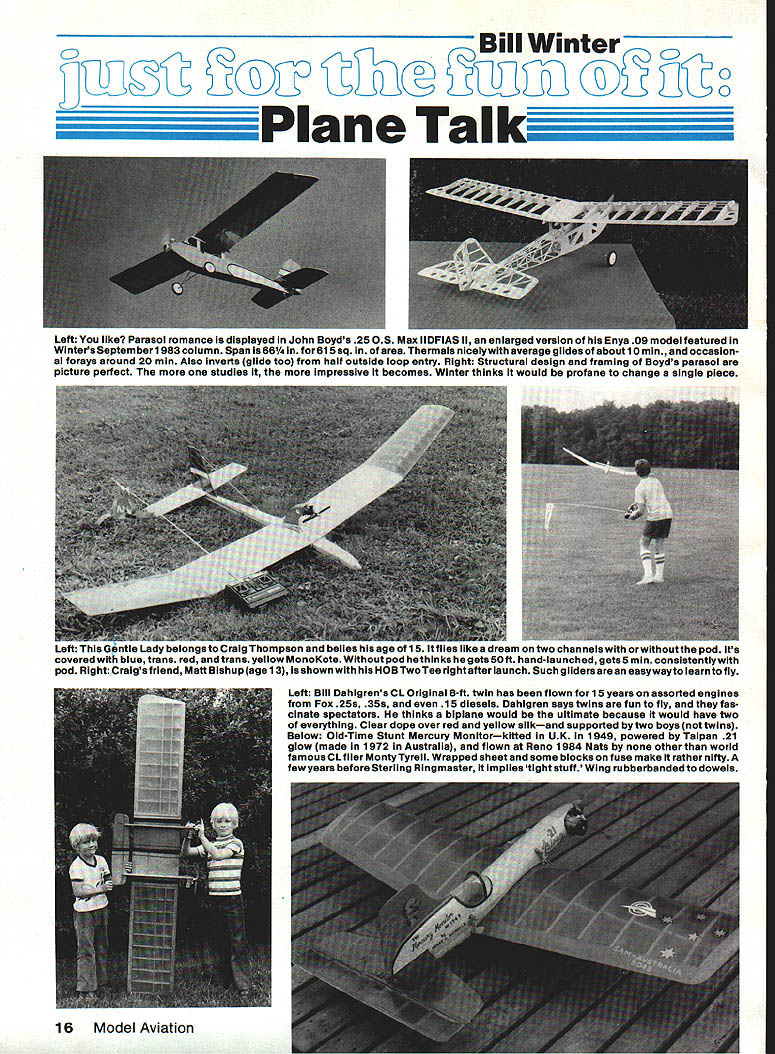
There is something about parasols. Some people love them; others can't resist the lure, eventually building one. The first doodle may be a nifty cabin job, a zippy low‑winger, or a heroic biplane. Keep doodling and, lo and behold, it often becomes a parasol. Such Rorschach images usually appear during phone conversations. My old friend John Boyd, Sioux Falls, SD, has a long‑standing romance with pretty birds.
In June 1983 I published shots of his Enya .09‑powered IIDFIAS little parasol. It proved very nice‑handling with no ailerons. John flew it a lot and decided enlarging it to 20‑size would produce a visible model for thermalling. That led to the current IIDFIAS II.
IIDFIAS II — basic data
- Span: 66¼ in.
- Area: 615 sq. in.
- Wing loading: 12 oz./sq. ft.
- Power: O.S. Max .25 RC
The design was adjusted to fly like an Old‑Timer. It doesn't deceptively clean‑glide; rather, it glides relatively fast yet appears slow in lift and can disappear through part of a climbing circle. Rudder response lags noticeably in power‑off, nearly stalled regimes. If I were to build another IIDFIAS II I would increase the rudder area and the dihedral slightly—Boyd wanted to work out the small negatives.
Dihedral and rudder considerations
- For normal flying Boyd used about 50° dihedral to give hands‑off 360° cruising turns and sustained stability around the field.
- For an Old‑Timer "look" he suggests increasing dihedral to about 70°. Old‑Timer flying requires rudder authority during approach turns.
- A sheet‑balsa rudder (trailing edge at the bottom on the order of 1/16–1/8 in.) is recommended to improve coupling with high dihedral; travel and area must be sufficient.
Flight characteristics and aerobatics
John reports the model thermals nicely. Typical glides average around 10 minutes, with occasional 20‑minute flights. In high thermals the plane needs little or no control input, though small continuous trim touches help maintain patterns.
Despite a crude Clark Y airfoil set at about 3° incidence from the chord line, IIDFIAS II flies well inverted. Flat‑bottom sections and significant dihedral usually don't invert the top half of a loop. On three‑channel models, entering a half‑outside (half‑outside loop) while holding full down can carry through into the final recovery; it’s a balancing act, but you can maintain altitude and recover a half‑loop outside — the model glides well inverted. I was probably holding a lot of down.
I've begun experimenting with dead‑stick aerobatics. It's great fun:
- From high altitude, go to idle, put the nose down to pick up speed and swoop into a loop.
- A controlled spiral with plenty of speed often results in a loop when the rudder is relaxed.
- On sturdy models you can even use strong rudder input (with or without elevator) to produce snap‑roll–like effects after a slight nosedown.
"In summary," John writes, "I would describe it as a gentle three‑channel sport model with good thermaling potential."
If you wish to contact John Boyd: 3005 Mayfair Dr., Sioux Falls, SD 57106
---
Youth is not wasted on the young
That hoary cliché had engine failure on takeoff. I often wonder not who reads this column but where age is concerned, who does not. Many older modelers write to me, often retirees, and I also hear from teenagers. Unless they tell me their ages I can't always tell the difference: older readers tend to reminisce and write longhand; younger readers are concise and usually type.
Over my 59‑year modeling career (52 years in editing and writing) I've received tens of thousands of letters. Standards change. Until the early 1950s, letters from the young were short, scribbled, inaccurate, full of misspellings. By the 1960s such letters were the exception; my younger readers now often express themselves as well as adults.
A typical young reader: Craig Hampson
Craig sent photos and notes about his models:
- Veteran Gentle Lady — 78 in. span, two channels, Futaba FP‑5Lk radio. Covering: blue, transparent red and yellow MonoKote. Modified with wing rubber‑banded dowels through the fuselage and a "bump" to prevent the wing sliding back. Tail fin lacks a dorsal (forgotten).
- Hand‑launch photo of the Gentle Lady: Craig's daughter (10) gets consistent 5‑minute flights using a power pod.
- Matt Biskup (age 13, Bridgewater, NJ) with a HOB Two‑Tee flown on a power pod, typically 6‑minute flights; he started flying less than a year earlier.
- Craig is learning an Eaglet with a bomb drop using a .049 power unit.
Craig likes the new format of the column and hopes it works out.
Control Line and early trainers
Control Line (C/L) was great fun and family friendly. Several of my children learned on balsa profile trainers — Goldberg had an excellent late‑Forties trainer with limited elevator control that was the best primary trainer I ever saw. My eldest son taught himself to fly on it and became an aerobatics natural. Lou Andrews' Trixter Profiles at Guillow were ideal for eager beginners: assemble, go to the park, learn to fly. I would not watch until they could "land." Those early profile planes were easy to fly and I miss them.
I loved steep spiral climbs of Free Flight models, the floating glide circles produced by wing warps, and the frantic tight-climbing circles of a well‑trimmed rubber model. Control Liners were unique: through the wires you felt a real machine and became one with it in a way nothing else in modeling offers.
Semantics: what "fun" means here
"Fun" is a small word with many meanings. I don't usually write about competition, though competition can be fun. The fun I focus on is individual effort: building, flying, interesting design developments, novel ideas, and the pleasure of flying one's feel‑good planes in a sport environment — alone or with friends away from the contest world. We're interested in anyone's interesting comments, problem‑solving, and lighthearted experiences across RC pattern, CL combat, multi‑engine rubber, or bungee pneumatic ships.
Letters and more "fun" models
Bill Dahlgren and others sent notes and pictures. A couple of highlights:
- An O.T.S. model kitted in England and later in Australia by Monty Terrell, flown at the 1984 AMA Nats — excellent workmanship.
- My original twin model: an 8‑ft. wing, two Fox .25s, clear dope over red and yellow silk. It flew for 15 years on a variety of engines (.35s down to .15 diesels) and was retired due to doubts about the control system. Twins are fun for pilots and spectators — perhaps the ultimate fun flier would be a twin‑engined biplane with two of everything.
I can't believe this kind of fun is shipwrecked on a lost island.
---
Reminiscences and other models
A few more memories and reports from readers:
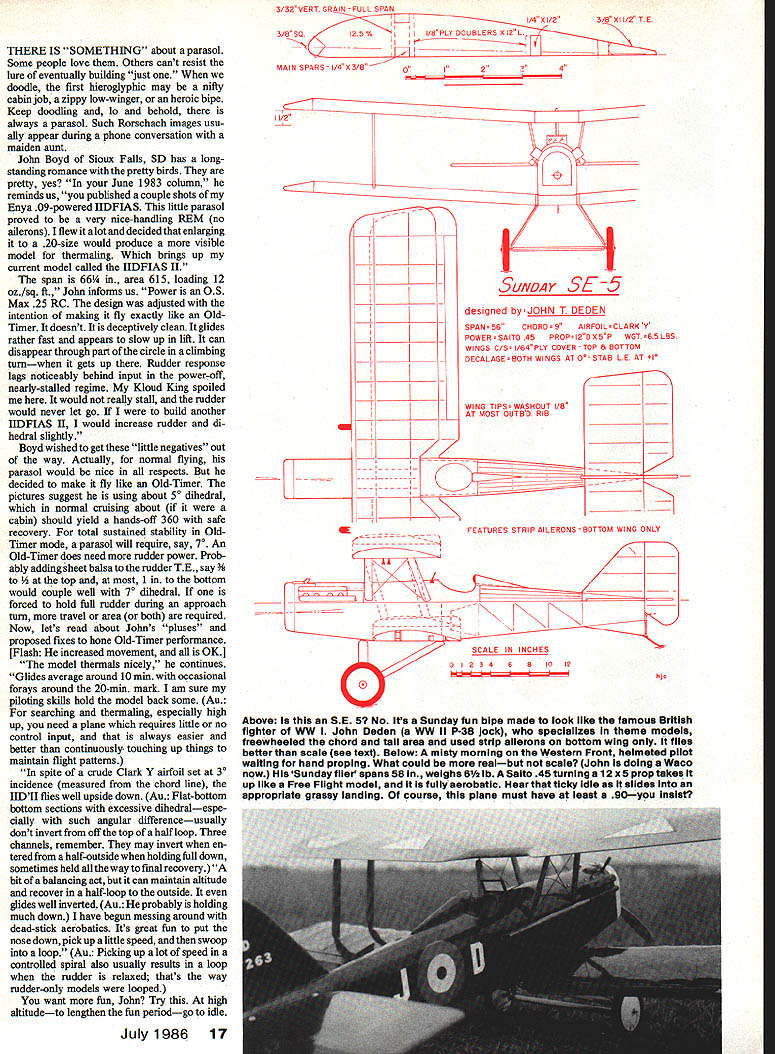
- Early popular aviation kits: lightweight WWI types (Nieuport, SPAD, Camel, Fokker D.VII, Triplane, etc.) at roughly 20–24 in. Some people stretched them to 30–45 in. I remember a 30‑in. S.E.5 that flew 15 ft. across a field with a carved balsa prop swooshing like a windmill.
- Skywriting Corp. of America flew over New York; visits to Roosevelt Field, Long Island, brought home the thrill of seeing many aircraft in the air on a Sunday.
- Deden (former pilot and tree engineer; member of the "How‑Texans") describes his slick red two‑winger:
- Span: 58 in.; chord: 9 in.; airfoil: 12% Clark Y; length: 42 in.; weight: 6½ lb.; power: Saito .45 four‑stroke with 12x5 prop; gear: Tower .4‑ch. Silver radio.
- He calls it a semiclassic Senior Citizen type — easy to fly, with 25 successful flights by January.
- Flies like a dream with modest nose ballast and a shim under the stab; MonoKote covering, water‑transfer decals.
- Deden reports tight round loops, no tendency to spin or drop a wing on stalls, good float on landing, lively climb on full power, and the ability to slow‑roll when using rudder, elevator and aileron together. He notes you don't need a .60 engine or a symmetrical wing to get dynamic aerobatics.
- John Boyd also enjoys sketches and models of classic types (Waco 10, Hammond‑type Caproni). He relates a colorful family tale about an uncle who flew in WWI and became a double‑ace; his S.E.5 design was adapted from pictures with modifications for better flying characteristics (higher aspect ratio, thicker airfoil, enlarged tail surfaces, strip ailerons on lower wings).
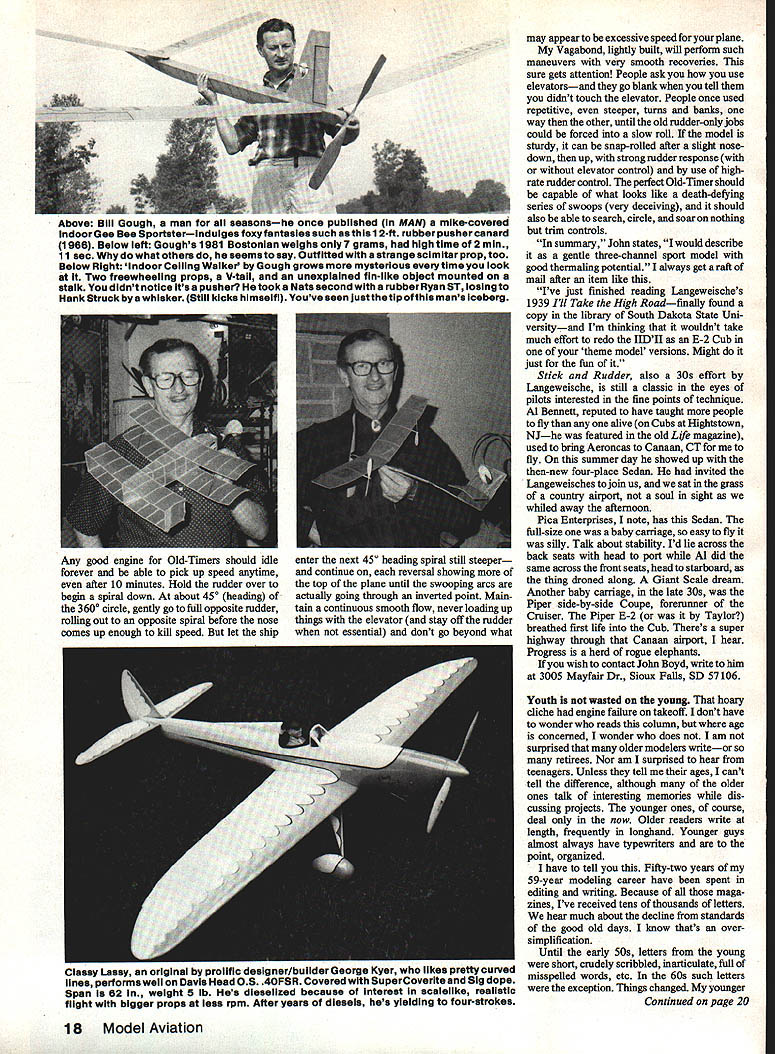
- George Keyser's "Classy Lassy" (Carnation, WA) is a curvaceous original: flowing lines, narrow D‑tube leading edge, laminated ribs, fiberglass shallow cowl, planked forward fuselage, lots of ribs and stringers, open cockpit, wheel pants. Power is a .40 FSR with a Davis Diesel head. Keyser prefers smaller models and engines under .40 and dislikes slab‑sided, constant‑chord designs.
Variety is the spice of fun. Put on your goggles, tie a silk scarf around your neck, and climb into the breezy open cockpit of an S.E.5 — or whatever you enjoy.
Transcribed from original scans by AI. Minor OCR errors may remain.

