
Just for the Fun of It: Plane Talk
Bill Winter
Off to See the Wizard
The PA system blasted the Light Cavalry Overture as Continental's 727 eased out toward the Denver hub. The music, the clapping, the cheers — the whole theatrical arrival — made the machine feel almost human. Touchdown at Ontario; the overture reached its climax as the jet turned onto the taxiway. California: Jack Benny land — "Anaheim, Azusa, and Cucamonga" — actually Rancho Cucamonga, only a few miles from Ontario Airport.
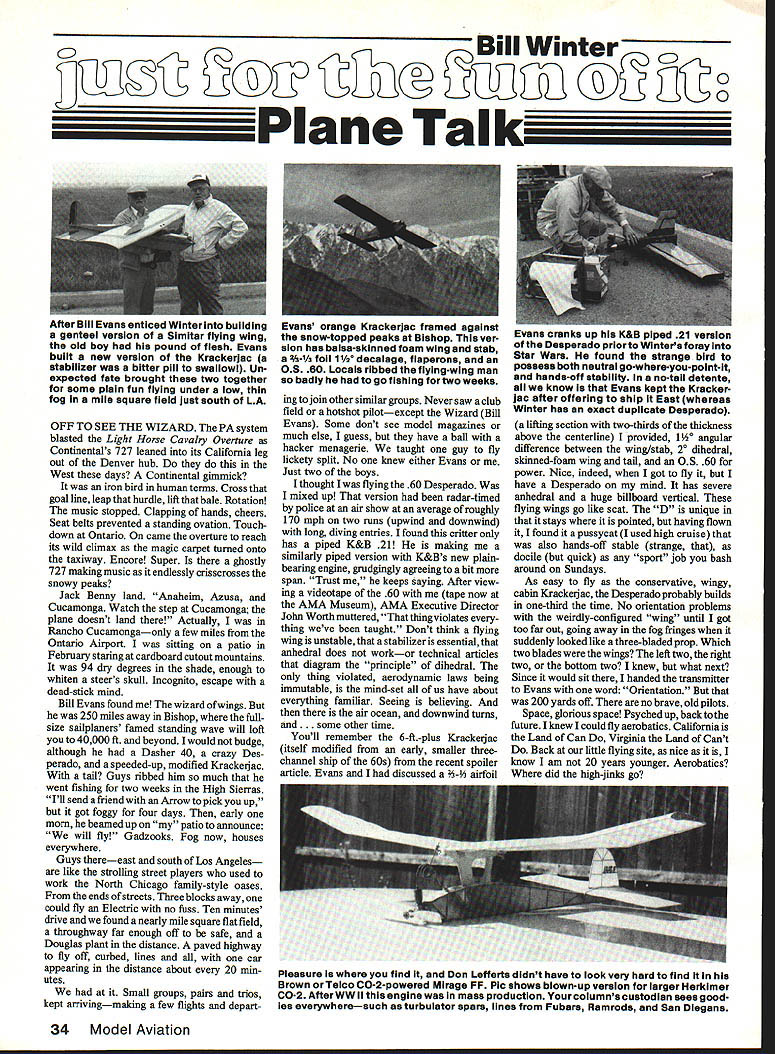
I was sitting on a patio in February, staring at cardboard-cutout mountains and baking in dry heat, when Bill Evans announced he had found "wizard wings" 250 miles away at Bishop. Bishop is famous for full-size sailplanes and the standing wave that will loft you to 40,000 ft. The model scene there was lively too: Dasher 40s, a crazed Desperado, and a speeded-up, modified Krackerjac. Evans had been ribbed so much about his flying-wing obsession that he "went fishing" in the High Sierras for two weeks. One foggy morning he turned up on my patio and said simply, "We will fly!"
We found a nearly mile-square flat field ten minutes from Los Angeles — a throughway far enough off to be safe, with the Douglas plant in the distance and a paved highway nearby. Small groups came and went, making a few flights and migrating. There was no formal club field, just a hacker menagerie of pilots having a ball. We taught a fellow to fly lickety-split; nobody asked about magazines or notoriety. Bill Evans, the "Wizard," was the exception — an obvious local hotshot.
Krackerjac and Desperado
Evans and I had been discussing flying-wing designs and the tradeoffs of airfoils, decalage, flaperons, and engines. There are several versions of the birds we flew:
- Krackerjac (6-ft-plus version): modified from an earlier, smaller three-channel ship of the '60s. This version had a bale-skinned foam wing and stab, flaperons, and about 2½° to 1½° decalage. It was typically flown with an O.S. .60 engine and was a relatively conservative, roomy "cabin" wing that handles predictably.
- Desperado: a much simpler, quicker-to-build flying wing with severe anhedral and a large vertical fin. Various engine installations exist — a radar-timed .60-powered Desperado averaged roughly 170 mph on timed runs, while other Desperados have run piped K&B .21s. The Desperado is unique: it stays pointed, is surprisingly docile in high cruise, hands-off stable, and a quick sport ship ideal for Sunday bashing. It probably builds in about one-third the time of a Krackerjac.
After watching a videotape (now at the AMA Museum), AMA Executive Director John Worth muttered, "That thing violates everything we've taught." People expect stabilizers and certain dihedral rules to be sacrosanct; flying wings and anhedral designs can challenge those preconceptions. Seeing is believing — aerodynamics are immutable, but mind-sets can be slow to change.
One memorable moment: I flew a Desperado out beyond visual range until fog fringes made the craft look like a three-bladed prop. Orientation gone, I handed the transmitter to Evans with one word: "Orientation." That was 200 yards off. Space felt glorious — psyched up for aerobatics, twenty years younger for an afternoon.
Electric experiments and Dave Peltz's J-3 Cub
Dave Peltz has been doing very useful comparative work with electric power and props, and his results are worth noting:
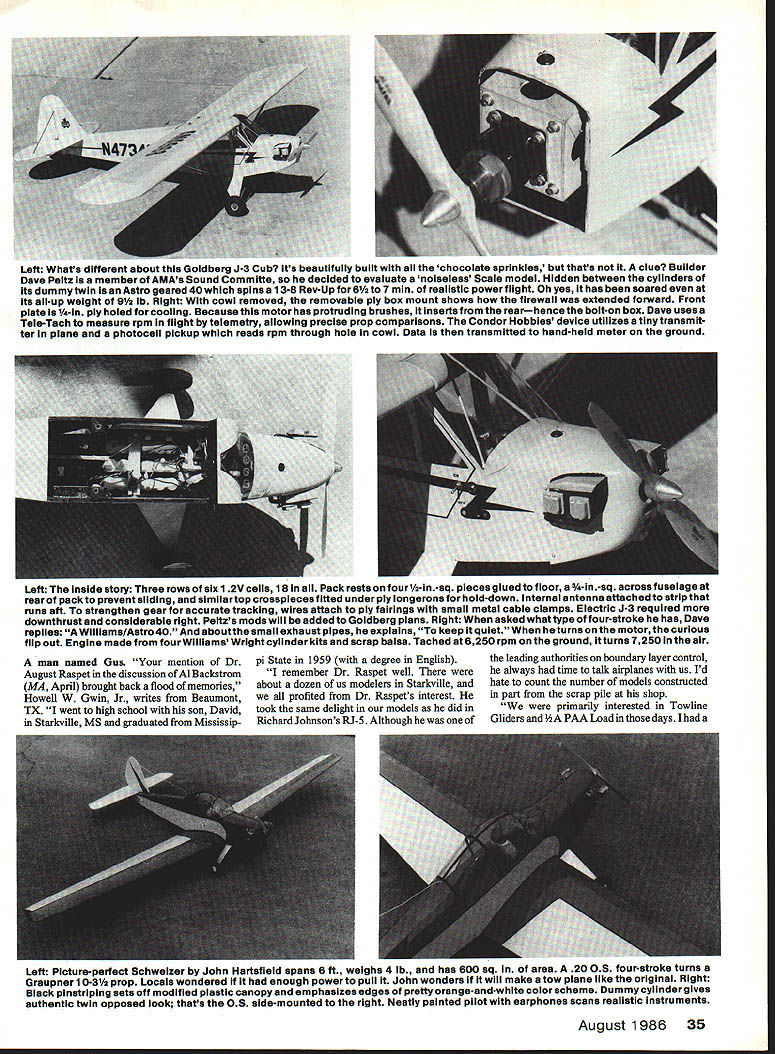
- In-flight rpm telemetry: Dave measures in-flight rpm using a Condor Hobbies Tele-Tach — a tiny transmitter in the plane and a photocell pickup taped to the motor, sending rpm to a handheld meter. His geared Astro 40 cobalt turning a Rev-Up 13x8 prop shows about 7,250 rpm in horizontal flight and about 6,250 rpm on the ground — a 1,000 rpm differential that's useful when setting needle valves.
- J-3 Cub electrification: Dave's not-too-modified Goldberg J-3 with electric power weighs about 9½ lb gross and is handled easily. The model needs realistic climb and scale-like behavior, and his setup gets 6½ to 7 minutes of motor run with a servo-actuated switch; with an Astro controller a practical run time rises to 10–11 minutes plus glide. A 13x8 at 7,000+ rpm has surprising pull and torque — an arming switch is gospel to prevent accidental spinups.
- Airframe modifications: he added downthrust and significant right thrust, beefed up the gear for tracking and ground handling, bent tall wheels ½ in. forward to reduce the nose-up ground stance, and twisted in ¼ in. of washout in both tips starting at about two-thirds semi-span as insurance against tip-stall at higher wing loadings.
Dave is on the AMA Sound Committee and views electric power as a growing necessity in quieter flying-site battles. Battery energy density remains the limiting factor, but motors and batteries have improved markedly in recent years. Carl Goldberg Models is reported to be adding more electric information to its kits because of findings like Dave's.
Anecdotes: cars, old-timers, and ultralights
- Don's mishap: Don tells of taking a free-flight Old-Timer (an early design) and while trimming it managed a one-bounce landing into a perfectly maintained 1957 Chevrolet owned by Sal Taibi. Sal was gracious but gruff — classic Old-Timer meet story. (Editor note: Sal is the original owner who has driven and maintained the car continuously; "restored" is not quite correct.)
- The Titus/Old-Timer trim story: At a dry-lake Old-Timer meet, the vintage model loaded with modern rubber and a long prop run performed well after trimming and a DT fuse saved a likely total loss. Such moments remind us why people build these retro models: to re-familiarize themselves with aeromodeling roots and to enjoy the romance and challenge of older designs.
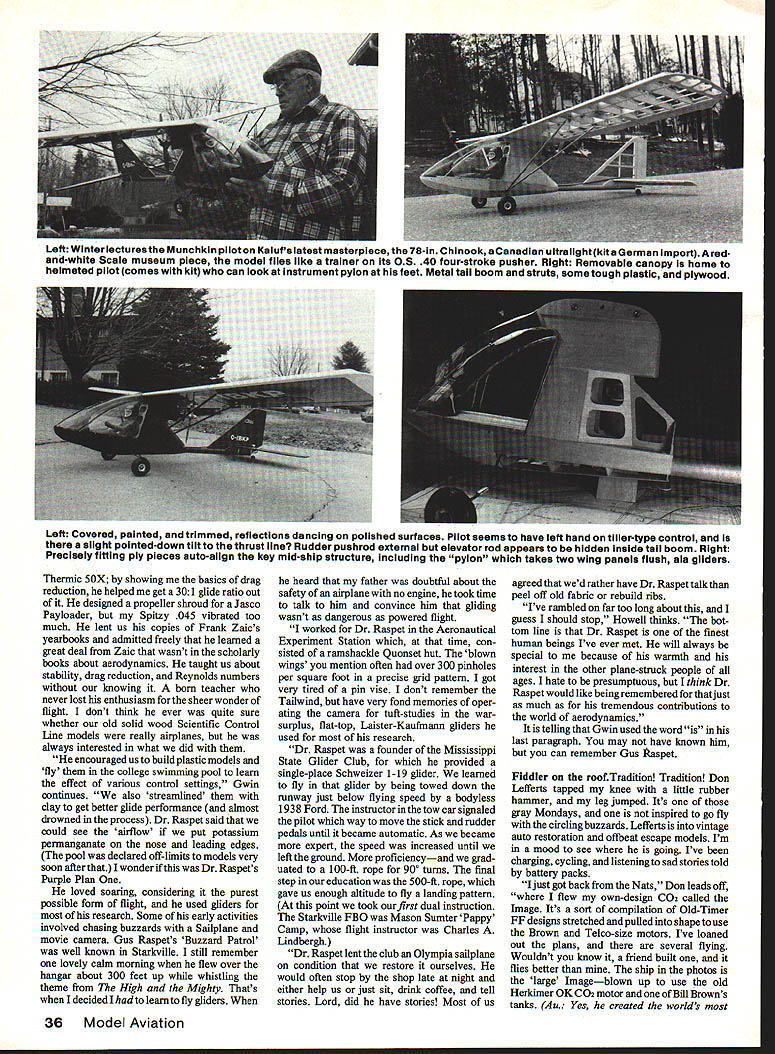
- Ultralights and scale models: There is a surprising lack of awareness about ultralights among modelers. I recently saw an enclosed ultralight model: a 78-in. span pusher-pylon with a 914 cc four-cylinder four-stroke — exquisite engineering, likely imported from Germany. Such full-size, scale-like ultralights are increasingly well done, and the model world is beginning to reflect that detail and craftsmanship.
Old-Timers and the Lanzo romance (John Oldenkamp)
John Oldenkamp from San Diego writes evocatively about building and flying retro models — Korda, Lanzo, and other Golden Age designs. He describes the labor of carving plywood props, fighting warps in tissue covering, and the joy of chasing that perfect glide. He recounts a trip to the VAMPS Las Vegas meet, the anticipation of flying over a huge dry lake, and the emotional satisfaction of reviving an era through careful modeling. His closing line: "Long live Chester Lanzo! Long live the rubberband!"
The China connection — Joe Tschirgi on reflexed airfoils
Joe Tschirgi (now in Nanjing) offers a clear correction to a common misconception about reflexed airfoils and stability. His points, summarized:
Facts:
- Airfoil camber — whether positive, reflex, inverted, or zero — has nothing inherent to do with static longitudinal stability.
- Most modelers mistakenly believe reflexed airfoils create a stable center of pressure travel; this belief is widespread but incorrect.
Explanation:
- Static pitch stability is the rate of change of pitching moment with angle of attack.
- Within the usual angle-of-attack range, conventional airfoils have about constant aerodynamic moments.
- The purpose of reflex camber in a tailless configuration is to provide a nose-up moment to trim the vehicle at a usable lift coefficient — similar in function to decalage or tailplane incidence in tailed aircraft.
- The old NACA practice of publishing "center of pressure" (moment divided by lift) led to misunderstanding; modern treatment uses the aerodynamic center (AC) concept, which does not move significantly with angle of attack.
- The AC and lift-curve slope (CLα) are the section parameters that matter for static stability; they are essentially fixed and similar for most airfoils (AC ≈ 25% chord, CLα ≈ 0.1/deg).
Proof suggested by Joe:
- Take an old free-flight wing, mount it on a stick fuselage with a big fixed vertical fin aft, and add a small flat plate drag area above the wing (this mimics decalage). Balance at about 15–18% MAC and hand-glide: both ends of the thing will glide stably, demonstrating that added drag area (or decalage) is analogous to tail incidence for trim and stability.
Dihedral, anhedral, and stability
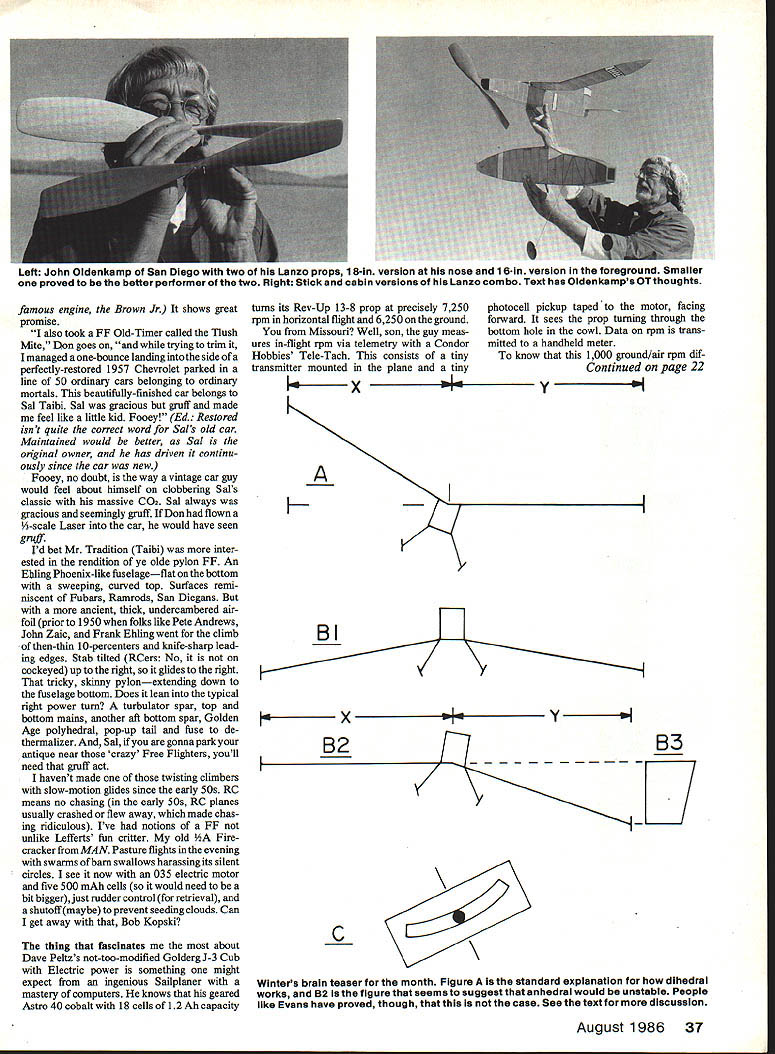
Dihedral is often explained with a simple moment-arm diagram: the lower wing in a roll produces more restoring lift because it has a longer moment arm. But reality can be subtler: anhedral can be stable in many designs, and some full-size airplanes with apparent anhedral are hands-off stable (our Desperado is a case in point). Considerations include:
- Slip/skid and the difference in angle of attack between the inside and outside wing in a banked turn.
- The pendulum effect of a high or low CG.
- Centrifugal force acting in a bank.
- The role of yawing moments and how the fuselage and vertical tail interact with dihedral/anhedral.
If a design tends to return to a coordinated banked turn without pilot input, modelers call it spirally stable. If pilot input is required to maintain or recover, the machine is only neutrally stable or even unstable.
For more on complex airflow in turns, Frank Zaic's Circular Airflow and classic articles (e.g., Van Hattum's "Gliders Nine") explore odd configurations that nonetheless can work.
Final thoughts
Planes and models are wonderful things — devices that combine art, history, and engineering. They provoke questions, myths, and passionate work: from flying wings that "violate" what we've taught ourselves to believe, to electrified scale Cubs with telemetry, to Old-Timers revived for the love of the past. Argue the theory if you like; for me, such debates are part of the pleasure — but I'm happy letting the experts hash out the details while I get a model in the air.
Bill Winter 4432 Altura Ct. Fairfax, VA 22030
Transcribed from original scans by AI. Minor OCR errors may remain.

