


Just for the fun of it: Plane Talk
Bill Winter
The average age
The average age of the 105,000-plus AMA members is 39, two years higher than it was in 1978 when I was last curious. Before anyone goes into a flap, I am not Chicken Little; the sky is not falling. I know the average age of modelers has been rising for over 50 years—since I began in 1927. Model Airplane News of 1929 was for kids, and I was one of the generation that identified with Lindy—the romance of daring World War I aces, the glamour of the early barnstormers with Standards and Jennies, heroic air mail pilots like Jack Knight who landed by emergency fires and auto headlights.
I saw American Boy with its plans and Twenties-style appeal to the 300,000 members. The AMLA preceded the AMA with starry-eyed Nationals and trip prizes to the Olympics. We grew up as a wave; modeling progress, always more complicated and expensive, has caused the age curve to rise. RC is a rich man's hobby. Consider the dollar volume of the aeromodeling industry today—roughly $500,000,000.
If the average member is 39, he was not yet born at a time when we were already bewailing the lack of kids. Relatively few of us know another world exists. Through entirely different outlets, barely noticed, millions of ROGs, gliders and other things sell. A substantial market that's been around for half a century reassures me. I am reassured by letters from many young people. So much to say. I asked for a computer breakdown and discovered that we have 11,000 in the group under 19! These are smart cookies, believe me, who manage well with things older folks also enjoy. They know how to put words and thoughts together.
Mike O'Bryan and the TD Coupe
"I just finished building a TD Coupe," reports Mike O'Bryan, a 16-year-old.
Why is a TD Coupe? When it appeared long ago in MAN, we all thought it was the niftiest gassie to see in print. It is an Old-Timer designed by Theodore Dykzeul—the TD comes from his name—in 1936! It is one of the most graceful of all the Old-Timers.
"There are two factors I consider before building an Old-Timer," continues Mike. "First and foremost, it must be pretty, 'cause if I don't like it, I ain't gonna build it! Second, I like it to be a design that isn't done very often. This ship fits both those criteria.
"This was my first humbling effort at covering with silk, although I doubt it will be my last; there is a yard of white and polka-dot silk at our hobby shop that has been sitting on the bottom of the box since the Wright brothers flew at Kitty Hawk. I'm a sucker for fun, crazy color schemes.
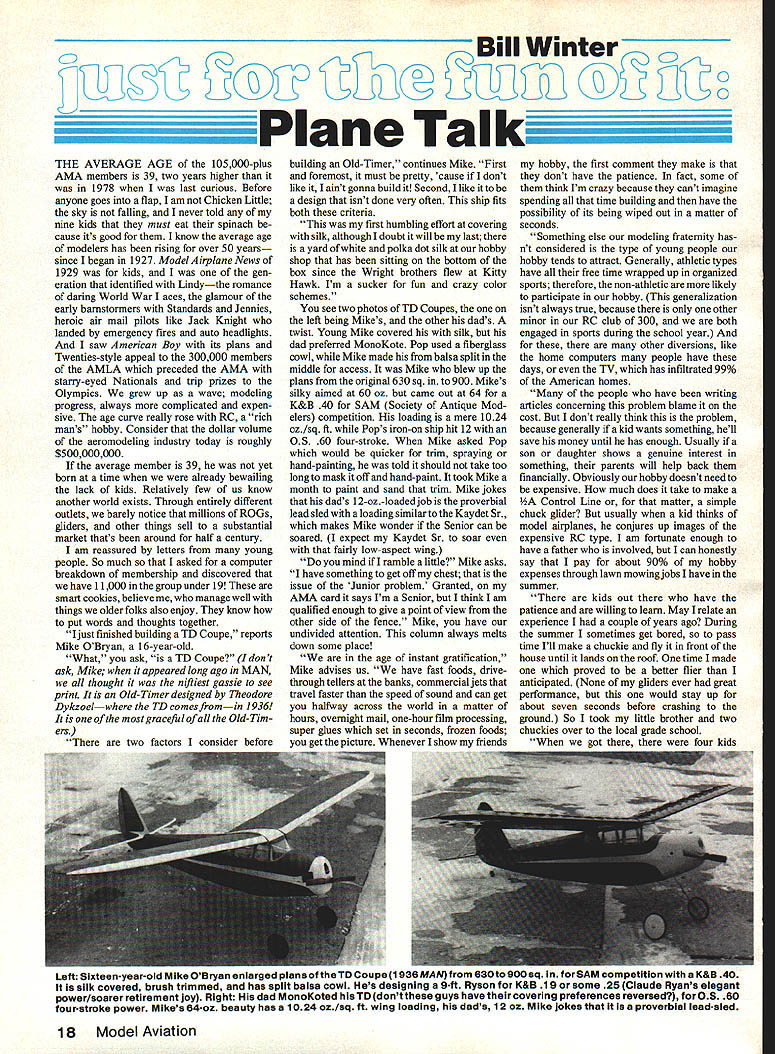
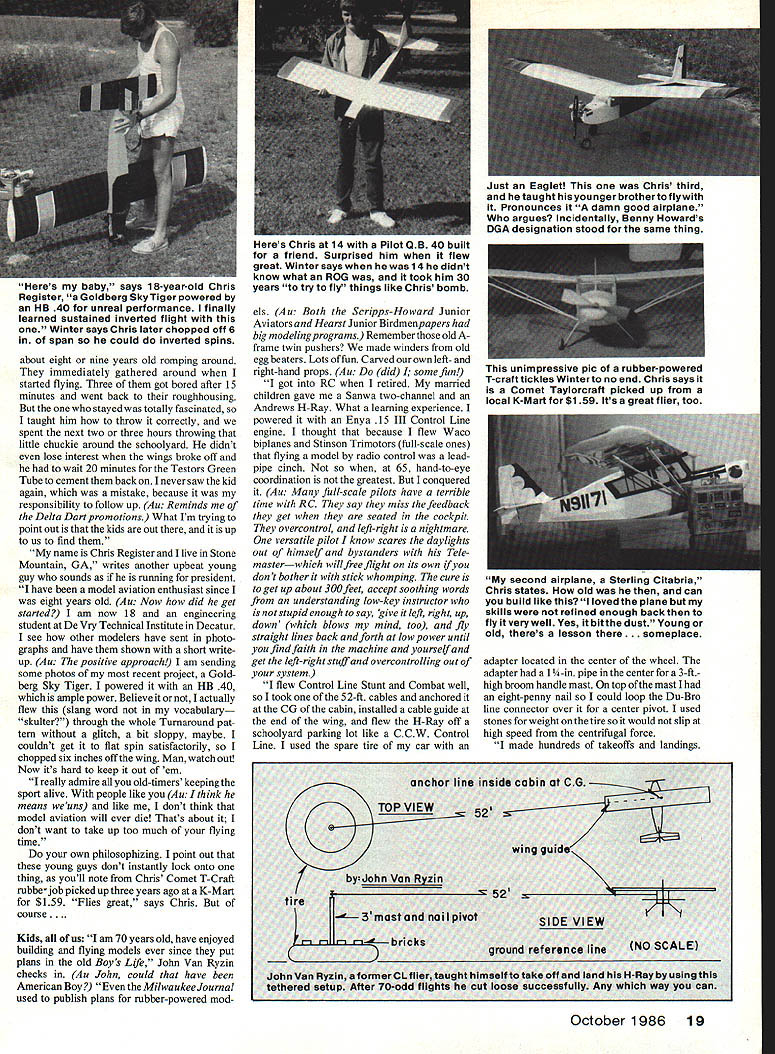
"You see two photos of TD Coupes, the one on the left being Mike's, and the other his dad's. A twist: young Mike covered his with silk, and his dad preferred Monokote. Pop used a fiberglass cowl, while Mike made his from balsa split in the middle for access. It was Mike who blew up the plans from the original 630 sq. in. to 900 sq. in. Mike's silky weighed 60 oz.; he came out at 64 oz. for a K&B .40 for SAM (Society of Antique Modelers) competition. His loading is a mere 10.24 oz./sq. ft., while Pop's iron-on ship hit 12 oz./sq. ft. with an O.S. .60 four-stroke.
"When Mike asked Pop which would be quicker to trim, spraying or hand-painting, Pop told him it would take too long to mask off and hand-paint. It took Mike a month to paint, sand and trim. Mike jokes that his dad's 12-oz.-loaded job is the proverbial lead sled; loaded with a loading similar to the Kaydet Sr., which makes Mike wonder if the Senior can soar. I expect my Kaydet Sr. to soar even with that fairly low-aspect wing."
The junior problem and instant gratification
"Do you mind if I ramble a little?" Mike asks. "I have something to get off my chest; that is the issue of the 'Junior problem.' Granted, on my AMA card it says I'm a Senior, but I think I am qualified enough to give a point of view from the other side of the fence." Mike, you have our undivided attention.
"We are in the age of instant gratification," Mike advises. "We have fast foods, drive-through tellers at the banks, commercial jets that travel faster than the speed of sound and can get you halfway across the world in a matter of hours, overnight mail, one-hour film processing, super glues which set in seconds, frozen foods; you get the picture. Whenever I show my friends my hobby, the first comment they make is that they don't have the patience. In fact, some of them think I'm crazy because they can't imagine spending all that time building and then have the possibility of its being wiped out in a matter of seconds.
"Something else our modeling fraternity hasn't considered is the type of young people our hobby tends to attract. Generally, athletic types have their free time wrapped up in organized sports; therefore, the non-athletic are more likely to participate in our hobby. (This generalization isn't always true; there is only one other club in our area of 300, and we are both engaged in sports during the school year.) And there are other diversions, like home computers. TV has infiltrated 99% of American homes.
"People have been writing articles concerning the problem and blame cost. I don't really think this is the problem, because generally a kid wants something, he'll save money until he has enough. Usually a son or daughter shows genuine interest in something and parents will help back it financially. Obviously the hobby doesn't need to be expensive; much does take to make. Control Line, matter-of-fact chuck glider—usually a kid thinks model airplanes conjure up images of eight or nine year-olds romping around."
Mike tells an anecdote: he started flying a chuck glider at a schoolyard; several kids gathered. Three got bored after 15 minutes and returned to roughhousing, but one stayed, fascinated. Mike taught him how to throw it correctly, and they spent two or three hours throwing that little chuckie around the schoolyard. The wings eventually broke, and the boy patiently waited 20 minutes for the Testors glue tube to mend them. Mike never followed up with the boy later, and he recognizes that as his responsibility. What he's trying to point out is that the kids are out there, and it is up to us to find them.
Chris Register — an upbeat young modeler
"My name is Chris Register and I live in Stone Mountain, GA," writes another upbeat young guy. "I have been a model aviation enthusiast since I was eight years old. I am now 18 and an engineering student at the DeVry Technical Institute in Decatur.
"I see how other modelers have set up their photographs and have them shown with a short write-up. I am sending some photos of my most recent project, a Goldberg Sky Tiger. I powered it with an HB .40, which is ample power. Believe it or not, I actually flew this through the whole turnaround pattern without a glitch—maybe a bit sloppy. I couldn't get it to flat-spin satisfactorily, so I chopped six inches off the wing. Man, watch out! Now it's hard to keep it out of 'em.
"I really admire all you old-timers keeping the sport alive. With people like you and like me, I don't think that model aviation will ever die! That's about it; I don't want to take up too much of your flying time."
Older modelers write in
"I am 70 years old, have enjoyed building and flying models ever since they put plans in the old Boy's Life," John Van Ryzin checks in. "Even the Milwaukee Journal used to publish plans for rubber-powered models." (Au: Both the Scripps-Howard Junior Aviators and Hearst Junior Birdmen papers had modeling programs.) He remembers old A-frame twin pushers, making winders from old egg beaters, carving left- and right-hand props, and lots of fun.
"I got into RC when I retired. My married neighbor gave me a Sanwa two-channel and an Andrews H-Ray. What a learning experience. I powered it with an Enya .15 III Control Line engine. I thought flying a model by radio control was a lead-pipe cinch. Not so when, at 65, hand-to-eye coordination is not the greatest. But I conquered it.
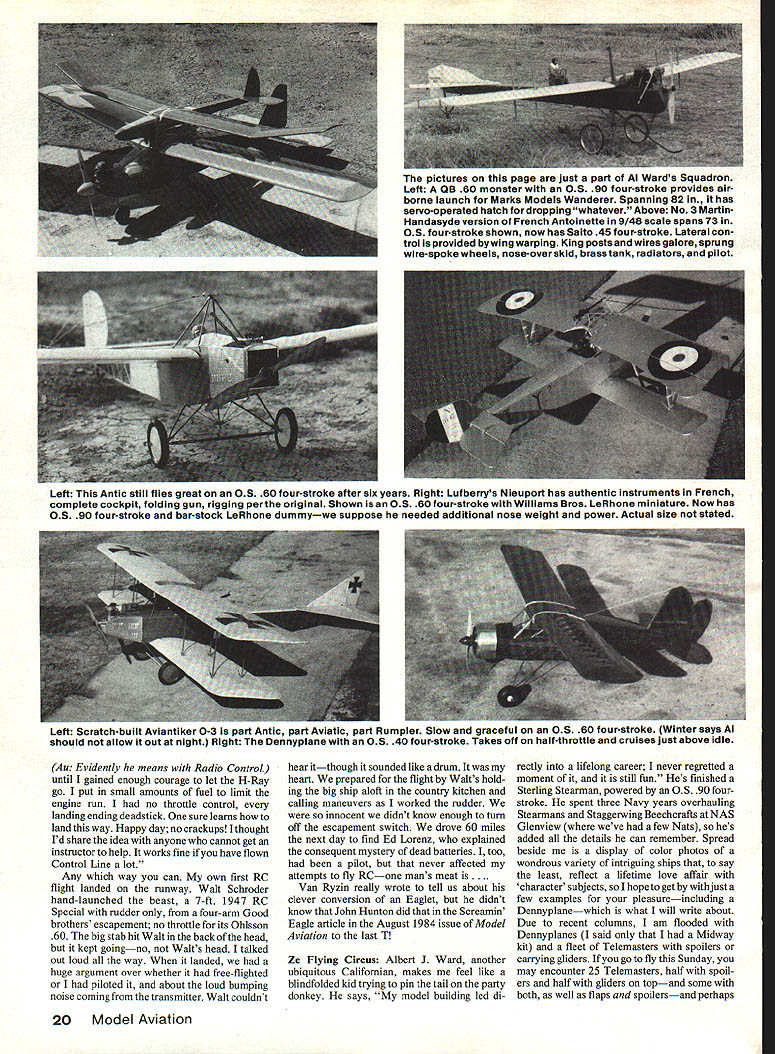
"If I flew Control Line Stunt and Combat well, so I took one of the 52-ft. cables and anchored it at the C.G. of the cabin, installed a cable guide at the end of the wing, and flew the H-Ray off a schoolyard parking lot like a C.C.W. Control Line. I used the spare tire of my car with an anchor line inside the cabin at C.G. I used a 3-in. mast and nail pivot, bricks as ground reference line, and a wing guide. The adapter located in the center of the wheel had a 1/4-in. pipe in the center for a 3/8-in. high broom-handle mast. On top of the mast I had an eight-penny nail so I could loop the Du-Bro line connector over it for a center pivot. I used stones for weight on the tire so it would not slip at high speed from the centrifugal force.
"I made hundreds of takeoffs and landings until I gained enough courage to let the H-Ray go. I put in small amounts of fuel to limit the engine run. I had no throttle control, every landing ending deadstick. One sure learns how to land this way. Happy day; no 'crackups'! I thought I'd share the idea with anyone who cannot get an instructor to help. It works fine if you have flown Control Line a lot."
Van Ryzin also wrote about a clever conversion of an Eagle, but he didn't know that John Huntoon did that in the Screamin' Eagle article in the August 1984 issue of Model Aviation to the last T.
Ze Flying Circus — Albert J. Ward
Albert J. Ward, another ubiquitous Californian, writes: "My model building led directly into a lifelong career; I never regretted a moment of it, and it is still fun." He's finished a Sterling Stearman powered by an O.S. .90 four-stroke. He spent three Navy years overhauling Stearmans and Staggerwing Beechcrafts at NAS Glenview, so he's added all the details he can remember.
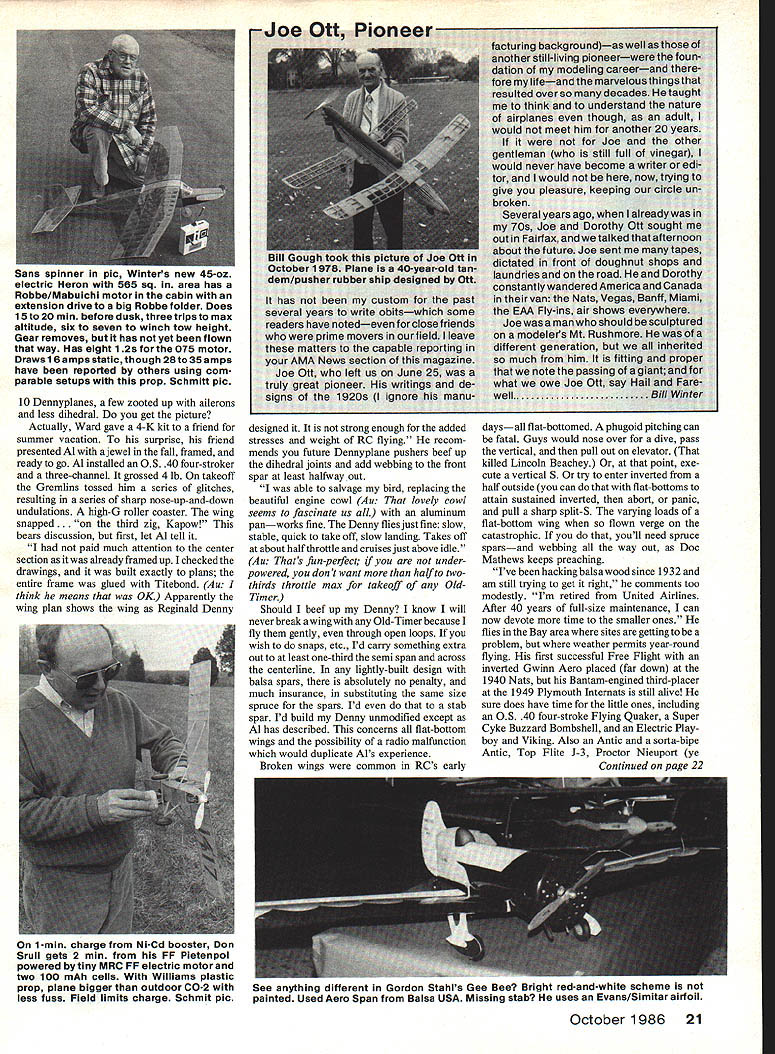
Spread before me was a display of color photos of a wondrous variety of intriguing ships that reflect a lifetime love affair with "character" subjects. A few examples include:
- a Dennyplane (which I will write about);
- a Flying Quaker with an O.S. .40 four-stroke;
- a Super Clyke Buzzard Bombshell;
- an Electric Playboy and Viking;
- an Antic and a sorta-bipe Antic;
- a Top Flite J-3;
- a Proctor Nieuport;
- Martin-Handasyde (like an Antoinette);
- a Falcon 56;
- Headmaster 40;
- QB 60 Monster;
- a Dennyplane Jr.;
- an original Bantam free flight;
- a 1/2A Mini-Hogan free flight;
- a rubber-powered Midwest Gollywock;
- a Comet Sparky;
- and a couple of Peanuts.
Ward gave a 4-K kit to a friend for summer vacation. To his surprise, the friend presented Al with a jewel in the fall, framed and ready to go. Al installed an O.S. .40 four-stroker and a three-channel system. It grossed 4 lb. On takeoff the Gremlins tossed him a series of glitches, resulting in sharp nose-up-and-down undulations—a high-G roller coaster. The wing snapped on the third trip. Al explains that he had not paid much attention to the center section; it was built exactly to plans and glued with Titebond. Apparently the wing plan shows the wing as Reginald Denny designed it, but it is not strong enough for the added stresses and weight of RC flying.
Al recommends beefing up dihedral joints and adding webbing to the front spar at least halfway out. He was able to salvage his bird, replacing the beautiful engine cowl with an aluminum pan—works fine. The Denny flies just fine: slow, stable, quick to take off, slow landing. It takes off at about half throttle and cruises just above idle.
Should you beef up your Denny? If you fly gently, as many Old-Timer fans do, you may never break a wing. If you wish to do snaps, etc., carry extra strength out to at least one-third the semi-span and across the centerline. In any lightly-built design with balsa spars, there is absolutely no penalty, and much insurance, in substituting the same-size spruce for the spars. I'd even do that to a stab spar. Build your Denny unmodified except as Al described. This concerns all flat-bottom wings and the possibility of a radio malfunction which would duplicate Al's experience.
Broken wings were common in RC's early days—all flat-bottomed. A plug-rod pitching can be fatal. Guys would nose over for a dive, pass the vertical, and then pull out on elevator. Or, at that point, execute a vertical S or try to enter inverted from a half outside; the varying loads of a flat-bottom wing when so flown were one catastrophe after another. If you do that, you'll need spruce spars—and webbing all the way out, as Doc Mathews keeps preaching.
Al says, "I've been hacking balsa wood since 1932 and am still trying to get it right." He is retired from United Airlines. After 40 years of full-time maintenance, he can now devote more time to the smaller ones. He flies in the Bay area where sites are getting to be a problem, but weather permits year-round flying. His first successful Free Flight with an inverted Gwinn Aero placed (far down) at the 1940 Nats, but his Bantam-engined third-placer at the 1949 Plymouth Internats is still alive!
Anecdotes and first RC flights
My own first RC flight landed on the runway. Walt Schroder hand-launched the beast, a 7-ft. 1947 RC Special with rudder only, from a four-arm escapement; no throttle for its Ohlsson .60. The big stab bit Walt in the back of the head, but it kept going—no, not Walt's head. I talked out loud all the way. When it landed, we had a huge argument over whether it had free-flight glue or I had piloted it, and about the loud bumping noise coming from the transmitter. Walt couldn't hear it—though it sounded like a drum. It was my heart. We prepared for the flight by Walt's holding the big ship aloft in the country kitchen and calling maneuvers as I worked the rudder. We were so innocent we didn't know enough to turn off the escapement switch. We drove 60 miles the next day to find Ed Lorenz, who explained the consequent mystery of dead batteries.
I, too, had been a pilot, but that never affected my attempts to fly RC—one man's rest is another's recreation.
The "Air Ocean" and the downwind-turn debate
Ken Willard once published someone's analysis claiming that a plane turning from upwind to downwind into a 180 will lose altitude. He had letters from all over the world. I can believe that from my own experience, and I'd bet most came from textbook theorists with no hands-on experience. Note that although the plane turned from an into-the-wind path to a downwind direction, Ken did not designate this as the infamous killer downwind turn, nor do I refer to the reference as only to the fact that a plane trimmed for cruise (at cruise power—or a glider, if you will) loses altitude when turning out of the wind and will regain it coming back into the wind (assuming it is hands-off stable and requires no interfering control inputs).
The debate largely divides into two camps: those who see the turning airplane as part of a drifting air mass—the "air ocean" theory—and those who emphasize inertia, momentum, or kinetic energy relative to the ground. The air-ocean proponents postulate that a turning airplane is part of a drifting air mass and is impervious to outside inputs. This view is often illustrated with an airliner in a 360 at altitude. But you'll never notice anything in either a one- or two-needle turn in a heavy fast airplane, since its airspeed relative to the wind it encounters is much greater than that of a model.
If the plane were impervious, its 360 would be a true circle; yet modelers often see elongated downwind legs and abbreviated upwind legs in a hands-off 360. "Hands off" means no control inputs are used. Entry requires the gentlest input—so let's assume the second 360 of a 720.
For years the pros said nothing about inertia or kinetic energy, which the cons claim is a factor. The cons argue that any moving mass will tend to continue in its already-established direction. This results, they say, in reduced airflow over the wing on the downwind portion of the circle, hence a lowered airspeed and a change in angle of attack, leading to the nefarious downwind-turn shenanigans that have caused many full-scale and model accidents.
An oversimplification: the key question is whether that kinetic energy is relative to the earth or, as others indicate, to the air. I prefer the latter interpretation.
An aside: I saw a good pilot bring a big Monocoupe over the fence against a strong wind, slightly dip a wing, and recover quickly into a nice go-round 360; then entering the approach again from downwind, it felt like a stone. The recovery 360, continued in the direction of the slightly dropped wing, was back over the fence out of a good wind and into the old approach path. He needed much more power, more airspeed, and a wider recovery pattern than what appeared adequate.
A reader wrote about his years-old Kougar doing the same thing; another lost his Stolp Starlet the same way. The common denominator: the dreaded downwind turn.
The opposing viewpoints will probably never be reconciled. Two aero engineers, high-time pilots, and expert model fliers pursued their debate to the bitter end. Each had access to top scientific organizations; each came up with at least six organizations that proved its cases and disproved the other's.
Ken published a thorough article that seemed to "settle" the matter and proposed a box-car thought experiment: imagine an indoor model flying 360s inside a box car moving down the track at the same speed as the wind. The model's airspeed and ground speed change relative to the moving car. Ken asks if the model climbs when going against the wind and loses altitude downwind as expected if kinetic energy is relative to the ground. The thought experiment begins to twist the mind.
My conclusion: the box car is an encapsulated box of air, and the model, being in that "chunk" of air, may not be subject to the full range of acceleration/deceleration that results from RC control inputs—pilot errors. Does the model inside the moving box know which is upwind and downwind within its moving, encapsulated chunk of still air? I don't know.
Kinetic energy involves mass and speed. If a flying machine had no kinetic energy—no tendency to remain in motion, to maintain direction, to resist changes in direction—the plane could not fly. The only flying machine that possesses no kinetic energy or airspeed is a balloon in zero wind stabilized at a fixed altitude.
Consider spin entries. An unintentional spin entry (usually a deadly snap) differs from an intentional spin entry, where the plane is slowed then, as the stall occurs, rudder is jammed in the direction of the wanted spin. The accidental spin can be entered "out of the bottom" or "over the top." Modelers say the wing on the outside of the circle is traveling faster and that, therefore, the spin is out the bottom as the slower-moving wing quits. Yet most snaps are over the top.
In training, an over-the-top entry is executed by maintaining a slightly banked, climbing turn. The top wing quits eventually, and your Cub will roll over the top, entering the spin to the right from what was a left climbing turn. I suspect the reason is that a tad of down aileron was required for the maintained left climbing turn, which is a wash-in condition, whereas the slower, lower wing, with its slight up aileron, was washout. Of course, if neutral ailerons were present, you probably would not see the over-the-top entry unless the plane were steeply banked and in a high-speed stall.
Every time I have seen a model snap under such conditions—such as an .09-powered little scale packed around when too far downwind—the pilot always yelled "interference."
"High-speed" and "secondary stalls" are unknown to the vast majority of modelers. Years ago when Cdr. Green mentioned the stall warning indicator, I interviewed him for Interavia. He had no idea of a partial stall in his Bonanza with recovery on the horizon. With plenty of power, level flight re-established, the ship feeling solid as it flew straight out at a good indicated airspeed, after a lapse of seconds the warning indicator intoned a series of tiny beeps. That plane was in the stall region. Obviously, still more power had been required.
Until one side or the other gives up, I am open-minded. When it comes to the air-ocean genesis of the debate, I know that my models do not conform—probably because competition structure and conditions are a necessary laboratory situation to be created. Hands on: no flying from a moving aircraft carrier or one "proof" recovery I read of in a story. In calm air, I've seen ships alike—loaded, low-powered craft—which perform 360s and even 720s hands-off with no changes in altitude. In a wind, they always lose altitude on the downwind side and regain it upwind; the flight circle then becomes a tilted disc. Proves nothing, I guess.
What I see easily in rubber models is that in a good breeze the wind strikes the underside of the plane as it begins its hoped-for 360; then with low power and a high-pitch prop, its climb is poor or nonexistent on the downwind leg; the prop slows down and seems to flail the air. Coming around into the wind, the plane will pick up—especially with a flat-bottom foil—which sometimes results in stalls and whip stalls. Lift appears tremendously magnified at this point.
If you fly rudder-only RC jobs, you know how you can lose them downwind out of sight—unable to penetrate after downwind turns. On the downwind portion of the circle, the sideways drift of my lightweight ship revealed the wind blowing against the top of the plane. Such changes show that the wind and airspeed are changing relative to each other at all points of the circle since wind relative to the wing is changing the angle of attack.
Is kinetic energy involved? All we know is that upon turning into the wind, a plane can slow abruptly and for some reason go into a climb or even a stall. As to the varying airspeed in a 360 with a model, I find that certain three-channel RC models are slow to respond to rudder on the downwind side—so much so that some can barely be brought back. Into the wind, rudder action is powerful.
I had two Gordon Light Rubber Commercials—a sport version of a Wakefield winner—which flew beautifully in a gentle wind. In a strong wind they always spiraled into the ground on the downwind segment of the circle. I added dihedral. The problem vanished. The Rebel or the G.L. model could then drift blissfully in the air ocean.
Suppose you are the wind. As the Gordon Light model banks in front of you, you see its top. The more dihedral it has, the more of the top wing you see and the less you see of the lower wing. With large dihedral you see a large expanse of the upper wing and little of the lower. With no dihedral and a vertical bank you see equal area of both upper and lower banked wings; the model will not roll out on its own. It is not drifting downwind at a speed to match your force (the wind). It is definitely not impervious to your influence.
From years of experience with Don Srull, I have learned to question nothing he says. He is a scientist par excellence, an experienced aeronautical engineer, and a constantly-winning modeler. I believe he is pro air ocean, and he cites Hewitt Phillips of NASA who did a definitive analysis. Hewitt is a genius whom I knew from his indoor days in the early Thirties. I cannot fully agree, but I think what I see in a lightweight turning out of the wind is precisely Hewitt's "gust" condition. In effect, my model has created its own "back of the gust" world when it turns and chases the wind. Turning into the wind, is it creating a gust-like environment head on? Its kinetic energy has to be converted into something.
What (really) is a downward turn, by the way? As Ken says, it's from downwind into upwind. It has killed hundreds of people and can kill your model if you go round, float and force it a bit, and don't bring up power more than you'd expect in a strong wind. Before the war, newly-schooled pilots and some commercial guys flew lightplanes over their homesteads or girlfriends' houses in a strong wind. They'd bank into the wind, gradually keep forcing the circle with rudder to see the house, simultaneously trying to flatten the bank with ailerons (cross controls), and they'd spin in. It was a terrible and mysterious problem until Leighton Collins explained it in Air Facts.
Argue among yourselves. Don't bother me with pros and cons. I share Willard's comment: "Hey, fellows, let's knock it off. Just let's say, some of you will lose altitude and some of you won't." I will go out on a limb: all planes drift downwind. Half-empty, half-full glasses—that's the air ocean, for models, anyway.
Bill Winter 4432 Altura Ct., Fairfax, VA 22030.
Transcribed from original scans by AI. Minor OCR errors may remain.

