
Just for the Fun of It: Plane Talk
Big Beginnings
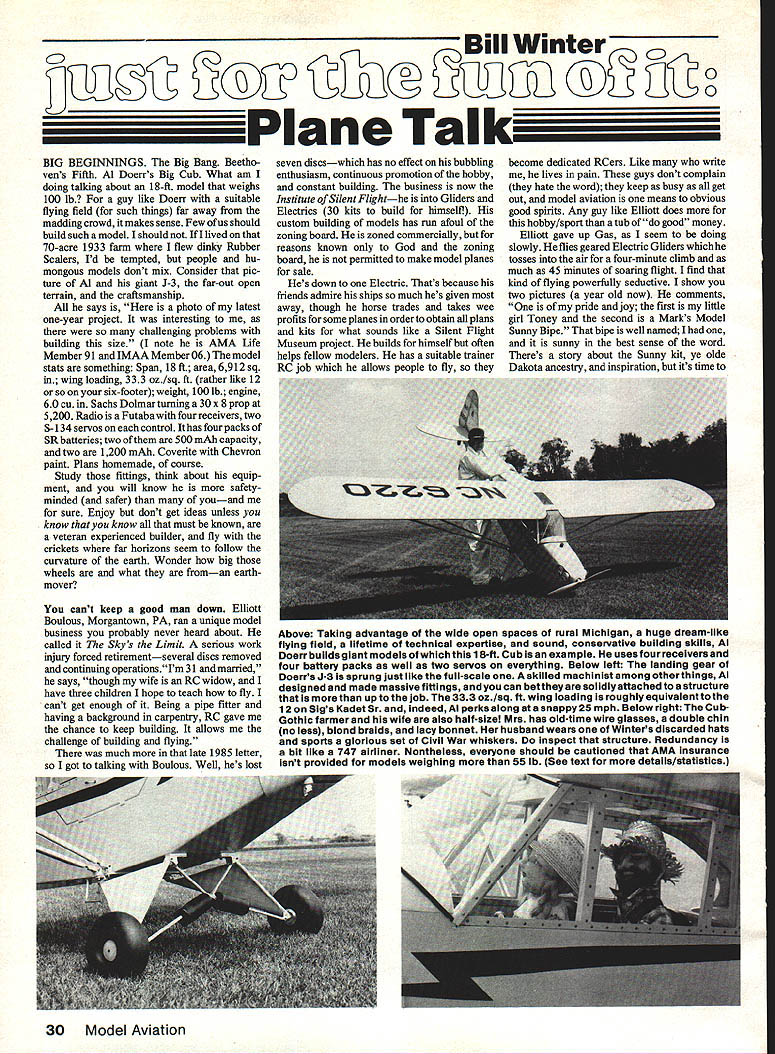
The Big Bang. Beethoven's Fifth. Al Doerr's Big Cub. What am I doing talking about an 18-ft. model that weighs 100 lb.? For a guy like Doerr with a suitable flying field far away from the madding crowd, it makes sense. Few of us should build such a model—I certainly should not. If I lived on that 70-acre 1933 farm where I flew dinky rubber scalers, I'd be tempted, but people and humongous models don't mix. Consider the picture of Al and his giant J-3, the far-out open terrain, and the craftsmanship.
Al says simply, "Here is a photo of my latest one-year project. It was interesting to me, as there were so many challenging problems with building this size." (He is AMA Life Member 91 and IMAA Member 06.) The model stats are something: span 18 ft.; area 6,912 sq. in.; wing loading 33.3 oz./sq. ft.; weight 100 lb.; engine a 6.0 cu. in. Sachs Dolmar turning a 30 x 8 prop at 5,200 rpm. Radio is a Futaba with four receivers, two S-134 servos on each control. It has four packs of NiCd batteries—two at 500 mAh and two at 1,200 mAh. Covered with Coverite and Chevron paint. Plans homemade, of course.
Study those fittings and think about his equipment, and you'll know he's more safety-minded (and safer) than many of you—and me for sure. Enjoy the picture, but don't get ideas unless you truly know everything necessary, are a veteran experienced builder, and fly where far horizons seem to follow the curvature of the earth. I wonder how big those wheels are and what they came from—an earthmover?
Elliott Boulous and The Sky's the Limit / Institute of Silent Flight
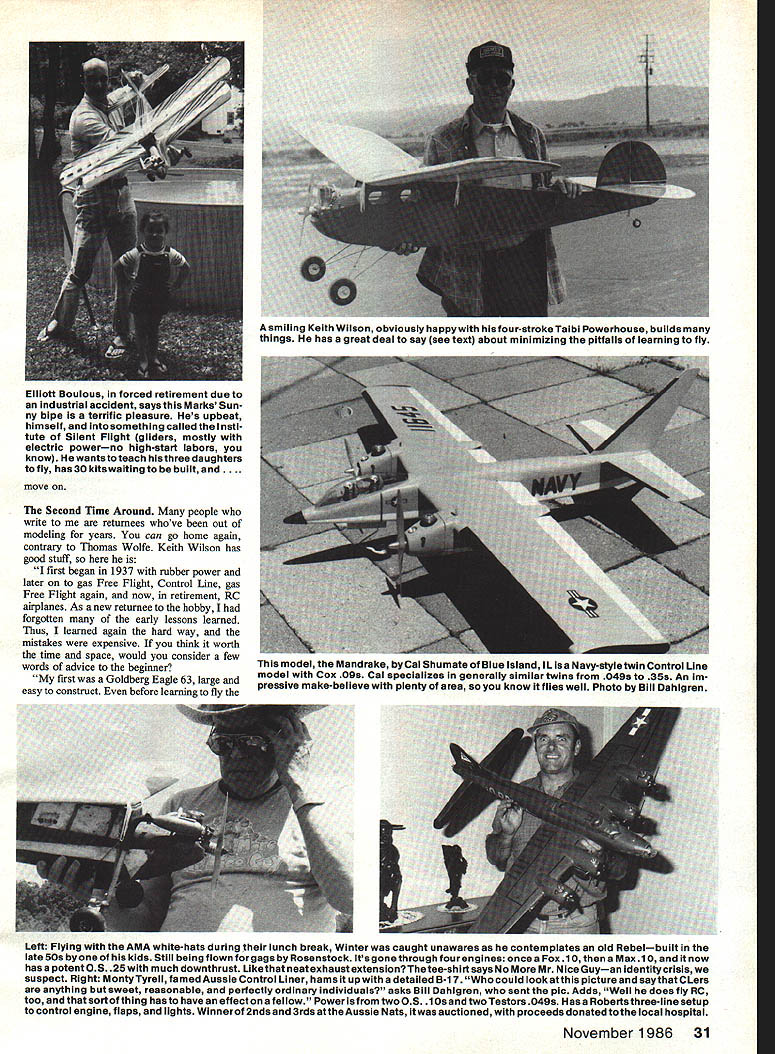
You can't keep a good man down. Elliott Boulous, Morgantown, PA, ran a unique model business you probably never heard about. He called it The Sky's the Limit. A serious work injury forced retirement—several discs removed—but it hasn't dimmed his enthusiasm. "I'm 31 and married," he said in a letter, "though my wife is an RC widow, and I have three children I hope to teach how to fly. I can't get enough of it. Being a pipe fitter and having a background in carpentry, RC gave me the chance to keep building. It allows me the challenge of building and flying."
Elliott later changed the business name to the Institute of Silent Flight and concentrated on gliders and electrics—about 30 kits to build for himself. Custom building ran afoul of the zoning board: although zoned commercially, he was not permitted to make model planes for sale. He gave away many of his ships because friends admired them so much, though he did horse-trade and took small profits on some. He builds to order, obtains plans and kits, helps fellow modelers, and runs a trainer RC job that gets people into the hobby.
Like many who write to me, Elliott lives in pain but doesn't complain; he keeps busy and cheerful. He gave up gas some time ago and now flies geared electric gliders: toss them in the air for a four-minute climb and enjoy as much as 45 minutes of soaring. It's a seductive kind of flying. He sent photos—one of his pride and joy and one showing his little girl Toney with Mark's Sunny biplane (the Sunny is well named). There's a story about the Sunny and its Dakota ancestry inspiration, but that's for another time.
The Second Time Around
Many people who write to me are returnees who've been out of modeling for years. Contrary to Thomas Wolfe, you can go home again. Keith Wilson has good advice from his return to the hobby:
"I first began in 1937 with rubber power and later moved on to gas free flight, control line, gas free flight again, and now, in retirement, RC airplanes. As a new returnee to the hobby, I had forgotten many of the early lessons learned. Thus, I learned again the hard way, and the mistakes were expensive.
"My first RC was a Goldberg Eagle 63, large and easy to construct. Even before learning to fly the Eagle with an instructor, I built the New Era 40 by Airtronics with multicolored covering, pinstriping, a hand-painted pilot, and other fancy details. The Eagle was covered with white and plum-colored MonoKote—colors easily lost in our high sky area. As a result, the Eagle crashed. During the rebuilding period, flight instruction stopped cold.
"The New Era was test-flown by club experts, but to this date I have not flown it—the flight characteristics were beyond my skill. I rebuilt the Eagle without cabin windows, engine covering, hand-painted pilots, or pinstriping, but with colors that are easy to see in any sky. Flight training began again—this time with success. Although I have since built a Midwest Super Sweet Stik 60 and a Champion 84 Powerhouse, I still return to the Eagle 63 to practice basic flight patterns.
"My building skills are about average. Building for the sake of building is not my goal; building and flying what I build without embarrassment is. In reviewing my many mistakes, I have come to the following conclusions:"
- Establish your goal in model aviation—building, flying, or a combination of both.
- For first-time airplanes, build large (60 to 70 in. wingspan) cabin, high-wing, flat-bottom airframes. If you can afford it, build a second airplane similar to the first as soon as the first one is finished. If the first crashes, the second is ready and instruction is not interrupted.
- Build for neatness and accuracy but avoid excessive finishing details (multicolored covering, hand-painted pilots, etc.).
- Before covering the airplane, visit the flying field and watch club members' airplanes in the air. Select covering colors that are easy to see.
- Talk to the flight instructors in the local club and plan to work with the one who best suits you. Set aside continuous time for flight instruction with short gaps between sessions.
- During construction of the first airplane, read books and articles by experts, ask questions of local club members, and make notes on techniques that solve construction problems best.
- Glenn Jarvis, the instructor who helped me most, eliminated the mental gymnastics of determining "right" and "left" when the airplane is approaching or departing. He suggests that when leveling the wings in flight, think only "low wing" and "high wing." As the airplane is coming toward you, push the aileron control toward the low wing to level it; if it is going away, push the aileron control toward the high wing. No more frantic shouting of "right" or "left."
Keith is a member of the Hemet (CA) Model Masters.
More Adventures with the Iron Bird
Forgive me; I should be passing on wonderful contributions and photos you really want to see and read about. Instead I talk about wacky stuff: the 100-in. RC Special, my new Desperado (a surprise from Bill Evans), or the Purple Plan I Kadet Sr. My scattered, extended family sends airline tickets with a command: "Come." This time it was a daughter who picked up a master's in philosophy, a son who got one in literature, and an old man (me) who left New York years ago with a flock of old escapement jobs given to Norm Rosenstock.
Norm and I have a tradition: we take two folding chairs, fly two or three Old-Timer models, and yak all afternoon about crazy models and flying deeds from the age of chivalry. We flew a Rebel built by Norm's son in high school in the '50s (originally with a Fox .10, later a Max .10). Norm had an O.S. .25 and believed in planning ahead—so the throttle was stuck and the throttle servo spun wildly. The solution: fly it wide open, no ailerons, no engine control.
A small hobby shop guy pointed us to a bulldozed spot in the pine barrens—an L-shaped paved runway, no one in sight. Windy, man. Up and out to pinpoints—the limit only when the plane vanished. Once the antenna hadn't been screwed in—an impromptu range test. Circling low and holding down, the Rebel developed such head of steam that I got dizzy and fell over a chair. Norm, thwarted by crosswind, did a wild cartwheel at our feet, flat and skittering. Put the tires back on and fly again. The Rebel survived; so did its ancient brothers.
We flew rudder-only at times. The old birds are beaten-up relics: Du-Bro wheels treadless and oil-soaked, engines replaced multiple times, yet they do touch-and-goes and remain acrobatic. People ask, "How can an airplane fly without elevators?" Climb is a power function. We both take flying seriously—some of Norm's giants include a 12-ft. low-wing Aeronca. He checks his big birds after every flight. Flying will never get better than a day with a funky relic in a clearing in the piney woods.
AMA, Old Timers, and a Day at Frederick
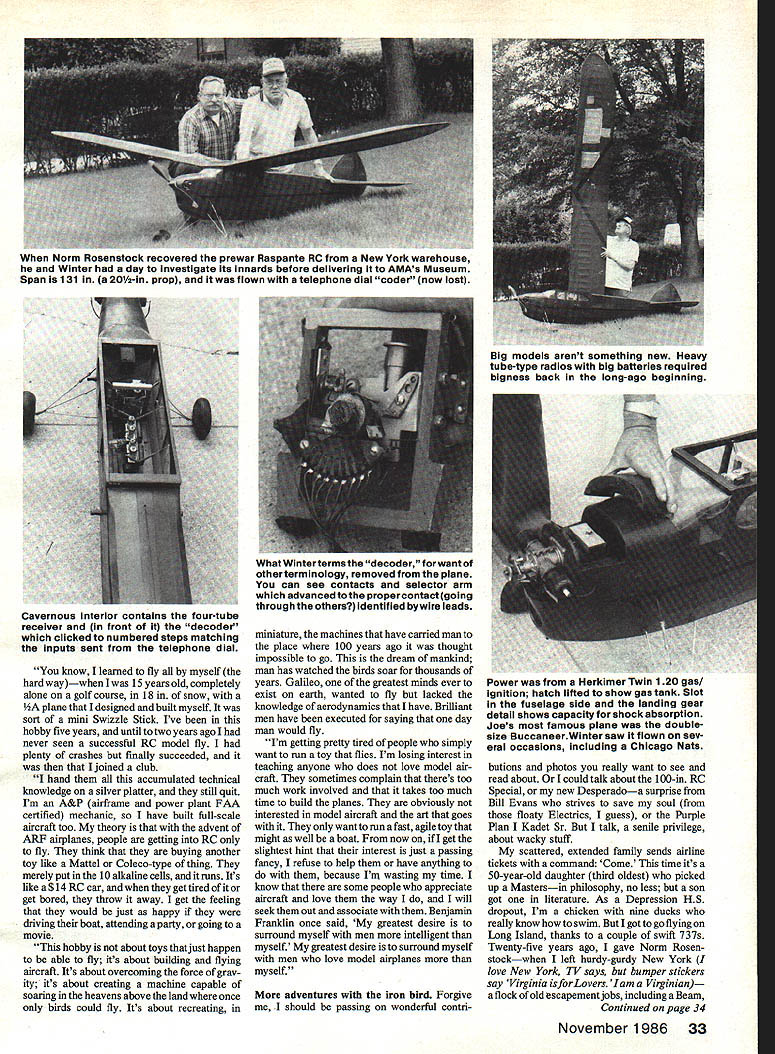
Until recently, another Raspante giant sat in a warehouse belonging to a Long Island aviation museum; John Roth's Volksplane (second place at the 1972 RC Scale World Champs at Lakehurst) was stored there as well. Norm swung a deal to have our museum show these historical machines, which gave us an excuse to bug each other and head for AMA HQ. We shot a roll of film in the hot Washington sun—only to discover the camera was empty. Saved from heat prostration and dehydration by my better half, we repeated the shots with film.
At AMA it so happened that old timers Frank Ehling, Frank Tlush (whose engine competed with the Brown Jr.), and free flighter Mike Granieri arrived simultaneously. Tlush displayed many plush engines dating back to the '30s—definitely worth seeing. We had a bull session to end all bull sessions. AMA taped part of it—better than Laurel and Hardy.
Then a day at Frederick where we hoped to show Norm and Bill Kauff how my electric-powered Heron flies. You need a big field to get airborne, but once up the Heron is a strong little flier and its glide is superb. After some lost beer flights, we ended up flying Benton rubber-powered models with geared front ends—quite stable out of the box.
AMA guys often fly on lunch breaks at a nearby field, so Norm and I joined them. Doug Pratt brought my Krackerjack and the Rookie. Also present was a Flyline Inland Sport with a funny squared-off cylinder diesel that ran like a clock but was underpowered. John Worth had my LeCrate with twin .035s on a horizontal nose pylon. I showed off the new Heron. At 17 minutes into the flight, Doug had a date with a line of trees and needed three re-rounds to get out of that scrape. Bob and I made a last flight with the Rebel. We all knelt, faced the sun and the machines, and had ourselves a fine time.
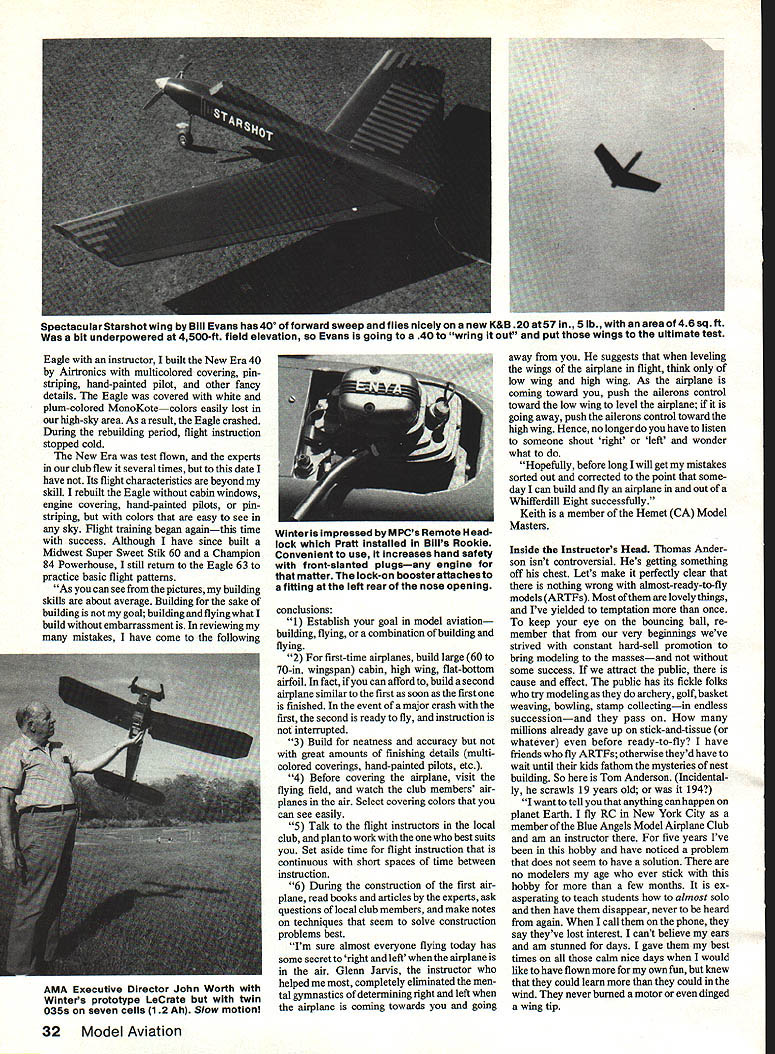
If you saw my Rookie article in Model Builder, you know I cautioned about operating engines with front-facing plugs; on wide-open, high-power outsides they tended to roll out. Doug Pratt made a useful change—a headlock (by Model Products Corp.) designed for remote boost that takes lock-on small Ni-Cd boosters. It's a better approach for many models.
The Red Rebel was built by one of my kids in the '50s. I fly seldom now, so it was mighty pleasant and strange to watch old birds out of their cages. One bystander had been looking for six months for someone to help test-fly his Hobby Horn Sky King (an Old-Timer revived by Doc Mathews). It had an Astro .05 Cobalt and, I think, six or seven 1.2 cells. No wonder the Sky King is so popular—smooth and stable, like a rock while surfing the wind.
We managed to lose Norm's van and his wallet at one point. If this column ever gets finished, it will be a miracle of modern science. The End.
Bill Winter 4432 Altura Ct., Fairfax, VA 22030
Transcribed from original scans by AI. Minor OCR errors may remain.

