
Just for the Fun of It: Plane Talk
Bill Winter
PICTURE A WORLD without magazines. Would the "hobby" exist? You'd have to say no, but the answer is yes. It would thrive. There would be clubs, contests, and many companies—most of them tiny, it's true, but some would be giants. And out of that would come magazines and spiraling growth. It has happened before, beginning with pre-1910 clubs and items in passing Aero magazines, long gone.
Suppose you acquire your first model plane in 1986. No one in your town has one, and except for a tiny ad in some general magazine and a catalog, there is no evidence that yours is not the only model in the world. It may be two years before you see anyone else with a model. If in 1986 you are 16 and you made your model only two years ago, it will be 59 years before you will see a photo of "your" model built by another. If you are 38 (AMA average age), and you built that model 24 years ago (in 1962), it will be 37 years before you see such photos. If you are 60 and you built that model 46 years ago, you won't see a photo of the same model for another 14 years.
My first model was an Ideal EveryBoy's Monoplane. I'd seen it in Popular Mechanics in an ad by Ideal with a sketch of a Jenny or a DH-4. The great bull-nosed radiator of the DH-4 (the Smithsonian has a full-scale one) still awes me. The price was $7.50 and, of course, I wanted one. To my father in that spring of 1927 $7.50 was major money, so when I graduated from grade school he gave me the EveryBoy's Monoplane instead; it cost a precious $6.50, but it was a marvelous thing—a triumph of kit engineering in some ways never equaled.
The kit included numerous prefab aluminum parts, a lovely 10-in. Paulownia wood prop, good ball-bearing shaft assembly, nice rubber-tire wheels, bamboo paper covering, and dope (I believe banana oil—that you could buy at old-fashioned hardware stores). The model was far overpowered; the finest rubber gave rope. Kits were complete in those days because they had to be. Where in tarnation could anyone find all those supplementary items that, today, would comprise a long list on the label?
After supper I went off to play ball. My father, for whom this thing was the Eighth Wonder of the World, assembled and covered the EveryBoy's before I got home at 10 o'clock. It even had rigging wires, king post and turnbuckles to take up slack and true the rigging—what a job. The next day we flew it (I tried to fly it, I realize now).
Flying instructions were a short paragraph. No mention of CG (what was that?) or how to bend elevators. Consequently it took us a year and many models to even find out rudimentary factors. No model magazines then; he didn't discover American Boy until 1929, the year MAN (Model Airplane News) was introduced. But a gas model had flown in 1904, and before he was born people flew rubber jobs as much as 2,000 ft. That was a communications problem.
The Ideal EveryBoy's Monoplane — Kit Features
The EveryBoy's kit was well thought out for construction and included many clever features. Its contents and notable parts included:
- Prefab aluminum cowling and radiator
- Aluminum sleeves for wing spars
- Paulownia (10-in.) propeller
- Ball-bearing shaft assembly
- Rubber motor and retaining hardware
- Rubber-tire wheels
- Bamboo paper covering and dope (banana oil)
- Brass/aluminum fittings, rigging wires, king post, turnbuckles
- Numerous wooden sticks, ribs, and bulkheads (basswood rather than balsa)
Selected Assembly Instructions (condensed)
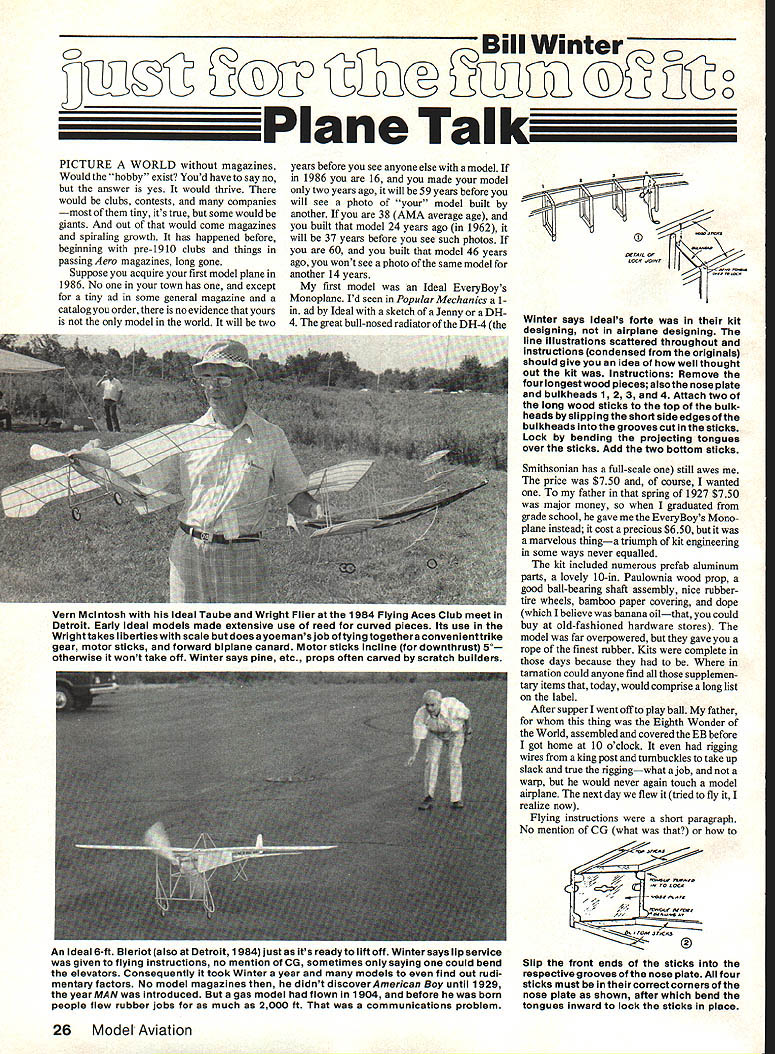
- Remove the four longest wood pieces, the nose plate, and bulkheads Nos. 1–4.
- Attach two of the long wood sticks to the top of the bulkheads by slipping the short side edges of the bulkheads into the grooves cut in the sticks. Lock by bending the projecting tongues over the sticks. Add the two bottom sticks.
- Slip the front ends of the sticks into the respective grooves of the nose plate. All four sticks must be in their correct corners of the nose plate, after which bend the tongues inward to lock the sticks in place.
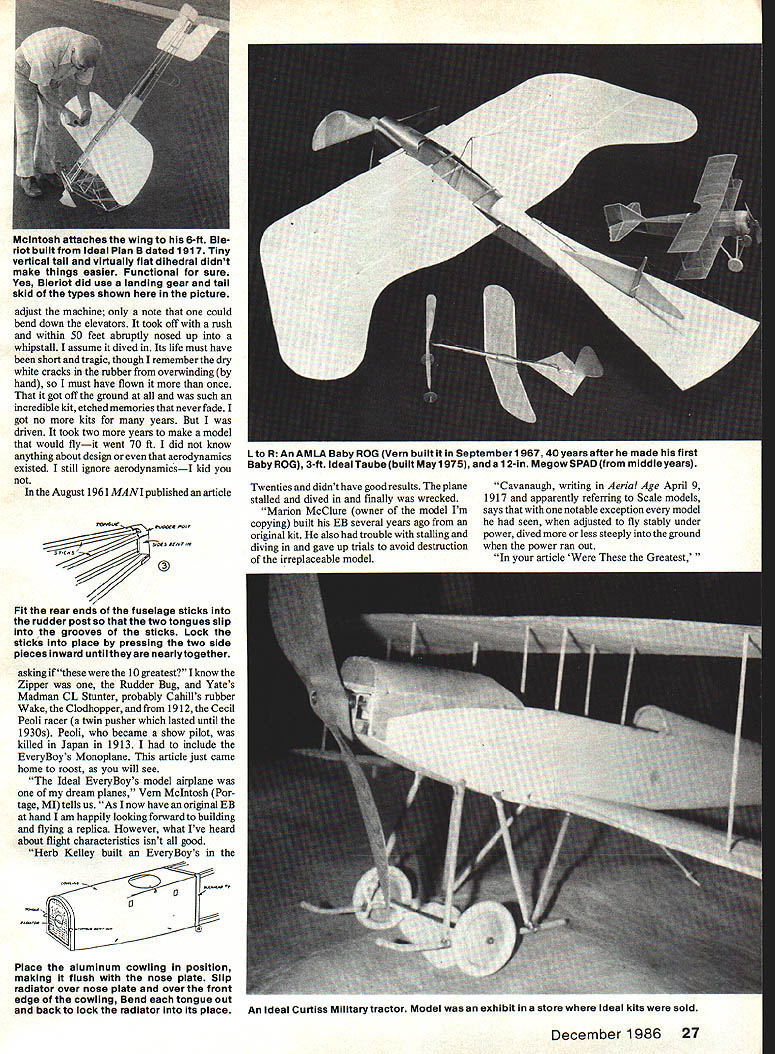
- Fit the rear ends of the fuselage sticks into the rudder post so that the two tongues slip into the grooves of the sticks. Lock the sticks into place by pressing the two side pieces inward until they are nearly together.
- Place the aluminum cowling in position, making it flush with the nose plate. Slip the radiator over the nose plate and over the front edge of the cowling. Bend each tongue out and back to lock the radiator into its place.
- Slip the two aluminum sleeves that hold the wing spars into place from inside the cowling. Bend the projecting tongues on the ends down flush with the cowling to lock the sleeves into position.
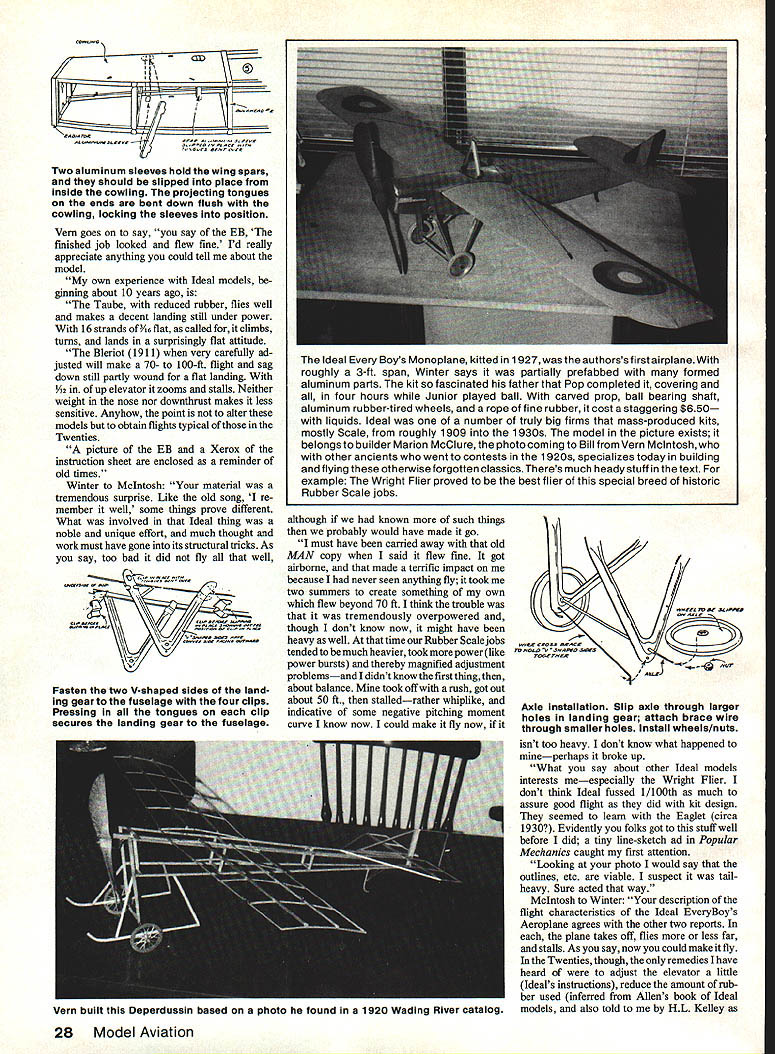
- Mount the mast over the hole in the cowling using the special mast clips and bend the tongues over as done on the landing gear.
- Thread the propeller shaft through the slotted opening in the nose plate. Remove the rubber motor from the box but do not remove the rubber bands that hold the strands together. Turn the model upside down and let the rubber strands slip through the openings of bulkheads Nos. 1, 2, and 3, attaching one end to the hook on bulkhead No. 4 and the other to the prop-shaft hook.
- Slip the prop onto the shaft with the name "Ideal" facing front. Install the nut and washer and tighten. The prongs should fit snugly against each side of the prop hub to prevent the prop from turning on the shaft.
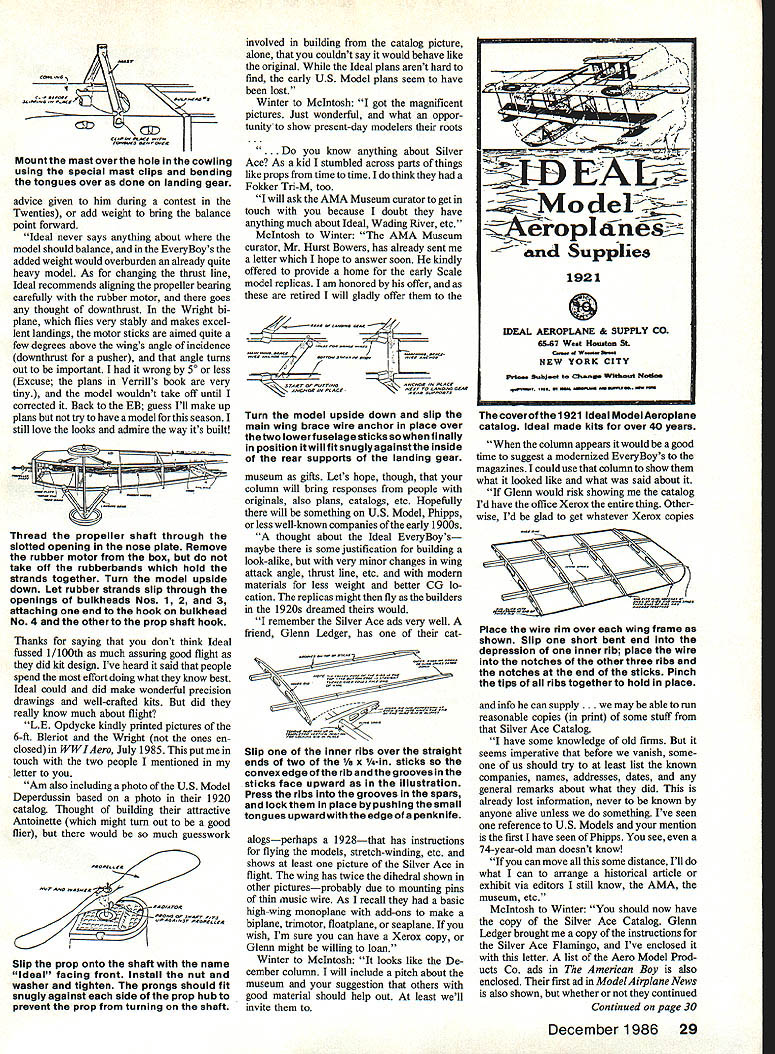
- Turn the model upside down and slip the main wing brace wire anchor in place over the two lower fuselage sticks so that when finally in position it will snugly against the inside rear supports of the landing gear.
- Slip one of the inner ribs over the straight ends of two of the 1/8 x 1/4-in. sticks so the convex edge of the rib and the grooves in the sticks face upward. Press the ribs into the grooves in the spars and lock them in place by pushing the small tongues upward with the edge of a penknife.
- Place the wire rim over each wing frame as shown. Slip one short bent end into the depression of one inner rib; place the wire into the notches of the other three ribs and the notches at the ends of the sticks. Pinch the tips of all ribs together to hold in place.
- Stabilizer: Join the three narrow ribs to the short wood stick. Let the two side edges of each rib fit into the grooves in the stick and lock the ribs in place by bending over the projecting tongues.
- As with the wing, slip the wire into the notches in the ribs and stick. Pinch these notches together to hold the wire in position. Slip the clamp up on each side of the center rib and lock in place with the tabs.
- Slip the split-clip at the lower part of the rudder through the slot in the back of the rudder post, and bend the projecting tongues of the clip back against the sides of the rudder post, first one side and then the other.
No balsa was used in many early kits; basswood was common.
Early Flight Characteristics and Reports
Several reports and letters regarding the EveryBoy's flight characteristics indicate a recurring problem: the model often took off well, climbed, then stalled and dived when power diminished. Reports include:
- Vern McIntosh (Portage, MI): He has an original EveryBoy's and plans to build and fly a replica, but notes that what he's heard about flight characteristics isn't all good. He cites experiences by others:
- Herb Kelley built an EveryBoy's in the Twenties and had poor results: the plane stalled, dived, and was wrecked.
- Vern McClure (owner of the model McIntosh is copying) built his EB several years ago from an original kit and also had trouble with stalling and diving, giving up trials to avoid destroying the irreplaceable model.
- Cavanaugh, writing in Aerial Age (April 9, 1917), apparently referring to scale models, said that with one notable exception every model he had seen, when adjusted to fly stably under power, dived more or less steeply into the ground when the power ran out.
Vern continued with comparative notes on other Ideal models:
- The Taube, with reduced rubber, flies well and makes a decent landing still under power. With 16 strands of 5/8 flat as called for, it climbs, turns, and lands in a surprisingly flat attitude.
- The Bleriot (1911), when very carefully adjusted, will make a 70- to 100-ft. flight and sag down still partly wound for a flat landing. With 1/2 in. of up elevator it zooms and stalls. Neither weight in the nose nor downthrust makes it less sensitive. The point is not to alter these models but to obtain flights typical of those in the Twenties.
A picture of the EveryBoy's and a Xerox of the instruction sheet were enclosed as reminders of old times.
Winter's Response and Reflections
Bill Winter to McIntosh:
- Winter was surprised and delighted by McIntosh's material. He acknowledged that his own recollection ("I remember it well") may have been carried away—he had said the EveryBoy's "flew fine" because it got airborne, and that made a terrific impression on him since he had never seen anything fly. He notes that his model may have been tremendously overpowered and possibly heavy, and that early rubber-scale jobs tended to be heavier and took more power, magnifying adjustment problems. He suspects his EveryBoy's may have been tail-heavy. If the model still exists he might make it fly now.
McIntosh to Winter:
- McIntosh agreed with the reports: the EveryBoy's takes off, flies somewhat, then stalls. In the Twenties, remedies known then were adding incidence or increasing wing area. Ideal's instruction to reduce the amount of rubber (inferred from Allen's book and told to McIntosh by H.L. Kelley) doesn't help much: reducing rubber reduces climb but doesn't cure the stall.
McIntosh suggested building a look-alike with very minor changes to wing incidence and thrust line and using modern materials for less weight and better CG location; such replicas might then fly as builders of the 1920s remembered.
Other Early Firms, Catalogs, and Research
L.E. Opdycke printed pictures of a 6-ft. Bleriot and the Wright in WW I Aero (July 1985), which helped connect Winter with people involved in early models.
McIntosh mentioned the U.S. Model Depewdrum (from a 1920 catalog) and the attractive Antoinette, but noted that building from a catalog picture alone would involve guesswork. Early U.S. Model plans seem to have been lost.
McIntosh and others have found and are collecting material:
- The AMA Museum curator, Hurst Bowers, offered to provide a home for early scale model replicas.
- McClure has a large collection of excellent Ideal scale models—one original and several built from original kits.
Hertz (author of a book on model companies) did good early work documenting White (U.S. Model) and Ideal, using catalogs. He lists better-known companies of the late Twenties and Thirties but omitted many lesser-known firms. McIntosh and Winter both stress the urgency of recording company names, addresses, dates, and remarks while people are still alive who remember them.
Compiled Lists and Historical Work
Winter and his associates have compiled several lists and resources:
- A list, by company, of model plane ads in The Aeroplane from 1924 through 1933, with date and page number; 47 companies listed.
- A trial run list of ads from Model Airplane News covering the first year (1929), by company, with extensive notes; about 90 companies, 23 of which also advertised in The American Boy.
- A list of about 90 names drawn from John Pond's catalogs (not yet checked against other lists).
Additional work and resources:
- Glenn Ledger obtained microfilms of The American Boy (1924–1934) and Model Airplane News issues, aiding the compilation of ads and historical references.
- A list, by author and title, of books on model aviation from 1909 to about 1929 (with later books included if they had material on early models) has been assembled from catalogs, references, and ads.
- Old catalogs (Wading River, White, etc.) are valuable sources of information but originals are scarce. Xeroxes and reprints are often used for study.
- Winter collaborated on an article, "There Were Giants in Those Days," for Model Retailer, drawing on Hertz and conversations with Charlie Grant, who recalled companies that turned out as many as 300,000 ready-to-fly models yearly from 1920 to 1930.
Reflections on the Hobby's Growth and the Need for Preservation
Modeling today is unified thanks to many great magazines. In the old days the left hand did not know what the right hand was doing. It is possible that Ideal, White, Wading River, and perhaps a dozen others sold millions of kits—basswood, bradded (nailed) together (no glue), bamboo, reed—basically similar for about 20 years (from, say, 1909). By 1920 Grant was using balsa wings—200,000 RTFs (ready-to-fly) a year. Two different cultures seldom crossed.
In the late Twenties, American Boy tied in with the Aeroplane Model League of America (AMLA's predecessor) and had over 300,000 members. There were contests and Nationals, fine flying teams, and modelers met in the field at fairs. Lindbergh flew the Atlantic, and one result was Bernard MacFadden's start-up of Model Airplane News—the fission point. According to the Rockefeller Foundation there were 2,000,000 of us (Air Youth) in the Thirties. What sparked Air Youth was the masses of modelers created across the nation by Hearst newspapers' Junior Birdmen and Scripps-Howard papers' Junior Aviators. Lindbergh turned on the world—model and full-scale.
When all these things came together, reinforced by magazines like Flying Aces and Air Trails (which had a larger audience than all of our current magazines combined), white-hot progress became commercially a fact of the day: the age of the giant kit companies.
They are almost all gone now. Winter recalls pioneers such as Ray Arden (flying a gas model across Van Cortland Park in 1904), Merrill Hampson, Jim Walker, Joe Ott, and those still with us—Charlie Grant and Bert Pond. He questions whether anyone will salvage our history and urges readers and modelers to care.
Bill Winter 4432 Altura Ct., Fairfax, VA 22030
Editor's Note
This is the last of Bill Winter's "Plane Talk" columns. Bill has already written a number of pieces to this effect, and as news spreads like wildfire, these words may sound familiar.
He has reached the stage of life where he does not enjoy meeting deadlines or keeping files in sufficient order to draw from them for column material. To put it in a nutshell, he wants a rest.
We have wondered if he will be happy not doing his life's work—writing and/or editing for the enjoyment of others—and we have suggested the possibility of continuing the column on an irregular basis. He said no, though we remain ready to consider alternatives.
If this column is to be no more, which seems to be the case, readers should not mourn its passing. Instead, be grateful for all the pleasure Bill Winter has provided us for so many years.
Carl Wheeley Editor and Publisher
Transcribed from original scans by AI. Minor OCR errors may remain.

