

WHY THE 1/4‑SCALE ARISTOCRAT
Another impulse! There is always one plane that is never to be forgotten. I always dream of planes to build, but they remain fantasies. I build things I never thought about — the subconscious at work. Buried in some pigeonhole of my mind was a dim memory of a long‑ago 9‑ft. rubber‑powered Cessna (1920s), the prop carved from a 24‑in. balsa 2×4. It took two of us to manhandle it — one row of knots of sliced inner‑tube rubber — no winder and no stretching. Tissue‑covered, the Cessna skimmed aloft, never above 6 ft., a slow‑motion Jumbo‑Jumbo, only to land gloriously in a blackberry patch. One flight — but Lindy was happy with one flight.
When the Aristocrat flew "off the board," it was as if a desk‑bound environmentalist went backpacking to see bees and bears and came upon the "Lost Ark." That airplane is more indelible now than my first model I got to fly, my solo in a J‑3, or any magazine I ever edited. It made me a "mixed‑up kid." The learning experience outweighed all others combined. I had gone from ROGs to twin‑pushers, to fuselages, pushers to tractors, Rubber Scale to Gas, Free Flight to Control Line, through CO₂, Jetex, Payload, Wakefield, scads of playthings like the Dakota, and finally to Radio Control, which would take more courses than the Mississippi Delta. Probably only a home‑builder of full‑size planes who gets to fly his lovely Pietenpol, et al., knows such feelings.
An airplane so big, so realistically mimicking its historical prototype, is not a model in the usual sense. I don't know what it is. It is real, but you can't ride in it, though you feel you do sometimes. I don't wish to inspire or even suggest — you'll see.
Kit, build and helpers
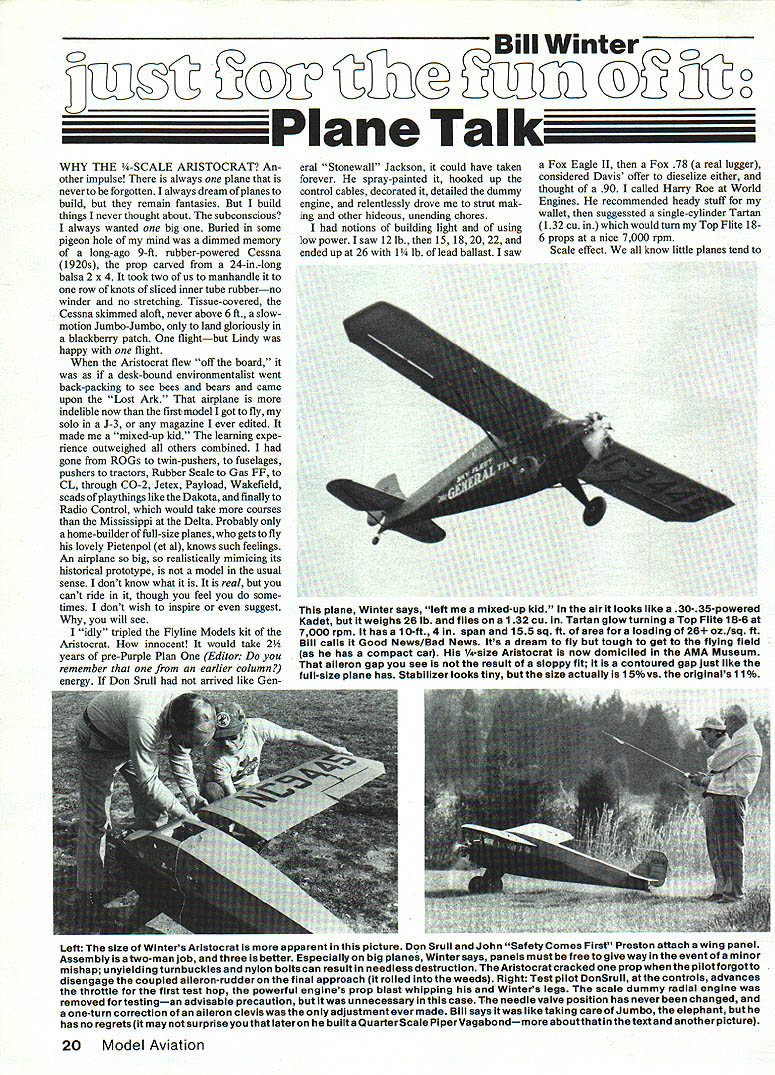
I idly tripled the Flyline Models kit of the Aristocrat. How innocent! It would take 2½ years of pre–Purple Plane One energy. If Don Srull had not arrived like General "Stonewall" Jackson, it could have taken forever. He spray‑painted it, hooked up the control cables, decorated it, detailed the dummy engine and handled other unending chores.
I had notions of building light and using low power. I saw weights of 12 lb., 15, 18, 20, 22 and ended up at 26 lb. with 1¼ lb. of lead ballast. I considered engines in this sequence:
- Fox Eagle II
- Fox .78 (a real lugger)
- Davis' diesel conversions
- possible .90s
In the end I called Harry Roe at World Engines. He suggested expensive hardware, then recommended a single‑cylinder Tartan (1.32 cu. in.), which would turn Top Flite 18‑6 props at a nice 7,000 rpm.
Scale effect and handling
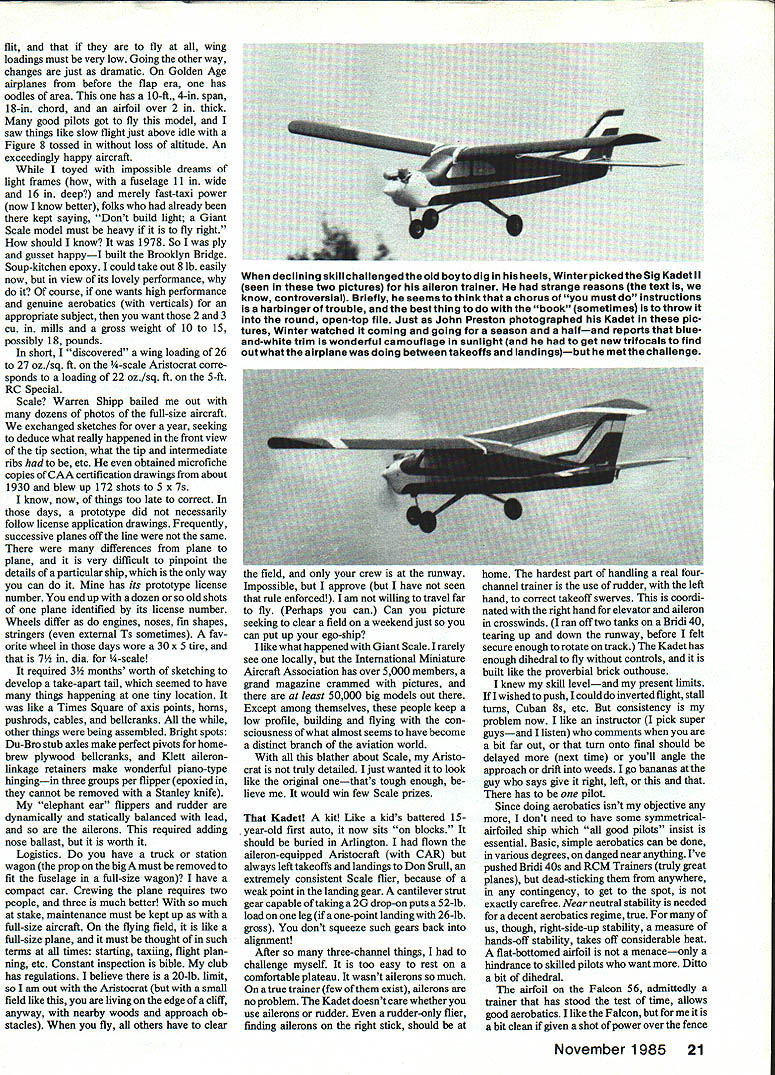
Scale effect — we all know little planes tend to be left‑size, but giant‑scale ships have their own demands. Assembly is a two‑man job, and three is better. Especially on big planes, panels must be free to give way in the event of a minor mishap. Unyielding turnbuckles and nylon bolts can result in needless destruction; the Aristocrat cracked a prop when a pilot forgot to disengage the coupled aileron‑rudder on final approach and rolled into the weeds.
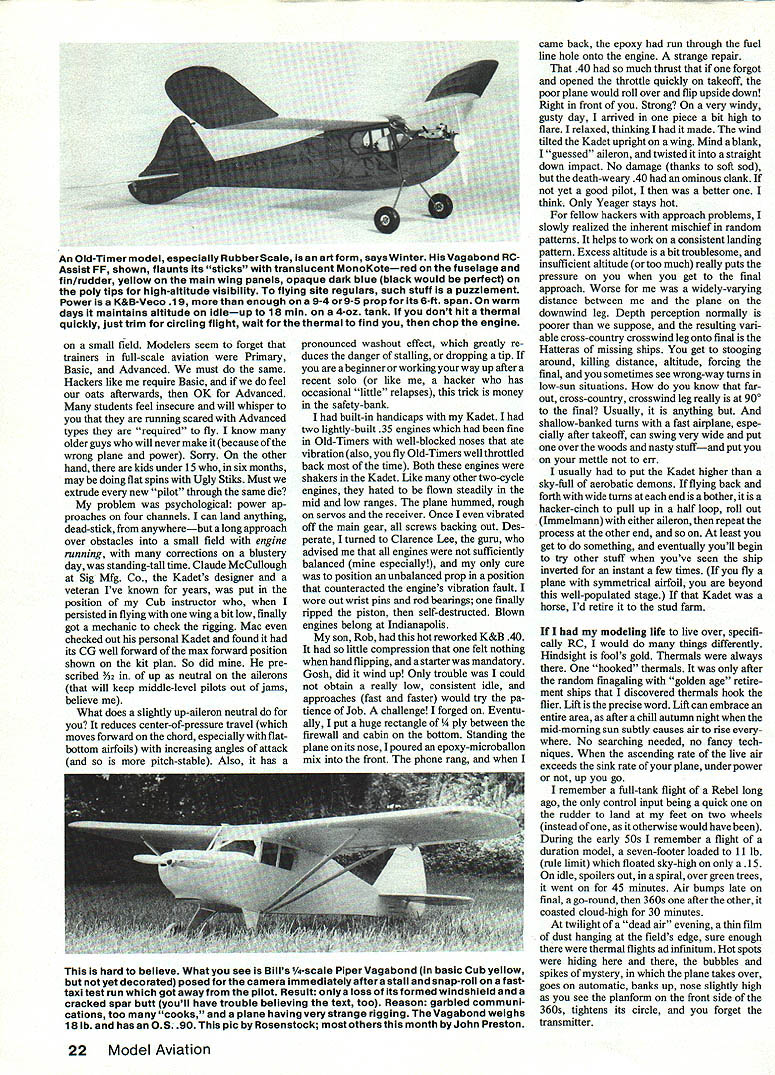
Test pilot Don Srull advanced the throttle for the first test hop. The powerful engine's prop blast was whipping Winter's legs. The scale dummy radial engine was removed for testing — an advisable precaution, though in this case unnecessary. The needle‑valve position has never changed; a one‑turn correction of an aileron clevis adjustment is the only control tweak ever made. Bill says it was like taking care of Jumbo. He has no regrets; it may not surprise you that later on he built a quarter‑scale Piper Vagabond.
A lot of Golden Age airplanes (pre‑flap era) have oodles of wing area. The Aristocrat has a 10‑ft. 4‑in. span, 18‑in. chord, and an airfoil over 2 in. thick. Many good pilots flew this model and I saw things like slow flight just above idle with a figure‑8 tossed in without loss of altitude. An exceedingly happy aircraft.
While I toyed with impossible dreams of light frames (how, with a fuselage 11 in. wide and 16 in. deep?) and merely fast‑taxi power (now I know better), folks who had already been there kept saying, "Don't build light; a Giant Scale model must be heavy if it is to fly right." How should I know? It was 1978. So I was play‑and‑gusset happy — I built the Brooklyn Bridge. Soup‑kitchen epoxy; I could take out 8 lb. easily now, but in view of its lovely performance, why do it? Of course, if one wants high performance and genuine aerobatics (with verticals) for an appropriate subject, then you want those 2‑ and 3‑cu.‑in. mills and a gross weight of 10 to 15, possibly 18 lb.
In short, I "discovered" that a wing loading of 26–27 oz./sq. ft. on the 1/4‑scale Aristocrat corresponds to a loading of about 22 oz./sq. ft. on a 5‑ft. RC scale. To flit and fly, these models must have very low wing loadings.
Research and detailing
Warren Shipp bailed me out with many dozens of photos of the full‑size aircraft. We exchanged sketches for over a year, seeking to deduce tip‑section geometry, tip and intermediate rib shapes, etc. He even obtained microfiche copies of CAA certification drawings from about 1930 and blew up 172 shots to 5×7s.
I learned that prototypes did not necessarily follow license‑application drawings and that successive planes off the line were often different. Wheels differ as do engines, noses, fin shapes, stringers and other details. A favorite wheel then was a 30×5 tire, which scales to about 7½ in. diameter at 1/4 scale.
It required 36 months' worth of sketching to develop a take‑apart tail, which seemed to have many things happening in one tiny location — a Times Square of axis points, horns, pushrods, cables and bellcranks. Bright spots: Du‑Bro stub axles make perfect pivots for home‑brew plywood bellcranks, and Kellett aileron linkage retainers make wonderful piano‑type hinging in three groups per flipper (epoxied in, they cannot be removed with a Stanley knife).
My "elephant ear" flippers and rudder are dynamically and statically balanced with lead, and so are the ailerons. This required adding nose ballast, but it is worth it.
Logistics and operations
Do you have a truck or station wagon? The prop on the big Aristocrat must be removed to get the fuselage into a full‑size wagon. I have a compact car. Crewing the plane requires two people and three is much better. With one person at stake, maintenance must be kept up as with a full‑size aircraft. On the flying field it is like a full‑size plane: starting, taxiing, flight planning, constant inspection.
My club has regulations; I believe there is a 20‑lb. limit, so I am out with the Aristocrat (but with a small field like this, you are living on the edge of a cliff anyway, with nearby woods and approach obstacles). When you fly, all others have to clear the field, and only your crew is at the runway — perhaps impractical, but understandable.
Giant Scale has grown nicely. I rarely see one locally, but the International Miniature Aircraft Association has over 5,000 members, Giant magazine is crammed with pictures, and there are at least 50,000 big models out there. Except among themselves, these people keep a low profile, building and flying with the consciousness of what almost seems to be becoming a distinct branch of the aviation world.
With all this blather about Scale, my Aristocrat is not truly detailed. I just wanted it to look like the original one — that's tough enough. It would win few Scale prizes.
---
Just for the Fun of It: Plane Talk
On a scale of one to ten, there is lift for any model that can fly. It's relative. Weight doesn't matter all that much; some planes are get‑lucky, a chance blending of vague tidbits so appetizing to the Free Flighter's god, Hung.
Design‑wise, the RC Special should never have soared — impossible. It (and the heavyweight Sniffer) had magic "automatic" qualities. Being so odd, I asked Scott Christensen of Top‑Flite Models for an explanation. He pronounced this MAFT — Mystical Affinity for Thermals — the bottom line: design‑wise, it's luck. My interest peaked. It should be a cinch to beat both the RC Special and the Sniffer if I designed one with the requirements for the job. I managed only to prove Scott a wise man.
---
WHY THE 1/3‑SCALE ARISTOCRAT
Another impulse — planes never forgotten, always dreamed about. Planes built remain fantasies; you build things you never thought about because the subconscious always wanted big. Buried in some pigeonhole of my mind was that dimmed memory of the rubber‑powered Cessna. The Aristocrat flew off a board and made me a mixed‑up kid again.
I idly tripled the Flyline kit and intended to build light. Notions of light frames and merely fast‑taxi power were tempting, but reality intervened. I went through many engine ideas and weights and ended up with a substantial airframe that flew beautifully. The 1/3 scale retains the same design demands as 1/4 scale: two‑person assembly, generous wing area, and conservative structural design.
Many good pilots flew these models and were impressed with slow flight capability, low stall speed and forgiving handling. On Golden Age subjects, the sheer area and thick airfoils make for delightfully docile flight characteristics.
---
Plane Talk/Winter
I didn't get to build or even always fly all the toys I saw. My son Mike, a demonic builder who could have a Gentle Lady the next morning, and good friends like Srull, Preston, Bowers and Kragnes often built and tested for me. "Here's a kit," I'd say; "you build it, we'll test it and make pictures, and it's yours to keep." Some of these things still fly regularly.
Foam trainers and Chipmunks
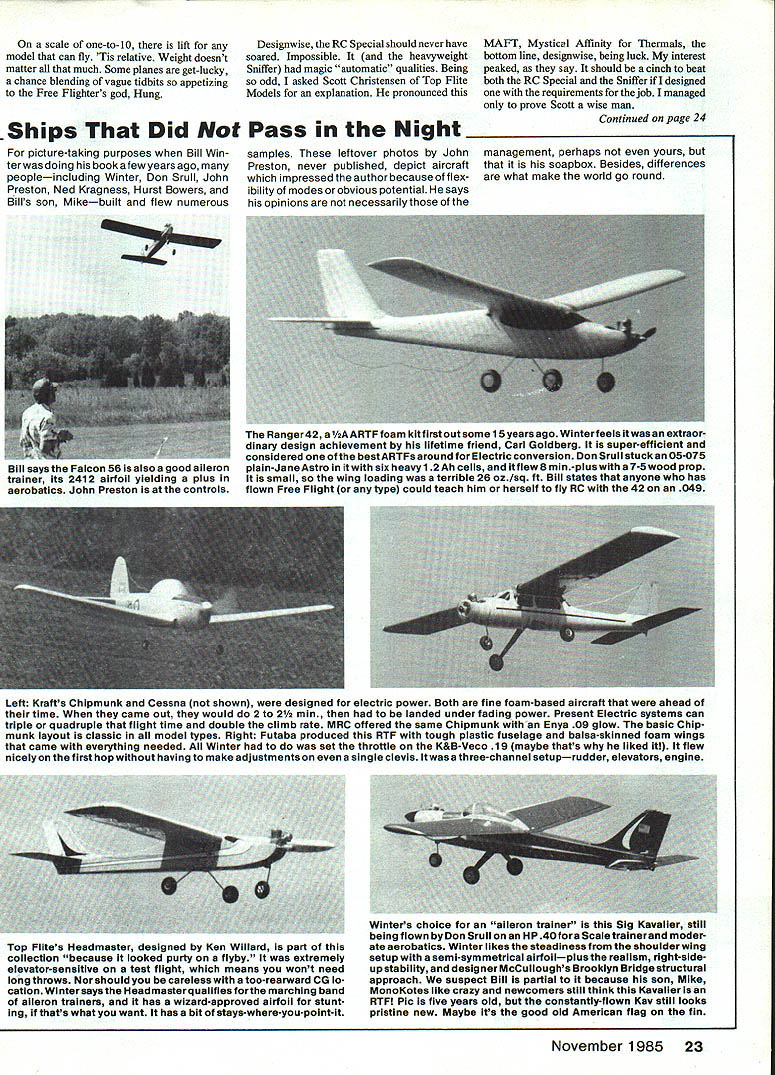
Everyone knows that Kraft had an early mass‑market electric Cessna and a beautiful Chipmunk, both fine‑grain foam. With the motors and batteries of the time, duration was only 2 to 2½ minutes. The Chipmunk could be flown on glow (.09). Phil Kraft himself snagged a glow‑powered Chipmunk landing approach over a parking lot (it had ailerons, too). That Cessna has been offered again at bargain prices; grab it. With a good .05 motor and six sub‑C cells, direct drive with a 7‑4 or 7‑5 prop, it does eight to nine minutes.
Chipmunks are terrific beginner ships. They scoot on three channels and mimic full‑scale WWII fighters, so you must fly them as if you were in the cockpit. Don Pratt thought he had interference with his Chipmunk; on tight high‑speed turns it tumbled like a clipped‑wing Mustang. Once Doug realized he had to fly it like a full‑size aircraft, he had a ball. Bigger foam versions are even smoother and more docile.
Miscellaneous trainer observations
A few observations from other models flown briefly:
- Owen Kampen's Air Scout (Concept/Ace) is a well‑coordinated three‑channel cabin model. With a .15 engine it should have an 8×4 prop, not a screaming 7×4. Match engine and prop to the airplane.
- Midwest's Champ is a lightweight floater; at modest power it's lovely for relaxed flying. Tail‑draggers may need lots of ballast.
- MRC's foam Trainer Hawk gets lively if a beginner freezes and forgets the throttle is the panic button.
- The Falcon .56 is a long‑lived trainer that allows good aerobatics; many beginners still admire it.
Don Srull still practices aerobatics five years later on the Sig Kavalier. If I wanted an aileron trainer for aerobatics, I'd opt for a good .40 job like Don's — realistic, clean, pretty in flight and rugged.
The Piper Vagabond story (3/4‑scale)
I couldn't manage the big Aristocrat, so logically I built a 3/4‑scale Piper Vagabond. I aimed for realism, using factory drawings and an O.S. .90 engine with a 14×5 prop and a target gross weight near 18 lb. Piper had many subtle design features: stubbed wing, negative stab incidence, twist to the tips and odd fuselage frame shapes.
On the first test, the ground crew inadvertently set a full‑down trim and marked the CG at the wrong spot (they thought 35%!). The Vag lifted off in a half‑speed rut, the pilot saved it, the engine quit temporarily, and then came back on full blast. The Vag shot up, stalled and snapped. Remarkably, outside of a shattered windshield and a broken rear spar stub, there was no major damage.
Lessons learned:
- Never lock two panels so they cannot fail‑safe. Giant Scale jobs cannot survive takeoff snaps if panels are rigidly held.
- Use white or aliphatic glue for double‑glue spruce joints rather than epoxy at butt ends and cross pieces.
- Use generous balsa gussets (diagonal grain) and 1/8‑ply tabs at cross‑piece junctions.
- Avoid film coverings on large scale ships that might promote fire; Sig Koverall cloth is a good choice.
One of these days the Vag will fly like a bird. Just one good session and it will be hung up forever.
Engines, vibration and approach discipline
I had built in handicaps with my Kadet: two lightly built .35 engines that were fine in Old‑Timers but vibrated badly in the Kadet. Many two‑cycle engines hate steady mid‑ and low‑range operation; the airframe hummed and receivers and servos suffered. I learned from Clarence Kee that engines are not always well balanced; sometimes you must position an unbalanced prop to counteract the engine's vibration. One piston and bearing eventually failed in my .35 and blew itself apart — blown engines belong at Indianapolis.
My son Rob had a reworked K&B .40 with little compression that required a starter. It wound up and had lots of thrust, but I could not obtain a really low, consistent idle and approaches were fast and trying. If you open the throttle quickly on takeoff, some setups will roll over and flip. On a gusty day I misjudged a flare and twisted an aileron into a straight‑down impact; soft sod saved the airframe, but the engine gave an ominous clank.
For fellow hackers with approach problems, a consistent landing pattern helps. Work on a steady downwind and final spacing. Depth perception is often poorer than we think and variable descent or widely varying turns can ruin final spacing. If wide turns bother you, try half loops or Immelmanns at the ends of your field to change direction more predictably and to see the ship inverted occasionally.
Thermals and duration
If I had my modeling life to live over with RC, I would do many things differently. Night‑flying is fool's gold. Thermals were always there; thermals can hook the liner. Lift can embrace an entire area after sun heating. I remember a full‑tank flight of a Rebel long ago with only a quick rudder input to land at my feet. In the early '50s I recall a duration model seven‑footer loaded to 11 lb. that floated sky‑high on only a 1.5° trim — 45 minutes in a spiral with spoilers, coaxing late go‑arounds and long coast times.
At twilight on a "dead air" evening, thin films of dust at the field's edge often reveal thermal activity. Hot spots ride here and there, bubbles and spikes of mystery, where the plane takes over and you forget the transmitter for a spell.
Closing
I'm now more into .15 (maybe .19) max glow sizes and .035 and .05 electrics — for local parks and peaceful pastures. If you guys enjoy pain, we'll have big scale, spoilers with power, electrics, and flying wings next month. By then the editor hopes we will talk only about reader‑built planes. Just give us nice photos, the facts, and worthwhile insights. If I have been freewheeling, forgive me — merely showing you my so‑so airplanes would otherwise have been boring.
Bill Winter 4426 Altura Ct. Fairfax, VA 22030.
Transcribed from original scans by AI. Minor OCR errors may remain.

