

Just for the Fun of It: Plane Talk
Author's Note
Madness? If someone submitted a collection like this to the old For Fun column, I would have muttered, "Good Lord!" Being asked to talk about my retirement airplanes — and even forgetting the flock of birds in the first two articles — this last roundup makes me wonder, "What am I doing here?" Electrics, flying wings, the updated Rookie, Scale, "sport" — you have got to be kidding. I have no delusions about designer "stuff," and I've always believed that a good covering job can hide a multitude of sins. As Mae West said, "Goodness had nothing to do with it, dearie." The point, if any, is that modeling can be enchantment when one pries oneself out of locked-in specialization.
Five years ago I would not have been caught dead with the notion of a motor (rather than an engine) and a pile of deadweight battery cells. Now, electrics make me wonder if occasionally kicking up one's heels is good for the modeling soul. Having built models for 58 years, I find this activity of ours to be "awesome." If I told you of the stupid things I did in the beginning with these "simple" electrics (just flip a switch and fly!), intelligent AMAers would drum me out of the corps. An electric is simple — I think — yet people write so much about it that most of us are scared to death. A few paragraphs should supply enough A–B–Cs for a gorilla to do a 10-minute flight.
I like the convenience, the almost-anywhere flying sites, and the non-offending "noise" which stirs no piranha neighbors. I like to sail high, wide, and handsome for as much duration as can be milked. I get back to the beauty of Free Flight (spirit of, sort of) before "atomic" power and javelin launches intimidated my gentle soul. I like leisurely long climbs, long glides, and the occasional thermal — infinitely superior to Valium.
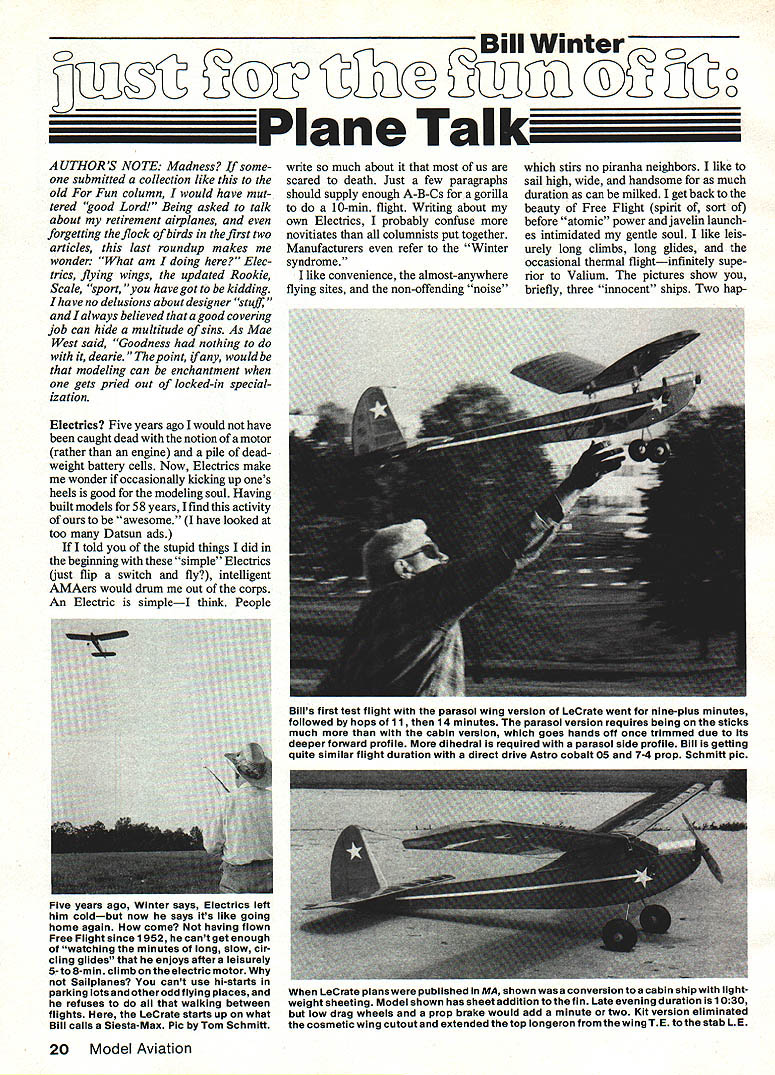
The pictures in the original piece show, briefly, three innocent ships. Two happen to be glow-engine models, which may jingle your bells.
Electrics
I was blind-sided into electrics. Both Astro and Leisure sent me systems because of books. The Astro system I first used was a "15" (since vastly improved) with a belt reduction drive to turn a 12×8 or 13×8 prop on a pack of cells that are now outmoded. Back then 1.2 Ah cells were the future and 800 mAh cells undreamed of. That early system required a voltage booster along with the charger (a car battery being only 12 volts), and hooking up this equipment at the field gave one a sense of working for the local utility company.
Don Srull had an ancient 6-ft.-span ultralight Spitfire that zipped along on a .23 two-cycle. We wondered if it would fly with an electric motor — it did, purring around for five-plus minutes and once getting about 7½ minutes on my Astro system. Gentle was the word for his piloting technique. Better motors and batteries have since allowed it to flex its muscles.
Srull also admired Ed Lidgard's Sparky, a cute old-timer design originally rubber-powered. He converted one with a geared .05 motor on six 1.2 Ah cells using an 11×7 prop — magic for lazy summer-day flying. I followed suit and built a LeCrate conversion: that old free-flight heritage (lifting tail, CG far aft, floating glide) adapted surprisingly well to electric weight and power. Srull's Sparky and my LeCrate were both published, and Ted Davey later updated the LeCrate for a kit.
Lifting tails and trimming
Lifting tails are strange beasts to modern R/Cers. A "flat" flight produces climb because the CG, in effect, has a working wing forward and aft (the model rides tail-high on the step), and a trace of visible climb angle yields high altitude on long runs (prop load is minimized, so battery drain is lower). When one shuts off the motor, full up-trim is instantly felt, and over the next two or three minutes one can slowly add back-stick until eventually the stick rests on the stop. That should cause the glide to sink like mad, but the combination of wing and tail section thicknesses allows the airplane to slow-glide for longer power-off descents than normal trimming would predict. (This is especially true with a high-drag, big, non-folding prop.)
Farman 400 (Scale project)
One whimsical, on-the-spot decision that became an adventure was the Farman 400. When I visited the AMA Museum, Hurst Bowers showed me an exhibit that included a simple green-and-silver rubber model of the Farman 400. I was seduced by its French license letters and elegance.
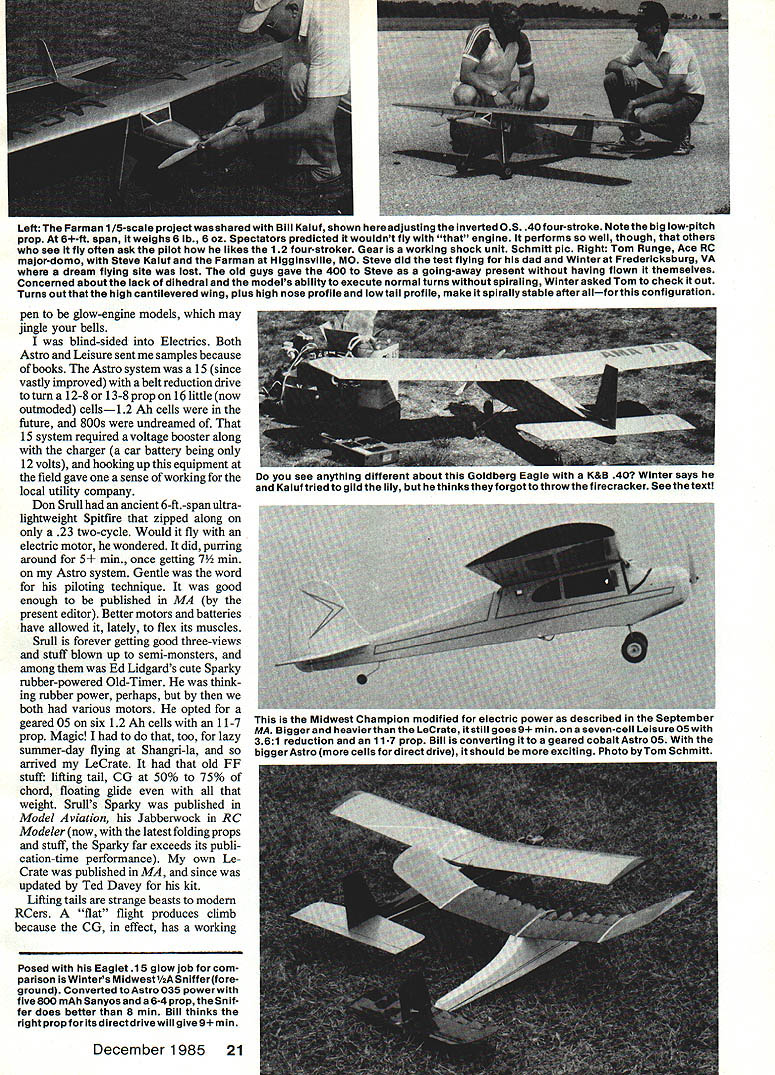
George Meyer had built a Farman from plans by Hurst Bowers based on three "reliable" sources. Bill Kaluf and I decided to enlarge the plans to about 6 ft. (roughly 1/3 scale) and share the project. I supplied most of the wood and an O.S. .40 four-stroke. Research turned up scarce original documentation; Don Berliner found an early brochure at the Smithsonian, Alain Parmentier in France supplied copies of early French articles, and other collectors contributed photos and information.
A few scale curiosities:
- The Farman 400 dates from around 1930 and had surprisingly large flaps.
- The full-size Farman seated three in tandem; the center seat reportedly swivelled to ease access.
- The aircraft had good performance for its era but needed adequate horsepower.
I worried about lack of dihedral and the model's tendency in natural turns; Bill worried about engine power. Despite doubts, the model flew beautifully with the O.S. .40 four-stroke in an enclosed cowling — though many who saw it on the ground thought it couldn't possibly fly on that small an engine. The perfect prop for the model proved to be a 13×4, giving decent performance. Bill's son Steve proved to be a fine test pilot and flew the model for seasons in Missouri and Kansas. Tom Runge evaluated the no-dihedral turning and judged it suitable.
Goldberg Eagle (a "sissy crate")
The Goldberg Eagle began as a kit trade with Bill Kaluf (the man nicknamed "The Airplane Factory"). Kaluf modified the tail arrangement; he did not like a negative tail and preferred zero-zero incidence, but he thickened and squared-off the stabilizer, adding area and incorporating flaps.
Flight characteristics:
- With flaps part way out and near-idle power, the Eagle is gentle — an "old man's airplane."
- When opened up, the lifting stab can produce a not-too-shallow dive, and trim becomes a challenge: you trim for that behavior, then cruise or slow up and the plane climbs strongly.
- I ended up with about 3/16 in. wing incidence on my example; opinions vary on the best setup.
- The combination of a K&B .40 and plenty of lift yields exuberant performance if you insist on full-bore power; a .25 could give more sedate behavior.
Simitar — a winged horse (my flying-wing experiment)
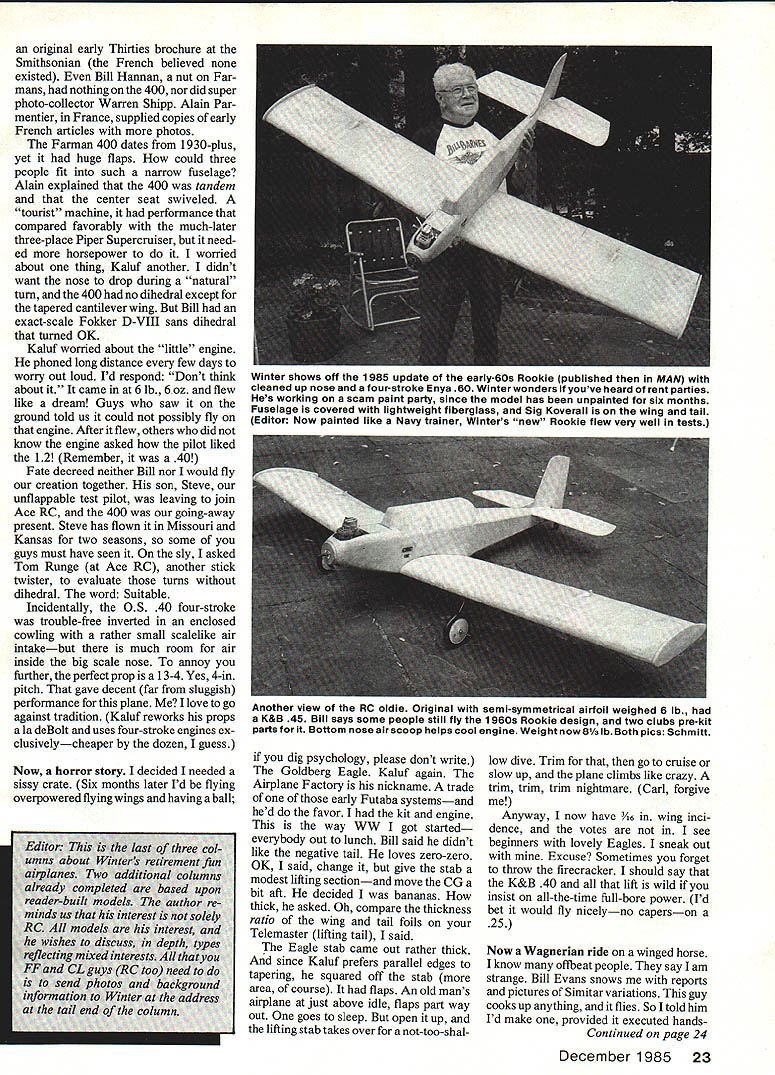
I know many offbeat people. Bill Evans showed me variations of the Simitar; the design intrigued me. I told him I'd make one provided it met a long list of flight requirements:
- hands-off 360s without loss of altitude,
- slow flight so I could keep track of it,
- ability to soar,
- aerobatic capability (roll and invert),
- ability to fly like an Eaglet on final,
- flight on three or four channels with choice, while flying, of elevons or rudder or both,
- dihedral if needed for hands-off stability.
My Simitar:
- wing: 5 ft. span (I wanted 6 ft. but was talked down),
- construction: light foam cores with 1/16" sheeting and cosmetic cap strips,
- configuration: tractor, no sweep, a straight leading edge like a P-40, initially with a very large vertical tail stump behind the wing (no conventional rudder),
- modifications: I extended the fuselage about 8 in. aft to increase weathervaning and rudder effectiveness, reduced side area of the vertical tail for better spiral stability, and added a forward canopy area to help longitudinal stability.
Flight behavior and tips:
- Takeoffs are easy — as simple as any trike with a tailwheel.
- The Simitar slow-flies and can move out quickly; it often flies better with elevons than with coupled aileron-rudder.
- It will fly hands-off 720s and grooves smoothly.
- You can hold full up through the takeoff run until it breaks ground, then ease to neutral.
- A short fuselage and plank wing make visual depth perception tricky on approach; anticipate crosswind early.
- Tailwheel setup: these tail-dragger wings can appear to rotate like a jet and then hold a climb; allow adequate free rotation by setting the tailwheel so it permits more rotation than usual. I recommend a slight upward slope of the aft fuselage bottom to raise the tailwheel and allow more rotation, or use a longer main gear strut.
- Power setup I used: 5% nitro fuel, Master Airscrew 9×4 or 9×5 prop for quick takeoffs at two-thirds throttle.
- Weight for my 5-ft. version: about 3½ lb.
Bill Evans eventually flew an electric-powered Simitar (Astro 25 cobalt direct drive with 14 × 1.2 Ah cells) and reported about 6 minutes including aerobatics — he said it "throws as much air as a K&B .40."
Krackerjack and spoilers — solving approach problems
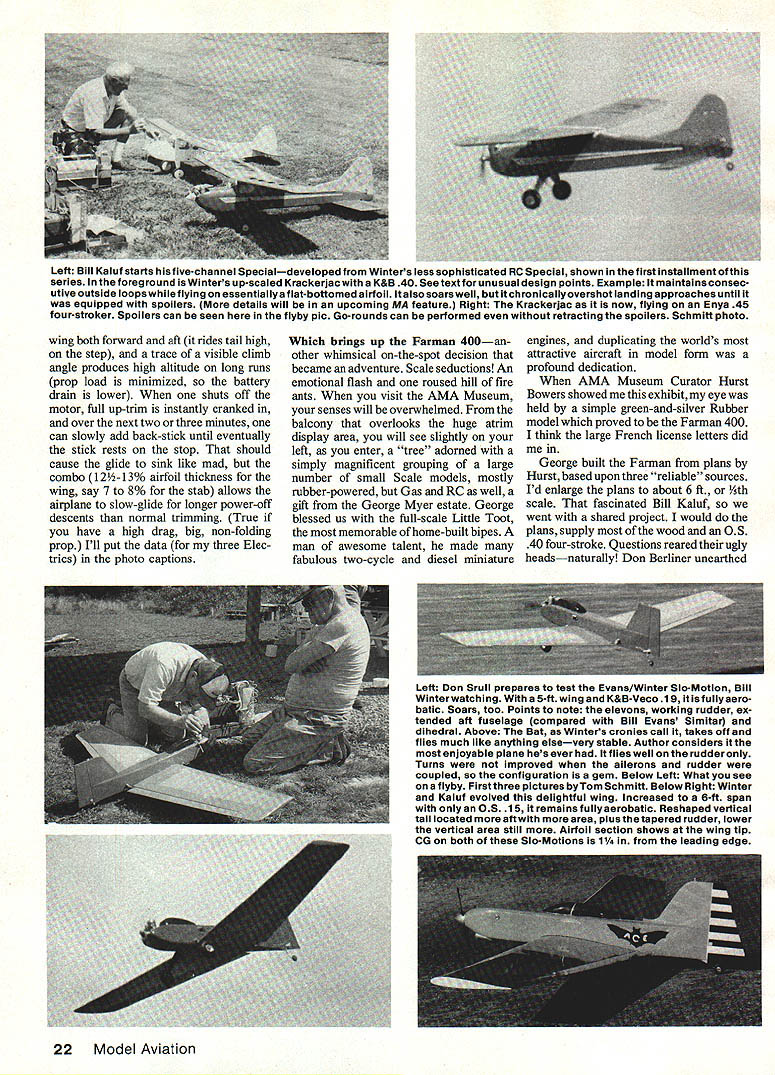
If you flew R/C around 1960, names like Krackerjack and Rookie will be familiar. The Krackerjack, an iconic one-channel design from Air Trails (later kitted by Jetco), lives on in many sizes and configurations. I built a larger Krackerjack and discovered a serious approach problem: it would overshoot small strips on low approaches.
Solution: spoilers.
- With properly sized and deployed spoilers, a high L/D model can descend steeply — 45° to 60° angles — from pinpoint distances.
- Using spoilers, power, and elevator together, I could nail a spot on the first third of a short strip, and even abort and fly around again with spoilers out.
Power and performance:
- With an Enya .46 four-stroke and a 10×7 Master Airscrew, the model performed outsides and handled inverted flight well at that weight and displacement.
- Spoilers greatly increased approach versatility and allowed precise landings from steep descents; Model Aviation will publish an article on spoiler technique with the Krackerjack.
The Rookie and the "K"
The Rookie — a 6-ft. span, 6 sq. ft. area, low-winger once intended for a K&B .45 (later flown with a Super Tigre .56) — was designed to be an "easy to fly," safe, fully aerobatic, multi-channel trainer. It was published in MAN and remains popular; people still build them and form small groups that pre-kit these machines.
Norm Rosenstock asked permission to reproduce Old-Timer RC plans, and I have his Rookie plans authentic down to figure-eight stitched hinges, though I modified the design for the '80s while keeping the original specifications. Rosenstock scaled a "K" up to 6 ft. with shallow dihedral and ailerons; I ended up redesigning aspects of it.
About the big "K":
- Scaling changes area, Reynolds number, and handling; a scaled-up "K" becomes a different machine with new surprises, problems, and solutions.
- The original small "K" was different in three respects: its airfoil, short coupling, and the stabilizer on the bottom. The small "K" had a thin airfoil with a swept-up bottom camber near the leading edge, resulting in small CP travel and stable behavior that resisted ballooning in turns — unusual for escapement-era designs.
- Short coupling and a bottom stab contributed to spirited three-channel aerobatics and a grooved feel that many pilots found friendly though unconventional.
- A scaled-up "K" of about 7¼ lb with a K&B .40 takes off easily and can be surprisingly quick; trimmed, it can be a penetrating, grooved performer rather than a floater.
Final notes and anecdotes
- On a few flights I experienced oddities: flying inverted with little or no down-trim and maintaining level flight, taxiing at walking speed while holding full up and walking beside the flying machine, and even landing safely when most of the radio channels were lost (the remaining rudder allowed recovery). Such experiences underline the importance of stable design and conservative piloting.
- We modelers are sometimes told "you gotta have power" to get out of trouble. In my experience, power is often the wrong answer and can pour fuel on a developing problem. Good technique and proper configuration usually matter more than brute horsepower.
Editor's Note
This is the last of three columns about Winter's retirement fun airplanes. Two additional columns already completed are based upon reader-built models. The author reminds us that his interest is not solely R/C: all models — FF, CL, and RC — are of interest, and he writes to discuss types reflecting mixed interests. All those Free Flight and Control Line guys (and R/C too) need to do is send photos and background information to Winter at the address below.
Bill Winter 4432 Altura Ct. Fairfax, VA 22030
P.S. If anyone wishes to argue about any of the above, don't bother. I'm beyond redemption.
Transcribed from original scans by AI. Minor OCR errors may remain.

