
Just for the Fun of It: Plane Talk
Bill Winter
THE MUSTANG
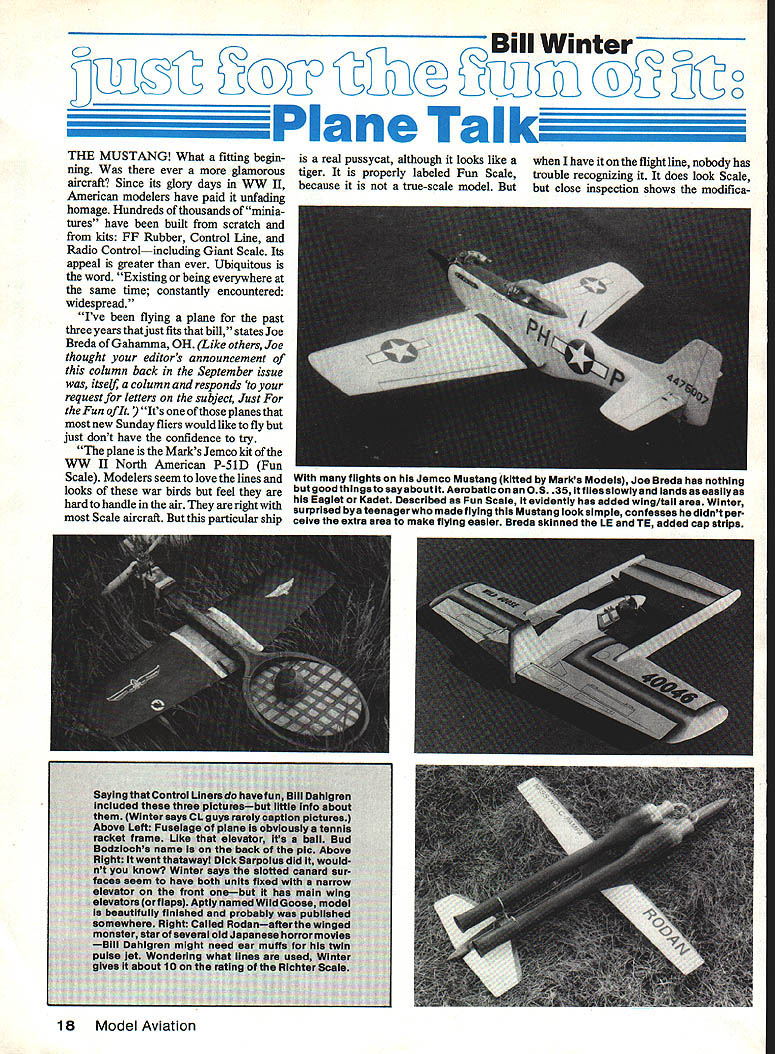
What a fitting beginning: the Mustang — one of the most glamorous aircraft ever. Since its glory days in WWII, American modelers have paid it unfading homage. Hundreds of thousands of miniatures have been built — scratch, kits, free flight, rubber, control line, radio control (including giant scale). Its appeal remains widespread.
"I've been flying a plane for the past three years that just fits that bill," says Joe Breda of Gahanna, OH. He refers to the Mark's/Jemco kit of the WWII North American P‑51D (marketed as Fun Scale). Modelers love the lines of these warbirds but often expect them to be hard to handle; this particular Jemco Mustang looks aggressive but flies nicely because it is not a strict scale replica — it has been modified to be docile while still looking realistic.
Joe and others note these key features:
- Larger wing and tail areas than true scale versions (more benign handling).
- Sheeted leading and trailing edges and capped rib strips for stiffness and finished appearance.
- Powered satisfactorily by an O.S. Max .35 in Joe's example; full throttle makes it aerobatic and realistic, throttled back it "putt‑putts" like a trainer.
Joe's experience:
- The Jemco lives up to its "Fun Scale" claim: aerobatic at power, and easy to land when throttled back.
- He would not recommend this kit as a first RC project — the instructions can be vague, and radio installation requires some prior experience.
- For tail‑draggers he suggests initial takeoffs from grass (less sensitive steering and kinder to the prop). Hold full up until the model lifts to keep the tailwheel down; a forward CG helps.
- Cost (at time of writing): advertised from about $25.95 to $34.95. Joe called it "the best $25 I ever spent."
Editor’s note: The nice Jemco Mustang seen flying was not drastically modified beyond the sheeting and caps mentioned. Open‑frame wings can look flexible but are reasonably rigid once covered. Joe's Mustang gave him years of pleasant flying as a relative beginner — easy to fly, aerobatic, and reasonably realistic.
---
CONTROL LINE IS FUN — Reader Letters
Control line drew surprising reader response. Below are highlights and excerpts from letters.
#### Ron Robinson, Encino, CA Ron says the column title "Just For the Fun of It" sums up modeling for him. He notes that despite technical progress, true fun remains in classic designs like Fireballs, Bipes, Clipper, Jersey Javelin, Playboy, Buccaneer, and Vagabond (several listed are free‑flight classics).
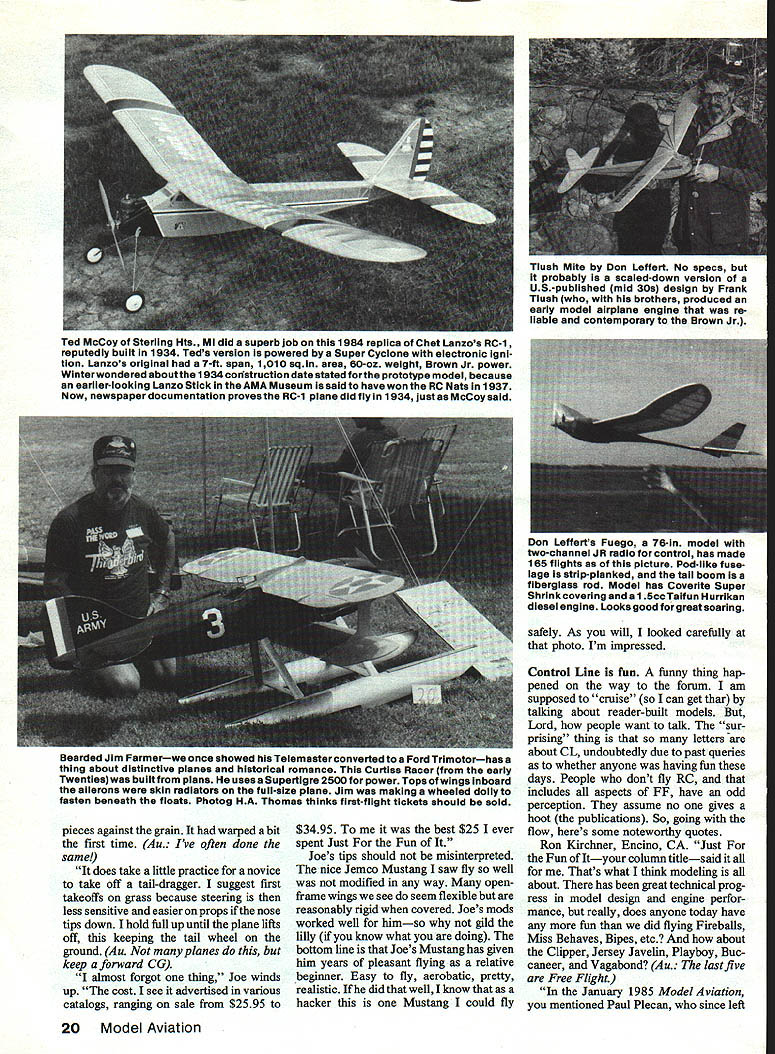
#### Paul Plecan (re: CL Navion) Paul mentions plan #369 from Mechanix Illustrated (1946) for a CL Navion. He built it with a Bullet .275 and remembers the first flight: it climbed to about 10 ft., made a very sharp left, and continued on the lines out to the end. He later used a Bunch .45 and flew it until it came apart. Reviewing the plans he found the balance point was shown about 3/4 in. behind the control pivot — likely the reason for its tendency to come in towards him. Editor’s note: you don't want a high bellcrank on a low‑winger, either.
Paul also fondly remembers Jim Walker and asks whether any book or tape of "An Evening with Jim Walker" exists. Editor’s note: Jim Walker has passed away.
Paul built multiple Fireballs and recalls Jim flying three at once (two in his hands and a third attached to a pylon on his helmet), using two‑speed ignition — feats that remain legendary.
#### Lou Melancon, Coral Springs, FL Lou says he returned to CL after college and family life, tried RC but missed the direct feel of CL. He now flies stunt and credits the Atlanta Stunt Conspiracy, the PAMPA newsletter, and old magazines for helping him. Points he makes:
- Serious stunt fliers must often build from scratch — there are few CL kits or ARF options in hobby shops.
- He spends roughly $75/month locally for fuel, props, paint, plastics, tools, covering, hardware, wood, etc., to support local shops.
- There are about 10 active CL fliers in his area, and they benefit from a paved circle laid down about 20 years ago.
- He feels magazines should cover more CL and encourages the need for a "new Jim Walker" type to inspire others.
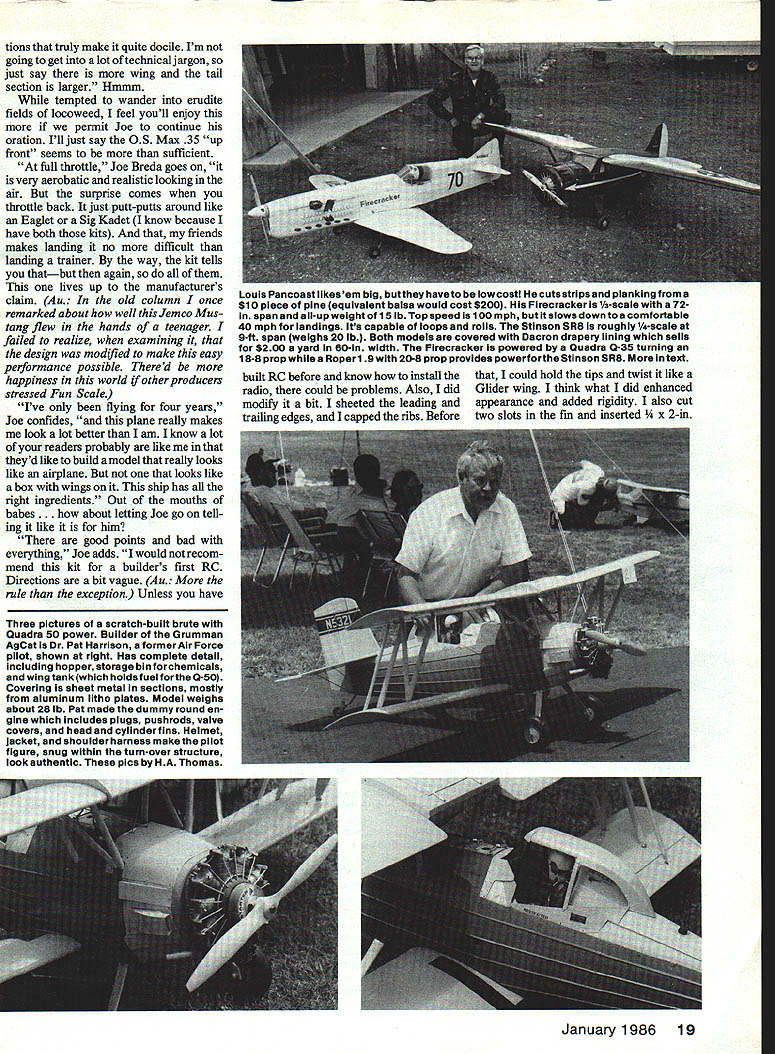
#### Bill Dahlgren, Glenview, IL Bill comments on magazine coverage: many RC‑oriented columns neglect the breadth of modeling. He urges recognition of many non‑RC activities, including micromodels, Peanuts indoors, hand‑launched and towline gliders, powered free flight (rubber, CO2, small gassers), and numerous control line categories. Editor’s note: this column invites submissions covering all fun aspects of modeling.
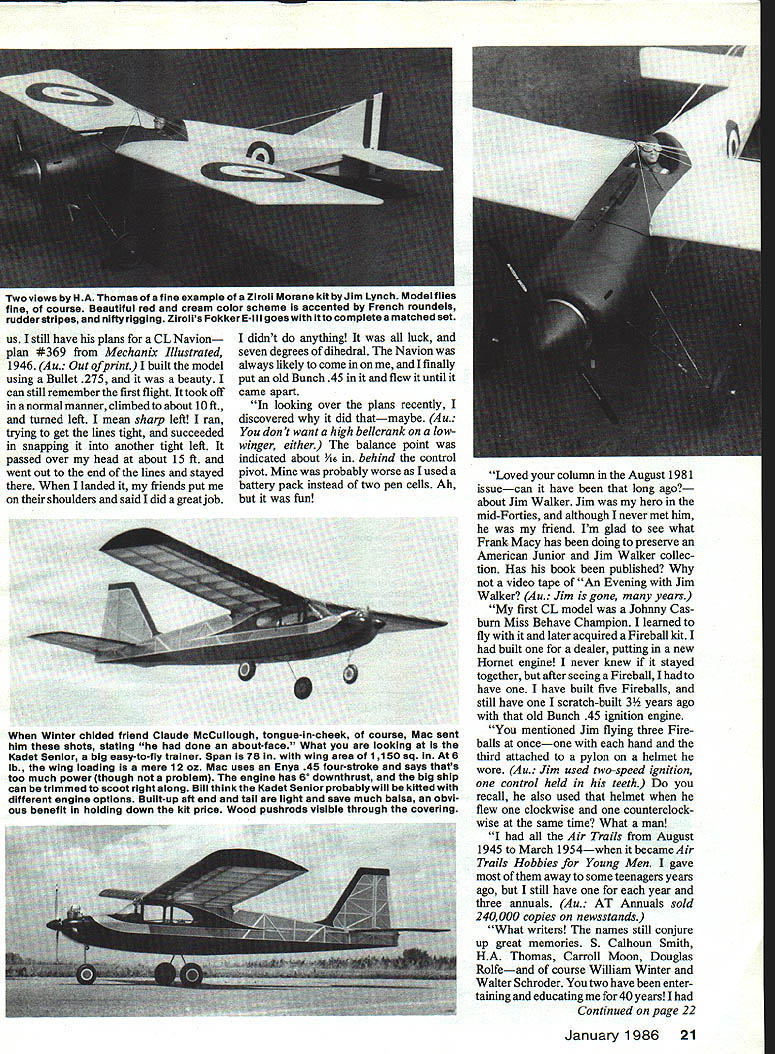
#### Claude McCullough Claude sent photos and notes about the Kadet Senior, a gentle trainer redesign:
- 78‑in. span, about 1,150 sq. in. area.
- Weight about 6 lb.; wing loading ≈ 12 oz./sq. ft.
- Powered by an Enya .45 four‑stroke (a bit more power than needed).
- Features more dihedral and a larger tail than a regular Kadet for very stable, slow, hands‑off flying — ideal for students without an instructor available.
- Caution: avoid flying in windy conditions. It's a gentle ship, not for banging around.
---
TECH TIPS & MISCELLANY
- Covering Monokote/film: When bonding an undercambered or banana airfoil, spot points along each rib on the bottom and gradually fill in before shrinking. Shrink both sides incrementally; never finish one side fully before the other to avoid warping. Avoid overheating when shrinking.
- Correction: In a recent column the words "negative tail" should have read "positive tail" regarding the modified Eagle; the distinction affects the sense of the modifications.
---
Bill Winter 4432 Altura Ct., Fairfax, VA 22030
Transcribed from original scans by AI. Minor OCR errors may remain.

