
Just for the Fun of It: Plane Talk
Bill Winter
They say there is nothing certain but death and taxes. It's also certain that I never know what I am going to write about. My old manual typewriter, like a horse, seems to know where it is going. It presents a "readout" without guidance. Vibes tell me it probably intends to prance through letters. "Don't think," it admonishes. "You'll hurt yourself."
I think about irrelevant things. I see Jim Walker, the master showman, doing his RC lawn mower act—when all we had was one frequency. It could only happen in Brooklyn. Such innocent-looking guys (who, me?) with transmitters hidden behind their backs.
Jim survived, but afterwards "his frequency" was a deep secret (40 watts, too!).
The readout sputters on. I often remark, as you do, that at the flying field one has little awareness of what his buddies are in "real" life. If Ronnie, himself, came out with an Ugly Stik, we'd get on him for flying over the pits. These letters are a flying site. These are folks! I see from a little red flag that one is a two-star general; there is a club at his base, and since he built models as a kid, he now wants to resume with an Electric Old-Timer. There's another on Kansas Wesleyan stationery. I pick up the phone. Toto, I think we still are in Kansas.
A friendly female voice tells me "he" is off-campus at a conference. He is the president and a Methodist minister. (Why do so many ministers write me?) Letters will be "From the Seat of Higher Learning."
"Your column in the October 1985 Model Aviation stirred me to write a letter of appreciation. Your perspective on flying and things that fly always provides an interest to me," says Marshall P. Stanton.
"A few years ago I built a Crosswind, only modified the construction from the MA suggestions. The fuselage was made from 1/32 ply bent in a U-shape as is the Funbird. The frontal profile is small and the half-cowl under the engine created by bending the plywood combines to make a slippery model. I cut the wing from foam, installed balsa leading and trailing edges, put in a spruce spar, then covered it all with silkspan using Elmer's cut with water in a 50/50 mixture as an adhesive. The original covering was Saran Wrap painted with a spray and stuck on the wing with a spray adhesive. Using the Goldberg type of main gear, I mounted the wheels and gear just ahead of the wing, and I put a tail wheel on it.
"There have been three power plants up front in the little bird: a Fox .15, an Enya .19, and an Enya .09. There is no dramatic performance with the latter, but it will ROG nicely and cruise at part-throttle. It does well in high winds, no wind, cold, wet, or foggy days (once it flew on a day when ice built up on the wing, so one flight had to suffice). I enjoy seeing it soar with the hawks when there are thermals, or laze around at 15–20 feet off the ground when the air is dense and the breeze is calm. It has been smashed and bashed, has amazing resilience; everything has been broken at least once, but the combination of building materials used allows easy repairs. By now it has lost all external beauty. However, I don't say that out loud; its presence still keeps flying nicely. I log all my flights so I know that it has more than 30 hours of actual flight time on it."
"Another flyable bird in my hangar is the venerable Kloud King," Marshall goes on. "I call it a 'motorized box kite.' Built from MA plans after a personal conversation with Doc Mathews, it has logged more than 65 hours. Originally powered by a Fox .25, it now climbs skyward with an Enya .19. The translucent orange wing helps visibility when it gets so high that no airplane shape is visible. Occasionally I have to give it downtrim and wait while it comes to an altitude I'm more comfortable at."
"Other interesting building/flying projects include an Aeromaster built 150%..."
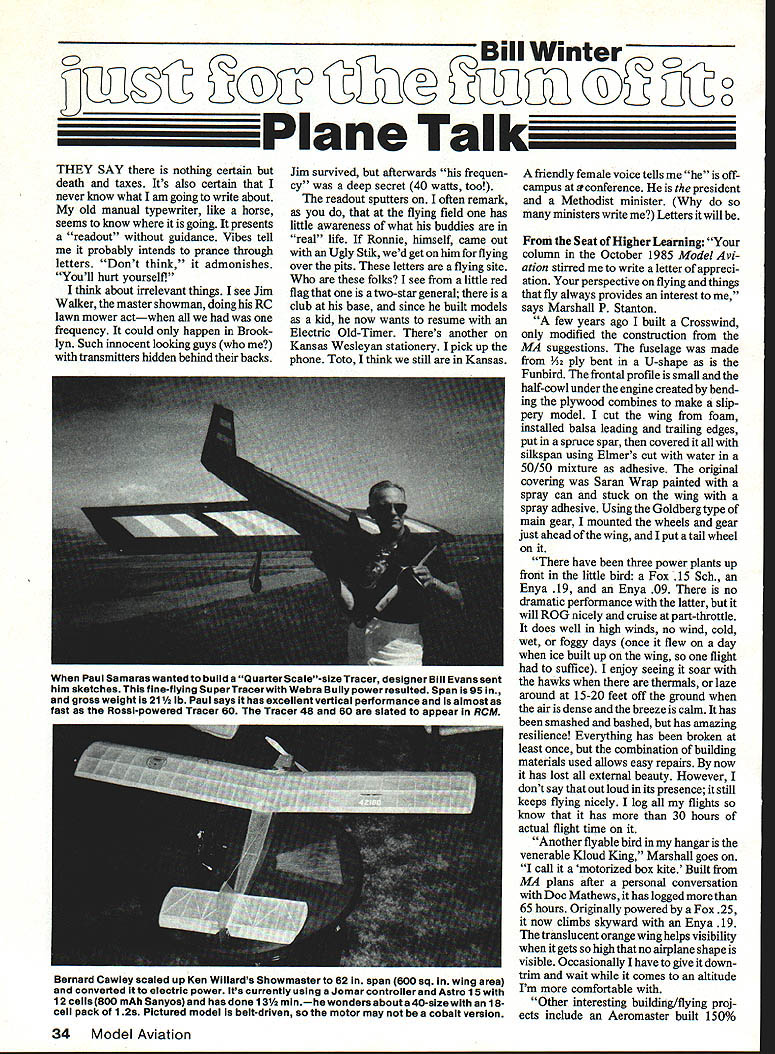
Paul Samaras wanted to build a quarter-scale Tracer; designer Bill Evans sent him sketches. The fine-flying SuperTracer, Webra Bully power, resulted. Span 189½ in., gross weight 19.2 lb. Paul says it has excellent vertical performance — almost as fast as a Rossi-powered Tracer 60. Tracer 48/80 is slated to appear in RCM.
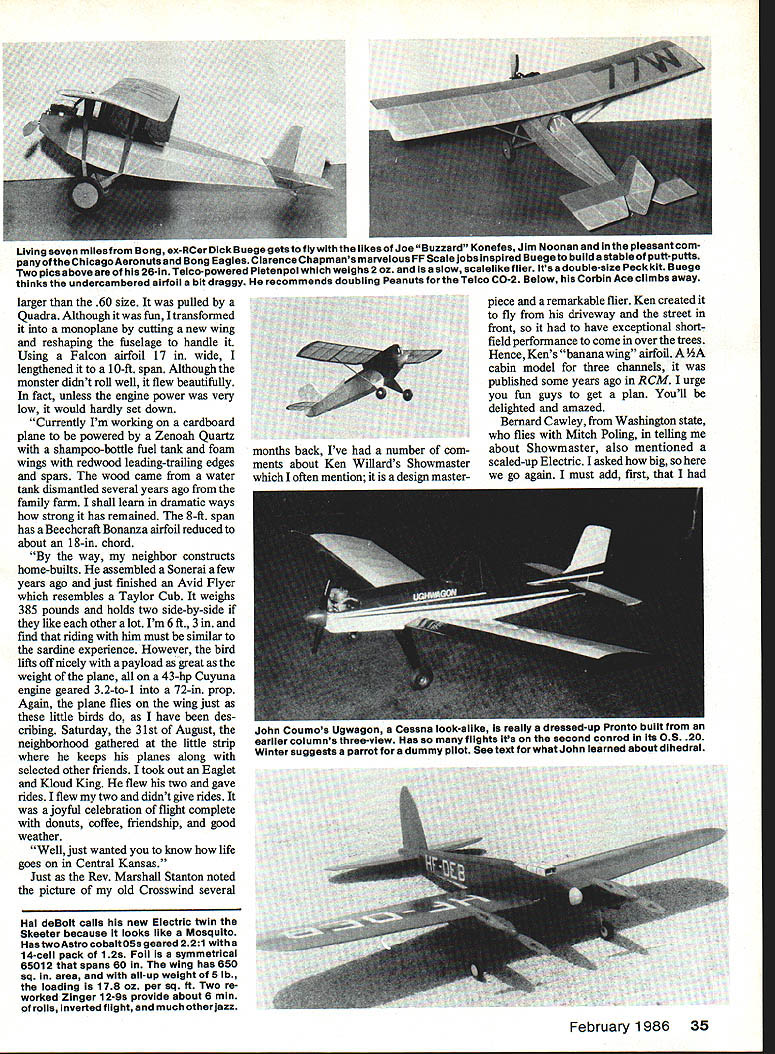
Bernard Cawley, from Washington state, who flies with Mitch Poling, in telling me about Showmaster, also mentioned a scaled-up electric. I asked how big, so here we go again. I must add, first, that I had months back had a number of comments about Ken Willard's Showmaster which I often mention; it is a design masterpiece and a remarkable flier. Ken created it to fly from his driveway and the street in front, so it had to have exceptional short-field performance to come in over the trees. Hence Ken's "banana wing" airfoil. A 3/4 cabin model for three channels, it was published some years ago in RCM. I urge you fun guys to get a plan. You'll be delighted and amazed.
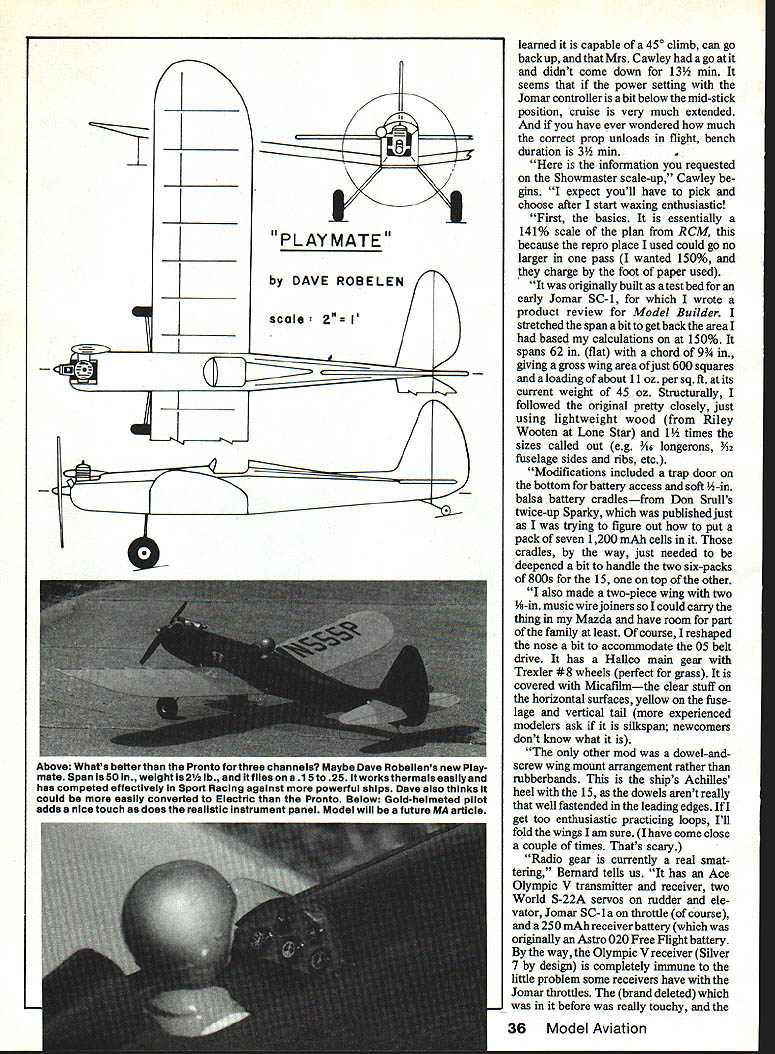
Living seven miles from Bong, ex-RCer Dick Buege gets to fly with the likes of Joe "Buzzard" Konefes, Jim Noonan and, in the pleasant company of the Chicago Aeronuts and Bong Eagles, Clarence Chapman's marvelous FF scale jobs inspired Buege to build stable putt-puffs. Two pictures above are of his 26-in. Telco-powered Pietenpol which weighs 2 oz. and is a slow, scalelike flier — it's a double-size Peck kit. Buege thinks the undercambered airfoil a bit draggy and recommends doubling Peanuts Telco CO-2. Below, Corbin Ace climbs away; a larger 60-size pulled Quadra. Although fun, I transformed a monoplane by cutting a new wing and reshaping the fuselage to handle it. Using a Falcon airfoil 17 in. wide, I lengthened it to a 10-ft. span. Although the monster didn't roll well, it flew beautifully. In fact, unless engine power was very low, it would hardly set down.
"Currently I'm working on a cardboard plane to be powered by a Zenoah Quartz with a shampoo-bottle fuel tank and foam wings with redwood leading and trailing edges and spars. The wood came from a water tank dismantled several years ago from the family farm. I shall learn in dramatic ways how strong it has remained. The 8-ft. span has a Beechcraft Bonanza airfoil reduced to about an 18-in. chord.
"By the way, my neighbor constructs home-builts. He assembled a Sonerai a few years ago and just finished an Avid Flyer which resembles a Taylor Cub. It weighs 385 pounds and holds two side-by-side if they like each other! It's 10 ft. 3 in., and I find that riding with him must be similar to the sardine experience. However, the bird lifts off nicely with a payload as great as the weight of the plane, all on a 43-hp Cuyuna engine geared 3.2-to-1 into a 72-in. prop. Again, the plane flies on the wing just as these little birds do, as I have been describing. Saturday, the 31st of August, the neighborhood gathered at the little strip where he keeps his planes along with selected other friends. I took out an Eaglet and Kloud King. He flew his two and gave rides. I flew my two and didn't give rides; it was a joyful celebration of flight complete with donuts, coffee, friendship, and good weather.
"Well, just wanted you to know how life goes on in Central Kansas."
Bernard Cawley continued on the scaled-up Showmaster: "I learned it is capable of a 45° climb, can go back up, and Mrs. Cawley had a go at it and didn't come down for 13½ minutes. It seems that if the power setting with the Jomar controller is a bit below the mid-stick position, cruise is very much extended. And if you have ever wondered how much the correct prop unloads in flight, bench duration is 3½ minutes."
"Here is the information you requested on the Showmaster scale-up," Cawley begins. "I expect you'll have to pick and choose after I start waxing enthusiastic!
"First, the basics. It is essentially a 141% scale of the plan from RCM, this because the repro piece I used could go no larger in one pass (I wanted 150%), and they charge by the foot of paper used.
"It was originally built as a tester for an early Jomar SC-1, for which I wrote a product review for Model Builder. I stretched the span a bit to get back the area I had based my calculations on at 150%. It spans 62 in. (flat) with a chord of 9¾ in., giving a gross wing area of just 600 sq. in. and a loading of about 11 oz. per sq. ft. at its current weight of 45 oz. Structurally, I followed the original pretty closely, just using lightweight wood (from Riley Wooten at Lone Star) and 1½ times the sizes called out (e.g. ¾" longeron, 3/32" fuselage sides and ribs, etc.).
"Modifications included a trap door on the bottom for battery access and soft ¼-in. balsa battery cradles — from Don Srull's twice-up Sparky, which was published just as I was trying to figure out how to put a pack of seven 1,200 mAh cells in it. Those cradles, by the way, just needed to be deepened a bit to handle the two six-packs of 800s for the 15, one on top of the other.
"I also made a two-piece wing with two ¼-in. music wire joiners so I could carry the thing in my Mazda and have room for part of the family at least. Of course, I reshaped the nose a bit to accommodate the OS belt drive. It has a Hallco main gear with Trexler #8 wheels (perfect for grass). It is covered with Micafilm — the clear stuff on the horizontal surfaces, yellow on the fuselage and vertical tail (more experienced modelers ask if it is silkspan; newcomers don't know what it is).
"The only other mod was a dowel-and-screw wing mounting arrangement rather than rubber bands. This is the ship's Achilles' heel with the 15, as the dowels aren't really that well fastened in the leading edges. If I get too enthusiastic practicing loops, I'll fold the wings I'm sure. (I have come close a couple of times. That's scary.)
"Radio gear is currently a real smattering," Bernard tells us. "It has an Ace Olympic V transmitter and receiver, two World S-22A servos on rudder and elevator, Jomar SC-1 on throttle (of course), and a 250 mAh receiver battery (which was originally an Astro 020 Free Flight battery). By the way, the Olympic V receiver (Silver 7 by design) is completely immune to the little problem some receivers have with the Jomar throttles. The receiver which was in it before was really touchy, and the Olympic V is in the place that was worst for the old unit, above the flight battery on a shelf; it is working flawlessly. I've only flown it twice since I wrote you, but the amazing climb and long flights (if throttled down) are true.
"For charging, I use an Astro Voltage Booster between my field box battery and my Astro AC/DC charger. The voltage booster makes a hellacious whine when it's working, and it isn't too efficient, but it is adequate for the 12-cell 800s at least (I wonder about the 18-cell 1,200s for a cobalt 40) and can deliver enough current for a 15-minute charge (3.2A). Mitch uses the Robbe Automax 21 for his 15 planes, but I don't have one.
"I don't have too many pictures of the plane. The enclosed one is out of the family album. It is sitting (barely) on the coffee table on which I take all of those record-it-before-I-fly-it pictures. If you still have the pictures of my original glow Showmaster, you can compare for size, as one of them was shot on the same table. (The glow one has been hung up for awhile, but it is still flyable with a battery charge and the purchase of some fuel.)
"Not much else to report," Cawley adds, "except that my beloved Schoolboy was totaled in a crash (the wing survived) of unclear cause. It was in a right spiral and refused to straighten up. The rudder servo was not moving after the crash until I gave the output wheel a nudge; now it works fine. I don't know if the servo was the cause or an effect of the crash. On opening it up I found no stripped gears or other obvious abnormality. The plane had been getting really ratty and in need of replacement, but I didn't really want to be forced.
"I'd been wanting to do another one incorporating the changes I wanted to make based on my experiences with the last one (which was my second Schoolboy), the first one being pulse rudder with a weak .049, wild paint scheme, from the kit, when I was in high school and flown at 7,000 ft. in Santa Fe, NM — which reminds me: the Electric one flies fine at 7,000 ft. with a coarser prop — 5¼ x 4. Also, just this week, a friend gave me a copy of the January 1962 MAN which has the original Schoolboy construction article showing a 36-in. built-up wing rather than a 29-in. sheet wing.
"That gets me thinking about more area and such, but I like the sheet wing — light, strong, and warp-proof. Oh well, perhaps if I implement a Purple Plan One approach... ?"
The booster whine Cawley mentions. He has good ears. I once could hear up to 16,000 cycles, at which frequency the sound faded in and out—like an out-of-sight flight (now you see it, now you don't). Occasionally I detect weakly a faint booster whine.
Why the booster? The general run-of-the-mill charger handles six to eight cells. To peak six cells, I have to use a portion of a second-cycle—beyond normal, automatically-safe 15 minutes for truly uncharged cells—and a much longer time to peak seven cells. You can't peak eight cells from a 12-volt car battery unless 1) you have a charger designed for more cells or 2) you use a booster. I am a hacker, not an expert, especially in electrics. If you must write someone, you'd be wise to ask columnist Kopski on MA, Poling on Model Builder, etc. After three years of electrics, I have a flock of second-generation questions for which I need answers.
Sometimes I feel alone. It is said that one feels most alone in a crowd. If you would test this, make a solo visit to a big city zoo on a summer Sunday. The range of interests so fondly described in so many letters should make me feel blessed. But I ponder. Long ago, when things were simple, virtually everyone had to build the same things, and cross talk sparkled with common interest. Today, our common interest is an exploding cosmos of proliferating hobbies receding from each other at nearly the speed of flight. It is as if we had a hundred hobbies, not one. Letters remind me that each twinkling speck of light is, when you get closer, a thriving, well-intentioned universe, self-sufficient and feeling good, thank you. Bridging gaps is what the mail feels like. My mail is, to my surprising degree, like this letter from Dick Buege. Perhaps you will enjoy it with me.
"Just got my MA and was glad to see your return," he begins. "I enjoy your rambling columns to the extreme. The memories that you share with us are a look at most aviation that a lot of us never see. Let me ramble. Have you ever seen Joe Konefes fly his Buzzard Bombshell? An absolutely perfect climb followed by a perfect transition to level flight. No stall and recovery here. The engine quits, and the nose just comes down to level. How about Eddie Konefes and his rubber-powered ships? A climb that seems to last forever and a flawless glide. Jim Noonan and his compressed-air model. Beautiful to watch. These are my teachers and critics. I am indeed fortunate."
"I am located only seven miles from the hallowed fields of Bong," Buege continues. "As far as I am concerned, this is an ideal situation. I have spent many a Sunday in the pleasant company of the Chicago Aeronuts and the Bong Eagles. I don't compete in the contests but go to watch and enjoy my own thing. When I first started going there, I ran into a couple of fellows flying FF Scale. It looked like a nice, non-competitive fly. What caught my eye was Clarence Chapman's CO2-powered ships. Being stuck on RC at the time, the thought never crossed my mind that I might try it. His planes belong on display and not on Bong, or do they? For about three or four years, I did nothing but RC and got to know Clarence quite well. I had several Comet and Guillow planes that wouldn't fly worth a darn. Three coats of colored dope is a real downer when applied to a small model.
"The Guillow Champ was converted to CO2 and tried. Super, and it even flew. That was followed by a Comet Cub built with the CO2 in mind. I believe the kit number is 3406. If anyone ever wants to try CO2 with the best possible chance of success, this is the plane. Much downthrust and a little right thrust, and flights are just as close to perfect as they come. It would fly one circle with very little climb and then go up. Flights of 1 to 1½ minutes as a matter of routine with the Telco.
"My latest effort is the Pietenpol. Span is 26 in. and weight is 2 oz. Flights are slow and scale-like. It does not fly as well as the Cub, which I place on the wing area being just about all the motor will pull. The undercamber on the wing is quite excessive and will be corrected if I ever build another one. Flat-bottomed might be even better. The plan is the Peck kit doubled and modified. Double-size Peanuts are a very good way to get designs. Most will have to be modified a little for strength but nothing very bad.
"I have tried a 26-in. Lacey, but that was more than the motor would pull. A 26-in. Fike flies very well with an .020 running very rich. Just don't let it go with more than 15 seconds worth of fuel if you value the plane and your legs. This would make a great one for G.G. (Au.: Galloping Ghost?) and a small schoolyard. I think the next one will be a Fike at 19½ in. for CO2.
"There are now three of us flying CO2 regularly at Bong," Dick relates. "This has been the nicest way to fly. No mess, no pressure, and if the wind is up, no one telling me that I might as well learn to fly in the wind. I think that many RC days are done. I have found, in Clarence and Derry, what was missing with the bunch in the local RC club. Each one of us does his own thing, and the rest of us accept it for what it is. There is no pressure to build and fly something that will meet the approval of the rest of the club. Each new plane is looked over by the rest of us, but never with a nit-picking attitude. Critics abound, but always in a friendly way. More people flying CO2 would be welcomed with open arms."
Derry has a small electric-powered Goldberg Ranger 30. It has had better days and better flights. A week ago I sold him a Flyline Travelair 600. This should be really interesting next year. Derry is a real craftsman and eventually gets his planes to fly very well.
Jim Noonan is a real gentleman in every respect. He is one of the first ones to look over my planes. He will speak his mind and tell me where I went wrong, and he's usually right. I have a Stahl 'T' Craft O-57 built just for something to build. Jim paid me the highest compliment that anybody has ever said. "I don't like your covering material, but I have to say you're a master at working with it." Jim is always selling something at the meets, and I always buy something. This time it was six tubes of Aerogloss cement. Two bits per tube is a bargain in any book.
Ted DeCook asked me if I wanted a few old Comet kits. Not many, maybe eight or 10 (there were 27). I never turn down free kits. Many of them are out of production, and I was darned glad to get them.
The 40-in. Super Cruiser is a real beauty of a kit. Comet had some real winners back then. The Phantom Fury is still a difficult plane to build because it is so light. The entire framework is 1/16 sq. This is a 32-in. plane!
"Keep on rambling every now and then. It does more for my modelling spirit than you could ever guess."
Nostalgia, rambling? You guys lead me on! Like the last prewar National Air Races, the 1941 Chicago Nats marked the passing of an era. The Good brothers spotlanded the RC Big Guff so close by I didn't hear more. Joe Konefes was as good then as now. His club had about 20 identical red-and-black Buzzards which contentedly climbed steep, straight, dead ahead, then nosed down into that glide. Joe won with 40 minutes plus, a speck off the edge of a white cloud. The new Goldberg Comet Sailplane was everywhere, and there were many of the Struck New Rulers.
The sensational Ohlsson .60 lent new zest to everything. Gibson and Beeler changed engines in their Arrow to try for Class A, B and C—and won both A and B. George "Speckled Bird" Perryman was way down the list in Rubber—a kid, I guess. The So Long landed on Midway Airport. Paul MacCready, no less, took a couple of firsts.
The place was awash with modelers who were to become famous in many fields. Jim Walker was flying his Fireball, and all we saw was a "brick on a string." Shows to you, Jim Noonan. Maybe he started before I did. He always has been one of the finest, but keeps his light hidden under a bushel. Few could relate to the Goods' impressive display, or to Walker. Black magic. RC and CL would explode, but so had the war in Europe. The world would not see another National Contest until 1946 in Wichita, KS. The Nats? It proves we are still here.
Uhgawon. You coulda fooled me, kid. The "kid" is John Couto of Forked River, New Jersey. You know it's nearly an Ag-wagon from the pic, but actually it's a customizing riot.
"Enclosed photo is of your 'beloved' Pronto," sez John. "I built it from your three-view in the July 1984 MA. It first took to the air resembling the plane in the James Bond movie, Octopussy. When it left the ground I was so delighted I almost cried. A moment later when I tried to make the first turn, I did cry. It wouldn't come around, and I suddenly knew why your drawing showed all that dihedral. I was able to get it back in one piece, and as soon as I got home I cut a short length of the center top between with a bandsaw and kept nibbling away until I raised one wing panel 8 in. Next time out that little bird was on the ground just long enough to fill the 4-oz. tank. What a joy! Since then I have flown the Monokote off its beautiful body. Retaining the original fuselage and wing, I made new tail surfaces and fashioned it into a caricature of the 'Agwagon.'
"That O.S. Max .20 is working its way through a second connecting rod. The engine was new when I put it in the Pronto. Thanks, Bill, for many glorious hours of flying with this design. You epitomize everything an airplane modeler should be."
I accept that praise on behalf of Dave Robellen, who designed the Pronto. In passing the glory to Dave, I double in spades Couto's praise.
Aunt Abbey's response. First, not only is the three-channel Pronto Dave's creation, but so is the slightly larger four-channel Super Pronto. Both are kits (once more) by a good-guy little manufacturer (Tidewater Hobby Enterprises) with Dave's approval. My sample Pronto kit tempts me. It is exceedingly simple to assemble. The Pronto appeared in MA in 1972. And there was a good kit report in RCM. The flatter-wing, four-channel Super Pronto has ailerons.
The Sunday hot-shots will tar and feather me for this, but most otherwise good pilots don't understand three-channel aerobatics. Forget precision. Improvised fun aerobatics are "barrelhouse." Whap the stick around, and you won't know what you are looking at. Keep pushing, and you'll get "high." Voss and his Fokker Triplane! But you must have good dihedral and he-man rudder response—and wear a sweat band. Follow your whims and instinct, and you'll need it. I also published in an old column a three-view drawing of my Jetco Lightning Bug for an .010. The decimal is correct. Enlarge that, a bit smallish, for an .049, an .09, maybe a .15, or a .25 if you dare. Too big, too powerful, and the thundering herd may pulverize you. The Lightning Bug was another contortionist. Too little dihedral is a "skid" airplane. Throw rudder and the thing yaws 45°. Dihedral is the key; the correct amount for such stuff is more than you dream of — if you want changes of directions that leave you looking at empty space. A minimum of 7° on a cabin and 10° on a low wing. If you think three-channel is sissy stuff, try a Pronto (etc.) and think like Rambo.
Better than the Pronto? By coincidence, I opened a letter from Robellen. (I had written Dave about Bernard Cawley's upscale of the Pronto for electric.) Here's Dave:
"Yes, I have been at it again," he reports.
"I am sending snapshots of my latest effort, the Playmate. Vital specs: 50-in. span, 2¼ lb. gross, .15 to .25 engine, and Pronto airfoil and construction techniques. Like the Pronto, the Playmate is a three-channel with a broad performance envelope. I have worked thermals easily with the prototype at idle power, and the same model has been used to compete effectively in Sport Racing against more powerful jobs. (Editor: The Playmate will be part of a future construction project in this magazine.)
"The concept of 'electrifying' the Pronto seems to be spreading. One recent column on electric flight described a very successful electric-powered version. (Au.: July RCM, by Mel Thomas, made from the three-view in this column.) I believe the Playmate will work out better for electric mainly due to its cleaner aerodynamics. (Au.: There's downthrust in both the Pronto and Playmate, a guess at the latter being 2°. With flat-bottom wings, you can't go wrong with about 1½° incidence and 2° downthrust. Works well on Scale, too.)"
Behind the green door
There is this growing grapevine of "old-timers" who pass around designs, useful info, and reports on R&D and performance of dream ships. Few ever do the same twice. Curiosity, mainly.
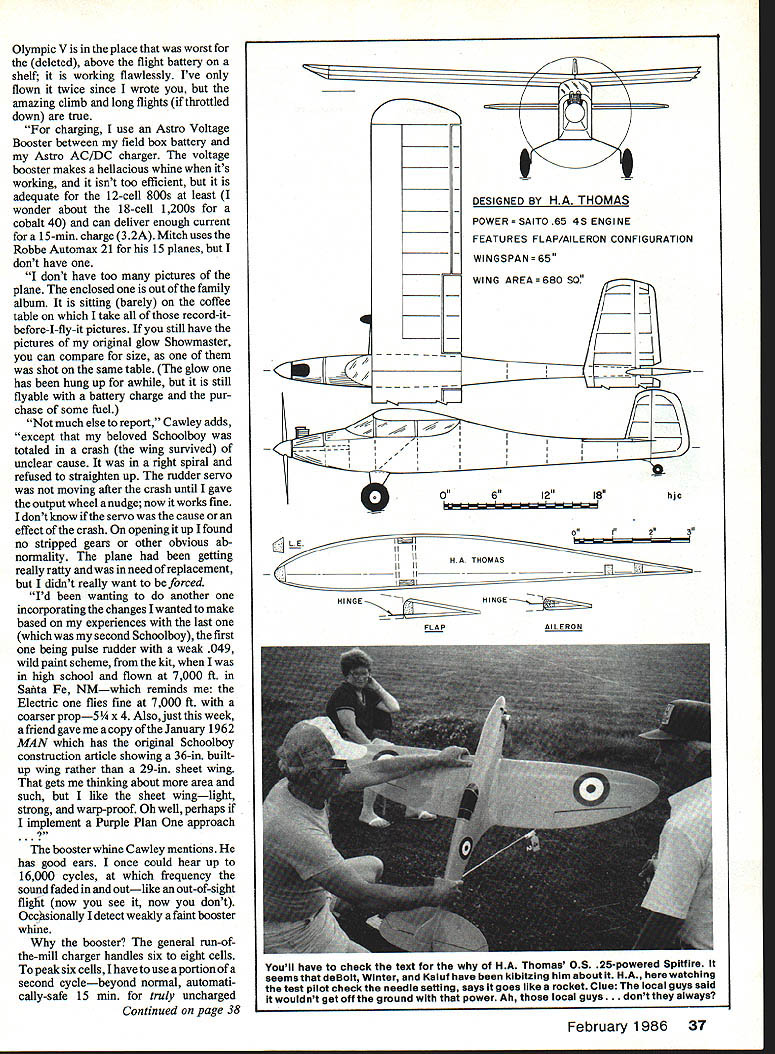
You may recall earlier pictures of H.A. Thomas' pretty 1/2A cabin model (with ground-adjustable flaps), which he flies from parking lots, ball fields, pastures, whatever. He has the notion he wants a big four-stroke version to "fly with the Ugly Stiks." I've corresponded with the artistically gifted H.A. for 48 years and a big reason now for symptoms of the acrobatic/go-fast syndrome. He was persuaded that his little O.S. .15 Spitfire (see pic) was so sensitive I'd need help to fly it safely, and said I'd be inclined to move the CG forward and cut down control throws. Hal DeBolt, long a skilled pilot, chimed in with a how-to treatise. So now, I sneak-preview H.A.'s proposed four-stroke cabin. I whispered that the ailerons seemed a bit gentle. H.A. says Bill Kuhn had the same comment, so I draw a broken line on the left aileron as a guess for what H.A.'s hinge line might become. H.A. is stubborn — so who knows? He does want to fly with the Ugly Stiks! Note the nice flaps.
H.A. envisioned a Saito .45, but this now becomes a Saito .65. My bigger Krackerjac at 7¼ lb. (H.A. shoots for 4 lb.) does consecutive outside rolls with essentially a flat-bottom airfoil with an Enya .46 four-stroke on only a 10-7 prop. That's with the power stick straight up and two-thirds down-elevator. One shocked model mag editor commented that guys would insist on .90 four-strokes in such a beast. H.A. can pull whatever power is needed from his .65, and it will have superior vertical performance. H.A. says he will shorten the nose ½ in., as four-strokes are heavier.
H.A., once an active walker, is a cool hand. You'll enjoy his comments:
"Your letter kidded me about being tied and power happy," he retorted. "Tain't so, Bill. That's why I put only a .25 in the spot. Some of the guys who saw my fuselage profile said it would never get off the ground. It's a rocket. I am going to enjoy the luxury of flying around easily at half throttle with the FS job. But I yearn to be able to do a realistic crossed-control slip into a landing."
And about that cabin: "Surprised to learn your Krackerjac weighs 7¼ lb. I am shooting for around 4 lb., and this morning bought a Saito .65. Hartsfield says I am crazy, that the .45 would be more than ample. He reminds me of John Sadler, who was just as stubborn. Sadler would say, 'Anything you do is OK, H.A. Just do it your way.' Sinatra patented that!"
Bill Winter, 4432 Altura Ct., Fairfax, VA 22030
Transcribed from original scans by AI. Minor OCR errors may remain.

