
Just for the Fun of It: Plane Talk
Bill Winter
YOU SAY you love nostalgia. I think of it as history, things that are past but not gone. Modeling is a continuum. My "nostalgic" things are mostly contributed by others. The what's-next beckons me. But it would be a sad loss if our yesterdays had no relationship to our tomorrows. The Wright Flyer is not nostalgic. It is awesome to see it in the National Air and Space Museum. Today's scientists respect the classic "systems approach" that produced it.
Now, let's pick up with Paul Brown, who runs an industrial company in Hobart, IN.
"I was only 17½ years old at the Nats in 1930," Paul recalls. "There were only three or four people in this area interested in model aircraft, and I got my info from American Boy magazine." (Au.: American Boy, a wonderful magazine which lasted for decades until the Depression, published news and plans for the AMLA, predecessor to AMA, with 300,000 members.) "I've continued my interest through the years, flying FF, Indoor, Control Line, Radio Control, and Electrics."
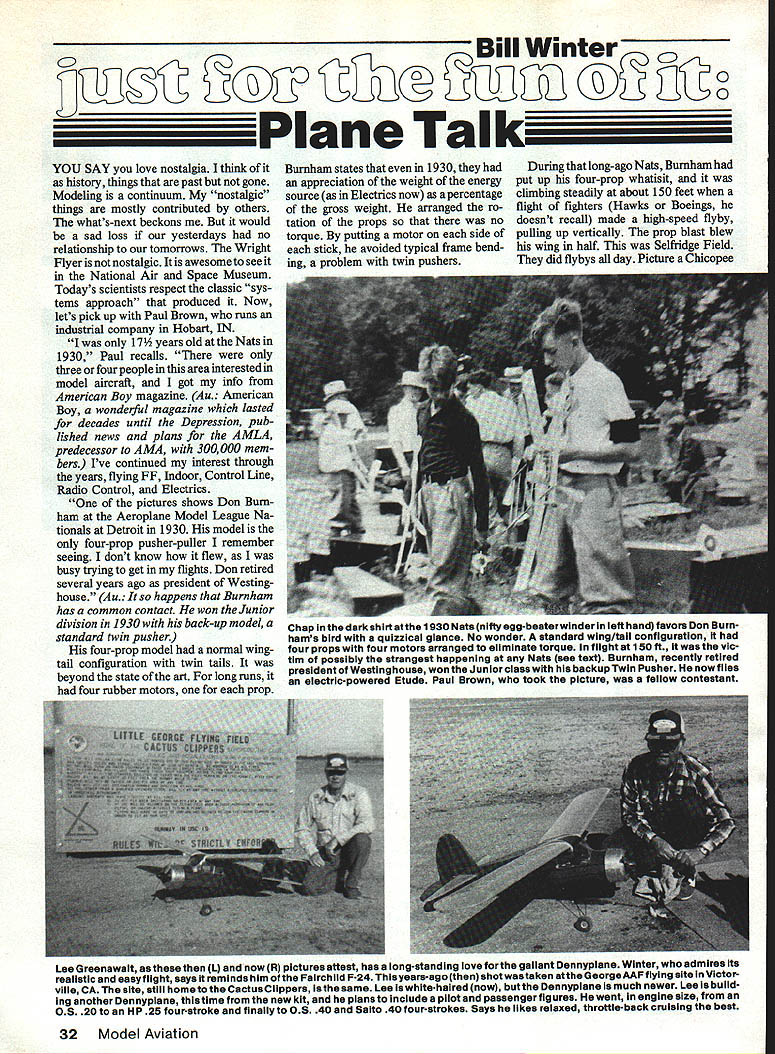
One of the pictures shows Don Burnham at the Aeroplane Model League Nationals at Detroit in 1930. His model is the only four-prop pusher-puller I remember seeing. I don't know how it flew, as I was busy trying to get in my flights. Don retired several years ago as president of Westinghouse. (Au.: It so happens that Burnham has a common contact. He won the Junior division in 1930 with his back-up model, a standard twin pusher.)
His four-prop model had a normal wing-tail configuration with twin tails. It was beyond the state of the art. For long runs, it had four rubber motors, one for each prop.
Burnham states that even in 1930, they had an appreciation of the weight of the energy source (as in Electrics now) as a percentage of the gross weight. He arranged the rotation of the props so that there was no torque. By putting a motor on each side of each stick, he avoided typical frame bending, a problem with twin pushers.
During that long-ago Nats, Burnham had put up his four-prop model, and it was climbing steadily to about 150 feet when a flight of fighters (Hawks or Boeings, he doesn't recall) made a high-speed flyby, pulling up vertically. The prop blast blew his wing in half. This was Selfridge Field. They did flybys all day.
Nats with Blue Angels buzzing the joint constantly! Hawks were stationed there, and Jane's says Selfridge was home to the First Pursuit Group, consisting of three fighter squadrons—and other type squadrons. So maybe Boeings, too.
Paul Brown included two pictures of himself, one with an absolutely stunning Legionaire Sailplane and another of a Bridi Two-Meter Glider with an .05 electric motor on a 6-4 prop (says it flies fairly well at 39 oz, but is marginal in wind). The field looks like Shangri-La, and I can't tell the difference between Paul and me ... but he builds better than I do.
Before we exit this twilight zone, Paul and Don Burnham are in touch after 55 years, and Don is about to fly his electric-powered Etude.
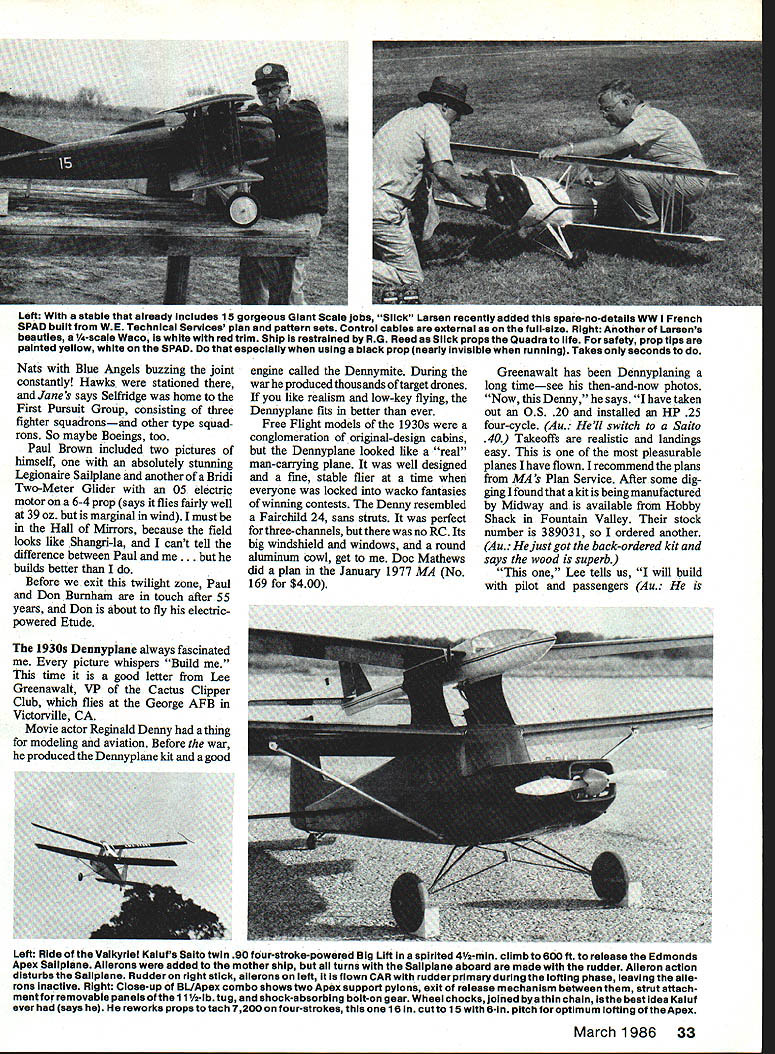
The 1930s Dennyplane always fascinated me. Every picture whispers "Build me." This time it is a good letter from Lee Greenawalt, VP of the Cactus Clipper Club, which flies at George AFB in Victorville, CA.
Movie actor Reginald Denny had a thing for modeling and aviation. Before the war, he produced the Dennyplane kit and a good engine called the Dennymite. During the war he produced thousands of target drones; the Dennyplane retained its realism in low-key flying. The Dennyplane fits better than ever.
Free Flight models of the 1930s were a conglomeration of original-design cabins, and the Dennyplane looked like a "real" man-carrying plane. It was well designed and a fine stable flier at a time when everyone was locked into wacko fantasies of winning contests. The Denny resembled a Fairchild 24, sans struts. It was perfect for three-channels, but there was no RC. Its big windshield and windows, and a round aluminum cowl, get to me. Doc Mathews did a plan in the January 1977 MA (No. 169 for $4.00).
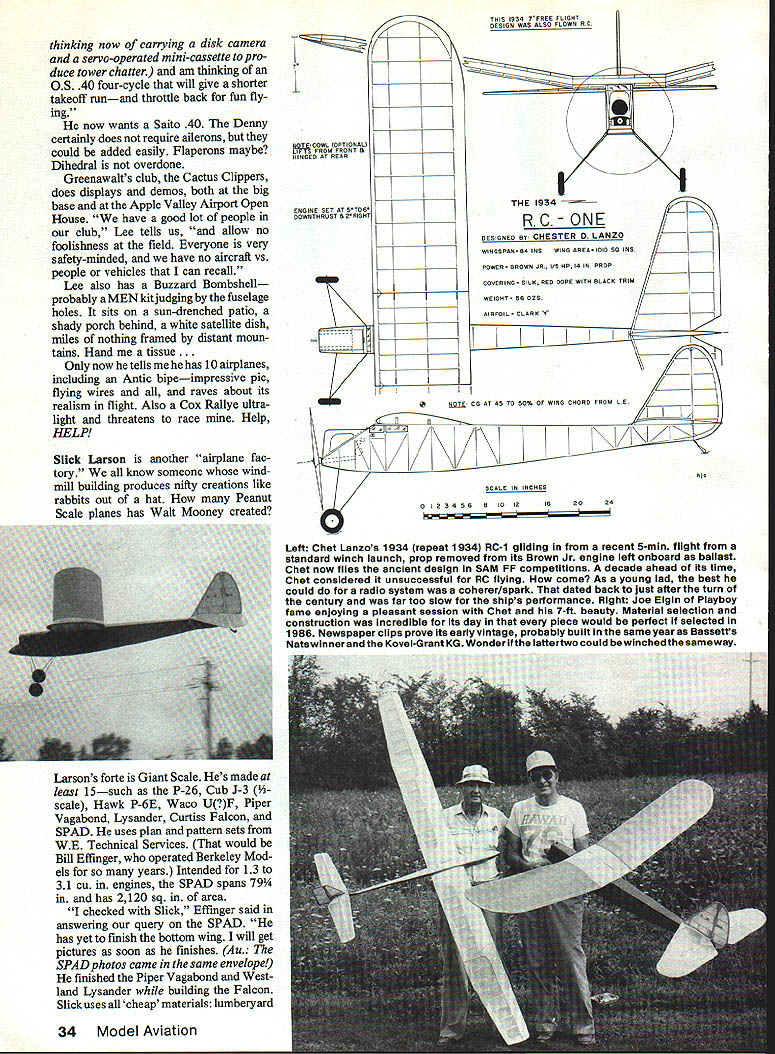
Greenawalt has been Dennyplaning a long time—see his then-and-now photos. "Now," this Denny, he says, "I have taken out an O.S. .20 and installed an H.P. .25 four-cycle." (Au.: He'll switch to a Saito .40.) "Takeoffs are realistic and landings easy. This is one of the most pleasurable planes I have flown. I recommend the plans from MA's Plan Service. After some digging I found that a kit is being manufactured by Midway and is available from Hobby Shack in Fountain Valley. Their stock number is 389031, so I ordered another." (Au.: He just got the back-ordered kit and says the wood is superb.)
"This one," Lee tells us, "I will build with pilot and passengers." (He is thinking of carrying a disk camera and a servo-operated mini-cassette to produce tower chatter.) He is considering an O.S. .40 four-cycle that will give a shorter takeoff run—and throttle back for fun flying. He now wants a Saito .40. The Denny certainly does not require ailerons, but they could be added easily. Flaperons maybe? Dihedral is not overdone.
Greenawalt's club, the Cactus Clippers, does displays and demos, both at the big base and at the Apple Valley Airport Open House. "We have a good lot of people in our club," Lee tells us, "and allow no foolishness at the field. Everyone is safety-minded, and we have no aircraft vs. people or vehicles that I can recall."
Lee also has a Buzzard Bombshell—probably a MEN kit judging by the fuselage holes. It sits on a sun-drenched patio, a shady porch behind, a white satellite dish, miles of nothing framed by distant mountains.
He tells me he has 10 airplanes, including:
- an Antic bipe (impressive picture, flying wires and all, and raves about its realism in flight),
- a Cox Rallye ultralight (and threatens to race mine),
- plus a variety of other nostalgic and scale ships.
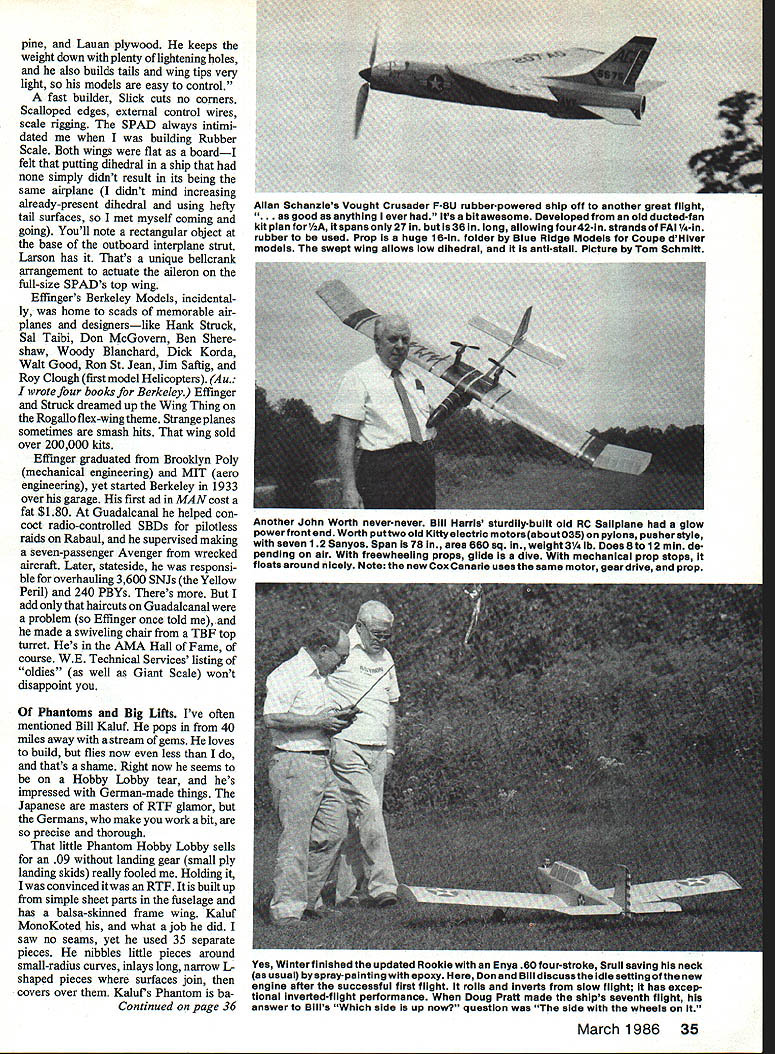
Slick Larson is another "airplane factory." We all know someone whose windmill building produces nifty creations like rabbits out of a hat. Larson's forte is Giant Scale. He's made at least 15, such as:
- P-26,
- Cub J-3 (1/3-scale),
- Hawk P-6E,
- Waco U,
- Piper Vagabond,
- Lysander,
- Curtiss Falcon,
- SPAD.
He uses plan and pattern sets from W.E. Technical Services (that would be Bill Effinger, who operated Berkeley Models for many years). Intended for 1.3 to 3.1 cu. in. engines, the SPAD spans 79¼ in. and has 2,120 sq. in. of area.
"I checked with Slick," Effinger said in answering our query on the SPAD. "He has yet to finish the bottom wing. I will get pictures as soon as he finishes." (Au.: The SPAD photos came in the same envelope!) He finished the Piper Vagabond and Westland Lysander while building the Falcon. Slick uses all "cheap" materials: lumberyard pine and Lauan plywood. He keeps the weight down with plenty of lightening holes, and he also builds tails and wing tips very light, so his models are easy to control.
A fast builder, Slick cuts no corners. Scalloped edges, external control wires, scale rigging. The SPAD always intimidated me when I was building Rubber Scale. Both wings were flat as a board—I felt that putting dihedral in a ship that had none simply didn't result in its being the same airplane (I didn't mind increasing already-present dihedral and using hefty tail surfaces). You'll note a rectangular object at the base of the outboard interplane strut. Larson has it. That's a unique bellcrank arrangement to actuate the aileron on the full-size SPAD's top wing.
Effinger's Berkeley Models, incidentally, was home to scads of memorable airplanes and designers—like Hank Struck, Sal Taibi, Don McGovern, Ben Shereshaw, Woody Blanchard, Dick Korda, Walt Good, Ron St. Jean, Jim Saftig, and Roy Clough (first model helicopters). (Au.: I wrote four books for Berkeley.) Effinger and Struck dreamed up the Wing Thing on the Rogallo flex-wing theme. Strange planes sometimes are smash hits. That wing sold over 200,000 kits.
Effinger graduated from Brooklyn Poly (mechanical engineering) and MIT (aero engineering), yet started Berkeley in 1933 over his garage. His first ad in MAN cost a flat $1.80. At Guadalcanal he helped concoct radio-controlled SBDs for pilotless raids on Rabaul, and he supervised making a seven-passenger Avenger from wrecked aircraft. Later, stateside, he was responsible for overhauling 3,600 SNJs (the Yellow Peril) and 240 PBYs. There's more. But I add only that haircuts over Guadalcanal were a problem (so Effinger once told me), and he made a swiveling chair from a TBF top turret. He's in the AMA Hall of Fame, of course. W.E. Technical Services' listing of "oldies" (as well as Giant Scale) won't disappoint you.
Of Phantoms and Big Lifts
I've often mentioned Bill Kaluf. He pops in from 40 miles away with a stream of gems. He loves to build, but flies more now even less than I do, and that's a shame. Right now he seems to be on a Hobby Lobby tear, and he's impressed with German-made things. The Japanese are masters of RTF glamor, but the Germans, who make you work a bit, are so precise and thorough.
That little Phantom Hobby Lobby sells for an .09 without landing gear (small ply landing skids) really fooled me. Holding it, I was convinced it was an RTF. It is built up from simple sheet parts in the fuselage and has a balsa-skinned frame wing. Kaluf MonoKote'd his, and what a job he did. I saw no seams, yet he used 35 separate pieces. He nibbles little pieces around small-radius curves, inlays long, narrow L-shaped pieces where surfaces join, then covers over them. Kaluf's Phantom is basically white, USAF deco with a red nose and black pinstriping. He gave the pretty bird to Jim Martin, who'll use it for show displays.
There's a significant item in the Phantom. "...using the European Bowden cable," said Kaluf, "You simply would not believe the absolute absence of any play until you use this. There are three parts: 1) an outer casing, 2) a very close-fitting inner casing, and 3) a 5 mm steel piano wire. The 5 mm is soldered into a threaded coupler so a clevis can be screwed on. It is a concept that you think won't work. Seems three pieces would give more slop; it does not. I checked. It is smooth and easy through bends. Don't ask how."
"I've included pictures of the Macchi Big Lift," Kaluf writes. "Note the wheel chocks—best little idea I ever had. Mounted on the cradle is the 99-in. Edmonds, a most stable sailplane capable of catching thermals with the best. In the same photo, see my shock system. It uses two #64 bands. Prop is carved to my own pattern. We fly it as 1-5.5 prop with no load, 1.5-6 with load. Note the climb angle in the flight shot. Steve could haul it to 600 ft. in 4½ minutes and be back on the ground after sailplane release in 35 seconds—leaving enough time to haul up a second glider while the first is still aloft. I love this airplane. She's built. Gear is held on by 16 4-40 bolts and blind nuts."
Now Kaluf is fussing with an AS W22 Elektro, a 9½-in. electric with Graupner folder and extension shaft. Has 3:1 reduction, uses two packs of 6V each. Electric power is Greek to Kaluf, but knowing him, I've got him interested in lifting it to altitude on his Big Lift—before starting the motor. Staggering, isn't it?
I noted the Big Lift in Hobby Lobby ads. Then Peter Miller, a regular contributor to a British RC mag, sent a copy of their equivalent of our National Geographic. The editor had chosen to comment in depth on Peter's Big Lift, which is used for aero photography. Peter's scientific use of model-borne cameras to search out Roman ruins, tidal flows, etc., is a distinguished achievement. Then Kaluf bounced in with his new Big Lift and fitted on its cradle the Edmonds Apex Sailplane. The structure of the motor ship is painstakingly engineered, and Kaluf's craftsmanship and installations are well out of my league.
Big Lift is for three-channel controls, and that's all it needs. Kaluf wanted ailerons, and my advice was to make them small, just useful at times, since aerobatics was not a goal. As it proved out, rudder/elevator/engine is superior for glider release, because use of ailerons changes the airflow between the wings of the two planes, and the glider then does not ride wing-steady. To me, Big Lift is a close copy of the Macchi-Lockheed, a short-fuselage biplane built in Italy in roughly 1960, and afterwards in Canada and other countries. Photos in Jane's seem to confirm this.
Kaluf actually went to Missouri so his son, Steve, at Ace RC, could flight-evaluate the Big Lift and the combo. Holding up-elevator to keep the tail down on the start of the run into a 5- to 8-mph wind, the Big Lift was off in 15 ft. Steve was still holding half-up and advancing the throttle to maintain an impressive climb.
Basic specs for the Big Lift:
- span just under 8 ft.,
- weight 11 3/4 lb.
Kaluf's Saito twin is revved at 7,200 rpm, and he selects a prop for that rpm; in this case he reworked 15x4.5 or 6. Five-inch pitch seems best. (He cuts down a 16-in. prop to give a 15-in. chord at the tip, wide point at 61% of the radius.) Idle was tached at 900 rpm, a true tick-over. Folks will insist his tach must be out of order. I saw a Saito .45 tached at 900. Doug Pratt runs many four-stroke engines, so I double-checked. He is taching his Saito .45 at 1,200 and the twin .90 at 1,000 and says that could be lowered.
"Takeoff went flawlessly," Steve Kaluf reported of the first glider-lift, "as the aircraft didn't seem to know that it was carrying a couple of extra pounds. If anything it was climbing a bit better due to the extra lift that extra set of wings was providing — gain a good amount of altitude before attempting to make any turns. For the first flight we wrongly decided to use coupled ailerons and rudder instead of using only the rudder. The aircraft did not respond to the controls as well as it normally did. More aileron/rudder was tried to make a good turn. The sailplane's wing immediately flexed, then it tilted to one side. The aircraft pitched down into a dive. I decided to uncouple the CA and fly with the rudder. This worked out.
"To make control easier during lofting," Steve further reports, "we put rudder-control on the aileron channel and the ailerons on the rudder channel. Still retained CA but just flew with the rudder instead of the ailerons — when the mixer was not turned on. Rudder was used while the glider was aboard. At launch point, I gave the glider pilot a 5-sec. countdown to drop-off. On the count of one, I would throw the release channel, and the glider floated free. Just prior to starting the countdown, power was cut to 1/4-throttle, which put the aircraft in a shallow dive. This allows maintaining a fair amount of airspeed and provides a margin of safety at release, since the Big Lift continues down, and the glider maintains its launch attitude."
Awe. Humility. Incredulity. How I feel about Chet Lanzo's RC-1. Two issues ago, I used, thanks to Hal deBolt, a photo of an RC-1 built by Tom McCoy, a builder's builder who competes seriously in SAM (Society of Antique Modelers) events. Since then, correspondence with Tom produced documentation, including newspaper clips, which prove the RC-1 did indeed fly in 1934, which suggests that the model probably was designed in the same year (1933) that Bassett swept the Nats with the "first" gas model. (I know of successful gas models dating to 1904.) That probably was the year in which the Kovel-Grant KG was built. I examined Bassett models as a timer in the mid-30s, and the KG, in a similar role, in 1935. In its across-the-board correctness, in layout and structure, the RC-1 is difficult to believe. Radio? In 1934?
We all know (or should) who Chet Lanzo is. Not only are many of his 40- and 50-year-old design pioneers (FF, Rubber and Gas and RC) now vividly built, but until two serious operations recently laid him low, Chet, self-effacing and little changed, showed up and flew at many Old-Timer meets.
But how is it that the public never heard of the RC-1? Chet has been flying it as an Antique FF. His "first" RC, in the AMA Museum, is dated 1937—and his 1934 airplane design far outclassed it (the pictures and three-view speak for themselves). I have full-size plans and background from Chet. He sells these plans for $8.00 postage paid (Chet Lanzo, 1485 Lester Rd., Valley City, OH 44280). (He sure doesn't push them; you have to know.) For this reason, structural details in Herb Clukey's three-view drawing are merely suggestive.
"The model was used to find out some things on RC in the early days," Chet tells us. "It was not a spectacular success as a radio model but was quite a good-flying machine." (Au.: There were no servos or even escapements at that time, which was well before the Good brothers.)
"I learned," Chet continues, "that the 7-ft. span and Brown power made it much too fast for the slow-operating RC equipment that I had built. The equipment was a coherer and spark transmitter—'nuff said.
"In one picture is Joe Elgin of Playboy fame with his RC sailplane and me with my 1934 RC-1. I was flying it as a sailplane with standard tow winch. Got flights of up to 5 min. Not bad for a 52-year-old design. The other picture shows me bringing in my 1934 RC-1 as a glider from a nice long flight. I used a Brown Jr. up front for ballast and standard rudder-elevator controls.
"Have flown the RC-1 in Antique Gas and am very happy with its old-timer flying qualities. McCoy built a beautiful RC-1 and placed second with it at the Toledo Show, I believe. That guy does beautiful work. So you see from the pix that the model is real, and it flies up a storm."
Thoughts. My first gas job came two to three years later, because $21.50 engines were like a Mercedes, and $9.00 wholesale for a Baby Cyclone was a needed break. My first RC came 13 years later than the RC-1, only because the Good brothers gifted me with the "impossible" radio. And Frank Schmidt, then getting old, produced prior to Orbit the first decent reed radio in the early '50s—because of his irritation with the somewhat unreliable prewar Rockwood reed radios (example: servos with gear trains from British toys). Frank told me of a long-ago RC flight which meandered around Pittsburgh, probably out of control. Harold deBolt says this was in 1923.
Successful RC goes back to shortly after 1900. The great early inventor, Nikola Tesla, rival to Edison and inventor of alternating current, demonstrated a workable model submarine at Madison Square Garden in New York. An article appeared in a 1916 Model Aviation, including the circuit/installations, but nothing on the radio. If anyone researched such mags as Scientific American, we might find Tesla's secrets. Did he, like Lanzo 20 years later, use spark coherers (iron and silver filings)? It was the time of Marconi. I don't find DeForest in my dictionary—didn't he invent the vacuum tube? And when?
What a shame. Chet (probably then around 20) had to make his own crude radio—for the want of a nail in 1934. If you want a genuine good flying Antique RC, not merely some ancient FF with radio in it, here's your chance.
Yo, ho, ho and a bottle of rum. A Cutlass is a nasty member of the sword family favored by pirates, but Allan Schanzle has a thing for the Cutlass, once a first-line Navy fighter, circa early '50s. We are talking of rubber power, son! It seems that in his youthful days, Allan was creamed by a kit of this beast. It was a ducted-fan creation which he says glided fine but under power (.049) acted like a dive-bomber at Midway. When he based his Rubber Scale ship on the old kit drawings, he found out why. The tail had a negative angle of attack relative to the wing and a too-small stabilizer. The short wing and shortened tail moment had been used to compensate for the engine location.
Why rubber power for the Cutlass? The span is 27 in. and the root chord 12 in., giving lots of area on the swept wing—which Schanzle saw as permitting deep dihedral, great stall resistance, and allowing a mammoth prop. With a 36-in. fuselage, the motor was as long as the big strings in a harp. Does it fly?
"You bet it flies," says Allan, "and probably as good as anything I ever had. With four loops of 1/4-in. FAI, each strand 42 in. long, this bomber really gets up on 60% turns...last flight about a minute to at least 100 feet. These Scale jets are fantastic—many of them can be made to fly as well as any of the high-wing cabin monoplanes. But beware of one flight feature. If you build a swept-wing jet, keep the nose down with downthrust...if you don't, you'll see a gorgeous flat spin. On one flight, this lunatic model went through three flat-spin turns and recovered before returning to the forgiving grass. Dave Smith is flying an F-84 and Glen Simpers an F-100. For me, this opens a whole new arena for FF Rubber Scale." (Au.: Allan rounded the radome for a spinner.)
Faced with a prop problem, Allan and Frank Schmitt visited Don Srull. "After all," Allan relates, "Srull can get two minutes on a cinder block. Good grief, Don makes kinds of props as well as pro-forming molds cut from 2 x 4s. Then he says, 'Wait—a minute. I've got something that ought to be perfect.' And out comes a set of preformed prop blades and a Z-shaped wire from Blue Ridge Models. It was designed for a Coupe kit. It is 16 in. in diameter (Au.: Well over half the span of the Cutlass), but very light, a requirement due to the obscenely-long nose of my F-8."
Life is like this in the land of Rubber Scale. These lovable "nuts" have rubberized practically every machine in history. Research is a big portion for truffles. As a historic Rubber Scaler, I rejoice in their numbers. You should know that one magazine found a Rubber Scale model to be its No. 1 plans seller for the year. Try that for chewing tobacco.
The Rookie
This updated version of my early-'60s model (then in MAN) proves itself a nice bird, very easy to fly with basic/advanced trainer traits well mixed. Nothing to touch — on the second flight it was rolling and inverting from near slow flight. Don Srull made the first six flights, Doug Pratt the seventh. Doug stayed inverted for so long, well out, touring the country, that twice during that episode I had to ask him which side was up.
Usual thoughts. The original was two pounds lighter on a K&B .45. This one (also .45, c.g. span 6 ft., area covered with Koverall, finished with epoxy paint, and powered by a hefty Enya .60 four-stroke) is, nevertheless, slightly loaded and does bounce around in a wind. For inverted flight only slight down-elevator needs to be held. Normally, advanced fliers don't like the front lines to be high, because the nose rises (only a bit) when throttling back. I feel safer with that trait, but I haven't noticed it yet in this case. Perhaps an offset in thrust has advantages. The high aspect ratio does seek to hold the nose down when the wing is stalled, interestingly, up when in a stall. After all, my inverted-engined Chipmunk is a premier aerobatics machine.
My impression of four-stroke engines is that any notions of a ratio of 60% power to weight of a two-stroke is thin-ice stuff. I still don't have the maximum performance prop, but a 14-6 pulls like a farm tractor. Ground checking at high power really requires the helper to have a two-hand hold for restraint. You hear the air tearing—like ripping silk. Only the Giant Scale folks seem to understand big props and brute power in terms of thrust and torque. An 11-8 on my ship is an absolute dog. It is a bit sad to see the seemingly mad drive to make the four-cycles go faster with small props, trying to make them behave like familiar two-strokes. It is evident that the Rookie requires right thrust—too late now. The torque twists it out of outsides—so far. We don't use the choke at all, and starting is quick (with a starter). Even though the gross is well over 8 lb., there is no apparent need for the bigger Enya .80, which is basically a re-bored .60 but 3 oz. lighter. Maybe you hotshots? On the .60 with that 14-6, the ship goes airborne during a moderately fast taxi upon hitting the slightest bump.
Don't ask for plans. There are none. Rosenstock sells plans of the authentic 1960s version. One thing: with this four-stroke engine it was necessary to place the 1,000 mAh pack above the CG instead of in the nose. And a word of caution. If your engine has a front plug, do use a remote booster hookup. On just seven flights, two guys have nicked fingers. Certain props in this size could easily remove a finger, though this is a user responsibility. We now hold the cylinder head with the same hand that takes care of detaching the battery clip (never locked on, but you really need a metered glow driver to be sure that you don't load up the engine due to no battery contact; that loosens the prop). Don't count on how smart you are.
Bill Winter 4432 Altura Ct., Fairfax, VA 22030.
Transcribed from original scans by AI. Minor OCR errors may remain.

