

Just For The Fun Of It: Plane Talk
Bill Winter
Twilight Zone: Beachey and Backstrom
Lincoln Beachey, the glamour pilot of the early century, said, "Give me a barn door, and I will fly it." Al Backstrom would be horrified to be compared to the immortal Beachey—Beachey was quite mortal, going out with his boots on while thrilling the multitudes at the San Francisco Golden Gate Exposition in 1915. Al designs and flies full-scale "planks." Planks go way back, notably in Europe, but Backstrom's addiction to these finicky birds, both gliders and powered, has attracted the attention of home-builders. His long involvement with fringe models similarly reflects a lifetime fascination with gliders and tailless aircraft.
What's a plank?
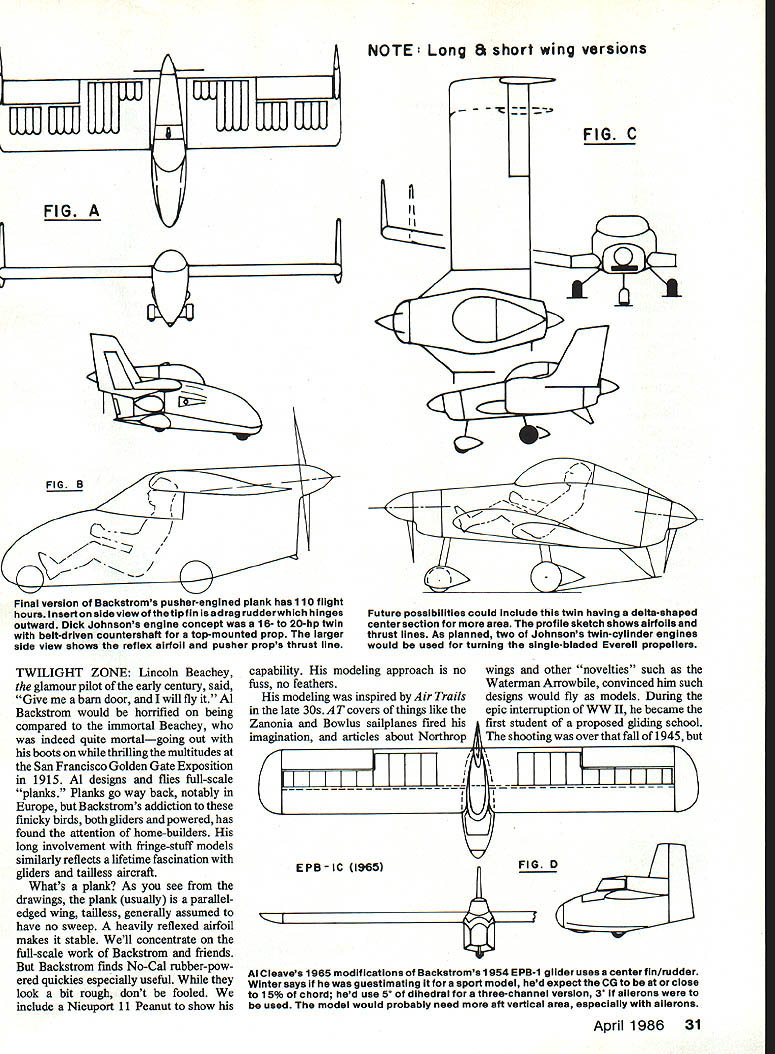
A plank is typically a parallel-edged, tailless wing, generally assumed to have no sweep. A heavily reflexed airfoil provides stability. This article concentrates on the full-scale work of Backstrom and his associates, though his modeling work—especially No-Cal rubber-powered quickies and a Nieuport 11 Peanut—demonstrates his no-fuss, no-feathers approach.
Backstrom: background and development
Al's modeling was inspired by Air Trails in the late '30s. Covers showing the Zanonia and Bowlus sailplanes fired his imagination, and articles about Northrop wings and other novelties such as the Waterman Aerobile convinced him such designs would fly as models.
During WWII he became the first student of a proposed gliding school. After the war he went to the Pacific in 1946 and drifted into Northrop's engineering school. In 1947 he saw flights of the huge Northrop XB-49 jet-powered flying wing; in 1948 Chance-Vought produced the Cutlass, a swept-wing tailless Navy carrier jet fighter. In 1950 he enrolled in Aero Engineering at Mississippi State, and in his junior and senior years he specialized in studies of tailless craft. Vought worked on the prototype Regulus cruise-type missile. Along the way he gained Bowlus experience, earned a commercial glider rating, and the last two-digit U.S. Silver Badge in soaring.
Soaring studies at Mississippi concluded the plank configuration was the best try. At Mississippi State Al came under the influence of Gus Raspet and formed a lifetime association. An avid modeler, Al continued to explore tailless designs throughout his career.
The EPB-1 plank
Back at Vought in the early '50s, Al doodled a 36-ft plank with an aspect ratio over 9. When his profile test model demonstrated soaring potential, colleagues said, "Let's build it." In 1954 the 26-ft 5-in EPB-1 was flying. By 1956 the ship was flyable by students with a few solo hours as well as famous pilots like Paul MacCready, Dick Schreder, and Paul Bickle. Ted Jancarek developed aerobatic routines and flew air shows in the plank. Van White handled construction of the powered version; Dick Johnson was the engine genius. Plans were sold and several EPB-1As were built. A comprehensive article appeared in Bungee Cord (summer 1968), and powered variations were published in Sport Aviation (February 1976 and February 1980, the latter with a full-color center spread).
Modeling and approach
Backstrom finds No-Cal rubber-powered quickies especially useful for experimentation. Though they can look rough, they reveal design capability; the included Nieuport 11 Peanut illustrates his workmanship and flying finesse. His modeling approach is straightforward—practical and unpretentious.
Wing-loading tease
Bill Winter has an ongoing interest in wing loading—the gross weight (in ounces) divided by wing area (in square feet). He notes that small planes behave differently from larger ones, so a universal "best" wing loading is invalid. He'd like a practical set of curves or charts to help builders match realistic wing loadings to their designs.
Two readers contribute remarks that extend this discussion: Roy Strader and Jeff McCammant. Their letters raise dimensional and scaling questions that are useful for modelers and full-scale experimenters alike.
Roy Strader on span loading and aspect ratio
Roy Strader, who first flew ROGs in 1929 and now pursues Rubber Scale, Old-Timers, and Antiques, emphasizes that changes in wing dimensions must consider three-dimensional effects. When wing dimensions are doubled, volume increases eightfold, affecting the volume of air displaced. Roy also discusses span loading (pounds supported per foot of span) and aspect ratio. He points out practical tradeoffs—low-aspect wings (e.g., Piper Pacers) can give a smoother ride and more solid landing behavior compared to long, high-aspect wings that float and can be rough on bumpy days. His observations on model analogues (eg, Monarch vs. Kadet) are well taken.
Jeff McCammant, Ron St. Jean, and three-dimensional wing loading
Jeff McCammant (editor of the Marshalltown RCer's Flyer) forwarded an article by Ron St. Jean that challenges conventional two-dimensional wing-loading concepts. St. Jean argues wing loading should be considered three-dimensionally—weight per unit wing volume (ounces per cubic inch)—because a wing has span, chord, and thickness.
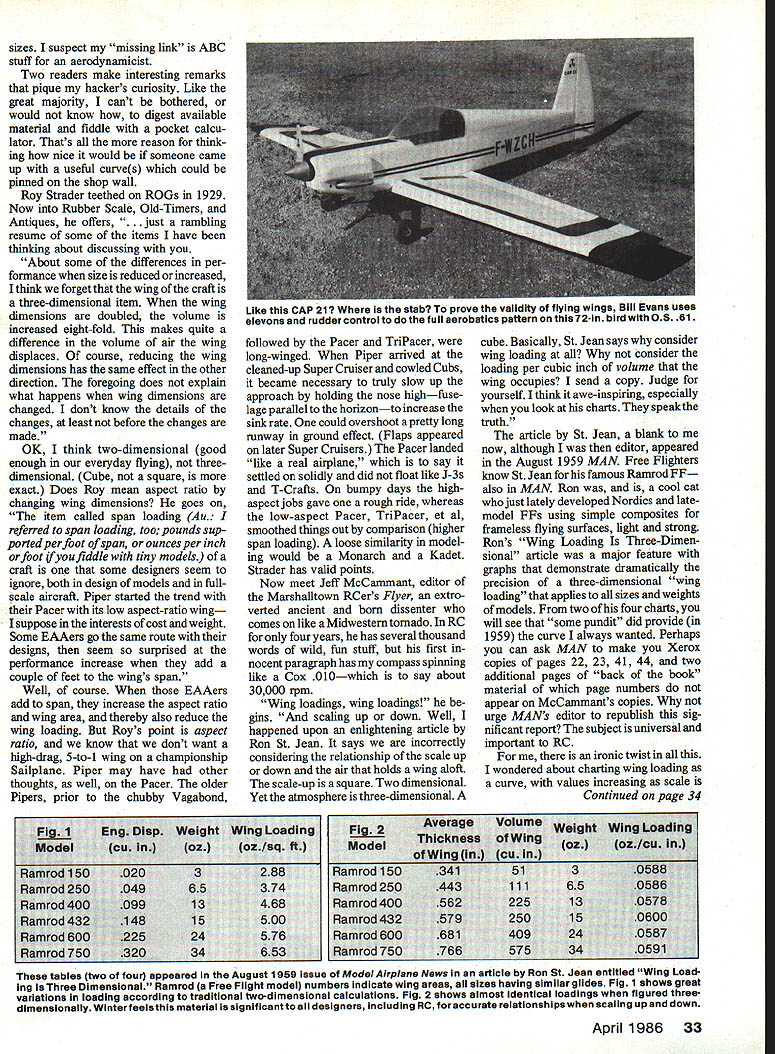
St. Jean's tests with his Ramrod free-flight fleet showed small and large models glided similarly despite differing area-based wing loadings. By calculating wing volume (using average thickness derived from rib area divided by chord) and then dividing weight by wing volume, he found the cubic wing loading was nearly identical across sizes. From this he formulated a scaling rule:
- To retain the same glide when scaling a design, the wing volume should be made directly proportional to the weight.
- Equivalently, weight should be proportional to the cube of the span, or to the 3/2 power of the area (i.e., the square root of area cubed).
St. Jean's charts (published in the August 1959 MAN) vividly illustrated this principle. Winter suggests readers seek copies of that MAN feature (pages 22, 23, 41, 44, and related back-of-book pages) for the universal significance to RC and model design.
Training, beginners, and recommendations
Jeff McCammant rejects the conventional trainer route and taught himself on a sailplane (a Sig Riser Rider fitted with a power pod). His approach—start, toss, climb, play, land at your feet—proved revolutionary in his club and inspired others to adopt powered gliders as trainers. Gliders give generous reaction time and are forgiving.
Bill Winter agrees that trainers should be forgiving. He notes many beginners learn on "Gentle Lady"-type kits and that a powered glider or pod-mounted .049 can be excellent primary trainers. For electric training, start simply: a common .05 electric motor and six 1.2 Ah Sanyo cells will do, with later experimentation possible.
Thrust-line advice:
- Nose-mounted power (glow or electric) usually requires downthrust (at least 2°, possibly 4–5°) to counteract excess lift at higher airspeeds and prevent a nose-high stall.
- A pod-mounted engine positioned above the CG and center of drag can have a similar effect to downthrust.
If you opt for a fast .40-powered, four-channel trainer, make sure the seller includes a certified instructor who communicates well; otherwise, learning can be slow and frustrating at busy fields. If you must learn solo, previous experience with other models helps.
Field boxes and equipment
Field boxes have evolved from simple doorbell-battery setups to heavy, elaborate benches. Bill Winter reminisces about detachable-leg field boxes and the evolution of starters, wet cells, glow drivers, fuel pumps, power panels, gallon fuel cans, and transmitter trays. Field boxes can be heavy and high-tech; simplicity still has virtues.
PVC field stand—Bill H. Greenhalgh
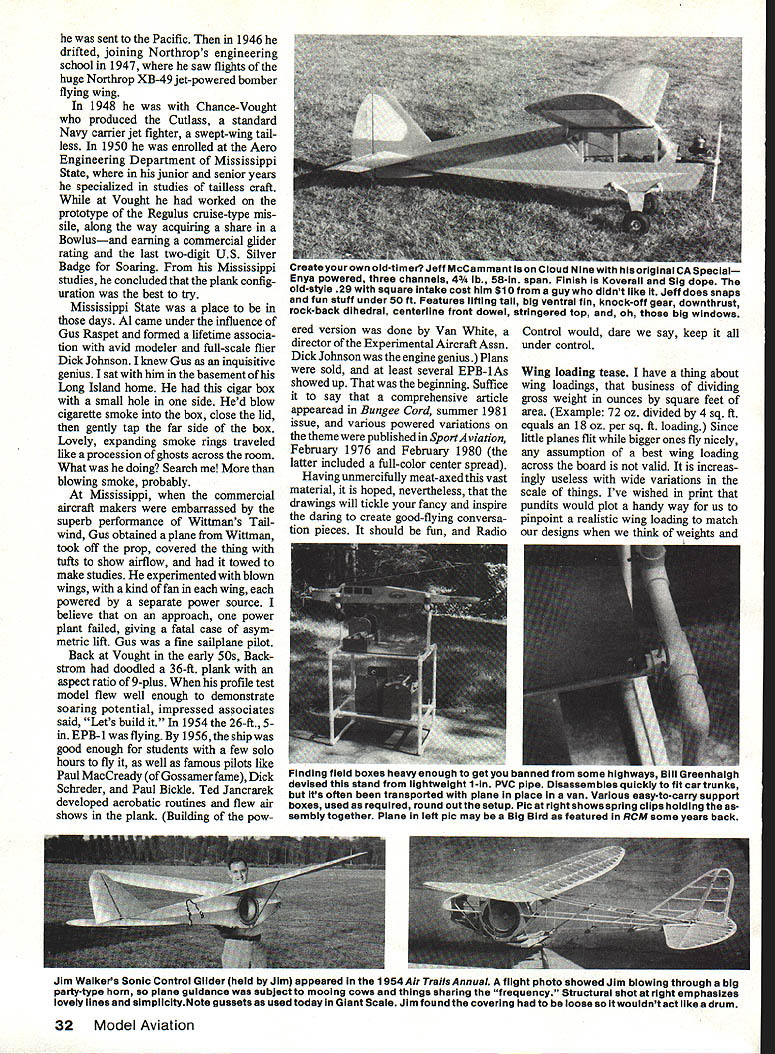
Bill H. Greenhalgh of Wetumpka, AL, wrote about his practical solution for a light, stand-up field box. Too old for the hands-and-knees routine, he built a stand of 1-inch PVC pipe consisting of two ends and two shelves. Airplane supports fasten to the ends with bolts and wing nuts, allowing quick changeover to fit different fuselages. Padding on the supports uses insulation sold for PVC pipe. The stand is light, comfortable, and easy to handle.
When responding to advertisers, mention that you read about them in Model Aviation.
Illustrations and captions (summarized)
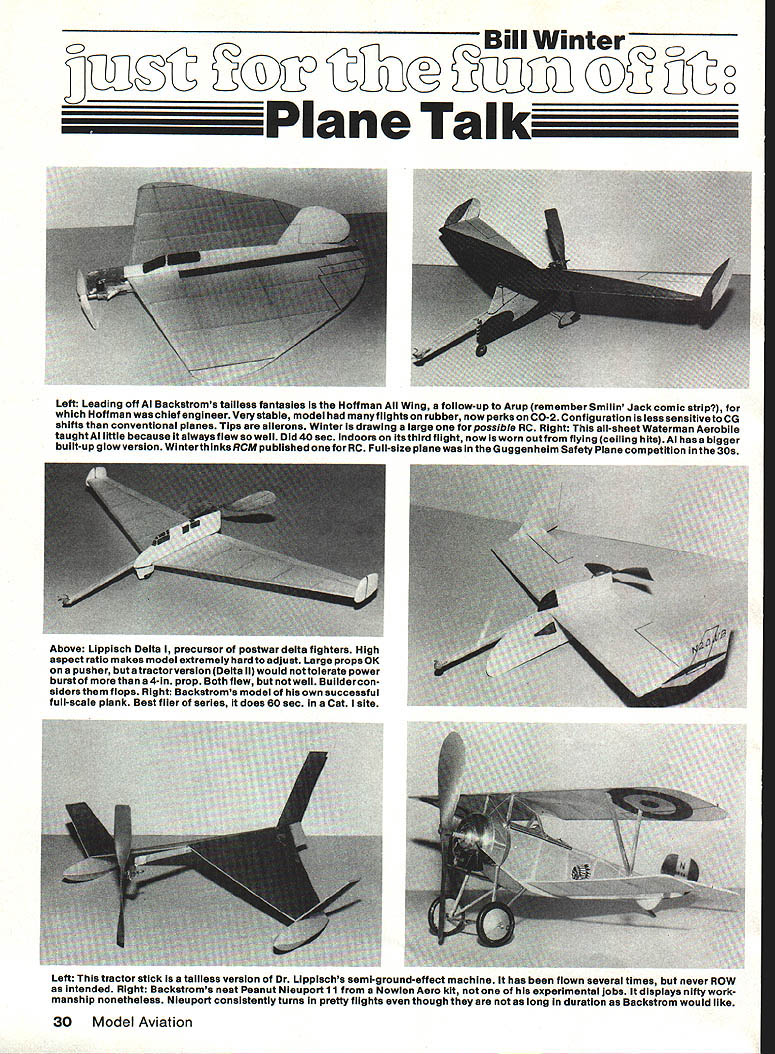
- Left: Hoffman wing follow-up, Arup-type. Very stable model with rubber power or CO2. Less sensitive to CG shifts than conventional planes; tips have ailerons. Large possible RC conversion.
- Right: All-sheet Waterman Aerobile. Always flew well—did 40 seconds indoors. A larger built-up glow version exists.
- Above: Lippisch delta precursor to postwar delta fighters. High aspect ratio makes model difficult to trim. Options include large props, pusher or tractor versions.
- Right: Backstrom's successful full-scale plank family. Tractor-stick tailless version and a semi-ground-effect machine by Dr. Lippisch have flown. Backstrom's Peanut Nieuport 11 (Nowlan Aero kit) shows neat workmanship and consistent turning flights.
- Final: Backstrom's pusher-engined plank with 110 flight hours. Tip fin acts as a drag rudder, hinging outward. Dick Johnson's engine concept used twin 16–20 hp units with belt-driven countershaft to a top-mounted prop. The reflex airfoil and pusher thrust lines are shown; future possibilities include twin engines with a delta-shaped center section.
Closing
Having pruned and organized this material, it is hoped the drawings and descriptions will inspire daring builders to create good-flying conversation pieces. It should be fun—and radio control will, dare we say, help keep it all under control.
Transcribed from original scans by AI. Minor OCR errors may remain.

