

Just for the Fun of It: Plane Talk
Bill Winter
THEY SAY you can tell a man by his books. We tell our fellows largely by the kinds of models they build and fly. Before this column sets sail on a three-year journey in search of the Great White Whale, I owe you a landmark.
Resisting the impulse to explore the Alice-in-Wonderland science of preparing competition Scale documentation — that calculated science of thought-controlling judges (show 'em everything but show 'em nuttin') — be it known that documentation done for its own sake can become a book.
This book is about the Albatross — the double S tells you it is not about Scale. The Albatros (one S) was a WW I German fighter.
Tom McCoy, Lanzo and the RC-1
Things such as this grow like ivy. Let's begin with Tom McCoy, whose picture of Lanzo's RC-1 (a radio job from 1934) appeared in this column three months ago. Aware that McCoy is an old buddy of Chet Lanzo, we asked both of them for photos and background. This resulted in the three-view and Chet's exciting photos presented two months back.
During a 1980 bull session, Chet mentioned drawing plans of the forgotten wunderkind, which remark went over Tom's head until he saw Chet fly the pretty bird at the SAM Champs at Westover AFB in 1982. One supposes that none knew what they were looking at. At a subsequent meet in Cleveland, Tom realized this had to be one of the earliest-ever RC jobs, so Chet gave him plans, and "the romance with the RC-1 began."
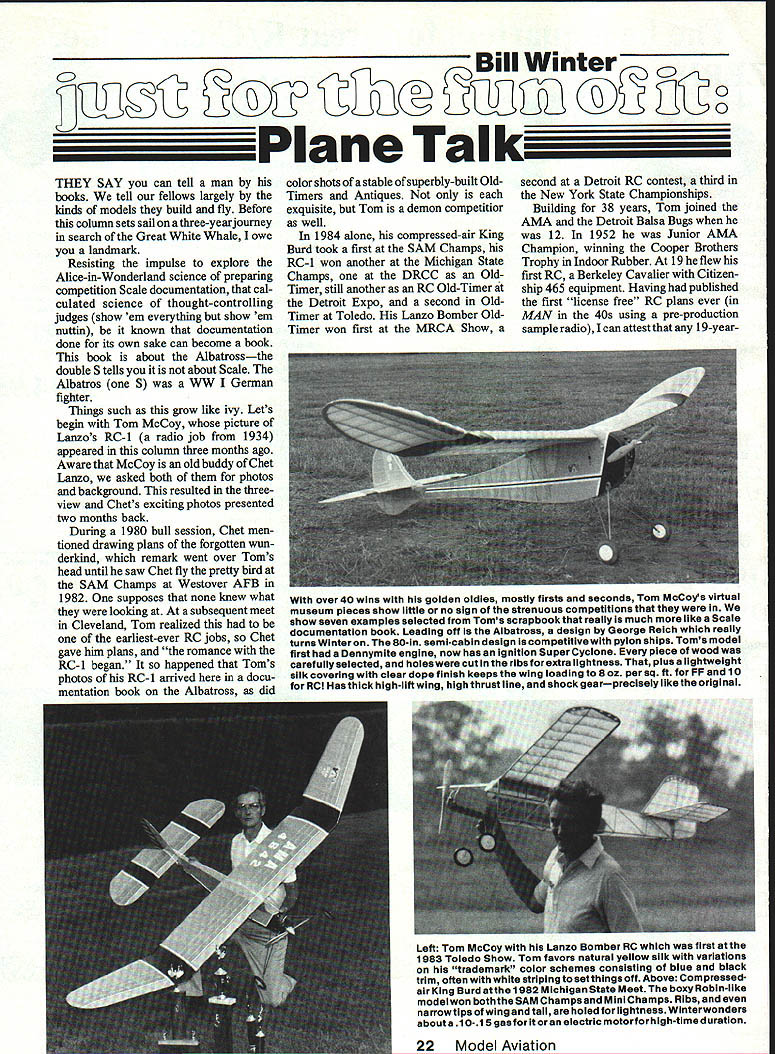
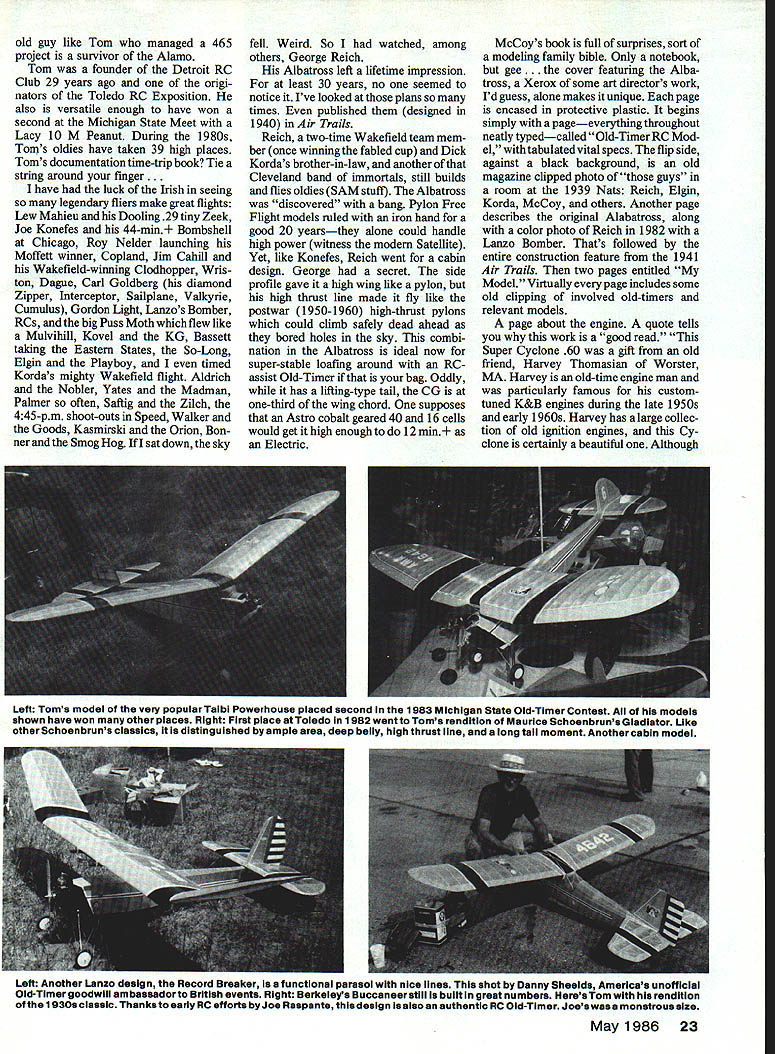
It so happened that Tom's photos of his RC-1 arrived here in a documentation book on the Albatross, as did color shots of a stable of superbly-built Old-Timers and Antiques. Not only is each exquisite, but Tom is a demon competitor as well.
In 1984 alone, his compressed-air King Burd took a first at the SAM Champs; his RC-1 won another at the Michigan State Champs, one at the DRCC as an Old-Timer, still another as an RC Old-Timer at the Detroit Expo, and a second in Old-Timer at Toledo. His Lanzo Bomber Old-Timer won first at the MRCA Show, a second at a Detroit RC contest, and a third in the New York State Championships.
Building for 38 years, Tom joined the AMA and the Detroit Balsa Bugs when he was 12. In 1952 he was Junior AMA Champion, winning the Cooper Brothers Trophy in Indoor Rubber. At 19 he flew his first RC, a Berkeley Cavalier with Citizens' 465 equipment. Having had published the first "license free" RC plans ever (in MAN in the '40s using a pre-production sample radio), I can attest that any 19-year-old guy like Tom who managed a 465 project is a survivor of the Alamo.
Tom was a founder of the Detroit RC Club 29 years ago and one of the originators of the Toledo RC Exposition. He also is versatile enough to have won a second at the Michigan State Meet with a Lacy 10 M Peanut. During the 1980s, Tom's oldies have taken 39 high places. Tom's documentation time‑trip book? Tie a string around your finger.
Notable Fliers and Flights
I have had the luck of the Irish in seeing so many legendary fliers make great flights:
- Lew Mahieu and his Dooling 29 tiny Zeek
- Joe Konefes and his 44+ minute Bombshell at Chicago
- Roy Nelder launching his Moffett winner, Copland
- Jim Cahill and his Wakefield-winning Clodhopper
- Wriston, Dague, Carl Goldberg (his diamond Zipper, Interceptor, Sailplane, Valkyrie, Cumulus)
- Gordon Light, Lanzo's Bomber, the big Puss Moth which flew like Mulvihill
- Kovel and the KG, Bassett taking the Eastern States, the So-Long, Elgin and the Playboy
- Korda's mighty Wakefield flight (timed by me)
- Aldrich, the Nobler, Yates and the Madman, Palmer often, Saftig and the Zilch
- The 4:45 p.m. shoot-outs in Speed, Walker and the Goods, Kasminski and the Orion, Bonner and the Smog Hog
If I sat down, the sky fell. Weird. So I had watched, among others, George Reich.
George Reich and the Albatross
His Albatross left a lifetime impression. For at least 30 years, no one seemed to notice it. I've looked at those plans so many times. I even published them (designed in 1940) in Air Trails.
Reich, a two-time Wakefield team member (once winning the fabled cup) and Dick Korda's brother-in-law, and another of that Cleveland band of immortals, still builds and flies oldies (SAM stuff). The Albatross was "discovered" with a bang. Pylon Free‑Flight models ruled with an iron hand for a good 20 years — they alone could handle high power (witness the modern Satellite). Yet, like Konefes, Reich went for a cabin design.
George had a secret. The side profile gave it a high wing-like pylon, but his high thrust line made it fly like the postwar (1950–1960) high-thrust tailplanes which could climb safely dead ahead as they bored holes in the sky. This combination in the Albatross is ideal now for super‑stable loafing around with an RC‑assisted Old‑Timer if that is your bag. Oddly, while it has a lifting-type tail, the CG is at one-third of the wing chord. One supposes that an Astro cobalt geared .40 and 16 cells would get it high enough to do 12+ minutes as an electric.
Tom McCoy's Book
McCoy's book is full of surprises, sort of a modeling family bible. Only a notebook, but gee... the cover featuring the Albatross, a Xerox of some art director's work, I guess, alone makes it unique. Each page is encased in protective plastic. It begins simply with a page — everything throughout neatly typed — called "Old‑Timer RC Modelling," with tabulated vital specs.
The flip side, against a black background, is an old magazine‑clipped photo of "those guys" in a room at the 1939 Nats: Reich, Elgin, Korda, McCoy, and others. Another page describes the original Albatross, with a color photo of Reich in 1982 with a Lanzo Bomber. That's followed by the entire construction feature from the 1941 Air Trails. Then two pages entitled "My Model." Virtually every page includes some old clipping of involved old‑timers and relevant models.
Engine and propeller notes
A page about the engine includes a quote that tells you why this work is a "good read":
"This Super Cyclone .60 was a gift from an old friend, Harvey Thomasian of Worcester, MA. Harvey is an old‑time engine man and was particularly famous for his customized K&B engines during the late 1950s and early 1960s. Harvey has a large collection of old ignition engines, and this Cyclone is certainly a beautiful one. Although it may look new, it is not a new engine. It is well broken-in, and I was pleasantly surprised to find it will turn 8,500 rpm on a 14-4."
'Tis a small world. Harvey was a buddy of Hal DeBolt's, and roughly 30 years ago I published a 1/4A Live Wire–type plane by Harvey with a trike gear. Just lately, during my 3/4-scale Vagabond project, he supplied photos of his full-scale red-and-white Vag. Just today, those same photos and much other documentation were sent to H.A. Thomas for a similar project by his friend, Hartsfield, in Little Rock.
McCoy's book turns to "The Propeller." Tom says flatly that present-day props are unsuitable for old ignition engines (similarly, I can tell you that traditional props are not best for four-stroke engines). There are no 3-in. pitches for FF, and the most useful prop in this case, a TF 11-4, has the wrong blade shape for lower ignition rpms, so Tom tells us.
The book has stuff on reworking props, the Lost Ark data coming from a 1940 Air Age Annual (Air Age was the corporate name for MAN's publisher — but I doubt if MAN had an annual in 1940, whereas Air Trails did). Thomas' article certainly needs republishing. Replete with wonderful drawings about methods for obtaining a true-pitch prop, it even includes blade top and side profiles for a 14-8, which probably would make my Enya .60 four-stroke run like blue blazes. Suffice it to say, McCoy is constantly pressured for his great props, and in various hands they have an impressive win record.
Tom's Personal Section
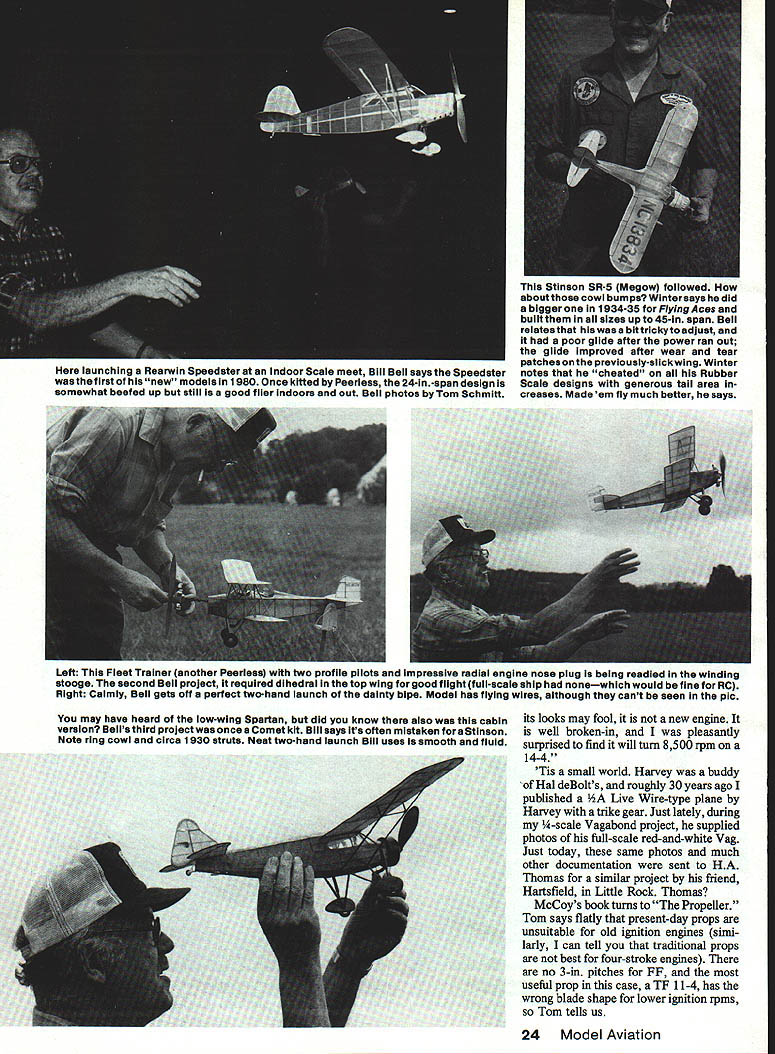
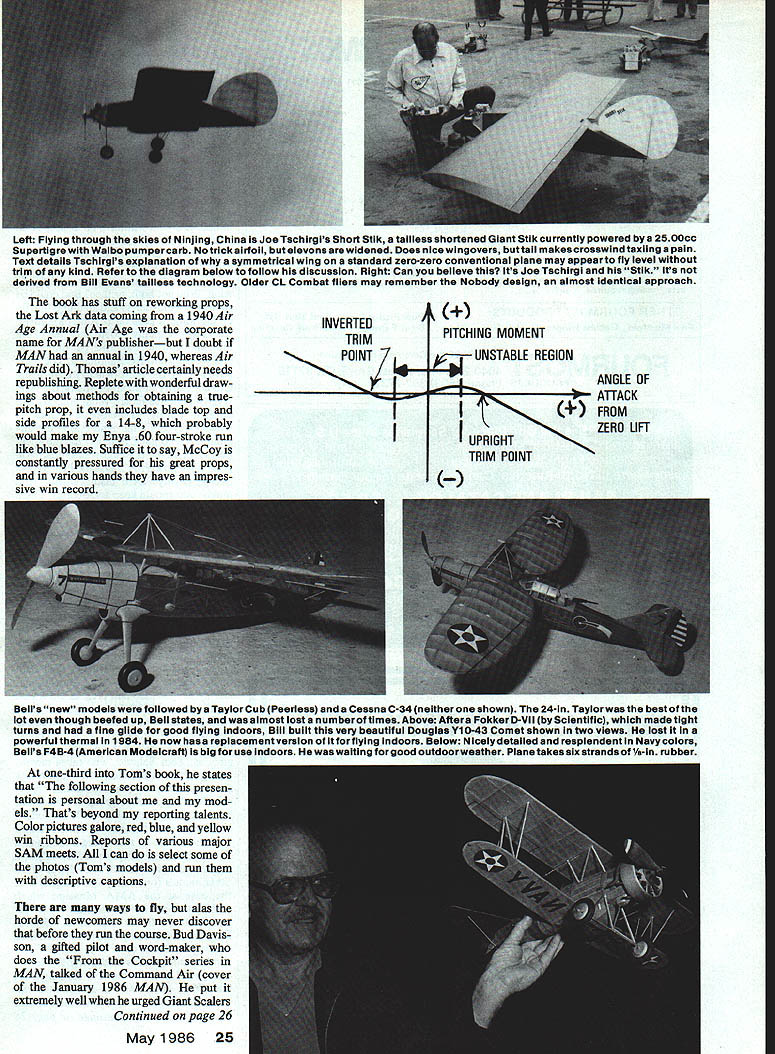
At one-third into Tom's book, he states that "The following section of this presentation is personal about me and my models." That's beyond my reporting talents. Color pictures galore, red, blue, and yellow win ribbons. Reports of various major SAM meets. All I can do is select some of the photos (Tom's models) and run them with descriptive captions.
Power vs. Wing — Bud Davisson and Flying Styles
There are many ways to fly, but alas the horde of newcomers may never discover that before they run the course. Bud Davisson, a gifted pilot and word-maker who does the "From the Cockpit" series in MAN, talked of the Command Air (cover of the January 1986 MAN). He put it extremely well when he urged Giant Scalers to put a Technopower radial in this standout biplane.
"But don't let me see you giving this airplane Warp 9 performance," he said. "Let it float along. Let it poke so slowly you can retrieve it by running under it and grabbing it. Let it be a change of pace." Bud may have gotten a bit carried away there, but I had that indelible experience nearly 50 years ago with a 30-in. rubber-powered SE-5 (a Joe Ott design).
Bud added, "You'll be the only guy at the field who can zig when he should have zagged and you should have zigged, and who will have an airplane that gives him plenty of time to correct his mistakes. It'll do that as a model, because it does it in 1/1 scale."
Two worlds. Fly on power. Fly on the wing. Why not both? Bud could be speaking of old-timers and all things that fly on the wing. It goes far beyond old-timers. Years ago, so many people had tired of the wall-to-wall Pattern-type thing that they ran away to RC sailplanes. You must have noticed the years of heavy advertising and popularity of them. Flying on the wing is not an antique fetish. What you do to an airplane during its aerobatic routine is wonderfully fulfilling. And letting the airplane do it to itself (almost) for the sheer beauty of flight is equally fulfilling. You gotta have power. A sailplane has none—except gravity.
Bill Bell and Rubber Scale
The gentleman from Dihedral Ave. If that address is not an omen, I never saw one. Bill Bell is a come-backer. So are thousands of our born-again readers. But his is a special case, and the course he chose is as specialized and beautiful as Tom McCoy's pursuit of Old-Timers. If you appreciate Rubber Scale — whether or not you fly them — Bill's efforts merit a resounding "well done".
As a kid during the Thirties, Bill built Scale models from 10-, 25-, and 50-cent kits by Megow, Comet, etc., as did a vast multitude. In 1980 his interest in these stick-and-tissue birds was rekindled by his discovery of Golden Age Reproductions' "new" kit models from an old Joe Fitzgibbons. Tom Schmitt, who likes memorable pictures where he wanders, provides the delightful prints that make this report possible.
Suppose we group a few of Bill Bell's Rubber Scale ships with captions. He does other things, too. I bumped into him once while he was flying an Aeronca C-2 and later while he was flying a giant flying model of a Stearman biplane (Flynine Models kit) with a 1/4-A engine, and lo and behold, one of his other models (one of my old designs) is in the case at the AMA Museum. When this was written, Bill was finishing an Albatross D-5, one of the most garish and streamlined fighting machines of WW I. The D-5, for some reason, makes a stupendous flier.
If you view these pictures the way I do, you Scale guys will be dreaming of all manner of RC things, including Giant Scale. Of course, Rubber Scale guys will go ga-ga. A little traveling music, please...
From Nanjing — Joe Tschirgi on Stability and Trim
Warning, rock slides ahead! Set the stage. A cast of characters. And a bit of background. I like strange airplanes. Each was impossible. Then they are not even novelties. Since they violate no aerodynamic lore, notions of how airplanes must fly have to be narrowly rigid. Among many of us, a little knowledge can be a dangerous thing.
Maybe it's good to challenge traditions. I live in Virginia, but I'm from Missouri. I am open-minded on at least a dozen things, including cockeyed dihedral explanations.
Now, a time-out to introduce Joe Tschirgi, who writes from his hotel room on the opposite side of the globe. Joe is a respected old-timer. He is famous for strange airplanes. Even his orthodox Scale models, all beautiful fliers, are apt to be strange. Some of you may remember things like his German WW I Brandenburg biplane flying boats or his really strange Scale bird which had its prop located aft of the wings in a conventional fuselage.
"Your description of an out-of-control RC model (your reed Rookie, December issue) caught my eye," Joe begins. "For some years I've been trying to finish a series of articles on stability and control of models. It's a natural endeavor since, before retiring 18 months ago, I fooled people into believing I knew something about the subject for 35 years. Anyway, the question of why good Pattern models need little or no down trim for level inverted flight has always bothered me. Since the wife and I decided to masquerade as English teachers here in Nanjing, I've had time to think about the problem, and I believe I now have the answer."
(Author's Note: While many excellent technical discussions are received by this column on a one-on-one basis because of references to "mysterious" things observed, the fun theme is best served by avoiding the esoteric "deep" stuff. For example, the pile of brilliant papers pro and con relating to the "air ocean" debate fills a series of large manila envelopes. Some letters exceed the length of this column. In making this exception (Joe Tschirgi), it is hoped the reader will not drop out when things become a bit sticky. Some will understand his presentation in its entirety. I am not one of those fortunate. But we all can interpret his comments by virtue of his simple diagram. There is no math. Will his prescription fly? Ponder his photo of the giant tailless Ugly Stik, which involves no trick airfoils. Follow Joe to the end, and you'll find other comments to play with.)
Joe's summary argument (paraphrased):
- Assume a perfectly symmetric aircraft: symmetric airfoils on wing and tail; thrust line, wing, tail, and CG all on the centerline; zero-zero incidence setup. Fore-and-aft CG is such that the model is in trim for level flight.
- Because the model is perfectly symmetric in the pitch plane, it will also fly straight and level when inverted.
- The tricky part: how can such a model be in trim at any angle of attack except zero? The model is symmetric but at an angle of attack at which the airflow over it is not.
"Behind any wing generating lift, we have downwash, which is evidence of the vorticity shed from the wing. Its strength at the centerline is a strong function of aspect ratio, but for normal model configurations, downwash is a small function of angle of attack. This is concentrated directly downstream, and as the model changes angle of attack, the tail sweeps through this region. Generally, this results in pitching moment curves that are nonlinear and have reduced static stability (near zero lift in the symmetric model we assumed) when the stabilizer is in the center of the downwash field.
"However, if the CG is far enough aft, static stability can be zero or even unstable in this region while exhibiting positive static margins outside. If it is unstable at the point of maximum downwash effect, then the model will have two trim points, and for the symmetric model we postulated, these would be at equal (but opposite sign) lift coefficients."
Joe also points out that the reduction of dynamic pressure in the wing's wake contributes to the non-linearity. This reversal cannot exist unless static stability is quite small even when the tail is out of the wake—i.e., CG well aft. He emphasizes that models are often easy to fly with little static stability because they have high dynamic damping; models have dynamic stability far in excess of full-scale aircraft because of their very low density.
"As you might have gathered, I'm convinced that dynamic stability (damping) is the most important primary factor in successful model design. It is the primary factor in both pitch stability and control in both RC and FF Power. It is also the major requirement for spiral stability of Free Flight models. While the discussion has been simplified by assuming a symmetric model, the same two-trim-point pitching moment curve is possible with an asymmetric model (including cambered wing). In fact, inclusion of the cambered wing may make it easier to achieve."
Joe believes the two-static-trim-point moment curve is certainly flyable — he thinks he has flown it — but he doubts it was the real cause of my most unusual incident. He suggests the servo deadband on reed servos could have left the servo stopped near neutral, allowing the model to "groove" at a trim point. Eureka — that explains one possibility.
The Rookie Incident and Discussion
The strange out-of-control flight of the Rookie occurred in 1962. Control was lost with the plane inverted overhead at low altitude. It had not been in up-trim when rolled inverted, and obviously no down-trim could be inputted for inverted since control was gone. The plane had circled the entire area, maintaining constant altitude and eventually arriving, low, overhead on the original heading — at which point control was regained for a quick landing.
The plane was not symmetrical. It had a 2-3/4 semi-symmetrical airfoil, some angular difference, some dihedral, and a high thrust line. All these design factors combined, especially the high thrust line (which was a low thrust line when inverted), helped maintain "impossible" level flight. It most probably could not do so if the servo had been stopped to one side of neutral (as Tschirgi said); that would impart unknowing slight down elevator trim. But Tschirgi's analysis shows how a truly symmetrical model also could maintain straight and level flight under similar conditions.
My modified Rookie comes close to, but will not duplicate, that inverted phenomenon. It is much heavier and is balanced at one-third of the chord, whereas the original lighter one had the CG at 40% of chord. You will have noted Joe Tschirgi's references to balance points. If I balance at 40%, what then?
The new Rookie surprises people who fly it by its ability to go inverted with the slightest urging and to remain inverted with ease for long periods of steering, such as inverted F1B turns. All of this implies that with non-symmetrical craft of any kind, the disposition of surfaces, thrust line, etc., can be fine-tuned to maximize the desired behavior.
Purple Plan One and Golden Octobers
Bats in the belfry. I know what's with you. So what's with me? Purple Plan One. Every mail brings a mention of some guy's Purple Plan repairs, finishing dusty frameworks, hanging on. I think AMA should have a Purple Plan or Badge. You could wear it proudly—or pin it on the rear of a buddy who can't get his act together.
By now, probably 50% of you do not remember and did not see that column of a year or so ago, but for many, Purple Plan One is more important than a tote. If this keeps up, we'll have to rerun that item! I've now applied it to my flying.
I keep saying, "Wait till next year." But next year the field is muddy in early spring, then the winds blow, then it gets too hot, then it gets windy again, and then it is cold. Once snow, sleet, and fog were no excuses to me. But in October (sometimes late September and into November) there are those golden days. Like the balmy days without wind. If I can get too-perfect October days, it makes up for the year, and it is worthwhile to make another plane or two (over many months via the Purple Plan), and my flying career goes on.
There is always another golden October. The modified Rookie for an Enya four-stroke .60 sat unpainted for nearly a year. It flies beautifully. The thrust and torque of its 14-6 at 8,300–8,500 rpm are awesome, especially when pulling through tight, slowed-up, close-in aerobatics. I won't fly it without a helper. It reminds me of crewing the Giant Scale Aristocrat with an 18-6 prop at 7,000 rpm. You need a two-hand hold. If I had a remote glow plug battery connection (must do this), things would be simpler. For years, I've had requests for plans. Rosenstock (see ads) has plans of the early-1960s version; you'll be able to get plans of the new one from Model Builder before too long.
Kits, New Projects and Tapes
I bought my first kit. I can't believe it! Midway's Dennyplane. I want to build, not think. This aluminum-cowled (round) Old Timer has been a dream for too many years. The wood and cutting are first rate, but the plans are something else.
To any old-timer, an old-fashioned plan (always with some mistakes and few details) doesn't matter, since we need only lines to pin down spars, longerons, etc. The plan certainly is authentic mid-30s, and the box has the original Dennyplane labels with a picture of Denny himself — with goggles. Typical of the day there's a block listing the guys who drew, traced, whatever; all signed off, including ol' Reggie himself. No cross sections, no rib patterns (only an outline in the side view) ... but that's the way it was.
I'm delighted, and I know it is a fine-flying ancient model that actually looks like an airplane. I took the plunge because so many of you showed me pictures of your Dennyplanes. You got me ... but I may go first with Sig's new Kaydet Senior, a big bird for a trainer, bigger than the Eagle, but only for three channels, and lots of open-frame stuff, even on the fuselage. I once flew planes like this with only .19s and with rudder-only control (when almost no one had elevators) — not even a throttle. I have aileron jobs already, so why not? I know I can enjoy it, floating around like a bird, and soaring to the heavens when it isn't very windy. Designer Claude McCullough even has me going back to silk and dope so I can enjoy this as he does. I will use spoilers (see my article in the February issue), and I plan a new wrinkle. I hate to install ailerons!
A tape from Bill Evans is now at the AMA Museum — company demo of the Slow Motion as an electric with an Astro 25 and 4 cells of 1.2 Ah capacity. I conned Bill into that. It is a roaring success on direct drive — acrobatics plus soaring (over an hour) and high-speed inverted flybys. They got a five-year-old kid to fly it. His attention wandered — you could see him watching other airplanes. Yet there he was, the Slow Motion sailing in wide circles, wide open. And then a piped .60 Desperado.
Evans hates stabilizers. And the Desperado (published in the April 1984 issue of this magazine) has cathedral and a huge towering tail. Stable as a rock; of course, it does what I consider fearful high-speed aerobatics. In the film he paused to ask me if I wanted a .60-powered Desperado!
If you subscribe to the old-fashioned explanation of how diehard works, this plane could not fly (or would be nearly unplayable). But it is as tractable as a Slow Motion (to be published in MA). I've told Bill if he could spec a version to match the SloMo, fine. But now he has a picture of a Dasher .60 — and I like that. I am willing to tackle the .60 Dasher but with a max of a .40 for power. What am I saying? Actually, I'd feel good with a hot .25 — but I am double-dared. At 74?
Then the tape showed a Giant Scale CAP — so pretty. Look close, and gosh, no stabilizer. The flights on that tape are better than what you can do with a stab. (It's called the T-CAP.) Not only that, but the slowed-up tendencies of the CAP to stall vanished without the stab. Slow, slow fly-bys with the tips quivering. Yes, it is hot. And with Tschirgi's crazy giant tailless Stik, one wonders why we bother making those boring tail surfaces! (Airfoils and CG locations make this possible.)
Many things to see and do. Thank the Lord for Purple Plan One and golden Octobers.
Bill Winter 4432 Altura Ct., Fairfax, VA 22030
Can we talk? If you ask for your pictures to be returned in an accompanying envelope, obviously I cannot use your wonderful things. Don't you have negatives for making more prints so the ones you send won't be so priceless? Others would like to see them. And please do include stamped, pre-addressed envelopes (or at least a stamp). Try to use your influence on the postman so he won't ask me for excess postage.
Transcribed from original scans by AI. Minor OCR errors may remain.

