

Just for the Fun of It: Plane Talk
Bill Winter
As Jackie Gleason used to say, "How sweet it is!" My flying is in an African-drought stage, but nice things rain like manna from Heaven. I've worked my way through an exciting electric model (motor on cabin bulkhead, prop speed reduction, long extension shaft, and a big folding prop), and I'm slowly building that incredible Kadet Senior. The Senior is a novel approach to a trainer if you like big airplanes that can handle Free Flight–like flying and offer the satisfaction of gluing together Old-Timer–style sticks. For me it is a fun airplane — I don't really need a trainer.
I'm trying a strange spoiler arrangement on the Senior: they operate in and out as usual, but a switch allows me to use them individually (the Senior has no ailerons). In that mode they can have proportional openings, and if I wish I can "CAR" (cross-control) them with the rudder. Please don't ask what might happen — only the Lord knows.
Engines — the Baby Cyclone. The price tag was $15.00, still a bit much, but thanks to Irv Polk I got one wholesale for $9.00.
Old Square Sides
I designed Old Square Sides back in 1936, when I knew almost nothing about glow engines, although I had been modeling for ten years. Hardly anyone had much money then; a Brown Jr. at $21.50 was a big purchase. I published Old Square Sides several years later in Air Trails, using my middle name (John Sprague) because discretion seemed wise. After that, the airplane was largely forgotten for nearly half a century.
Enter Bill Northrop and Model Builder. A fellow in Alaska sent Northrop a photo of a half-size version on floats with a caption saying John Sprague's ship would be a future construction project. As a prank I rushed a three-view to Model Aviation under my own name and both items appeared simultaneously. Northrop wondered if his organization was leaking. Model Builder later published my revised Rookie, and Northrop jokingly asked if the check should be made out to John Sprague.
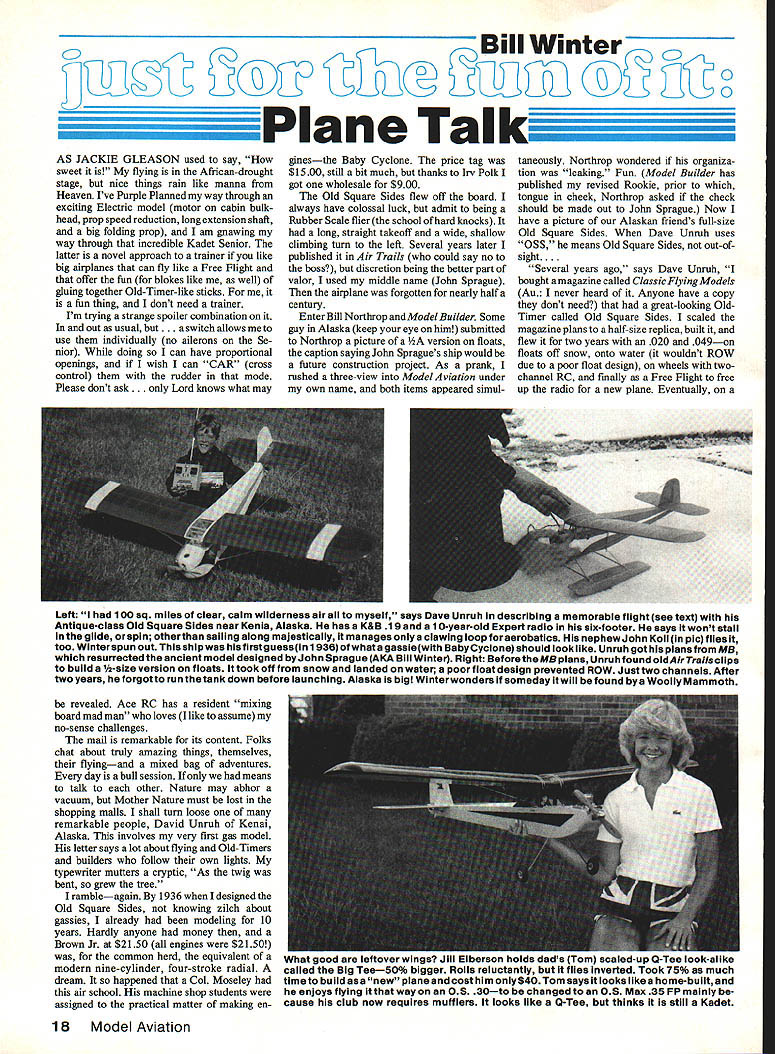
Dave Unruh of Kenai, Alaska now builds and flies a full-size Old Square Sides (OSS). When Dave uses "OSS," he means Old Square Sides — not "out of sight."
Dave Unruh — OSS and life in Alaska
Dave wrote about finding plans in a back issue of a magazine and scaling them to a half-size replica. He built and flew that replica for two years with .020 and .049 engines — on floats (from snow onto water; it wouldn't ROG because of poor float design), on wheels with two-channel RC, and finally as Free Flight to free up the radio. Later he built a full-size OSS from Model Builder plans and reports:
- Power: K&B .19 mounted upright (fits within a lowered thrust line).
- Prop: 10-3/4 in.
- All-up weight: under 5 lb.
- Radio: 10-year-old World Expert five-channel.
- Control authority: he uses only half a rudder and half an elevator and it still works.
- Handling: "It won't stall with power off, won't spin or roll, and a loop (after a long dive) usually results in a clawing climb over the top."
Dave's flying description of a special day on Kenai Lake is memorable. He and his wife camped on a gravel bar that extends into a long, narrow, glacial-fed lake surrounded by mountains. On a clear, perfectly calm day he hand-launched OSS and climbed to about 1,500 ft. The quiet, jewel-like model cruised on quarter-throttle for ten minutes. For landing he throttled back and descended to 50 ft, flew a downwind leg out over the lake, burned off altitude in a wide 180, and then performed a series of near-touch-and-goes — easing the throttle to hold the model's reflection just apart from the airplane itself on the water surface. He did this five times and called it "what a gas!"
Dave is also a modeling missionary in Alaska. In 1984 he volunteered in the local QUEST program for gifted/talented fifth-graders, teaching them to build Sig Cabinaire and Sig Tiger models in class. None of the students or the teacher had built models before; the kids built the models entirely in class, and all of them flew.
Dave's current projects include:
- A Flyline Models Great Lakes Trainer with a simulated five‑cylinder radial using an O.S. .40 four-stroke (four dummy cylinders).
- Refinishing his CAP 21 for skis.
- Building a three‑channel Arctic Tern (a 1/4-scale version of the Interstate Cadet, built in Alaska as the Terran).
He is fond of the out-of-production K&B .19 and several club members are building Terns from his plans.
I regret I can't include pictures of everything, especially the kids stretch-winding rubber motors and mass launching, but Dave's letter says a lot about flying, Old-Timers, and builders who follow their own lights.
Tom Elberson — The Big Tee
Welcome Tom Elberson of DeForest, OH. Tom has been an off-and-on modeler for 35 of his 46 years, holds aero and mechanical engineering degrees, served in the Navy during World War II, worked in aircraft and missile design, and later taught high school.
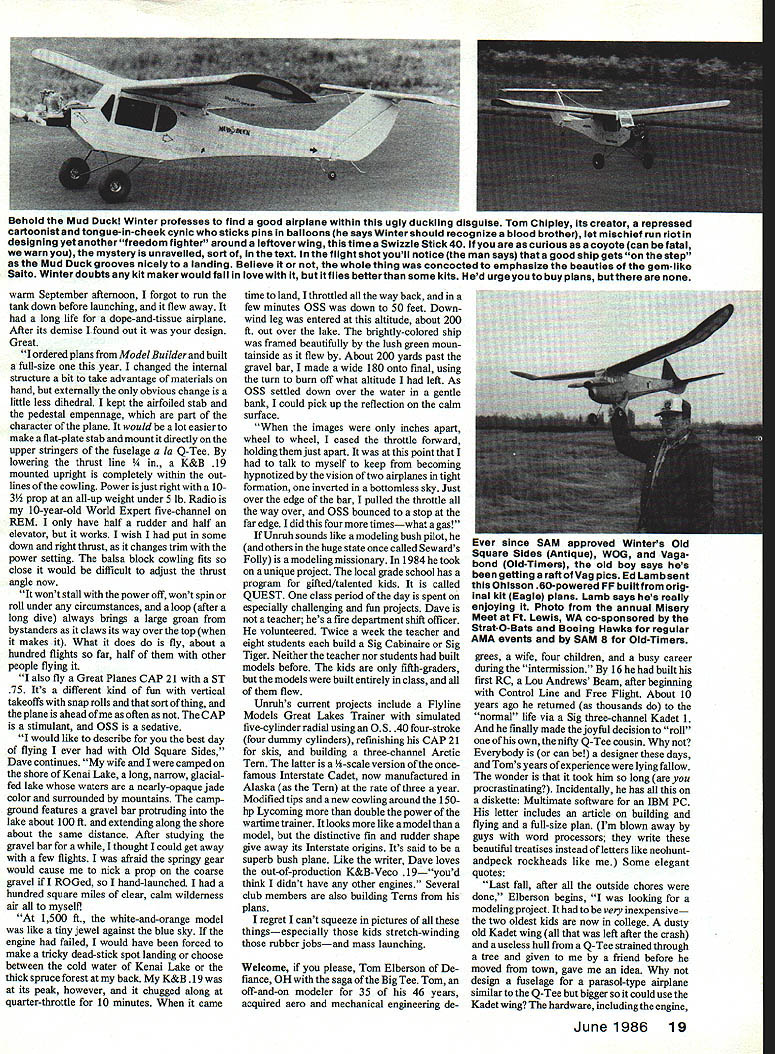
Tom found a dusty Kadet wing and a full fuselage in his garage and decided to design a parasol-type fuselage that would use the Kadet wing. The result is the Big Tee — a high-wing, strut-braced cabin ship intended for slow, stable flying and built largely from leftovers and surplus parts.
Highlights of Tom's experience with the Big Tee:
- He positioned the wing at the same incidence as the Kadet; tail moments are typical and the wing loading is about 18.5 oz./sq. ft.
- Initial power was an O.S. .30; he plans to replace it with an O.S. Max .35 FP with muffler to meet club muffler rules without adding much weight.
- Control throws were adjusted after flight testing: rudder ±3/16 in., elevator ±5/16 in.
- Flight characteristics: similar to the Kadet, sensitive controls initially, better spins, comfortable inverted performance, and overall satisfying handling.
- Fuel tank: 8 oz. gives up to 20 minutes; Kadet's 6 oz. had given only 10–12 min.
- Build time and cost: about three-fourths of the time required for a Kadet; with leftovers and surplus materials the out-of-pocket cost was a little over $40.
Tom recommends turning an old wing into a new design if you’re bored with the old model — a cheap, creative way to get a unique, conversation‑starting airplane.
Engine Mounting and the "Spine"
One correspondent described a painful crash in which the firewall buckled because the aluminum engine mounts transmitted high impact loads directly to the firewall. He preferred the Contender's engine mounting system, which uses maple mounts glued along the fuselage sides back to the second former, plus a soft 1/8 x 1/2 in. balsa block glued in front of the mounts and a soft balsa cowl. In a crash the balsa crushes and absorbs energy, so aft loads go through the mounts rather than buckling the firewall.
Another construction feature he liked was the "spine": a piece of 1/8-in. balsa sheet shaped like the fuselage platform, pinned to the plans first, with the sides and formers glued to it. That assures shape and alignment. By making the inside fuselage width equal to the full balsa width, you save material and cutting. A turtledeck and tank hatch can be built above the spine later for a realistic shape.
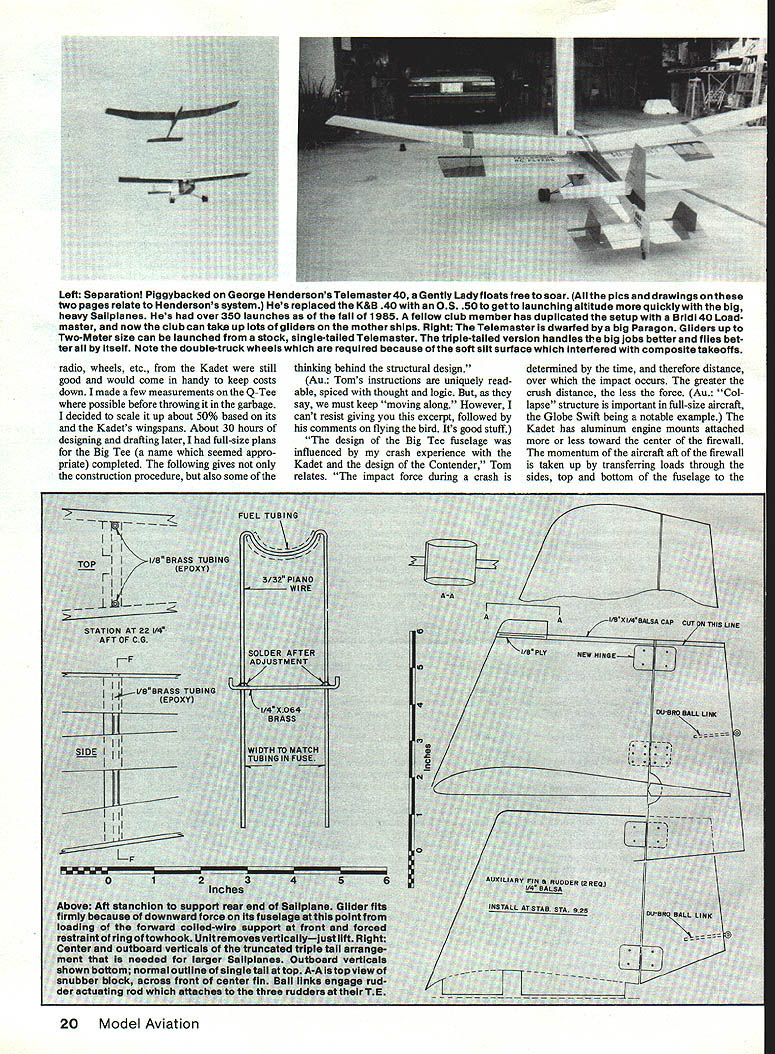
The Ugly Duckling — Mud Duck (Tom Chipley)
Tom Chipley sent the story of the Mud Duck — a parts-and-pieces airplane built mostly for fun and personality rather than looks. The fuselage was originally built for an electric installation but became heavy; the nose forward of the firewall is merely filler. The wing came from a Kadet (or Swizzle Stick 40), the tail surfaces are small, landing gear is simple scrap, and the wheels have become a recurring decoration on many of his models.
Tom chose a Saito .30 mostly for aesthetic reasons — he appreciates the exposed valve assembly and the mechanical charm of a quality four-stroke. For him the model should be a reflection of function without overstated pride of speed. The Mud Duck flies easily and is fun to fly: stable takeoffs, slow, floating landings, and responsive handling.
Specifications (as provided by Tom):
- Span: 60 in.
- Chord: 10 in.
- Area: 500 sq. in.
- Weight: 62 oz.
- Engine: Saito .30 (approx. 1.2 bhp)
- Radio: 4-channel
- Servos: 3
- Prop: 10x6
- Tank: 10 oz.
- Gear: 5/32 in.
- Wing loading: 18 oz./sq. ft.
Tom concluded: "Nothing fancy, just a lot of fun."
Mail: Jets, Ducted Fans, and Other Questions
Dick Hunt (Ocala, Fla.) asked about a 1/6-scale F-86: his two-position flaps reduce speed by about 10 mph but cause porpoising on landing. Short answer:
- Don't use flaps purely as speed brakes on jets; lowering flaps changes wing pitching moment and trims the airplane.
- On a jet the effect can be amplified by thrust line and lack of propwash over the elevator.
- Remedies: try differential (asymmetric) trailing-edge flaps, add a slight reflex to the elevator with flaps down, or use speed brakes inboard of the ailerons that do not change camber as much.
Ron Petersen asked about pitch instability at high speed with a ducted fan. Advice:
- Check aerodynamic center relative to center of gravity. Ducted fans and jets can shift pressure distribution.
- Add tailplane area or move the CG forward to improve longitudinal stability.
- Small amounts of tailplane incidence adjustment can also help.
Telemaster Glider Launcher — George Henderson
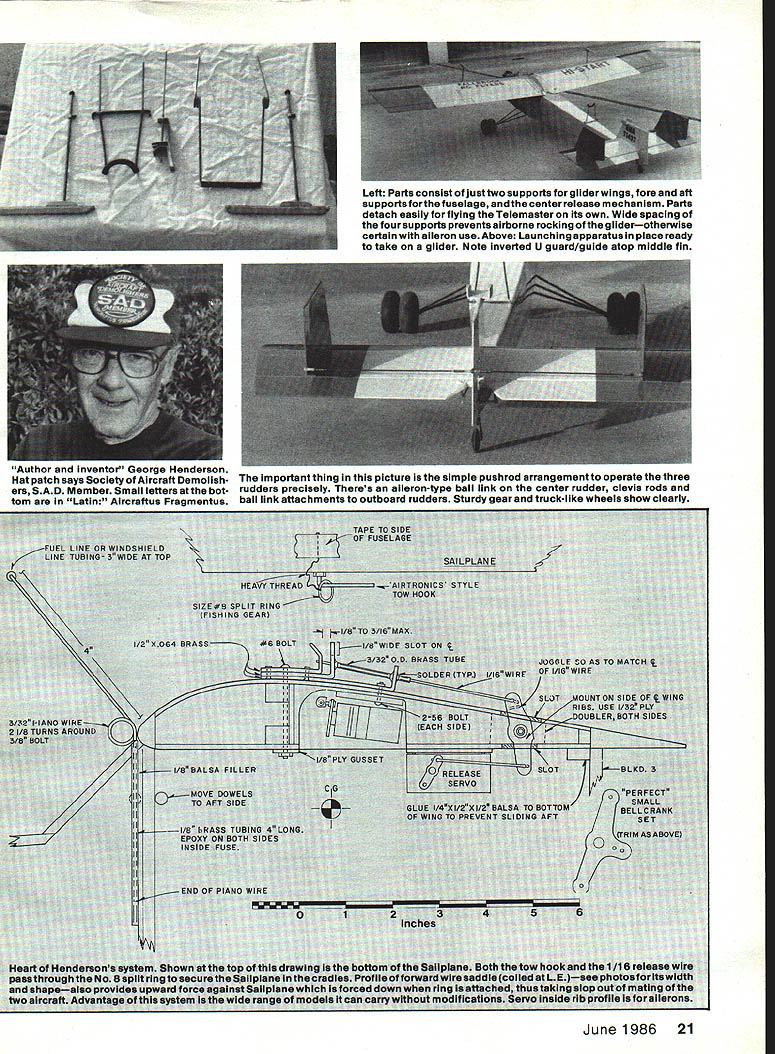
George Henderson (Fallbrook RC Flyers, CA) described adapting a Bridi .40–powered Telemaster for glider towing. He iterated three versions and ended up with a triple tail (cut the center fin and rudder, added outboard fins and rudders) so the Telemaster can launch large gliders without interference. He upgraded power from a K&B .40 to an O.S. .50 to handle heavier gliders more quickly. He also added trussed bulk-tire gear and dual wheels to prevent the airplane from bogging in fine silt at his field; removing the added gear parts quickly returns the plane to normal configuration.
George's creativity is a reminder that RC is not just one kind of model and one kind of engine — variety is the spice of life.
Closing — Can we talk?
I am receiving some unusually difficult questions that fall outside my main areas of expertise. For deep or highly specialized topics (electrics, RC scale work, advanced electrics), you will be better served by addressing a specialist columnist with that focus. I will continue to take questions relating to my own planes and projects; normal mail is always welcome and essential to the continued prosperity of this fun column.
Bill Winter 4432 Altura Ct., Fairfax, VA 22030
Transcribed from original scans by AI. Minor OCR errors may remain.

