
KRC Electric Fly
From a fledgling start in 1980, this event has turned into the biggest one of its kind that is totally sponsored by a club. As in the beginning and continuing now, emphasis is on educating modelers in things electric and fellowship. — Bob Kopski
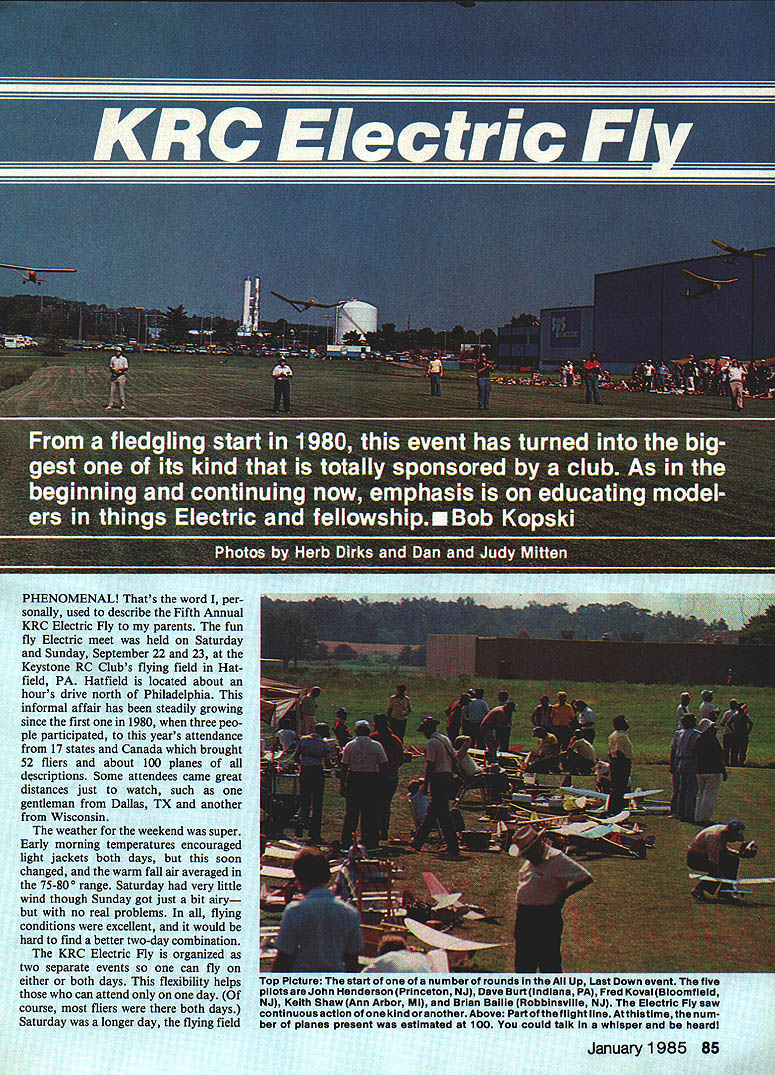
PHENOMENAL! That's the word I used to describe the Fifth Annual KRC Electric Fly to my parents. The fun-fly electric meet was held on Saturday and Sunday, September 22 and 23, at the Keystone RC Club's flying field in Hatfield, PA. Hatfield is located about an hour's drive north of Philadelphia. This informal affair has been steadily growing since the first one in 1980, when three people participated, to this year's attendance from 17 states and Canada which brought 52 fliers and about 100 planes of all descriptions. Some attendees came great distances just to watch, such as one gentleman from Dallas, TX and another from Wisconsin.
The weather for the weekend was super. Early-morning temperatures encouraged light jackets both days, but this soon changed, and the warm fall air averaged in the 75–80° range. Saturday had very little wind though Sunday got just a bit airy—still with no real problems. In all, flying conditions were excellent, and it would be hard to find a better two-day combination.
The KRC Electric Fly is organized as two separate events so one can fly on either or both days. This flexibility helps those who can attend only one day (of course, most fliers were there both days). Saturday was a longer day; the flying field was open for extended hours. The flight line was crowded, and several planes were kept in cars until needed.
Some of Saturday's participants were not able to return on Sunday, but there were several new arrivals. Some who said they could not return on Sunday changed their minds, claiming they had so much fun they had to come back! In other instances, long-distance travelers who planned an earlier Sunday departure lingered long into the day.
The KRC Electric Fly, being a low-key activity designed to encourage the fun of electrics, is not a contest. Instead, the meet has used loose judging categories of Most Acrobatic, Best Looking, and Longest Flight Time for the five-year history of the event. There are no strict rules—pilots just do their thing, and the judging team keeps a lookout. When all is over, awards are given out. KRC has been fortunate in receiving support from the modeling industry with all kinds of prize donations. This year we were able to give awards through sixth place in the three categories each day, thanks to increasing industry interest in electrics.
This year something new was added: the All Up, Last Down event. This is exactly what it sounds like, except it's not all at once because of frequency conflicts. The complication was accommodated by flying in rounds. In all, 42 fliers tried their skills over the two days. KRC put up cash prizes for this event so that, for the first time in Electric Fly history, KRC members could participate in their own meet (KRC members aren't allowed to share in the industry-donated awards). The four cash prizes were $50.00, $30.00, $15.00, and $5.00 each day, and Brian Bailie took the top prize each day. Only one KRC member placed: Herb Dirks got third on Sunday.
As with any affair of this size, there are bound to be some disappointments. Roland Boucher of Leisure Electronics had planned to attend but then couldn't. Roland had been here in the past, and many were anxious to see him again.
One modeler drove a few hours from New Jersey with several planes only to find he had forgotten his transmitters! Ordinarily this might not be too bad a problem because surely someone at the meet would have one that would work, right? Wrong—Joe Beshar, a regular at the annual Electric Fly, flies on 53.3 MHz. A sad moment.
Brian Bailie, whose solar-powered plane was pictured in the September 1984 RC Electrics column, had planned on using that plane in the All Up, Last Down event, but the plane was recently damaged when a forklift went through its crate during shipment back to Brian from a science fair. He had it on display, though, and as it turned out, he didn't need it to win.
Larry Sribnick of SR Batteries is heavily into photography and came prepared with a camera-equipped electric, only to have a mishap early on Saturday. This is unfortunate, as otherwise we could have shown what the event looked like from "up there."
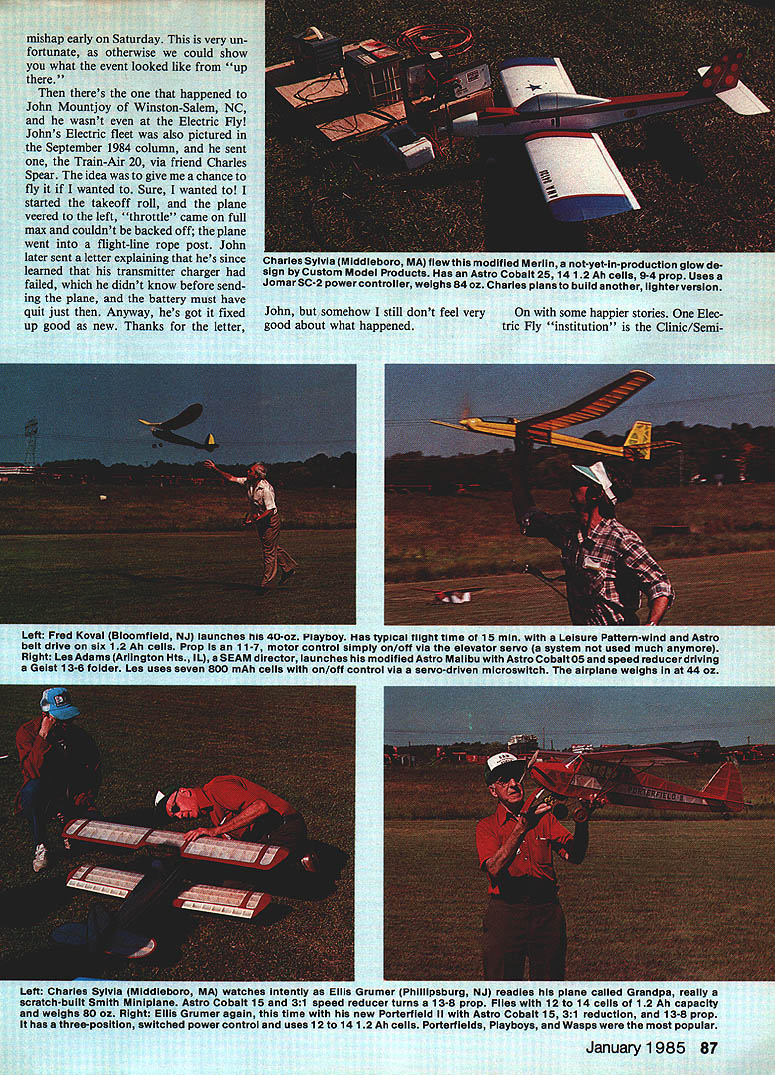
Then there's the one that happened to John Mountjoy of Winston-Salem, NC—and he wasn't even at the Electric Fly! John's electric fleet was also pictured in the September 1984 column, and he sent one plane, the Train-Air 20, via friend Charles Spear. The idea was to give me a chance to fly it if I wanted to. I started the takeoff roll and the plane veered to the left; the "throttle" came on full and couldn't be backed off; the plane struck a flight-line rope post. John later sent a letter explaining that he'd since learned his transmitter charger had failed, which he didn't know before sending the plane, and the battery must have quit at that moment. Anyway, he's got it fixed up good as new. Thanks for the letter, John, but somehow I still don't feel very good about what happened.
On with some happier stories. One Electric Fly "institution" is the Clinic/Seminar—a combination of very popular activities in past years. KRC's Heinz Koerner has been running the clinic since its inception four years ago. Heinz sets up a complete workshop each year on the field and is prepared to assist anyone seeking help with electric problems. Historically, Heinz has been swamped all day both days, normally not even getting a break for lunch. Not so this year. The clinic was not busy. This dramatic change, combined with the overwhelming number of participants and good-performing planes, leads me to conclude that electric flying has taken one heck of a giant step forward in the past year. In fact, this change in clinic "business" was noticed and commented on by quite a few people. Phenomenal!
The seminar is an informal, conversational part of the clinic activity. In the past, I have hosted this hour-or-two activity with Heinz and once with Roland Boucher. This is an opportunity for everyone to field questions of general interest. This year, with the generally light interest in the clinic and the busy excitement of the flight line, we dropped the seminar on Saturday. Following the All Up, Last Down on Sunday, Heinz, Bob Boucher, Frank Heinrich, and Jeff Surgnier (the latter two representing Robbe) hosted the "round table" (stand-'round-Heinz' work table) seminar discussions. There was something for everyone.
Earlier, I mentioned another Electric Fly institution—the informal Saturday Social. We've been getting attendance from afar for several years, with visitors normally staying at a local motel over the weekend. Three years ago KRC offered some diversion for these guests with a local social. Like the rest of the Electric Fly, this is a low-key gathering. It takes place in our club's regular meeting place, the Hatfield American Legion Hall. KRC ladies bring many and varied goodies to snack on, and liquid refreshments are available from the Legion. Guests can relax and enjoy a change of pace from the flight line. Wives and kids join in, too.
We have several door-prize drawings for our visitors, including items for the ladies. This year we were fortunate to have Bob Boucher in attendance at the social. I twisted his arm into telling us a few words about his experiences on the man-powered and solar-powered flight successes in which he played a key role. Bob was very entertaining, bouncing between light-hearted stories and some of a more technical nature. The social wrapped up just before midnight so there'd be enough time to "charge up" for Sunday's flying.
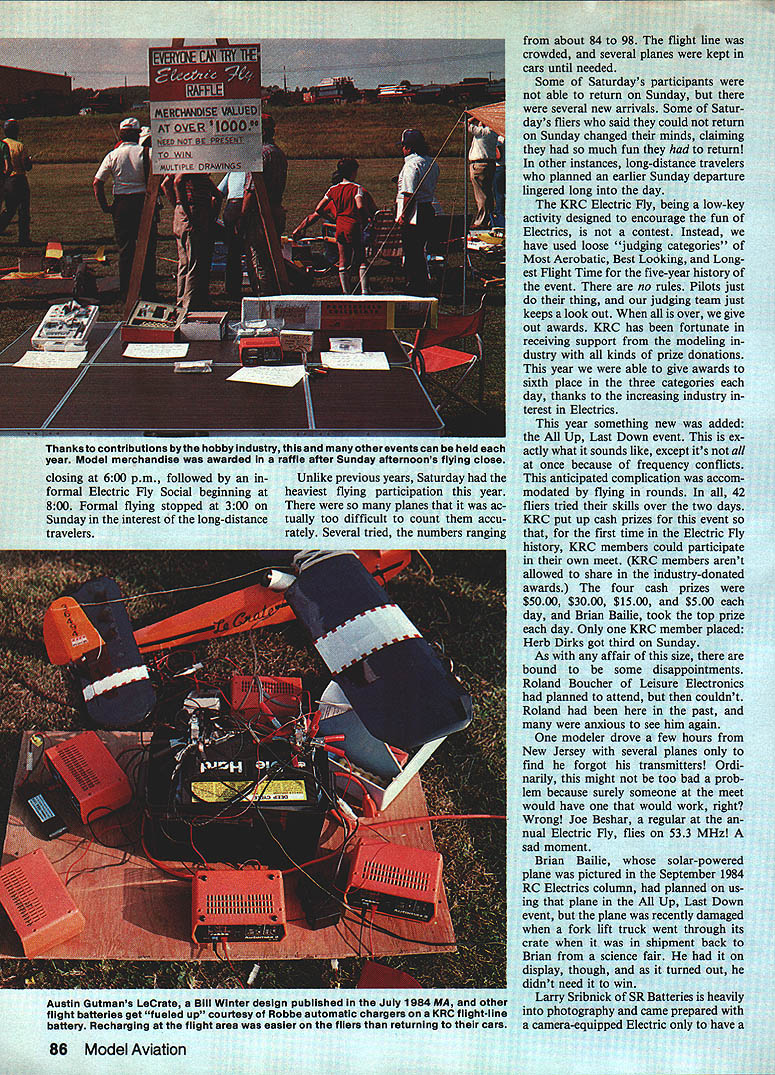
KRC tries to make the event easy and fun for everyone. One part of this was providing flight-line batteries so visitors wouldn't have to continually return to their cars for recharging. In past years our batteries had a hard time keeping up, and we anticipated an even larger requirement this year. To help, we obtained loan of five high-power, line-operated laboratory power supplies to use with five auto batteries on the flight line. In this way, fliers could drain amps out of the batteries to charge their planes, and the supplies would put amps back in so the next person would have a battery in good condition. As it turned out, with the very heavy attendance and intense flying, the supplies were a real salvation.
The recharging story doesn't end there. Frank Heinrich and Jeff Surgnier of Robbe were in attendance all weekend. Along with many other Robbe products, they brought several automatic chargers and were offering charging services to everyone. I personally know these products are not always easy to find, but Frank tells me distribution of the Robbe charger is rapidly improving. Anyway, lots of people can say they saw and were "charged up" by these at the 1984 Electric Fly.
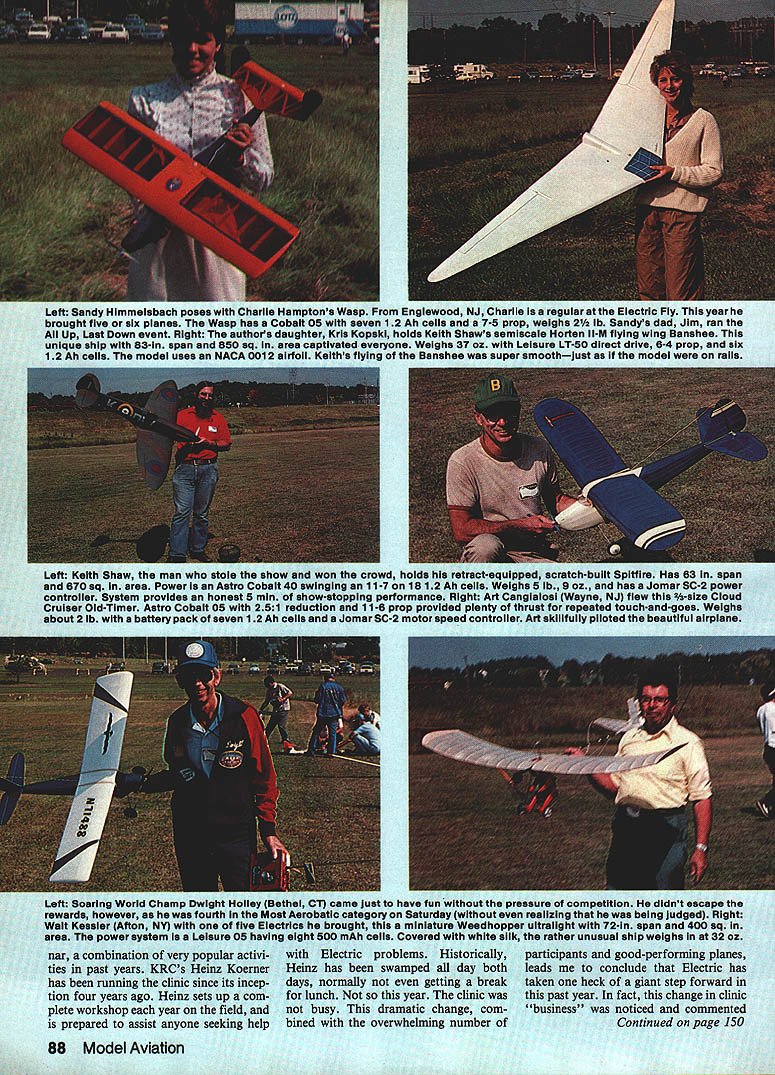
It is normal for most people to leave with vivid memories of the particular aspects most pleasing to them. I can't help but feel that this year's Electric Fly offered many such memories to most visitors. Included among these must surely be the sheer delight of watching Keith Shaw (Ann Arbor, MI) fly. He brought four planes, three of them new, and one, the Zolty Old-Timer, from his past visit. Keith is a very likable fellow, an excellent craftsman, and a truly outstanding pilot. In effect, Keith is a one-man Electric Fly. This year he flew his flying wing Banshee, his precision aerobatic Columbine, and his amazing retract-equipped Spitfire. When Keith went up, all others came down to watch. He held the crowd with every flight. Every flight ended with an ovation.
For those of the "brute power" persuasion, Bob Boucher provided something to remember. His Astro Challenger glider (a new Astro kit) would burst upward, leaving no doubt as to who had the highest rate of climb.
It would be hard to imagine the casual spectator not finding something to his special interest and liking.
This year was a time of reunion. Arthur Garzon of Lester, PA; Austin Gutman of Bala Cynwyd, PA; and John Henderson of Princeton, NJ—all attendees of our very first Electric Fly—showed up early on Saturday morning. This original trio, and 45 others, made Saturday the biggest club-sponsored Electric Fly day ever in the U.S.
Aside from the participants, we had many spectators—hobbyists wanting to see electrics. Naturally, with all these modelers witnessing this overwhelming display of electric excitement, some were moved to want to do it too. Fortunately, Bob Boucher had some spare motors and batteries with him and made them available at very reasonable prices—sort of Electric Fly specials.
The AMA has been filming a new movie on R/C models and was at last year's Electric Fly and came back this year for more footage. There should be lots of good electric coverage in the film, depending on the final editing. Those who could not attend and want to see some outstanding electric flying should watch for the AMA film release for a club showing.
Among all the Electric Fly "institutions," the one most essential to the continuance of the affair is the raffle. The hobby industry has been very supportive of our efforts over the years; some donated items of significant value were used as raffle prizes—eight separate drawings. The first-place drawing for a radio system was won by Walter Winter of Philadelphia. He had been in aeromodeling in the past, particularly Scale, but had dropped out about seven years ago. Now, after visiting the Electric Fly and winning a new radio, he's all "charged up" and plans to return next year—with a plane!
Many phone calls and letters were received prior to the event. One in particular says a lot about electrics. Dwight Holley, of sailplane-world-championship fame, called for some technical assistance and also to say he planned to attend the Electric Fly. I excitedly told Dwight about all the nice awards we had to give away. Why call that a "mistake?" Dwight simply didn't care—he was looking for a relaxing break from his normal competition activities and just wanted to fly electrics without any pressure. That, he was able to do.
Of the many conversations I had during the busy weekend, one comment by Jim Zarembski, RCM's "Silent Power" columnist, rings long and loud in my ears: "Don't change a thing..."
Events and Winners
#### Saturday, September 22 Best Looking:
- Keith Shaw — Spitfire
- Vic Walpole — Sagitta
- Keith Shaw — Zombie Old-Timer
- Les Adams — Malibu (modified)
- John Henderson — Porterfield
- Sam Slizer — Daydreamer
Most Aerobatic:
- Keith Shaw — Columbine
- George Watson — Wasp
- Don Belfort — Wasp
- Dwight Holley
- Charlie Hampton — Wasp
- Keith Shaw — Spitfire
Longest Flight:
- Brian Bailie — Drifter II
- Adrian Koerner — Olympic II
- Bill Hale
- Bob Boucher — Challenger
- Guy Stauffer — Spectra Soar
All Up, Last Down:
- Brian Bailie — Drifter II
- Frank Heinrich — Robbe ASW 17
- Adrian Koerner — Olympic II
- Bob Boucher — Challenger
- Guy Stauffer — Spectra Soar
- Bill Hale
#### Sunday, September 23 Best Looking:
- Keith Shaw — Spitfire
- Ellis Grumer — Grandpa
- Les Adams — Malibu (modified)
- Al Knight — Playboy
- Ted Davey — Prophet
- Charles Sylvia — Spectra Soar
Most Aerobatic:
- Keith Shaw — Columbine
- Charlie Hampton — Wasp
- Charles Sylvia — Merlin
- Jim Zarembski — Skylark
- Ellis Grumer — Grandpa
- Ted Davey
Longest Flight:
- Brian Bailie — Drifter II
- Adrian Koerner — Olympic II
- Bill Hale
- Bob Boucher — Challenger
- Herb Dirks — Spectra Soar
- Guy Stauffer — Spectra Soar
Overall Meet High Times:
- Brian Bailie
- Adrian Koerner
Raffle Winners
- Walter Winter, Philadelphia, PA — Airtronics XL 4-ch FM system plus two extra servos and battery
- John Semos, Stamford, CT — Astro 25 Cobalt system plus Dual Charger and gear drive
- John Berksheiser, Lansdale, PA — Two 6-cell 1.2 Ah packs
- Mike Kramer, North Wales, PA — Robbe Automaix 8 Charger
- Ward Brown, Quakertown, PA — Astro Powerfield 6
- Bill Meleske, Baldwin, NY — Victor Electronic Speed Controller
- Dale Jones, Sellersville, PA — Jomar Speed Controller
- Frank Villani, Hatfield, PA — 6-cell 1.2 Ah pack
KRC Electric Fly saw continuous action—one event after another. At the height of the meet the number of planes present was estimated at about 100. The flight line was about 80–90 feet long; several planes kept others talking in whispers as they waited. Despite a few mishaps early Saturday, the weekend was otherwise very successful and gave everyone a good look at what the Electric Fly is all about.
Transcribed from original scans by AI. Minor OCR errors may remain.

