
KRC Electric Fly
In its first 10 years the KRC Electric Fly grew from a tentative one-day meet into a major regional gathering for electric model aviation. The 10th‑anniversary event drew 110 pilots and 272 electrics to the same field over one weekend — unquestionably the best Electric Fly yet. The meet’s fun‑fly format, friendly atmosphere, and steady industry support helped spur rapid advances in electric model technology and participation.
History and milestones
- 1980 — First meet (Sunday, September 28)
- Organized by a few members of the gas‑oriented Keystone RC Club with a $25 budget.
- Only three people and four planes attended.
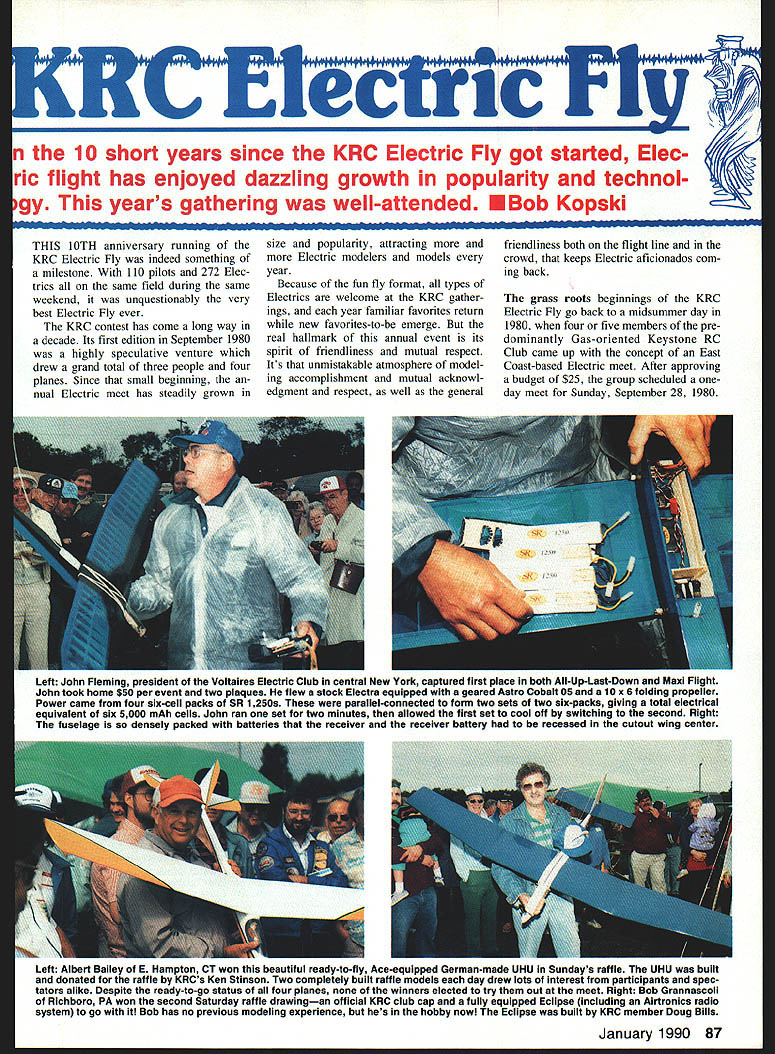
- John Fleming (Voltaire’s Electric Club, Liverpool, NY) won both All‑Up‑Last‑Down (AULD) and Maxi Flight, receiving $50 per event and two plaques. Fleming flew a stock Electra with a geared Astro Cobalt .05 and a folding 10 x 6 prop. Power was from four six‑cell SR‑1250 packs arranged as two parallel sets, with a dense battery installation in the fuselage.
- 1981 — Second meet (September 20)
- About 10 attendees; 17 industry donors.
- An Electric Fly Clinic was added to help newcomers. Three participants came from Virginia.
- 1982 — Expanded to two days (September 18–19)
- Improved clinic with how‑to handouts (motor mounting, battery installation, wiring, etc.). These handouts later influenced Model Aviation columns and a series on electrics.
- Introduced the Electric Fly Raffle and Saturday Night Social.
- Attendance: 26 participants, about 40 aircraft, roughly 300 spectators. First‑time attendees included Roland and Nancy Boucher (Leisure Electronics), Keith Shaw, Bill Winter, John Worth, and Jim Zarembski.
- 1983 — Date change attempt (August 20–21)
- Participation rose to 33 entrants. John Grigg (AMA president) attended and flew. Jay Gerber filmed for AMA promotional material.
- 1984 — Fifth meet (September 22–23)
- Attendance: 52 fliers and over 100 electrics from 17 states and Canada.
- Bob Boucher (Astro Flight) attended; All‑Up‑Last‑Down prototype event proved popular and continued thereafter.
- Raffle prizes exceeded $1,000, including an Airtronics radio for first draw.
- Frank Heinrich (Robbe Model Sport) attended for the first time.
- 1985
- Attendance: 64 participants and 122 airplanes.
- 1986
- Attendance: 77 fliers and 135 planes.
- Keith Shaw’s high‑performance flying set benchmarks. The Electric Fly Clinic was dropped as installations and techniques became more widespread.
- 1987 — Planned move to Quakertown
- Heavy rains flooded the Quakertown field; the contest was relocated back to the old field the day before opening.
- Participation dropped to 63. The meet featured two successful electric helicopters and several cobalt‑60‑powered planes. The raffle included a fully assembled Amptique. The Saturday Night Social was canceled due to the relocation.
- 1988 — Move to Quakertown accomplished
- Attendance: 113 fliers and 224 planes — field filled to capacity.
- Friday and Sunday saw good flying; Saturday afternoon was shut down by a heavy downpour.
- Raffle featured a custom‑built, fully equipped, ready‑to‑fly PT Electric.
- 1989 — 10th anniversary (celebration year)
- Attendance: 110 pilots and 272 electrics.
- Backed by a $1,600 budget and unprecedented industry support (53 backers).
- Four special fun events with cash and plaques: Most Rolls, All‑Up‑Last‑Down, Most Loops, and Maxi Flight.
- Other awards: Best Aerobatics, Best Scale, Overall Most Impressive, and Most Unusual (clandestinely judged).
- Raffle success: 1,275 tickets sold; multiple ready‑to‑fly planes and kits donated and raffled.
Notable aircraft, conversions, and winners
- John Fleming — Electra (see 1980 entry) — winner of AULD and Maxi Flight.
- Albert Bailey (East Hampton, CT) — won a ready‑to‑fly Ace‑equipped UHU donated by Ken Stinson.
- Bob Grannascoli (Richboro, PA) — won a fully equipped Eclipse (Airtronics radio) in a raffle; was a new hobbyist after the meet.
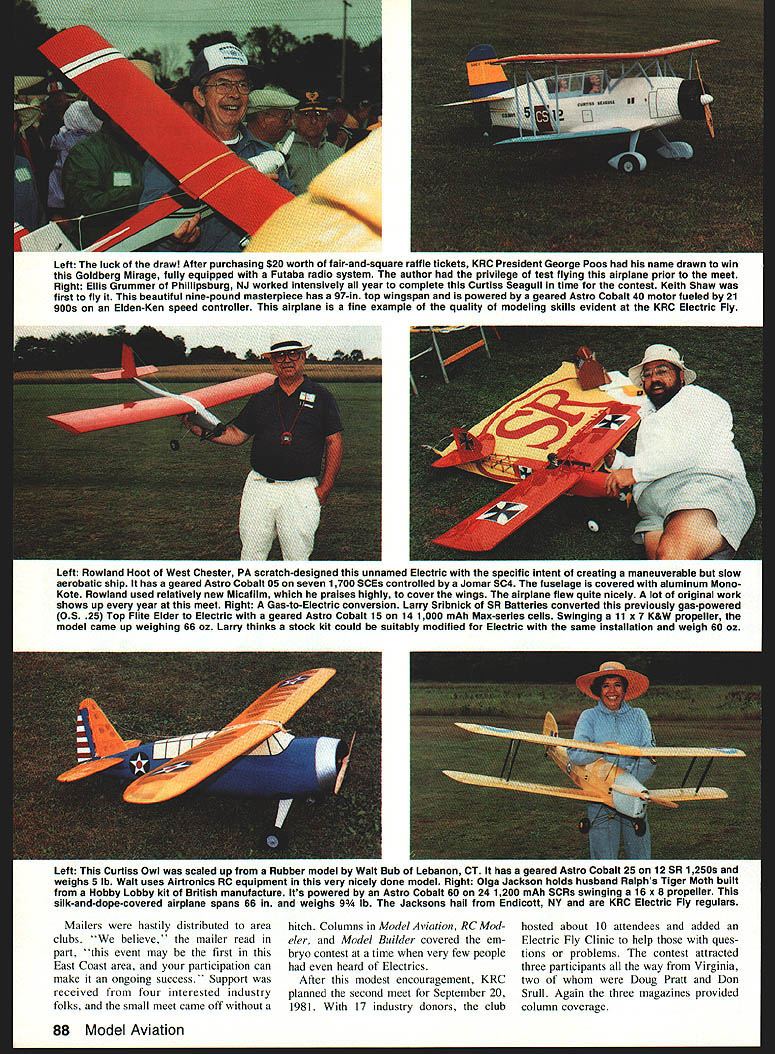
- Rowland Hoot (West Chester, PA) — scratch‑designed aerobatic plane using a geared Astro Cobalt .05 with seven 1700 SCE cells; fuselage covered in aluminum MonoKote, wings in Micafilm.
- Larry Sribnick — converted a Top Flite Elder .25 to electric (geared Astro Cobalt .15 with fourteen 1000 mAh Max cells); conversion weighed 66 oz.
- Walt Bub (Lebanon, CT) — scaled‑up Curtiss Owl rubber model powered by a geared Astro Cobalt .25 and twelve 1250 cells; weighed ~5 lb.
- Olga and Ralph Jackson (Endicott, NY) — Tiger Moth (Hobby Lobby kit) powered by an Astro Cobalt .60 with twenty‑four 1200 mAh SCRs and a 16 x 8 prop; 66 in span, 9 lb.
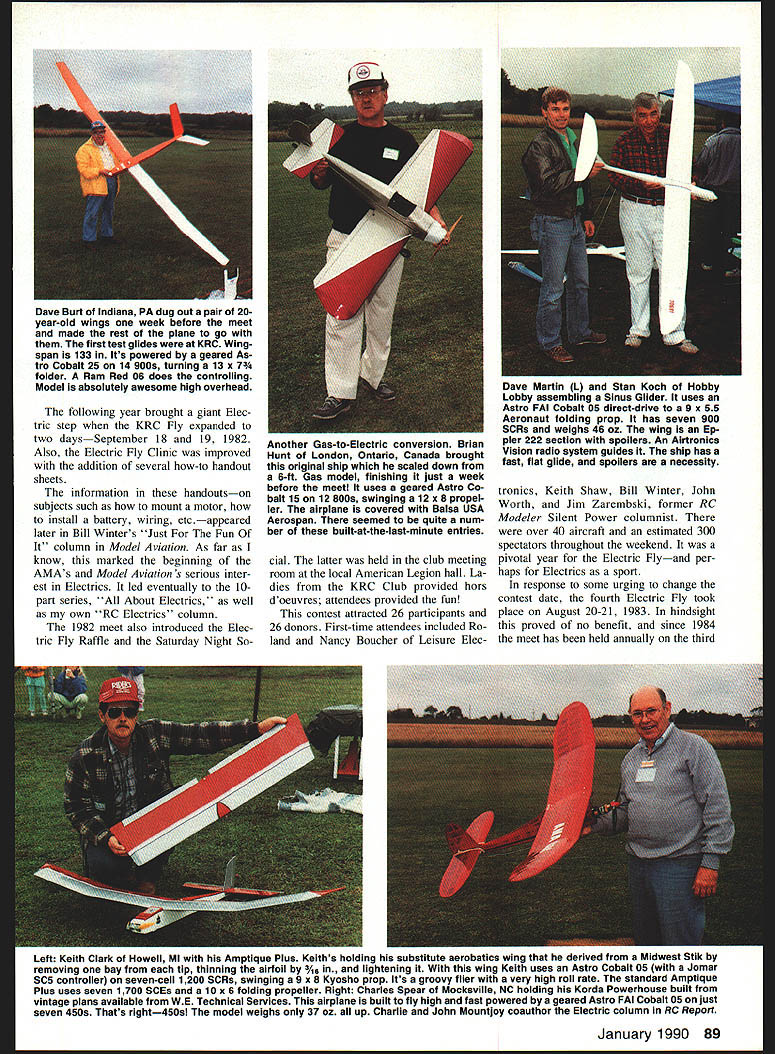
- Dave Martin (Hobby Lobby) — dazzling performance with an Ultra 1600‑powered ASW 22 glider; won Overall Most Impressive.
Event features and format
- Fun‑fly format welcomes all types of electrics: conversions, scratch designs, kits, and ready‑to‑fly entries.
- Popular events:
- All‑Up‑Last‑Down (AULD): all entrants launch together; last aircraft flying wins.
- Maxi Flight: one‑change continuous flight task with required landing and reclaiming every fourth minute. Winner has highest total of four‑minute segments plus the final fractional segment.
- Clinics, handouts, and peer troubleshooting helped spread best practices for motors, gearing, battery installation, and prop selection.
- Saturday Night Social provided informal fellowship; club members supplied hors d’oeuvres and entertainment.
- Raffle: a major fundraising and crowd‑pleasing element — increasingly significant as industry support and donated prizes grew.
Logistics, weather, and atmosphere
- Growth drove the move to larger fields (Quakertown) to accommodate more pilots and planes.
- Weather occasionally disrupted flying (notably a Saturday afternoon shutdown in 1988); otherwise the event enjoyed good flying conditions.
- Ground support: KRC volunteers cut grass, provided sound systems, and announcers. Bruce Kane (announcer) handled flight calls, interviews, paging, and raffle duties.
- Despite heavy activity on the runway and in the air, mishaps were relatively few. Visibility issues during drizzle caused one quasi fly‑away; many flights were visible simultaneously (10+ in the sky at times; AULD launches with a dozen aircraft).
Survey results and closing notes
- Survey respondents reported a combined 2,207 years of involvement in electrics and 394 total attendances at the KRC Electric Fly.
- The farthest flier recorded on the survey traveled about 1,300 miles (from Florida); others traveled comparable long distances.
- Spectators came from as far as Texas, California, and Australia.
- The KRC Electric Fly’s combination of friendly grassroots spirit, fun events, clinics, industry support, and a lively raffle helped make it a focal point for electric model aviation and a showcase for advances in electrics.
Transcribed from original scans by AI. Minor OCR errors may remain.

