

The Lake Sawyer Hawks Acquire a Flying Field
by Arnold C. Anderson
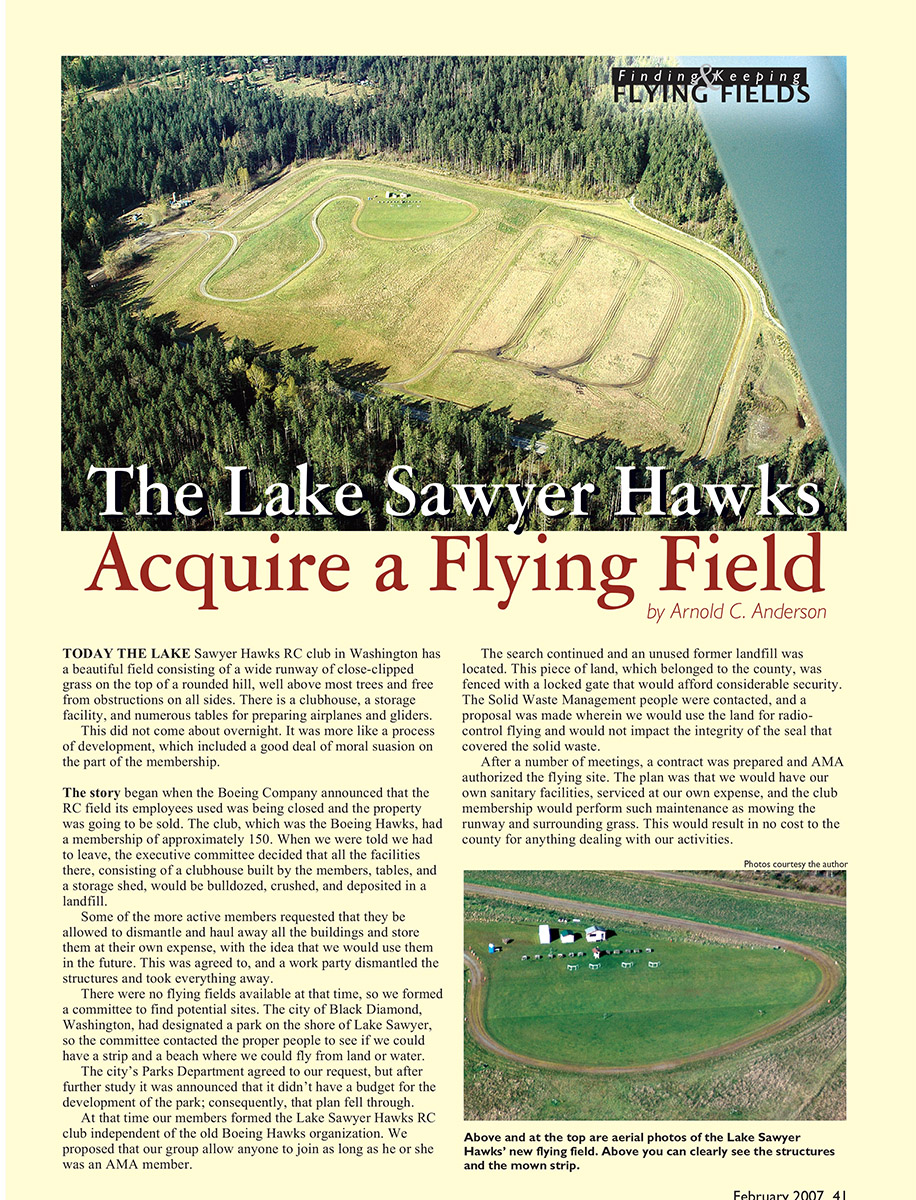
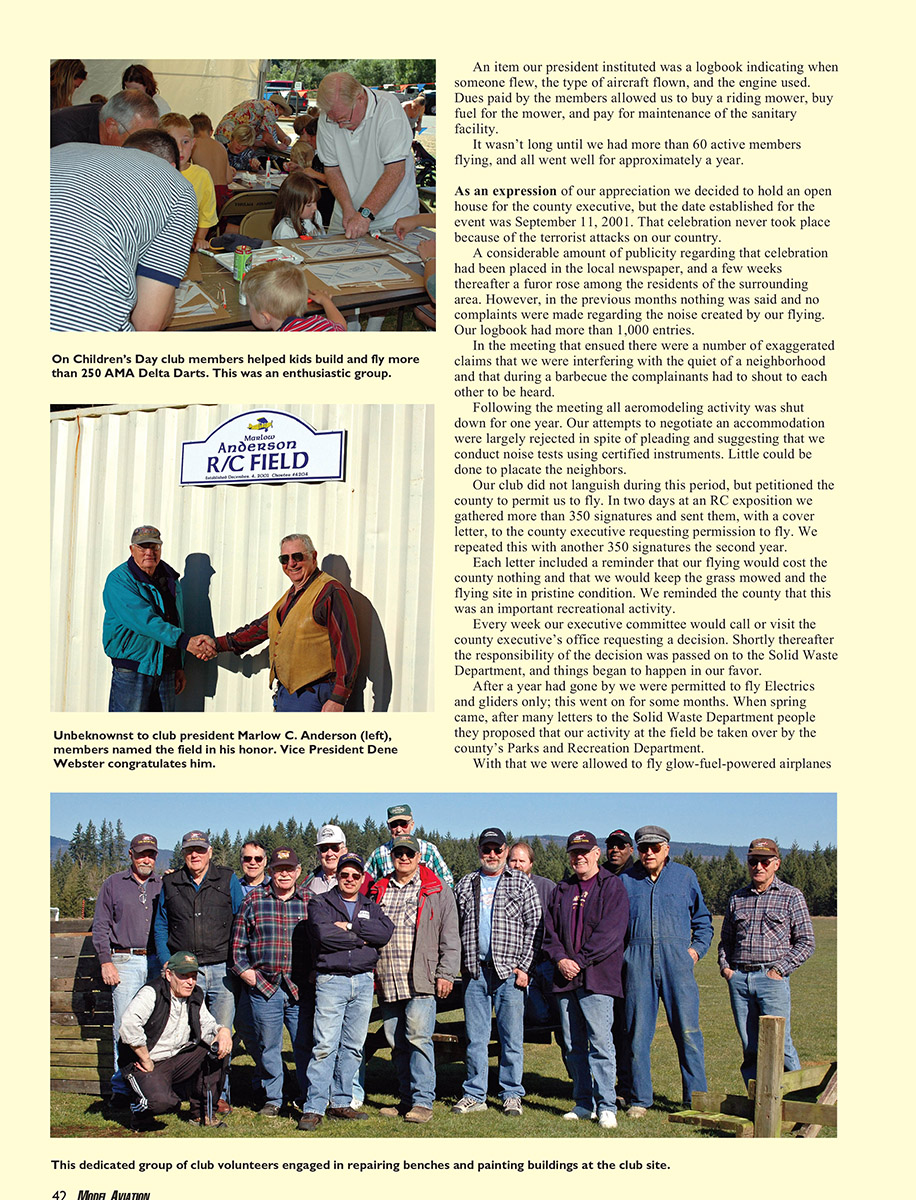
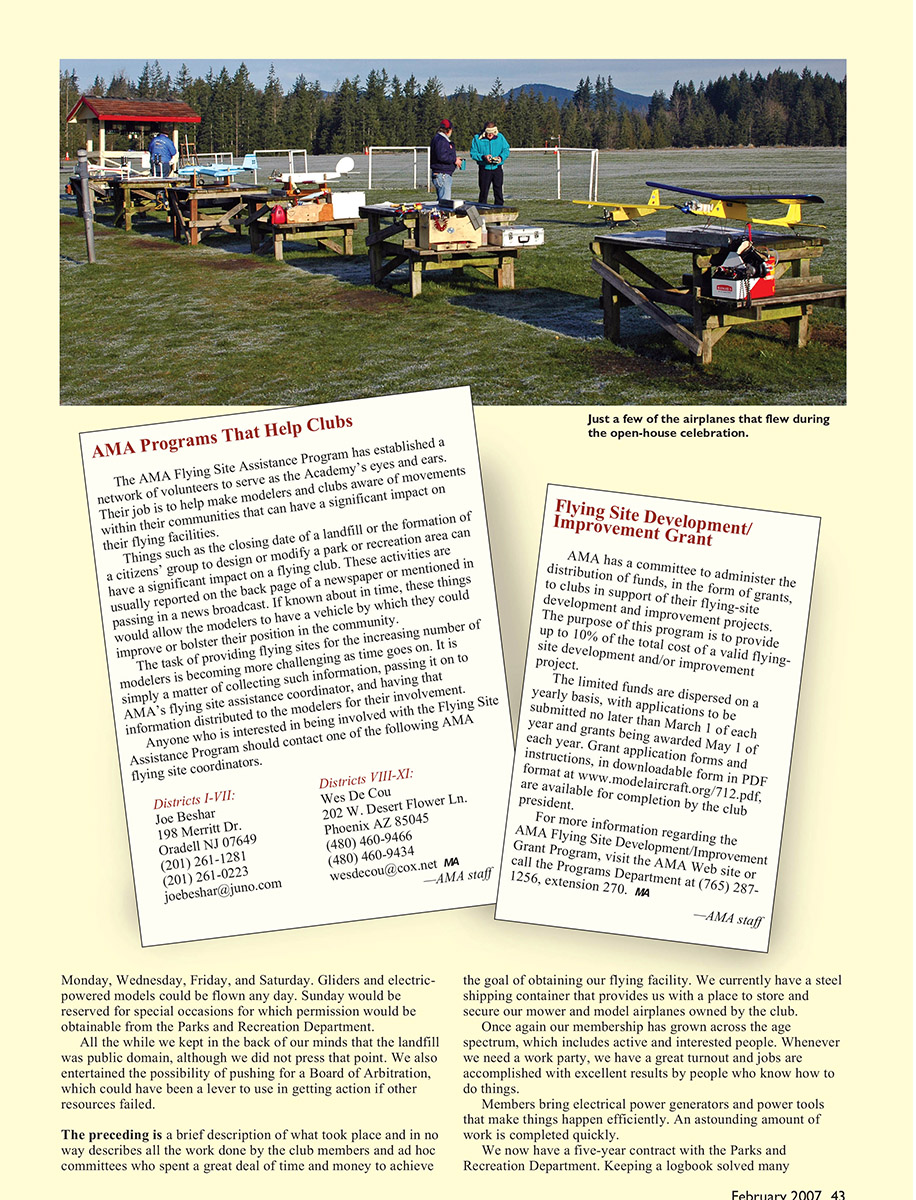
TODAY the Lake Sawyer Hawks RC Club in Washington has a beautiful field consisting of a wide runway of close-clipped grass on the top of a rounded hill, well above most trees and free from obstructions on all sides. There is a clubhouse, a storage facility, and numerous tables for preparing airplanes and gliders.
Background
This did not come about overnight. It was a process of development that included a good deal of moral suasion on the part of the membership.
The story began when the Boeing Company announced that the RC field its employees used was being closed and the property was going to be sold. The club, then the Boeing Hawks, had a membership of approximately 150. When we were told we had to leave, the executive committee decided that all the facilities there—consisting of a clubhouse built by the members, tables, and a storage shed—would be bulldozed, crushed, and deposited in a landfill.
Some of the more active members requested permission to dismantle and haul away all the buildings and store them at their own expense, with the idea that we would use them in the future. This was agreed to, and a work party dismantled the structures and took everything away.
Searching for a New Site
There were no flying fields available at that time, so we formed a committee to find potential sites. The city of Black Diamond, Washington, had designated a park on the shore of Lake Sawyer, so the committee contacted the proper people to see if we could have a strip and a beach where we could fly from land or water. The city’s Parks Department initially agreed to our request, but after further study it announced it didn’t have a budget for park development; consequently, that plan fell through.
At that time our members formed the Lake Sawyer Hawks RC Club independent of the old Boeing Hawks organization. We proposed that anyone could join as long as he or she was an AMA member.
The search continued and we located an unused former landfill. This piece of land, which belonged to the county, was fenced with a locked gate that would afford considerable security. The Solid Waste Management people were contacted, and a proposal was made: we would use the land for radio-control flying and would not impact the integrity of the seal that covered the solid waste.
After a number of meetings, a contract was prepared and AMA authorized the flying site. The plan was that we would provide our own sanitary facilities, serviced at our own expense, and the club membership would perform such maintenance as mowing the runway and surrounding grass. This would result in no cost to the county for anything related to our activities.
An item our president instituted was a logbook indicating when someone flew, the type of aircraft flown, and the engine used. Dues paid by the members allowed us to buy a riding mower, buy fuel for the mower, and pay for maintenance of the sanitary facility.
Early Success and Setbacks
It wasn’t long until we had more than 60 active members flying, and all went well for approximately a year.
As an expression of our appreciation we decided to hold an open house for the county executive, but the date established for the event was September 11, 2001. That celebration never took place because of the terrorist attacks on our country.
A considerable amount of publicity regarding that planned celebration had been placed in the local newspaper, and a few weeks thereafter a furor arose among residents of the surrounding area. Prior to that, nothing had been said and no complaints had been made regarding the noise created by our flying. Our logbook had more than 1,000 entries.
At the meeting that ensued there were a number of exaggerated claims that we were interfering with the quiet of the neighborhood and that, during a barbecue, complainants had to shout to each other to be heard.
Following the meeting, all aeromodeling activity was shut down for one year. Our attempts to negotiate an accommodation were largely rejected despite pleading and suggesting that we conduct noise tests using certified instruments. Little could be done to placate the neighbors.
Persistence and Negotiation
Our club did not languish during this period. We petitioned the county to permit us to fly. In two days at an RC exposition we gathered more than 350 signatures and sent them, with a cover letter, to the county executive requesting permission to fly. We repeated this with another 350 signatures the second year.
Each letter included a reminder that our flying would cost the county nothing and that we would keep the grass mowed and the flying site in pristine condition. We reminded the county that this was an important recreational activity.
Every week our executive committee would call or visit the county executive’s office requesting a decision. Shortly thereafter the responsibility for the decision was passed to the Solid Waste Department, and things began to happen in our favor.
After a year had gone by we were permitted to fly electrics and gliders only; this went on for some months. When spring came, after many letters to the Solid Waste Department, they proposed that our activity at the field be taken over by the county’s Parks and Recreation Department. With that we were allowed to fly glow-fuel-powered airplanes on specific days.
- Glow-fuel-powered airplanes: Monday, Wednesday, Friday, and Saturday
- Gliders and electric-powered models: any day
- Sunday: reserved for special occasions with permission from the Parks and Recreation Department
All the while we kept in mind that the landfill was public domain, although we did not press that point. We also entertained the possibility of pushing for a Board of Arbitration, which could have been a lever to use in getting action if other resources failed.
Current Facility and Operations
The preceding is a brief description of what took place and in no way describes all the work done by club members and ad hoc committees who spent a great deal of time and money to achieve the goal of obtaining our flying facility. We currently have a steel shipping container that provides us with a place to store and secure our mower and model airplanes owned by the club.
Once again our membership has grown across the age spectrum, including active and interested people. Whenever we need a work party, we have a great turnout and jobs are accomplished with excellent results by people who know how to do things.
Members bring electrical power generators and power tools that make things happen efficiently. An astounding amount of work is completed quickly.
We now have a five-year contract with the Parks and Recreation Department. Keeping a logbook solved many problems regarding complaints. Each month copies of our logbook are transmitted to the Parks and Recreation manager.
The last time a complaint was lodged, a check of the logbook indicated that no one was flying that day. Since that time all complaints have stopped.
Acknowledgments
Members who contributed to our club’s success in this endeavor included:
- Marlow C. Anderson — president and primary driving force behind our success
- Dene A. Webster — vice president and major contributor
- Charles (Dan) Vencill — treasurer
- Amy Kuipers — provided space to hold meetings and printed materials
- Dave (Skip) Nason — secretary
- Amy Kuipers — secretary (shared duties)
- Arnold C. Anderson — corresponding secretary
Other movers and shakers were:
- Reese Burnett
- Richard Joslin
- Dennis Long
- James and Betty Gray
- Ken Hutchinson
- William Myrvell
- Buddy James
- Thomas C. Schwartz
Arnold C. Anderson
Transcribed from original scans by AI. Minor OCR errors may remain.

