
Lancair IV
Don Berliner
Introduction
After World War II, when airplane factories switched from fighters and bombers to private planes, the Beech Bonanza leapt into the spotlight. With its futuristic lines, all-metal construction, and exotic "V" tail, it was far ahead of the resurrected prewar Piper Cubs, Aeroncas, and Taylorcrafts.
Forty-five years later, the Bonanza looks about the same and remains at the top of the line. It has more interior room, a bigger engine, and vastly improved radios and navigation gear. The price has risen from a little more than $5,000 to more than $200,000. Many of its rivals have come and gone, but the Bonanza is still the Cadillac of personal airplanes.
How can it be that an updated 1946 airplane is the best that the American aircraft industry can come up with for someone who wants to get places in a hurry, but who isn't quite up to buying a Learjet? Where are the results of decades of progress in aerodynamics and materials?
Homebuilts and the Composite Revolution
How about an airplane for less than half the cost of a Bonanza that flies 100 mph faster on the same power, and tells everyone that its owner is out front when it comes to advanced thinking? The Lancair does that, thanks to its truly modern design.
Like almost every other personal airplane that has debuted in the past decade, the Lancair is a homebuilt. And, like many homebuilts, it offers performance and looks that are eons beyond anything the lightplane manufacturing industry in the USA, France, or elsewhere have been able to build.
The source of such shocking differences is mostly economic: the cost of a homebuilt needn't include labor (it's really recreation), liability insurance, advertising, and administration overhead. These items have turned the once-vibrant industry into memories. It's not that there aren't smart people in the lightplane industry; it's that a new kind of cottage industry has arisen to fill the demand for modern personal airplanes. A kit manufacturer turns out superbly molded major components—wings, fuselages, tails—and the home craftsman completes the job, producing lines, contours, and finishes that make the latest Pipers and Cessnas look crude by comparison.
The secret: composite materials. Long popular in sailplanes, they entered the homebuilt movement in the 1970s when Burt Rutan introduced the tail-first VariEze, built from carved blocks of plastic foam covered with fiberglass cloth. The combination is lighter, stronger, and easier to build than aluminum, plywood, and steel tubing. The resulting airplanes are cleaner and aerodynamically more advanced than could possibly have been built of old-fashioned materials. Foam-and-fiberglass construction and advanced materials such as Kevlar and carbon fiber don't seem to have practical limits to what can be done. Rutan continues to turn out amazingly shaped airplanes—canards, tandem wings, push-pulls—and continues to make new ideas work as well as, or better than, conventional shapes.
Others, however, have developed the conventional layout—wing up front, tail back, engine in the nose—and made them perform in ways that were long thought to be the trademark of high-tech factories with million-dollar computers.
The Lancair Line: Models and Prices
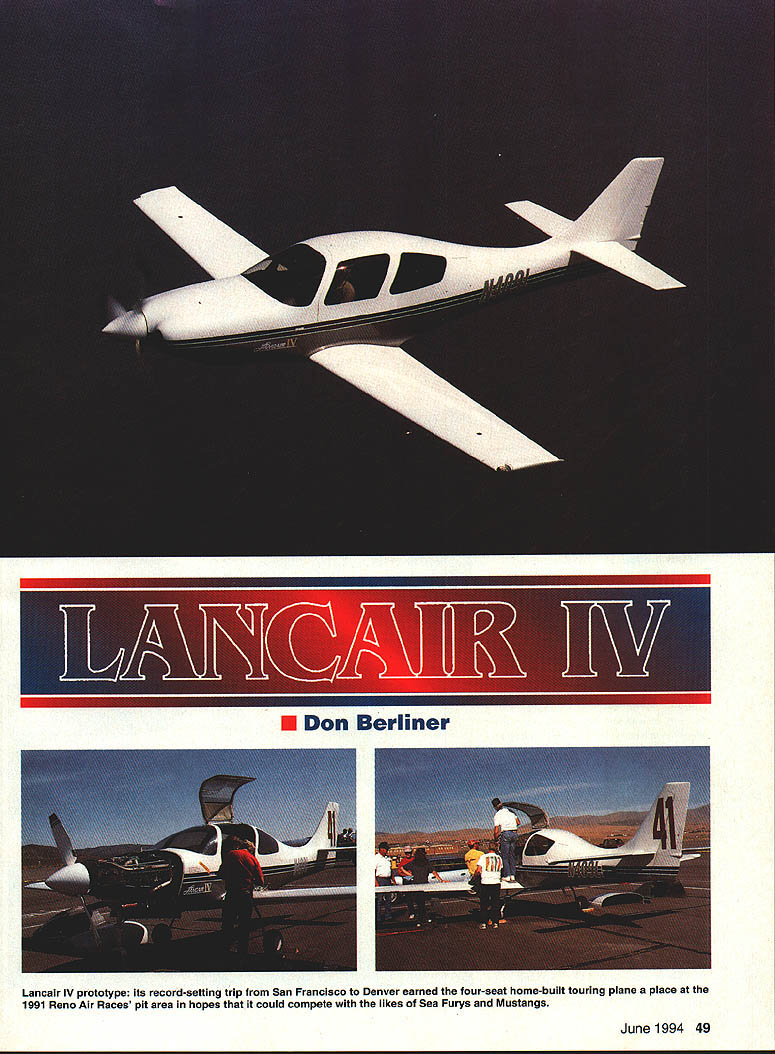
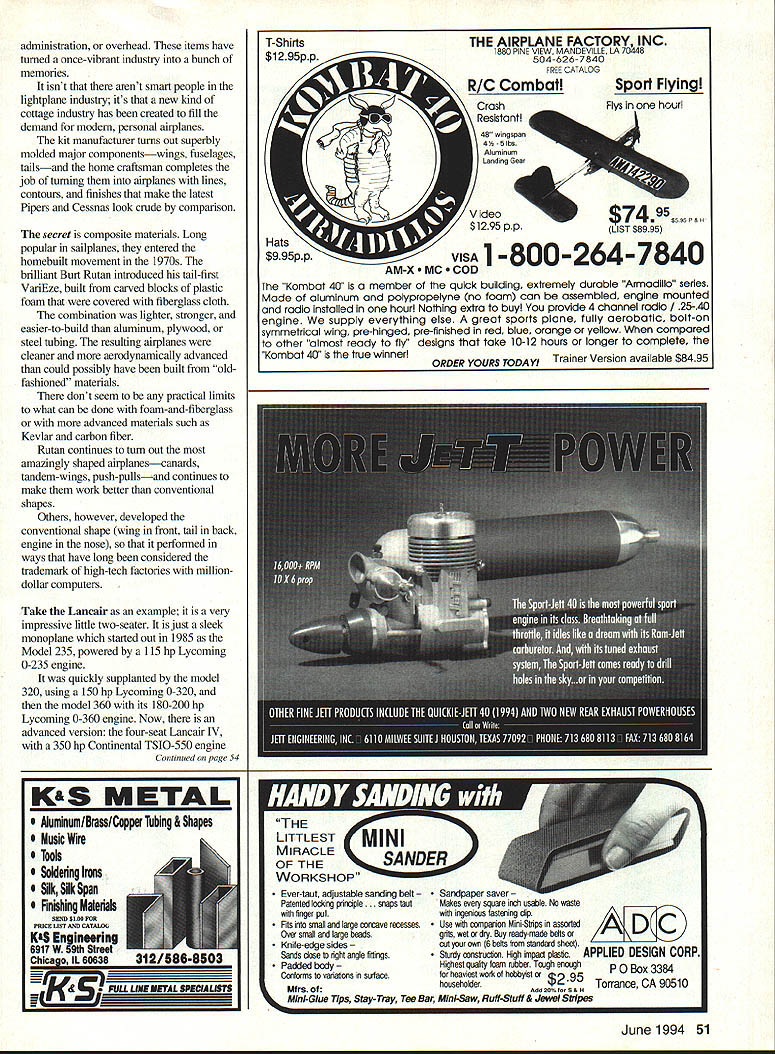
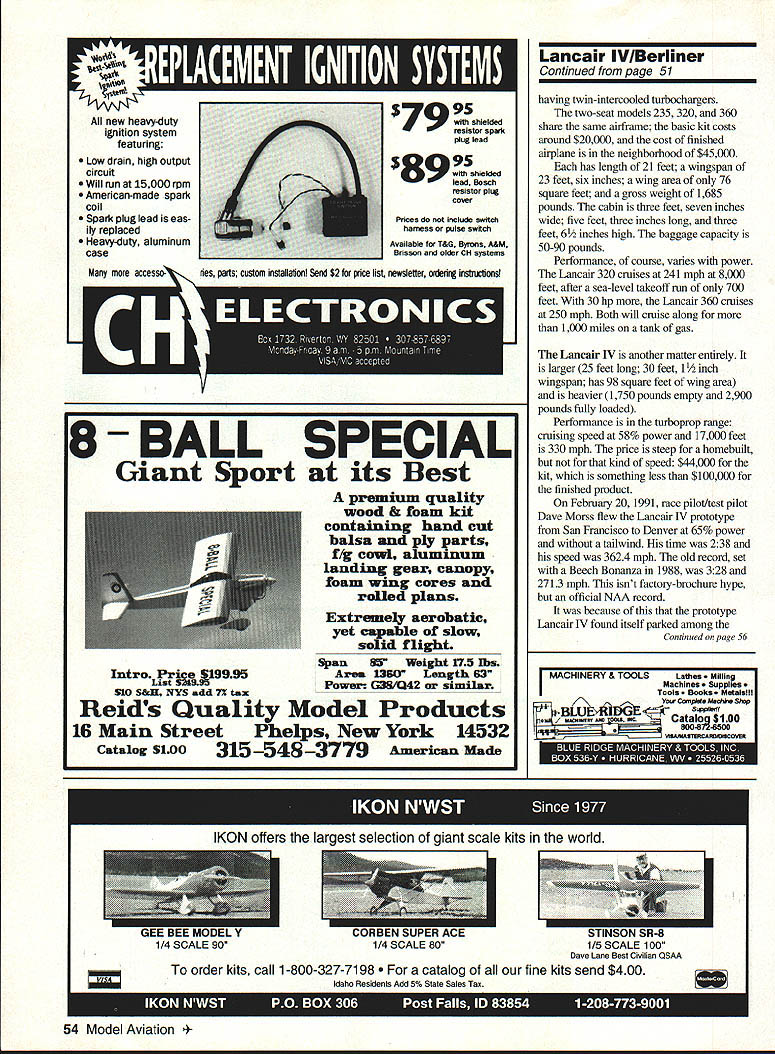
Take the Lancair, for example: a very impressive little two-seater, a sleek monoplane that started out in 1985 as the Model 235 powered by a 115-hp Lycoming O-235 engine. It was quickly supplanted by the Model 320 using the 150-hp Lycoming O-320; the Model 360 followed with the 180–200-hp Lycoming O-360. Now there is an advanced version, the four-seat Lancair IV, powered by a 350-hp Continental TSIO-550 engine with twin-intercooled turbochargers.
- Two-seat models: 235, 320, 360
- Basic kit cost: around $20,000
- Typical finished cost: about $45,000
Two-seat model dimensions and capacities:
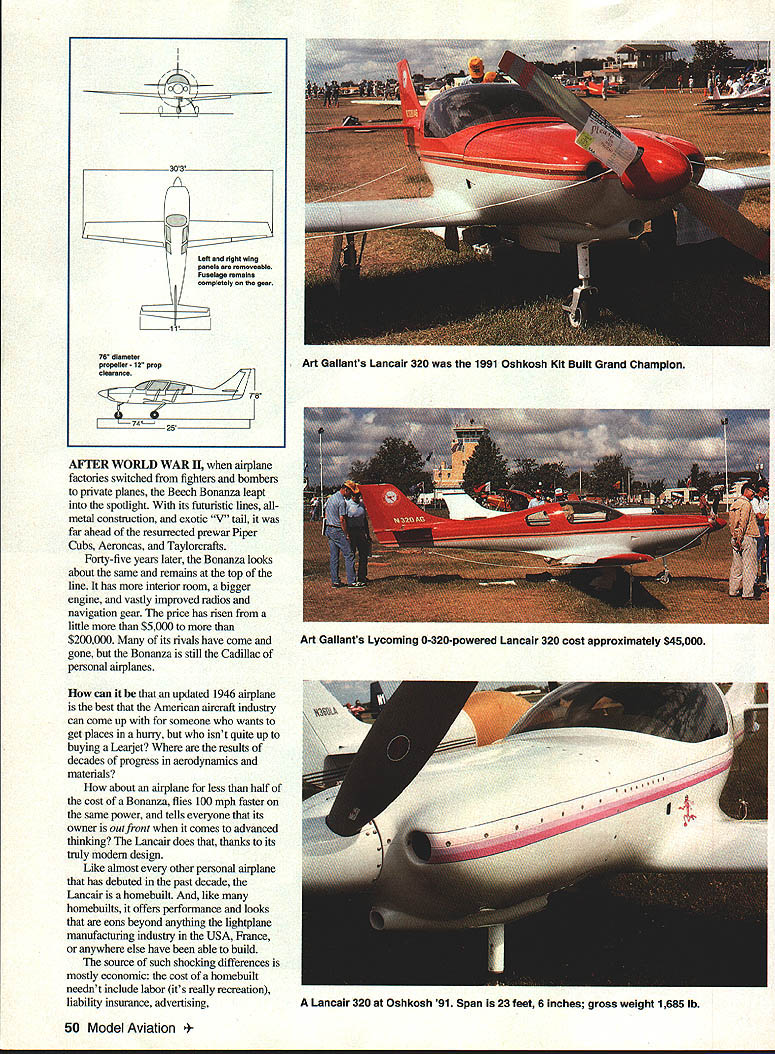
- Length: 21 ft
- Wingspan: 23 ft 6 in
- Wing area: 76 sq ft
- Gross weight: 1,685 lb
- Cabin: 3 ft 7 in wide; 5 ft 3 in long; 3 ft 6.5 in high
- Baggage capacity: 50–90 lb
Performance (varies with power):
- Lancair 320: cruises at 241 mph at 8,000 ft; sea-level takeoff roll ~700 ft
- Lancair 360: cruises at 250 mph
- Both: range >1,000 miles on a tank of gas
The Lancair IV: Size, Performance, and Cost
The Lancair IV is another matter entirely. It is larger and heavier than the two-seat models:
- Length: 25 ft
- Wingspan: 30 ft 1.5 in
- Wing area: 98 sq ft
- Empty weight: 1,750 lb
- Gross weight (fully loaded): 2,900 lb
Performance is in the turboprop range: cruising speed at 58% power and 17,000 ft is about 330 mph. The price is steep for a homebuilt, but not for that kind of speed: kit price about $44,000; finished airplane typically something less than $100,000.
On February 20, 1991, race pilot/test pilot Dave Morss flew the Lancair IV prototype from San Francisco to Denver at 65% power and without a tailwind. His time was 2:38 and his speed was 362.4 mph. The old record, set with a Beech Bonanza in 1988, was 3:28 and 271.3 mph. This was an official NAA record.
Reno Air Races and Structural Integrity
Because of this performance, the prototype Lancair IV found itself parked among Mustangs and Sea Furys in the pit area of the 1991 Reno Air Races. Several practice laps around the nine-mile course at more than 325 mph produced great optimism that a four-place homebuilt touring airplane could actually compete with the big boys.
But all this ended when an entire blade of the special racing propeller parted from the hub. Dave Morss made a fine emergency landing with much of the cowl missing and needles shaken off instruments. The engine stayed on, and no obvious damage was done to the airframe, proving its structural integrity right out in the open.
Construction and Airfoil
The entire Lancair airframe is made of pre-molded epoxy-based, high-temperature advanced composites, including DuPont Nomex honeycomb and high-temperature Divinycell, bonded with special epoxy resins. The wing airfoil is a 15%-thick NASA Laminar Flow NLF-0215-F.
Contact
For details about obtaining an information kit and videotape, contact:
- Neico Aviation Inc.
- 403 S. Ojai St., Santa Paula, CA 93060
- Tel.: (805) 933-2747
Transcribed from original scans by AI. Minor OCR errors may remain.

