
FROM LANDFILL TO FLYING SITE
Severn Green
In 1992 my club, the Ashland Cloud Chasers, approached the city of Ashland, Ohio to see if we could use its new soccer fields for flying model airplanes. We received written permission to use the facilities when vacant, but soccer became very popular—if there wasn't a game there was practice, which lasted from early spring until late fall, the peak of our flying season.
Finding a site
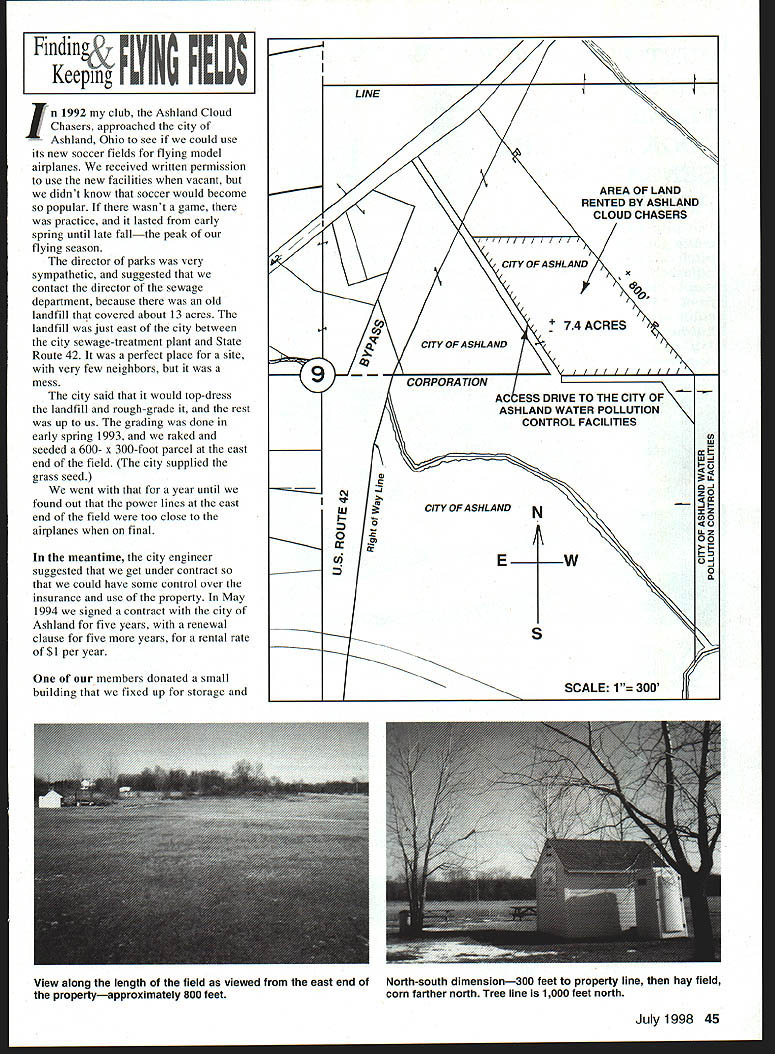
The director of parks was sympathetic and suggested we contact the director of the sewage department because there was an old landfill of about 13 acres just east of the city between the sewage-treatment plant and State Route 42. It was a perfect site with very few neighbors, but it was a mess.
The city agreed to top-dress and rough-grade the landfill and leave the rest to us. The grading was done in early spring 1993. We raked and seeded a 600-by-300-foot parcel at the east end of the field (the city supplied the grass seed).
Contract and layout changes
The city engineer suggested we get under contract so we could have some control over insurance and use of the property. In May 1994 we signed a five-year contract with a renewal clause for five more years, for a rental rate of $1 per year.
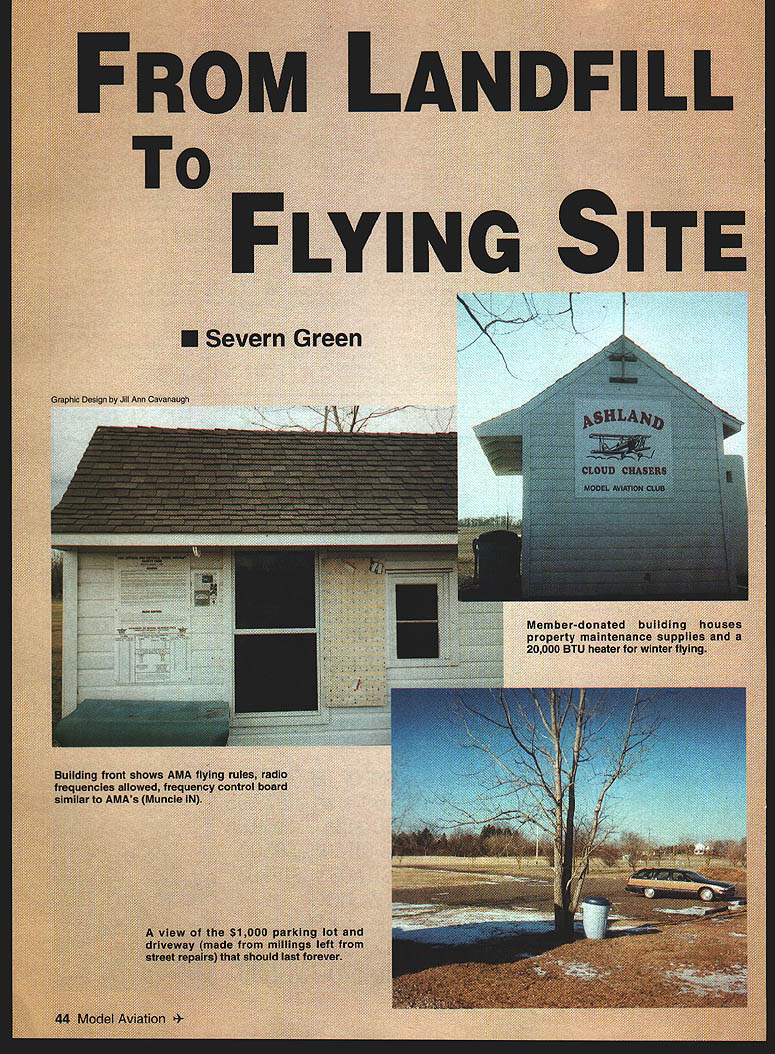
We faced a problem with power lines at the east end of the field that interfered with final approaches. We extended the flying strip to nearly the entire length of the area we rented and moved a small storage/winter-use building (donated by a member and installed with city permission) to the center of the field. Moving the building gave us excellent approaches to the east–west ends and created a short north–south runway. When using the east-end runway we could unload from the road because the building was a short distance off the road; after moving the building access to the field was approximately 100 feet from the road.
Driveway and parking
Our next project was a driveway and parking lot. The city engineer made rough cost calculations, but the city council couldn't justify spending $3,000, so we were told to use millings left over from street repairs. Millings are the result of grinding down roads before replacing the old asphalt; Ashland city specifications allow reusing up to 10% millings when making new asphalt.
The city graded the property, hauled the millings to the site, and spread them over the clay base. The base averages six inches thick, has no give, packs down perfectly, and will withstand the weight of a car. Total cost for the work was less than $1,000.
Facilities and maintenance
In 1997 the club participated in the Ashland Balloonfest during the July 4 weekend. We initially rented a Porta-Potti for three months at $180, but rather than keep renting we bought a used one for $150 and permanently installed it at the field. We contracted to have it pumped as needed at $20 per service.
We appointed a select committee to maintain a good relationship with the city and to comply with the city's wishes. The club mows the landing strip and the city mows the surrounding grass.
Outcome
This has been a win-win situation: the city cleaned up an eyesore in front of the sewage-treatment plant, and the Cloud Chasers gained an excellent flying field. Together we have turned an abandoned landfill into a beautiful park.
Severn T. Green 603 Center St. Ashland, OH 44805
Transcribed from original scans by AI. Minor OCR errors may remain.

