
Last Flight of the Dornier
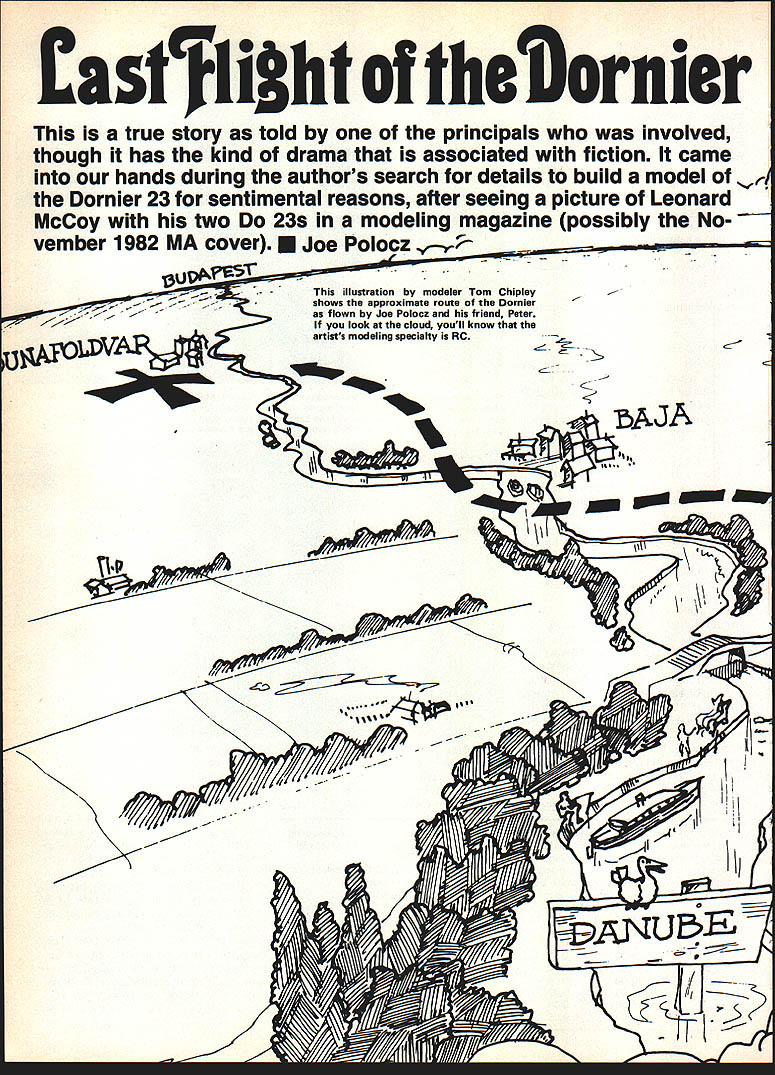
This is a true story as told by one of the principals who was involved, though it has the kind of drama that is associated with fiction. It came into our hands during the author's search for details to build a model of the Dornier 23 for sentimental reasons, after seeing a picture of Leonard McCoy with his two Do 23s in a modeling magazine (possibly the November 1982 MA cover).
Joe Polocz
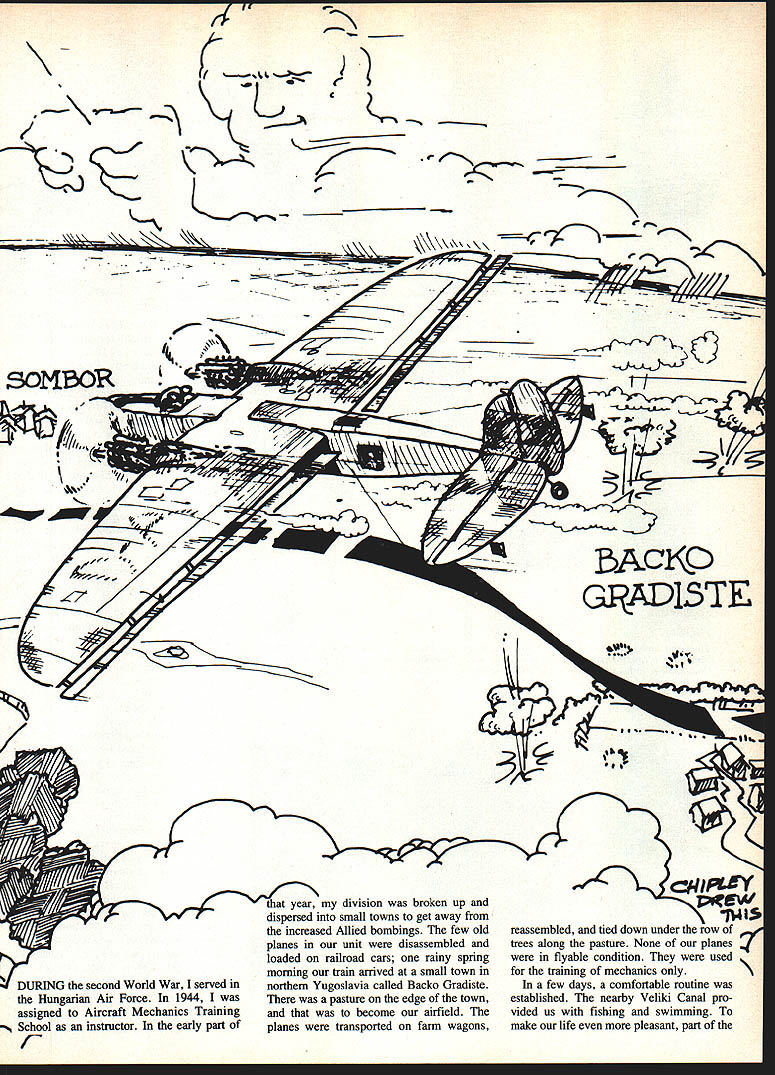
During the Second World War, I served in the Hungarian Air Force. In 1944 I was assigned to Aircraft Mechanics Training School as an instructor. In the early part of that year, my division was broken up and dispersed into small towns to get away from the increased Allied bombings. The few old planes in our unit were disassembled and loaded on railroad cars; one rainy spring morning our train arrived at a small town in northern Yugoslavia called Backo Gradiste. There was a pasture on the edge of the town, and that was to become our airfield. The planes were transported on farm wagons, reassembled, and tied down under the row of trees along the pasture. None of our planes were in flyable condition. They were used for the training of mechanics only.
In a few days, a comfortable routine was established. The nearby Veliki Canal provided us with fishing and swimming. Rumors started that we would be transferred to the western part of Hungary. Because of the shortage of transports, our departure time kept sliding back. In the meantime, the Russians arrived on the other side of the nearby Tisza River. The married and hardship personnel, regardless of rank, were separated for transfer to western Hungary. The rest of us were stationed on the western bank of the Tisza to set up an infantry defense line against the Russians. The only officer who remained with us was Captain Zentai, our company commander. He came around almost every day to see how things were going. There wasn't much activity—except an occasional mortar shelling—and a few of our guards were captured by Russian patrols. Needless to say, we had a very primitive existence. We were not trained or outfitted for this type of activity, and supplies of any kind were nonexistent.
One afternoon, our captain came by and told my buddy, Peter, and me, "Tomorrow morning, go back to town. One of you should be the mayor, the other the police chief to keep order; and with the time you can spare from your high offices, look over the old Dornier to see what, if anything, can be done."
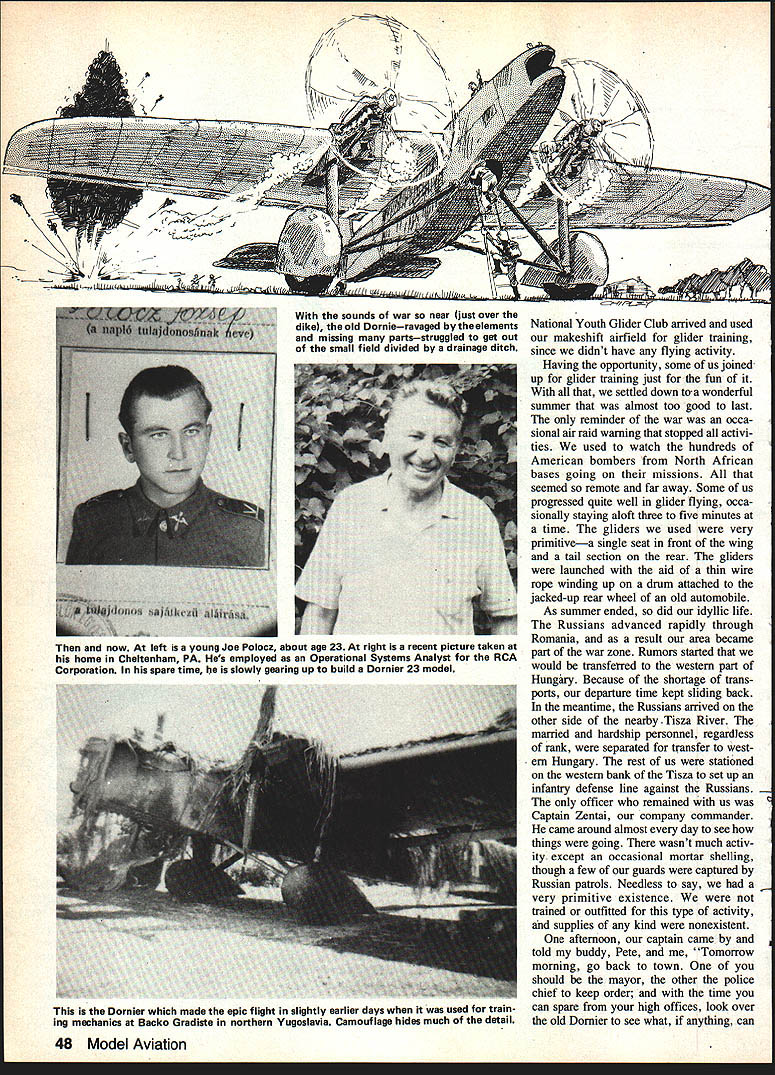
Next morning, as we walked back to town, it became apparent that it wasn't a comfortable place to be. The almost continuous random shelling had turned the place into a ghost town. Not seeing a soul, we came to the conclusion that there was no need for a mayor or a police chief. As we got back to our airfield, the hasty packing and departure were very obvious. The only plane remaining was the old "Dornie" (as we used to call it). There she stood on the edge of the field under the trees, still covered with dry grass, corn stalks, etc., for camouflage. Fortunately for us, the fuselage was used as a catchall for oil cans, fire extinguishers, shovels, and some hand tools (the original bomb racks had been removed long ago, and the floor was covered with pine boards).
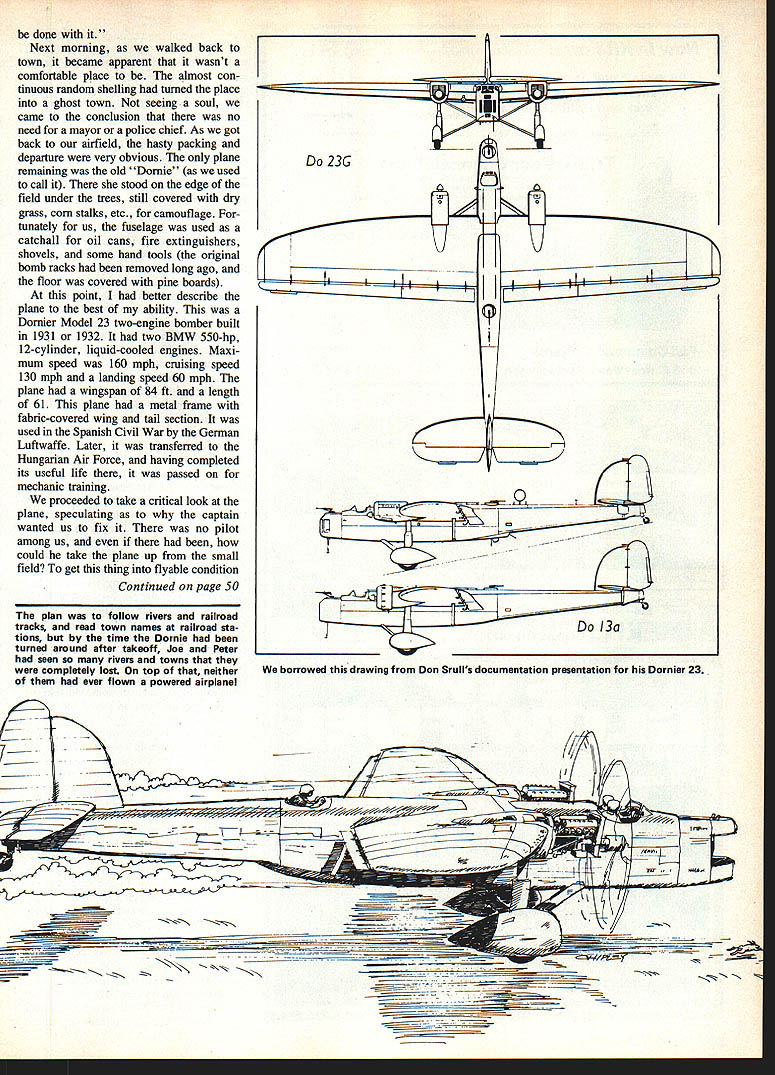
At this point, I had better describe the plane to the best of my ability. This was a Dornier Model 23 two-engine bomber built in 1931 or 1932. It had two BMW 550-hp, 12-cylinder, liquid-cooled engines. Maximum speed was 160 mph, cruising speed 130 mph and a landing speed 60 mph. The plane had a wingspan of 84 ft. and a length of 61 ft. This plane had a metal frame with fabric-covered wing and tail sections. It was used in the Spanish Civil War by the German Luftwaffe. Later, it was transferred to the Hungarian Air Force, and having completed its useful life there, it was passed on for mechanic training.
We proceeded to take a critical look at the plane, speculating as to why the captain wanted us to fix it. There was no pilot among us, and even if there had been, how could he take the plane up from the small field? To get this thing into flyable condition seemed beyond the realm of possibility. In spite of our better judgment, we proceeded to check things out. We were looking at the basic functions only. The fabric covering on the wing was in very poor condition because of careless handling and exposure. The controls didn't function for one reason or another. No instruments remained in the panels. Finally, the condition of the engines remained a big question.
We had first-hand knowledge of the fact that if anybody needed some special bolts or nuts, the old Dornie was the place to get them. With all that in mind, we commenced. We worked from sunup to sundown, since we had no electricity. Even if we could have worked at night, it wasn't the sensible thing to do under the circumstances.
Our difficulties were many and varied. We were limited by the lack of tools. Parts and supplies were nonexistent. Everything had to come from within the plane. If we needed bolts or nuts, they had to be taken from less important places and used on a strict priority basis. Non-essential items were eliminated, the pieces being used somewhere else. Leaky radiators were repaired with pieces of rags forced into the cracks. At the time, we thought that if things worked out we could make more substantial repairs later.
Inspiration to work hard and try the impossible was supplied by the almost continuous shelling and machine-gun fire which, at times, sounded uncomfortably close. Fortunately, one end of our field was bordered by an 8- to 10-ft. flood dike which protected us from direct exposure.
By the evening of the fourth day, everything we thought important was functioning. One by one, we got the engines started. We decided to report the progress we had made on the Dornier to our captain and to inform him of the deteriorating situation all around us. In the evenings the shelling usually ceased, so we went into the town's post office where a couple of our soldiers handled the telephone switchboard. We tried to make some calls to locate our captain. Much to our dismay, the Russians answered the phone most of the time.
Besides the Russians, we were very concerned about guerrilla activity. During the past summer, the countryside was infested with Marshall Tito's guerrillas. Now that "liberation" was imminent, this activity increased. Previously, we had no real trouble with them, but the signs of impending problems were all around us. That was a good reason for the two of us to stay together as much as possible. There wasn't much else we could do but try to get some sleep since we were dead tired. In the morning, we knew we had to find our captain for sure.
As we walked back to the plane, we found a small motorcycle. We drained some gasoline from the Dornie for the motorcycle; fortunately, it started. We decided that I would keep working on the plane while Peter drove out to the riverside to bring back the captain. The defense line was the only place we had not looked for him. During the night, a remnant group of German soldiers dug into a position facing over the dike toward the canal. By all indications, they intended to stay, even setting up a makeshift kitchen on the edge of our field in a small shack. For the first time in days, I started to feel comfortable. At least there was someone on our side. However, the peace and quiet did not last long; once the Germans started to fire over the dike, they started to get it back tenfold.
Peter returned around noon. By then, all hell had broken loose. Shells started to explode on our side of the dike. He had not been able to find the captain in spite of his best efforts with the motorcycle. He covered a large area, checking all possible places, often at great risk—but to no avail.
I started to feel alone, abandoned and bitter. For the first time, I suggested to Peter that we try to fly the Dornier 15 to 20 miles west, to a town where our division headquarters was located. We were sitting under the plane trying to decide what to do, while the situation on the dike was going from bad to worse. Peter kept raising objections—objections which I had already considered. First of all, neither of us had ever flown an engine-powered plane, let alone a two-engine plane. All of our "flying" experience amounted to about 20 to 30 minutes total in gliders, accumulated five minutes at a time. Our "airfield" had a drainage ditch running diagonally through it, dividing the field into two-thirds and one-third proportions; we were on the one-third area. There was a bridge over the ditch which was wide enough to get the gliders over—but impossible for the Dornie. As for navigation, I had read somewhere that the old-time fliers used to follow rivers and railroads. I figured if we could just fly along the railroad tracks and read the town names on the railroad stations, we could get there.
All in all, our chances of success didn't look too promising, but neither did staying put. The Germans started to throw hand grenades over the dike, and then started to pack up in order to abandon their position. When I saw one kicking over a pot with half-cooked food, I knew this was the end. I remember finishing the argument with Peter: "I would rather pile up in the plane trying to get away than to sit and wait for the Russians where the best of the possibilities is to rot away in a Siberian prison camp."
That did it. I climbed into the plane, and Peter started cranking. This plane had inertia starters. With a hand crank, we could wind up the flywheel to high revolutions, then energize the engine by pulling a lever. I got the left engine started after a few tries, but by then Peter was completely exhausted from cranking. I grabbed some of the camouflage material and stuffed it into the pilot's seat (which was contoured to accept a parachute, but without the chute, it was very uncomfortable).
We changed positions, Peter taking the controls while I started cranking. Even after several attempts, we just couldn't get the right-hand engine started. In the meantime, the Germans started to pull back from the dike under the trees. They had to pass by the plane. Speaking in broken Hungarian, one told me we had better clear out as fast as we could, because the Russians were on the other side of the dike. He was ready to throw a hand grenade into the plane. By then, I had recovered from the previous cranking effort and started all over again. Fortunately, one of the Germans came to my aid while Peter kept the other engine going. This time we got the engine started.
We had to race toward the dike to gain all the available field for takeoff. I ran ahead to give Peter some direction. As I looked back it was a strange sight to see the plane without engine and wheel covers. I couldn't help wondering about the additional drag that would occur. I kept on, occasionally glancing at the dike, expecting the Russians to appear. The day I did, I knew it would be all over for Peter and me. As we got to the end of the field, I signaled Peter to speed up the right engine to help the plane turn around, while I was pushing on the tail. Suddenly, the plane spun around with such force that I barely got out of the way. For an instant, I started to lose confidence in our abilities, but fortunately there wasn't much time to think. We had to start all over again to orient the plane in the correct direction.
As I climbed into the plane, I remember taking a last glance down at the "runway" and looked at the spot where we would pile up if we didn't clear the field in time. When I got up front, Peter asked me if I wanted to fly. I told him that since he was already in the pilot's seat, and with all the maneuvering on the ground, he had more experience than I, and there was no time to lose.
Peter was obviously moved by the solemnity of the moment. With a loud voice he shouted, "God help us," and pushed the throttle controls forward. I grabbed some structural pieces next to him so that I could lean forward to see where we were going, but the rising nose of the plane blocked my view. Peter was very busy flying; I had nothing to do but hang on. My thoughts drifted toward home and family. We must have been fixed in our positions for quite a while. Finally, Peter screamed jubilantly over the engine noise, "Hey, old buddy, we're flying!"
From where I was standing it was difficult to see out, so I walked up to the nose of the plane. This area was a machine-gun position at one time, but now it was empty and provided a good observation platform. We gained altitude rapidly, and I signaled Peter to turn around so that I could get our bearings by locating the railroad to the next town.
By the time we had turned around, I had seen so many towns and rivers that I was thoroughly confused. I couldn't even recognize the town we had just left. In short, we had lost our sense of direction completely. We looked at each other, wondering what to do next. In any case, since the Russians were coming from the east, we figured we had to go west. We took our bearings on a heavily overcast sun and headed west.
(Note: Our captain told us months later that he saw the plane rising above the horizon and gaining altitude at an unbelievable rate. He expected the plane to stall out any moment, but it kept on climbing until it disappeared into the clouds. As he said, it was "like somebody pulling it up on a string." He figured that whoever was flying the plane must have been insane. Never in his wildest imagination had he considered that it might be us. Later, when he found out that Peter and I were the ones, he didn't expect to see us again.)
We slipped into the clouds so gradually that we didn't realize it until we found ourselves completely in the soup. Fortunately, the plane broke through shortly into sunshine, which we greeted with a loud cry. That was a lucky break for us, as we were flying northwest. Now with the sun clearly visible, we corrected our bearing and headed west by keeping the sun to our left. We considered the sunshine a good omen for the future. Our spirits started to rise.
It was getting very cold. I took one look at Peter and started to laugh. He was a sight to behold. His face was snow white with enormous goose pimples and on the top of each, a long black whisker was sticking straight out. He looked like a porcupine. When I told him what I was laughing at, he started to laugh and assured me that I didn't look any better. (I came to realize we hadn't shaved for weeks.) We wound up in a hysterical laughing session. I decided to look for some rags or canvas which might help protect us from the cold.
While walking toward the rear of the plane, I was startled to see a German soldier calmly enjoying the scenery through a convenient hole in the floor. Looking up at my approach, he smiled, and I recognized him as the one who had helped me to start the plane. I couldn't talk to him because of the language differences, but I was getting the impression that he was enjoying the trip, although he didn't know where he was going—but then, neither did we! Peter would not believe me until I brought him up front.
I didn't find anything for protection from the cold, but suddenly I realized the source of our problem. All the junk piled up in the rear of the plane had loaded down the tail, and that was the reason we had been climbing higher and getting colder all the time. I started to drag the heavier pieces forward and somehow convinced our passenger to sit closer to the front. When I explained to Peter what I was doing, he gladly agreed, and we began to descend to a lower and, hopefully, warmer altitude. Time seemed to drag on, and we started to wonder if we would ever reach the Danube. Fortunately, the clouds started breaking up.
As we noticed a silvery strip on the horizon, our hopes jumped. We started to congratulate each other on the approach to the river. We were sure that this was the Danube. Flying over the river, we turned north. Peter wanted to find a place to land on the western side of the river. I suggested that he go on toward Szekesfehervar. I knew this city had an airfield, because that is where I had my basic training. If we could only find it.
As I think back now, both of us knew from glider training that it is one thing to go up and another to come down. Our meager glider training hardly equipped us to make a decent landing. I don't think either of us was looking forward to it. At the same time, we were sure we had to come down sooner or later. The cold still bothered us. The descent helped somewhat, but we just couldn't get warmed up. In the middle of October, an open cockpit is mighty cold. All the outer clothes we had on were a pair of pants and a jacket. To make matters worse, we were very hungry. We had not eaten since the day before. In short, we weren't exactly prepared for the trip. At this point, I took over the controls. Peter could hardly move because of the cold and from sitting in one position since taking off.
We were approaching a larger city recognizable from its bridge across the river (although the bridge had been destroyed). The city was Sombor, or so we thought at the time. Later on we learned that it was Baja.
We reasoned that the bridge had probably been bombed by enemy aircraft. We began to worry about anti-aircraft fire. Our plane had insignia painted on the tail section only, but even that had partially peeled off from weather deterioration.
We decided to come down low over the river and inadvertently created a lot of disturbance to the people on the ships and barges when they saw us descending. I saw people running in all directions, and some were jumping into the river. After passing the city, we climbed somewhat higher. I took a good look at our flying machine and wondered what would happen if some enemy plane should bump into us. The plane was a sad sight. We hadn't had time to install the engine covers, so the engines just seemed to be hanging out in the air. Because of the missing covers, a section of the front part of the wing was open, and the wind blew in and tore the fabric covering into shreds. Strips of rags were waving from the wing and tail section. On the right engine, the valve lifters were bobbing up and down against the horizon. In our makeshift repair job, we had used the screws of the cover for more important places and never had the time to put them back.
We started to be concerned about our gasoline supply. Throughout the summer, the Dornier tanks were used for fuel storage. It was ideal, since they were high up and easy to drain as needed. During our repair work, we divided the gasoline evenly between the two tanks. By measuring with a stick, we knew that each tank was about half full, but we had no idea how much that meant in gallons or what our consumption rate was. Another problem started to appear because of our missing valve cover; the right wing panel behind the engine was covered with oil. Obviously our time in the air was running out.
Peter suggested that we keep on the western side of the river in case we had to come down fast. This way, we would be on the ground and not in the drink. A trail of smoke from the right engine confirmed our worst fears. We decided to try and land near the first large town; small towns didn't have doctors, and we might need one after landing. We were following the railroad tracks as a town came into sight. I lowered the plane to try to read the name of the railroad station, but neither of us could make out the letters as we were too far away.
I pushed the throttle forward again to gain altitude so that we could look for a suitable landing place, but the old Dornier didn't respond. (We didn't know it then, but by not responding to our wishes, that old plane saved us from certain disaster.) Losing altitude rapidly, we skipped over a row of trees. After a big jump, the plane settled down in a cornfield.
By then, the right engine was on fire. Peter ran to the rear of the plane to get the fire extinguishers while I climbed up to the top of the plane. Together, we put the flames out. When we got down, it was wonderful to feel the solid ground under our feet. We were very happy, shook hands, hugged each other and literally jumped up and down for joy. However, our passenger didn't join the celebration. He was lying on the ground obviously not feeling very well. If he had known with whom he was flying, he would have felt worse.
A farmer approached us cautiously, but he relaxed after we greeted him in Hungarian. He told us we were in Dunafoldvár, about 50 miles south of Budapest. In answer to our questions, he told us the date was October 12.
We were busy questioning the farmer about the latest news when I noticed we were completely surrounded by Hungarian soldiers with weapons drawn. A lieutenant came forward and asked us who we were. He dressed us down for our unkempt appearance, then asked for our pilot's licenses, flight orders, and flight plan. The only thing we had were our ID cards. It was no use to try to explain our predicament, as all he was interested in were procedures.
Fortunately for us, an artillery sergeant arrived with four men from the area Air Defense Command. The lieutenant told us that he was traveling on a nearby highway on the way to the front line with a motorized column. When they saw the plane landing, he came over to investigate. He handed us over to the sergeant after instructing him on procedures and making a grim prediction concerning our future. He was one unfriendly chap, to say the least, full of spit and polish and procedures. I am ashamed to admit it, but at that moment I was rooting for the Russians.
The sergeant assured us that the area Air Defense Commander was a sensible down-to-earth artillery general, and we should not worry what the lieutenant had said. He left two men to guard the plane, and we started to walk back to town. He told us his version of our flight.
First of all, Dunafoldvár had only the bridge open south of Budapest, and at the time very heavy fighting was going on across the river. The bridge was the lifeline for the combined German-Hungarian forces on the other side. (That's the first time we realized how deeply we had been buried under the Russian offensive.) The bridge had to be kept open at all cost. In order to protect the bridge, the area had the largest anti-aircraft fire concentration next to Budapest. They had been notified as soon as we crossed the river and had then followed our progress.
The problem was that nobody could identify the plane—not its nationality or its type. They had never seen or heard of anything like it. As we approached the town, the anti-aircraft batteries kept calling each other for instructions since they noticed that something was wrong with the plane. A decision was made that under no circumstances could the plane approach the bridge—or leave the area. (Lucky for us that we switched our course to follow the railroad tracks and that the plane didn't pull up or that it just couldn't go any further.)
As we got to the command center, we said goodbye to our passenger, who was taken to the German command. The only thing we knew about him was that he was about our age (both of us were 23), and that he was of Croatian nationality, indicated by the red-and-white checkerboard emblem on his German uniform.
As we were waiting to see the general, a young officer started to recite the procedures for us again as soon as he found out that we didn't know any. We were very apprehensive by the time we got to see the general, but he put us at ease and listened to our story attentively. He congratulated us for the successful flight, shook hands with us, and gave each of us a big cigar.
What we regretted the most by the time we got through with all of this was that we had missed supper again. The next day, the decision was made that Peter would go to Sarvar, where our advanced detachment was supposed to be, and report our arrival. I would stay with the plane. He departed, and I settled down to a meager existence—sleeping in that leaky old plane and living off the fat of the land.
One day an Air Force captain arrived on a motorcycle. He looked over the plane and asked lots of questions. Before he left, he shook hands with me and said, "Son, I am a test pilot. My only requirement to take up a plane is that the propellers are turning, but I'd be damned if I would take up this one." It was almost a month later before Peter got back. Because of gasoline shortages, transportation difficulties, and the general deterioration of the overall military situation, he told me we were to leave the plane behind and report to our unit, where some of our comrades started to drift in, one or two at a time.
Peter and I managed somehow to get a week's furlough. Since Peter's home was already under Russian occupation, he came here with me. He felt very badly that our captain didn't give up in all this time. He had just about given up hope for him when, a few days before Christmas, he arrived. He was the last one to get out. When we met him, Peter and I gave him a snappy salute. He greeted us in his customary friendly way by starting out, "You dirty [expletive deleted], how in the [expletive deleted]..." and finished with, "I am an old Air Force captain who came out on horse and buggy, and you punks flew out!" We had trouble keeping a straight face, for we knew him too well. The first odd thing he wanted to know was where he was when we couldn't find him. Now it was his turn trying to keep a straight face while he was telling us that he was at his girlfriend's house, and we should have known better than to look for him in the trenches. Finally, we couldn't hold it in any longer and we all burst into laughter. Since they were getting married shortly, he invited us to their wedding.
Postscript
One thing puzzled us. Why didn't the Russians come over the dike after the Germans abandoned it? We will never know for sure, but we came up with a theory. Just about when the Germans pulled back, we got one engine started—and after a while the second one started. They couldn't see us, but they must have heard the engine noises as we were maneuvering for the takeoff; we had to get closer and closer to the dike. To them, it may have sounded like German tanks getting into position.
Transcribed from original scans by AI. Minor OCR errors may remain.

