

At Last: Success with a Model Gas Turbine Jet Engine
David Boddington
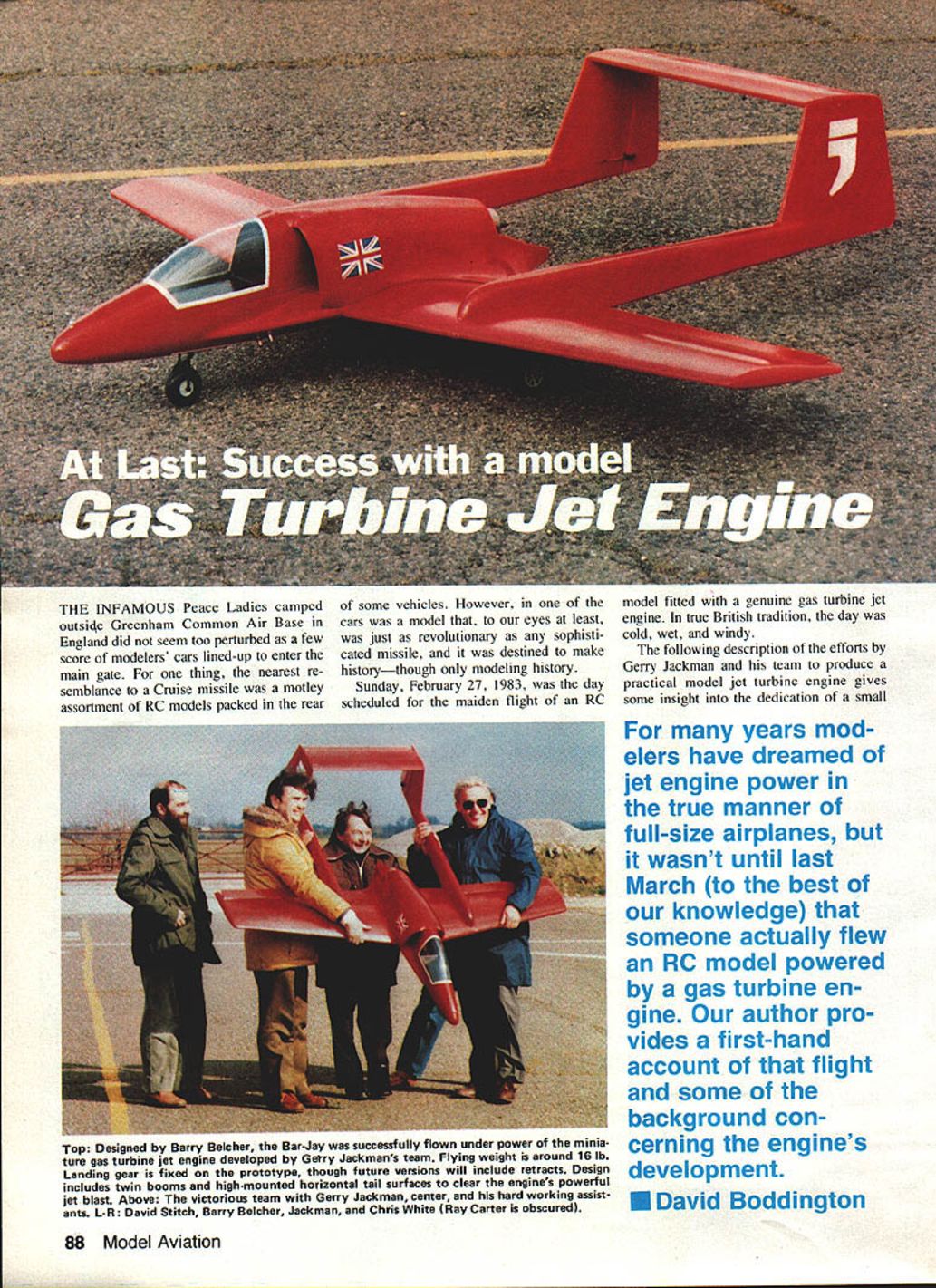
The infamous Peace Ladies camped outside Greenham Common Air Base in England did not seem too perturbed as a few score of modelers' cars lined up to enter the main gate. For one thing, the nearest resemblance to a cruise missile was a motley assortment of RC models packed in the rear of some vehicles. However, in one of the cars was a model that, to our eyes at least, was just as revolutionary as any sophisticated missile, and it was destined to make history—though only modeling history. Sunday, February 27, 1983, was the day scheduled for the maiden flight of an RC model fitted with a genuine gas turbine jet engine. In true British tradition, the day was cold, wet, and windy.
The following description of the efforts by Gerry Jackman and his team to produce a practical model jet turbine engine gives some insight into the dedication of a small group of people who were not prepared to abandon their project in the face of many setbacks, frustrations, and disappointments. Despite the many admonitions that what they were attempting was impossible, and the realization at various times throughout the development period that the detractors might well be right, they persisted with their plans to a stage where their dreams became reality.
For many years modelers have dreamed of jet engine power in the true manner of full-size airplanes, but it wasn't until last March (to the best of our knowledge) that someone actually flew an RC model powered by a gas turbine engine. The author provides a first-hand account of that flight and some of the background concerning the engine's development.
Background: jets, pulse-jets, and the challenges of scaling down
When the first pure jet aircraft flew in 1939 (the Heinkel He 178), Frank Whittle had already been carrying out test runs on his jet engine for two years. It was 1930 when Whittle first took out a patent for this form of propulsion. Perhaps it is surprising that, nearly 50 years after the original design of a full-size gas turbine aircraft engine, we are only just reaching the stage of developing the equivalent in a model size. A look at a few of the considerations involved in producing such an engine will give some insight into why this goal has eluded engineers and modelers for so long.
The only form of jet engine that has found any favor with modelers has been the pulse-jet. These have been with us since the 1950s. Pulse-jets have a big advantage in that they have a minimum of working parts—just reed (flap) valves at the front of the combustion chamber. Air is introduced through the valves, mixed with the fuel, and the mixture is ignited by a spark plug. After the combustion is completed and the gases have been expelled at high velocity via the tail pipe, a partial vacuum is created in the combustion chamber, and the cycle is repeated. The frequency of the pulses is governed by the design shape of the combustion area and tail pipe.
The simple pulse-jet is not, unfortunately, the ideal answer to the scale modeler's prayer for a jet engine. Starting it requires a high-pressure blast of air at the intake, throttling qualities are virtually zero, and the noise levels are sufficient to put any self-respecting heavy rock band to shame. Worse still, the sound doesn't even resemble a full-size jet—except for the dreaded V-1 flying bomb.
The essential difference between the ram-jet, pulse-jets, and a jet turbine engine is that the latter uses a compressor, or multi-stage axial compressors, to draw air into the combustion chamber and compress it. To rotate the compressor unit, a turbine wheel is fitted to the common shaft; gases from the combustion chamber pass through the turbine blades to turn the complete compressor/turbine assembly. Part of the energy is absorbed by the turbine; the remainder provides the propulsive thrust. All jet engines are based on the fundamental law of physics which states that action is equal to reaction. Combustion gases are expelled at a much higher velocity (as a result of compression and heating by combustion) than the intake air velocity, producing the thrust.
One of the big problems in producing a miniature jet turbine engine is that operating temperatures will be in the region of 600°C. Another is that the shaft speed of the compressor/turbine assembly may be approaching 100,000 rpm to obtain workable thrust levels. The degree of technological expertise required in the fields of metallurgy, thermodynamics, and engineering is considerable.
The expanding team
When Gerry Jackman, originator of the project, decided to build a jet turbine engine, he was given little encouragement by his colleagues; they considered him a loser. Only his determination and obvious will to succeed encouraged fellow modelers to offer their assistance. Gradually, over the past eight years, the strength of the team increased with the inclusion of those with specialist knowledge of the various facets of technical design and engineering.
First to offer his services was Barry Belcher, an aerodynamicist, who was responsible for the design of the Bar-Jay model used as the testbed for the latest engine. Barry was also responsible for a major breakthrough when he designed a revised turbine blade section, improving the static thrust of the engine by 20%.
Following a turbine failure on one of the earlier engines—a traumatic and catastrophic event that served to emphasize the complexities and dangers of the project—Ray Carter was brought in to work on the stress calculations and engineering design. Since this time there have been no similar failures, and Ray has been able to advise on special welding techniques, pressed steel work, and to prepare the technical drawings.
One recurring problem with early engines was the failure rate of the shaft bearings. With the speeds and temperatures involved, the bearings would only survive for a matter of minutes at full operating power. Failures were due partly to the high temperatures and speeds, but a serious contributing factor was the shaft's whirl—the whipping and oscillation over the unsupported length (about 6 in.). David Stich, a bearings consultant, was able to recommend the correct selection of bearings, where to obtain them, and how to control shaft whirl.
The correlation of compressor design, combustion chamber heat output, and nozzle ring and turbine blade angle settings are of paramount importance for efficient output of a small gas turbine engine. These points are even more critical on model-sized engines than in commercial-sized units, as inefficiencies will result in power outputs that are too low for any practical purposes.
Thermodynamic design considerations became the responsibility of Chris White. He has been constantly striving to refine the design of the engine to improve thermal efficiency and produce more useful thrust. His current development work is aimed at producing a superior tail-pipe design.
Whereas a model aircraft can usually be designed and built so that it will "fly straight off the building board," there are no easy and straightforward solutions for constructing a miniature gas turbine engine. Gerry Jackman has a phlegmatic and tenacious personality, but he freely admits that, in the eight years of development, there were a number of occasions when the prospect of eventual success appeared to be very remote. Without the support of a strong backup team the project may have faltered, as one crisis was succeeded by another seemingly impassable complication.
They triumphed where others had failed only because they refused to be beaten, and they had the collective faith to see the job through to the end. In their final engine the major components are:
- a centrifugal compressor and turbine (single stage each)
- a combustion chamber
- a fuel/air control system
- gearbox and bearings
- supporting structure
In our opinion there is no reason why any commercial firm could not have produced a practical working jet turbine engine for modelers—provided they were prepared to invest many thousands of dollars in development and experimental work. Theirs has been a solo effort; they received no assistance or advice from the manufacturers or designers of full-size turbojet engines. It has been amateurism of the highest professional standards.
Design and construction
In view of the proprietary nature of this miniature gas turbine engine, it would be unfair to give any detailed information on the design or construction of the unit. After many thousands of hours of research and development work, the team naturally hopes to recoup some reward for its efforts. The following brief comments will provide an idea of the methods employed and the considerable technical barriers that were overcome.
Nimonic alloys and stainless steel were the principal metals used in the construction of the engine. Correct selection of metals to allow complementary rates of expansion on closely mating components is vitally important. Equally important is that the metals are capable of withstanding high stresses for certain components (the tip speed of the compressor is 1,100 ft per second) and high temperatures. The compressor was machined from high-quality duralumin; drop-forged material would have been preferable, but this couldn't easily be obtained in the small quantity needed for the development prototypes.
Early attempts at producing the turbine were not totally successful, and it was eventually necessary to construct a special spark-eroding machine to manufacture this item. Each turbine takes some 130 hours of machining and eroding (the fumes from the dielectric fluid during the eroding process are pretty obnoxious, despite being perfumed). Balancing of the compressor/turbine rotor has to be ultra-precise, and rebalancing has to be carried out each time a bearing is replaced.
Close-tolerance machining is obviously needed for a project as sophisticated as a gas turbine engine, but most of the work was carried out on a Myford Super 7 lathe (modest by commercial standards), a small milling machine, and the typical power and hand tools one would expect to find in a modeler's well-stocked workshop.
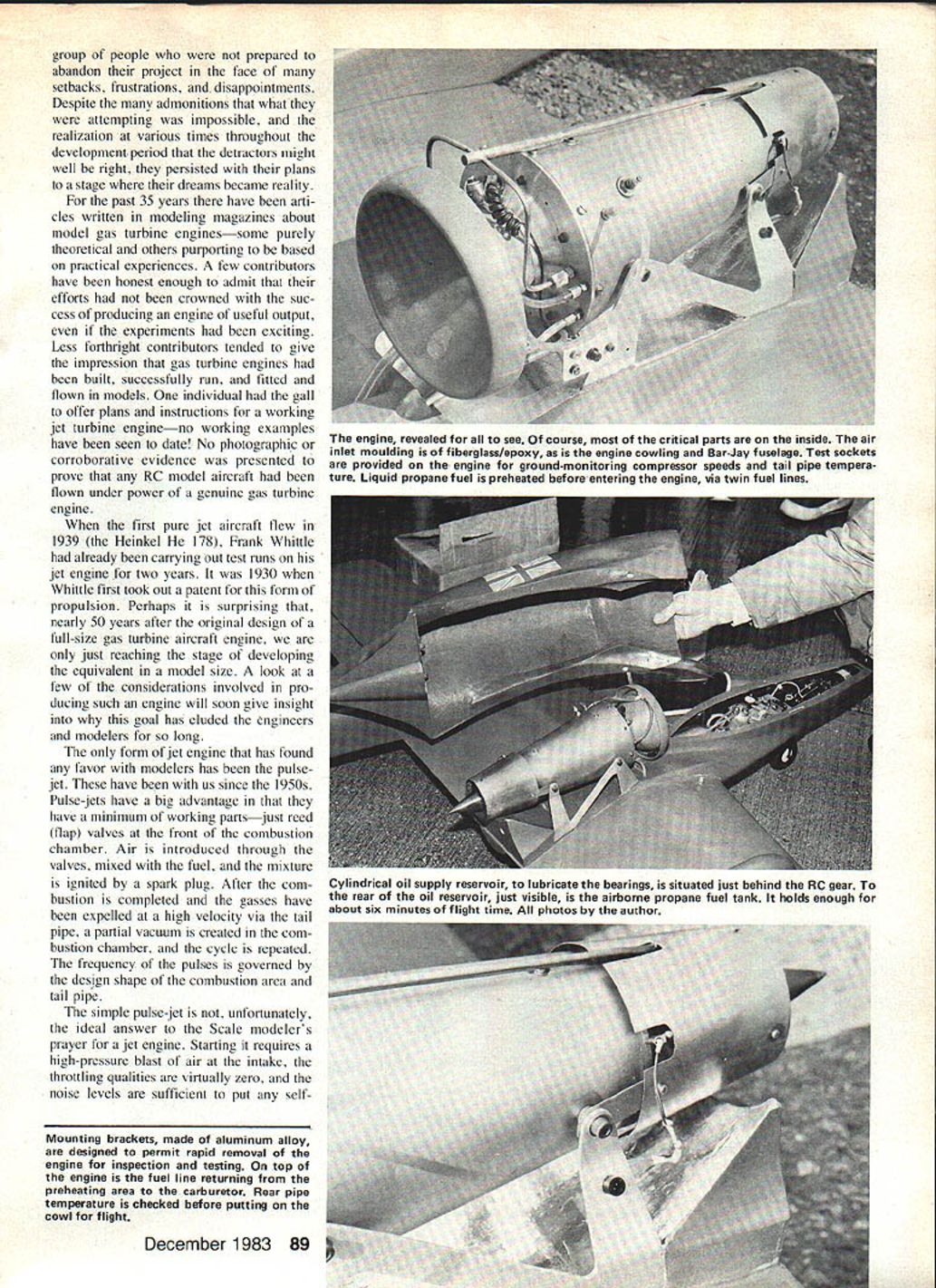
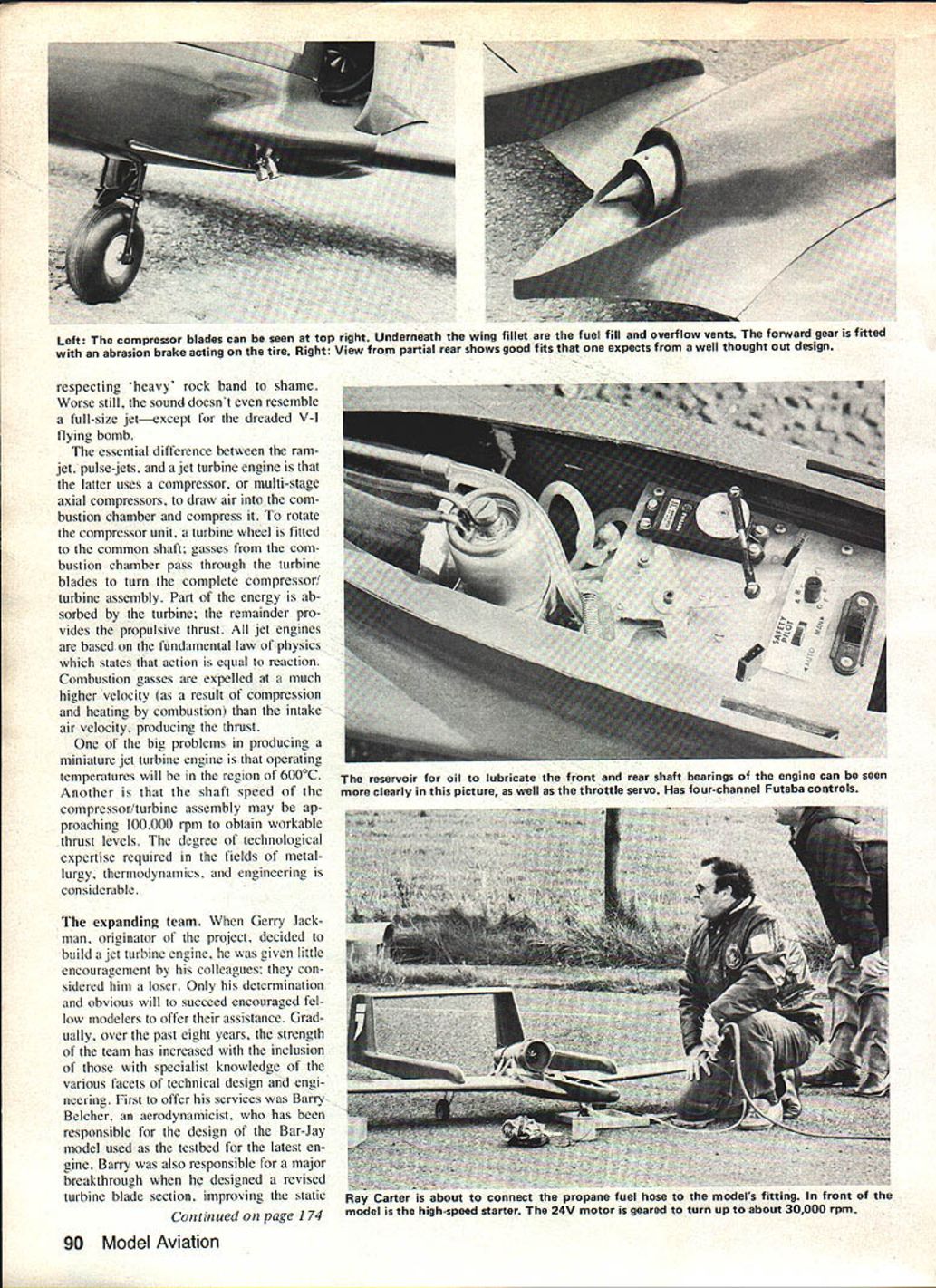
The present engine has been tested over the past 12 months, concentrating initially on obtaining reliable running, then on improving thrust levels. Propane gas was used for bench running, and this proved to be a very suitable fuel. When the engine was fitted into the model, a change was made to liquid propane, as the storage vessel for the propane in gas form was too large. One bonus of injecting liquid propane into the combustion chamber is an increased thermal efficiency of the engine. A disadvantage is that it became more difficult to accurately meter the fuel supply.
Rear bearings now survive for an acceptable period, proving that the team had been able to select the correct bearings and achieve reasonable operating temperatures at the rear end of the rotor shaft. Temperature readings at various points on the engine have been monitored throughout the test period. Indeed the total development has been logical and planned throughout the eight years of experimentation. Temptations to bolt a unit to a temporary airframe—just to see whether it would fly—were resisted. The whole project has been professionally handled.
Good throttling response is a feature of the engine, although the aircraft response to power changes is slow compared with propeller-driven aircraft. Shaft speeds of 80–85,000 rpm, maximum, result in static thrusts of 7½ to 8½ lb and jet pipe temperatures in the region of 600–650°C.
Greenham Common debut
Waiting for the rain to cease at least gave me the opportunity of chatting with Gerry Jackman before the maiden flight was to be attempted. He seemed remarkably relaxed and composed in view of the circumstances, and his only wish was to get the engine started, aim the model down the runway, and watch it make for the sky. This, he assured me, would make all of the previous struggles worthwhile, and the whole team would probably dissolve into floods of tears.
When the rain eventually ceased, it was late in the afternoon. The Bar-Jay model was quickly assembled. The numerous spectators moved to a safe position, and the model's fuel tank was filled. Looking down the line of critical spectators—including some of the cynical prophets of doom—it was impossible not to admire Gerry's courage in inviting such a gathering for the proposed maiden flight.
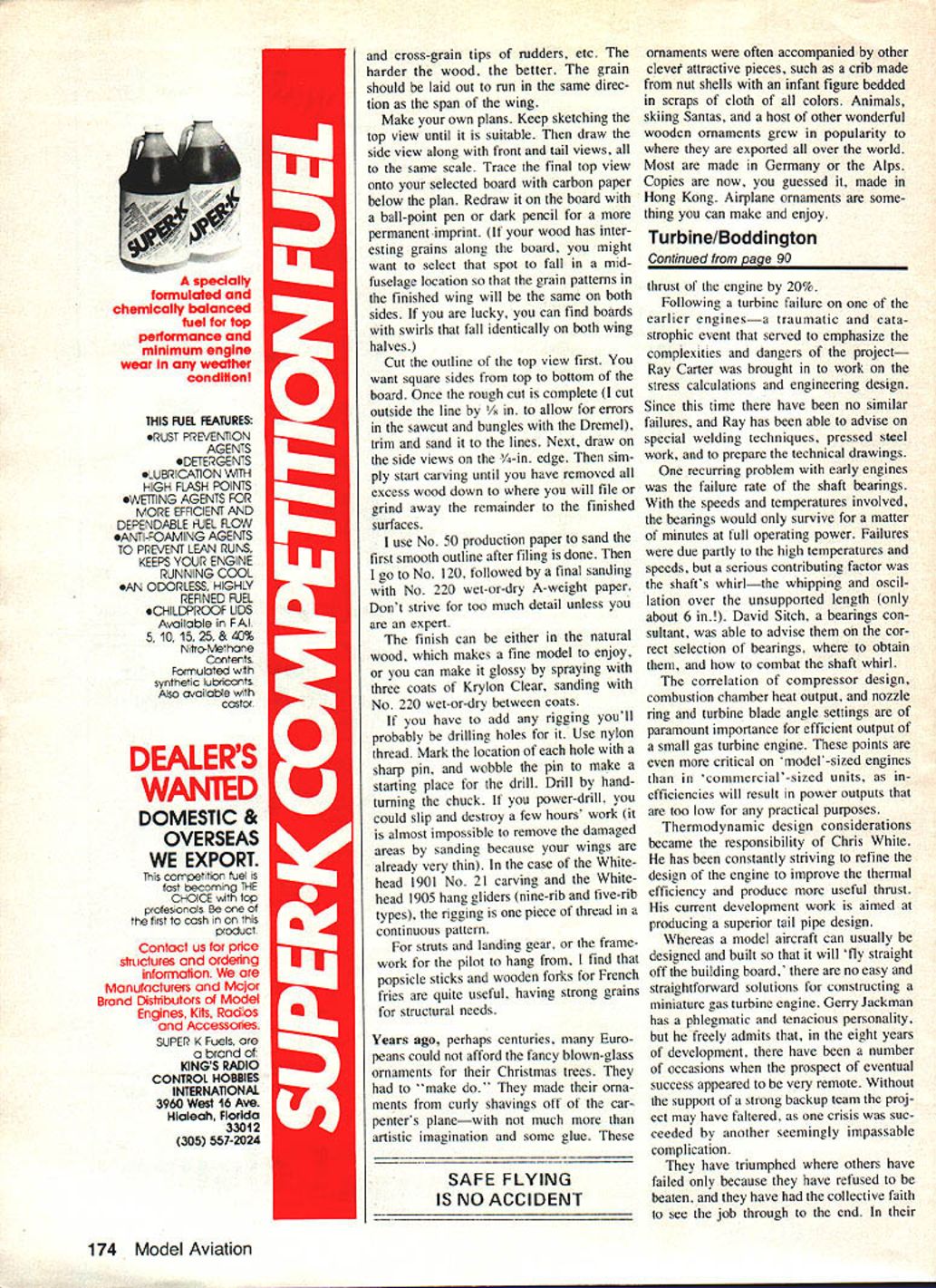
Anxious faces watched as the ignition plug was energized and the starter applied to the nose cone. Starter speeds of 25,000 rpm are required to overcome the turbine losses, and as this speed was reached there could be heard the unmistakable turbine whine as ignition took place. Gradually the pitch of the whine increased, and the sound to an ex-jet-pilot was pure music. Surprisingly, the overall noise levels were by no means objectionable.
As the engine built up to full operating speed, there were signs of rough running, almost as though there was an afterburner operating intermittently. Just as the hatch was about to be attached, the engine began to die. Further attempts at starting the engine resulted in the same erratic running. Eventually, the efforts had to be abandoned because of the impending darkness.
To say that the failure to get the model airborne was a disappointment to the spectators is stating the obvious. For the team, it must have been devastating. They had every confidence that the venture would be a success, and they had been thwarted at the last minute.
The sweet smell of success
It did not take long for Gerry and his crew to overcome the temporary setback, and they were soon investigating the reasons for the erratic running of the engine. It had worked perfectly on the bench. The conclusion they came to was that the liquid propane was not fully vaporizing in the combustion chamber, and secondary combustion was taking place in the jet pipe. To cure this, the fuel feed line was routed around the tail pipe to preheat the fuel before it was injected into the combustion chamber. Excessive pressure was built up in the fuel line in the first experiments, but further modifications showed greater promise.
In the meantime, they decided the next outing would be only to carry out extended taxi trials before attempting to fly the model. The throttle opening was fixed to give an upper operating limit of 60,000 rpm—well below the maximum speed that was available.
A further trip to Greenham Common Air Base (by kind permission of the C.O.) was made. Again the weather was poor, but this time it was less critical, as there was to be only taxiing. Gerry was quite happy with the general ground-handling qualities of the model, and he decided to give it a faster run. Acceleration was considerably more rapid than anyone had predicted, and he found himself in the position of having to make an instant decision. Flying speed was being reached, and either the engine had to be shut down or a flight had to be made.
Being a man of conviction and faith, Gerry eased back on the elevator stick, and to the immense surprise of those fortunate enough to witness the historic event, the wheels left the ground. After climbing smoothly away, the Bar-Jay was flown for two complete circuits, and then it was brought in for a gentle touchdown.
It had all happened so suddenly that it took some time for the enormity of the event to sink in; it was hardly believable. Fortunately, one of the spectators was armed with a video camera, and the happenings were all recorded for posterity—and for the team to be able to prove that it really did happen.
Sunday, March 20, 1983, will be remembered as the day that one more model aeronautical achievement was attained—after nearly 40 years of quest. Likely it will not substantially change the hobby, as only a few modelers may be able to use a jet turbine engine if and when they become available commercially.
The significance of this achievement is that a group of modelers had the pioneering spirit to accept a challenge, and they had the determination to carry it through to a successful conclusion.
Transcribed from original scans by AI. Minor OCR errors may remain.

