

Le Petit Santos
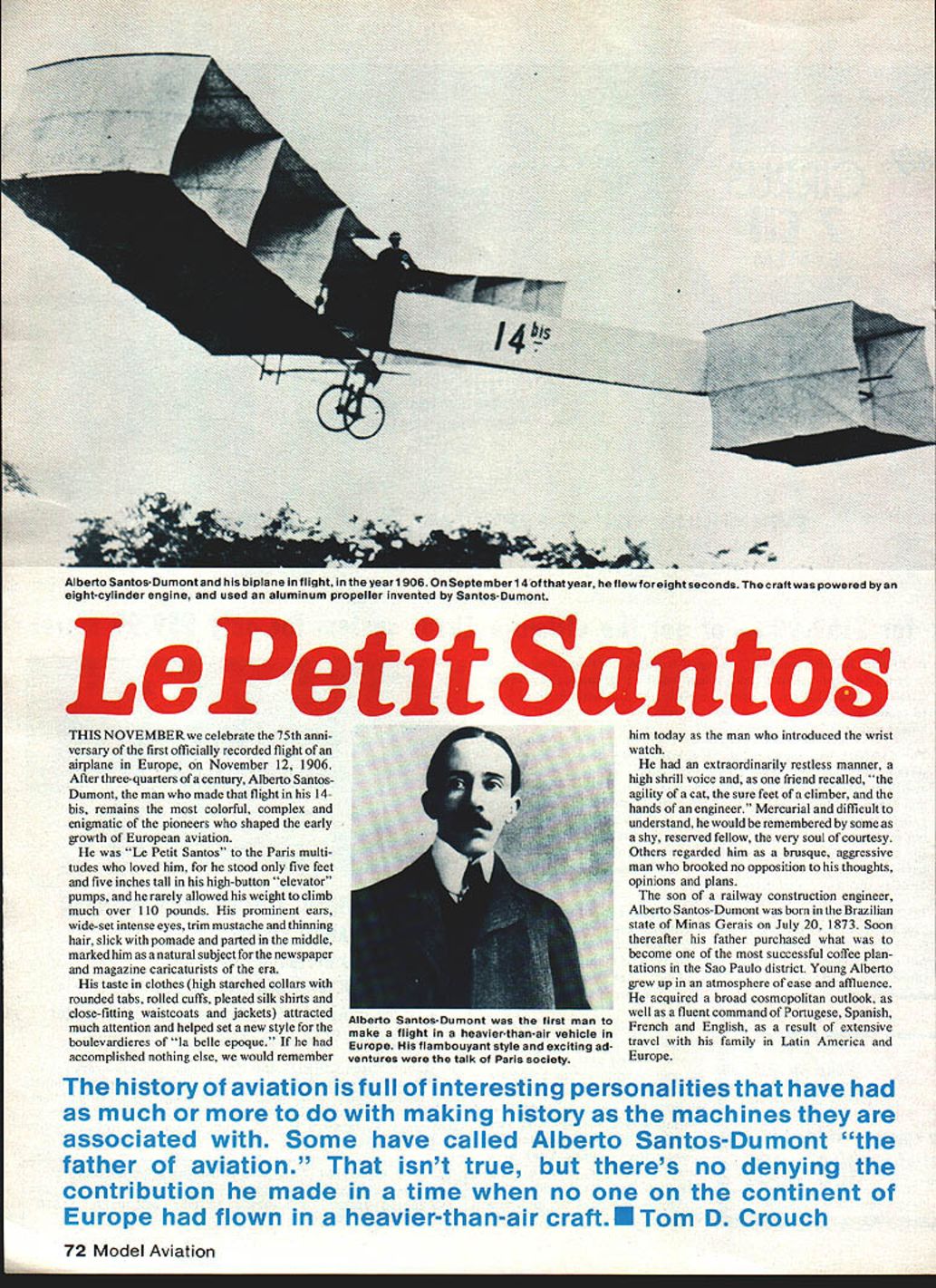
This November we celebrate the 75th anniversary of the first officially recorded flight of an airplane in Europe, on November 12, 1906. After three-quarters of a century, Alberto Santos-Dumont, the man who made that flight in his 14-bis, remains the most colorful, complex and enigmatic of the pioneers who shaped the early growth of European aviation.
He was "Le Petit Santos" to the Paris multitudes who loved him, for he stood only five feet five inches tall in his high-button "elevator" pumps, and he rarely allowed his weight to climb much over 110 pounds. His prominent ears, wide-set intense eyes, trim mustache and thinning hair, slick with pomade and parted in the middle, marked him as a natural subject for the newspaper and magazine caricaturists of the era.
His taste in clothes — high starched collars with rounded tabs, rolled cuffs, pleated silk shirts and close-fitting waistcoats and jackets — attracted much attention and helped set a new style for the boulevardiers of la belle époque. If he had accomplished nothing else, we would remember him today as the man who introduced the wrist watch.
He had an extraordinarily restless manner, a high shrill voice and, as one friend recalled, "the agility of a cat, the sure feet of a climber, and the hands of an engineer." Mercurial and difficult to understand, he would be remembered by some as a shy, reserved fellow, the very soul of courtesy. Others regarded him as a brusque, aggressive man who brooked no opposition to his thoughts, opinions and plans.
Early life
The son of a railway construction engineer, Alberto Santos-Dumont was born in the Brazilian state of Minas Gerais on July 20, 1873. Soon thereafter his father purchased what was to become one of the most successful coffee plantations in the São Paulo district. Young Alberto grew up in an atmosphere of ease and affluence. He acquired a broad cosmopolitan outlook, as well as a fluent command of Portuguese, Spanish, French and English, as a result of extensive travel with his family in Latin America and Europe.
"The history of aviation is full of interesting personalities that have had as much or more to do with making history as the machines they are associated with. Some have called Alberto Santos-Dumont 'the father of aviation.' That isn't true, but there's no denying the contribution he made in a time when no one on the continent of Europe had flown in a heavier-than-air craft." — Tom D. Crouch
Ballooning and airships
He made his first balloon flight in 1897, shortly after taking up residence in Paris. Entranced by the experience, he quickly placed an order for a small balloon of his own, the Brasil, with which he made a number of ascents in and around Paris during the summer and fall of 1898.
But Santos-Dumont was unwilling to remain a captive of the winds. By September 1898 he had test-flown the first of 12 dirigible airships that he would construct over the next seven years. The sight of this eccentric, courageous little Brazilian chugging across the rooftops in one of his frail airships thrilled Parisians. His exploits were the talk of café society.
Already something of a celebrity, Santos-Dumont first achieved international fame on October 19, 1901, when he piloted his airship No. 6 from the Aero-Club grounds at St. Cloud to the Eiffel Tower and back in less than 30 minutes to win the 100,000 franc Deutsch Prize.
Turning to heavier-than-air flight
In spite of the fact that most of his admirers continued to regard him as a "fanatical champion of the dirigible balloon," Santos-Dumont had begun to turn his attention toward the problems of heavier-than-air flight as early as 1904. News of the early success of Wilbur and Orville Wright had caught complacent Europeans by surprise. Leading members of the Aero-Club de France were determined to recapture and preserve the French tradition of aeronautical leadership, and the club offered prizes which would encourage countrymen to overtake and surpass the upstart Americans. Santos-Dumont responded with enthusiasm. In January 1906 he announced himself the first contestant for the greatest of the new prizes, the 50,000-franc Grand Prix d'Aviation offered by Ernest Archdeacon and Henri Deutsch de la Meurthe.
His first ventures in the field of powered heavier-than-air flight already had fallen far short of success. Number 11, a monoplane glider designed and built in 1905, proved incapable of flight; his next machine, a helicopter, was disappointing and never completed. Following a brief interlude, during which he constructed his No. 13 airship, Santos-Dumont began work on his first powered airplane, the 14-bis (model 14 b) in 1906.
Design and construction of the 14-bis
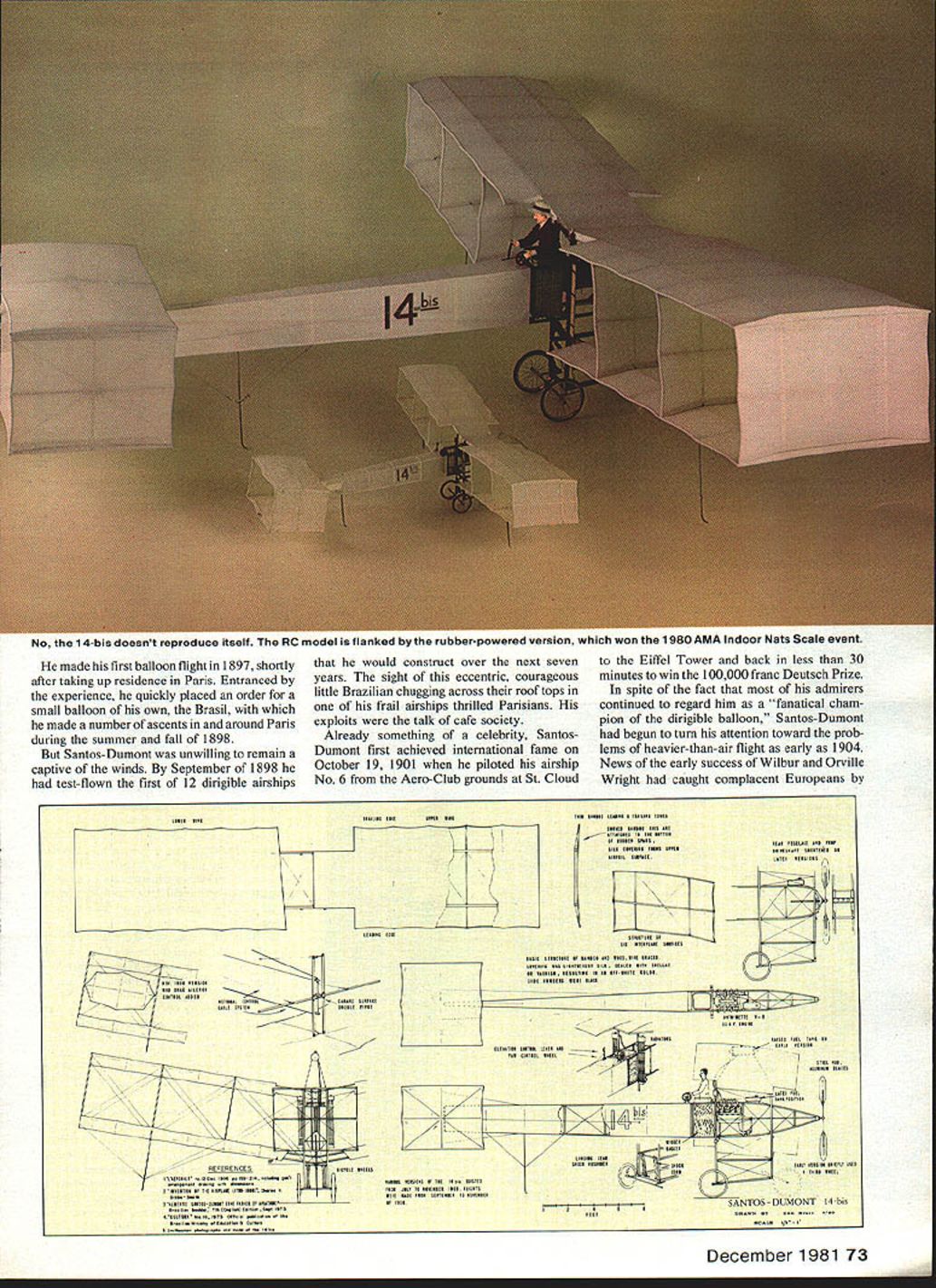
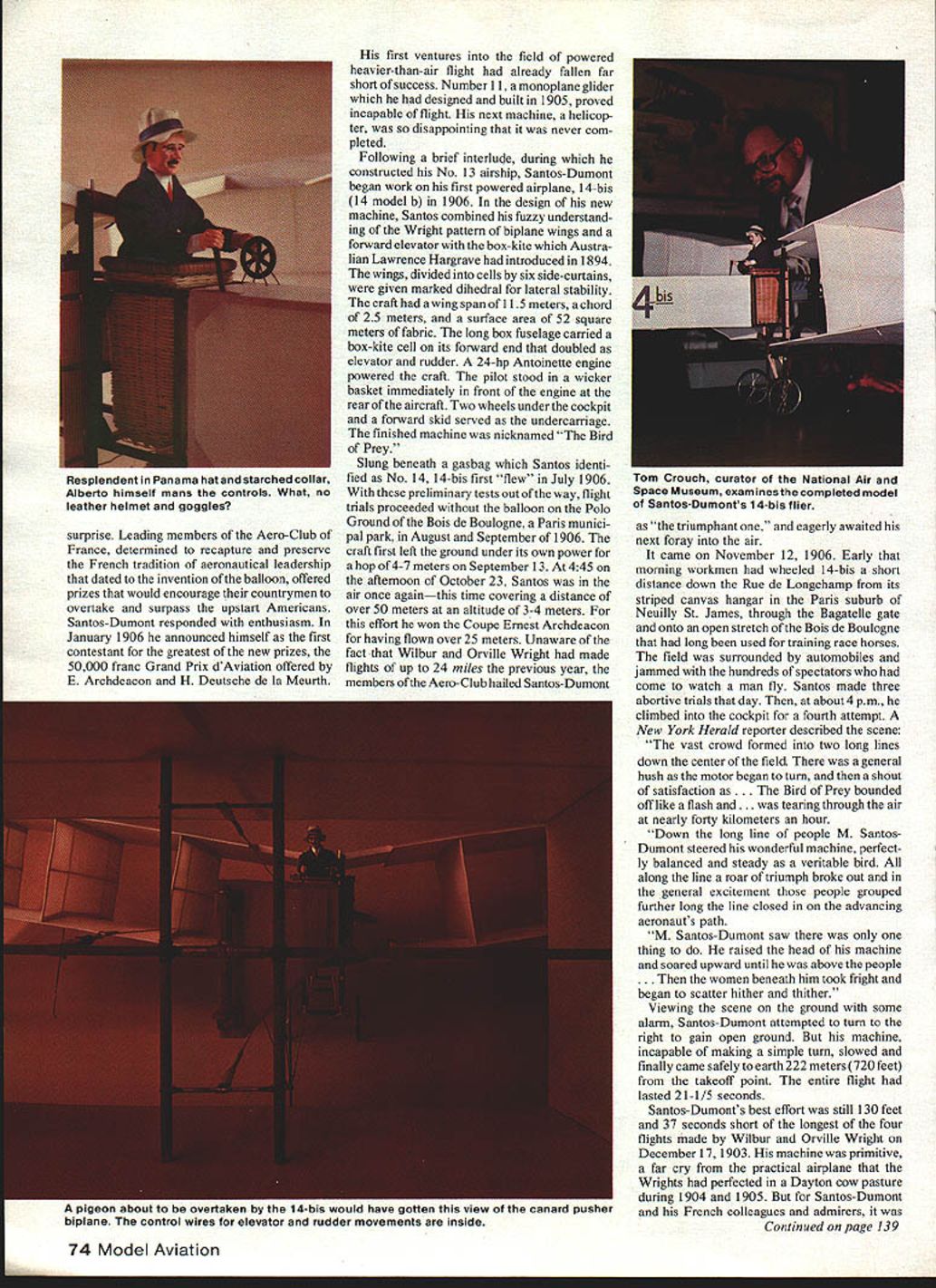
In the design of his new machine, Santos combined his incomplete understanding of the Wright pattern of biplane wings and a forward elevator with the box-kite which Australian Lawrence Hargrave had introduced in 1894. The wings, divided into cells by six side-curtains, were given marked dihedral for lateral stability. The craft had a wingspan of 11.5 meters, a chord of 2.5 meters, and a surface area of 52 square meters of fabric. The long box fuselage carried a box-kite cell on its forward end that doubled as elevator and rudder. A 24-hp Antoinette engine powered the craft. The pilot stood in a wicker basket immediately in front of the engine at the rear of the aircraft. Two wheels under the cockpit and a forward skid served as the undercarriage. The finished machine was nicknamed "The Bird of Prey."
Slung beneath a gasbag which Santos identified as No. 14, 14-bis first "flew" in July 1906. With these preliminary tests out of the way, flight trials proceeded without the balloon on the Polo Ground of the Bois de Boulogne, a Paris municipal park, in August and September of 1906.
The flights of 1906
- September 13, 1906: The craft first left the ground under its own power for a hop of 4–7 meters.
- October 23, 1906: At 4:45 p.m. Santos flew over 50 meters at an altitude of 3–4 meters, winning the Coupe Ernest Archdeacon for having flown over 25 meters.
Unaware that Wilbur and Orville Wright had made flights of up to 24 miles the previous year, the members of the Aero-Club hailed Santos-Dumont as "the triumphant one," and eagerly awaited his next foray into the air.
It came on November 12, 1906. Early that morning workmen had wheeled the 14-bis a short distance down the Rue de Longchamp from its striped canvas hangar in the Paris suburb of Neuilly St. James, through the Bagatelle gate and onto an open stretch of the Bois de Boulogne that had long been used for training race horses. The field was surrounded by automobiles and jammed with the hundreds of spectators who had come to watch a man fly.
Santos made three abortive trials that day. Then, at about 4 p.m., he climbed into the cockpit for a fourth attempt. A New York Herald reporter described the scene:
"The vast crowd formed into two long lines down the center of the field. There was a general hush as the motor began to turn, and then a shout of satisfaction as... The Bird of Prey bounded off like a flash and... was tearing through the air at nearly forty kilometers an hour.
"Down the long line of people M. Santos-Dumont steered his wonderful machine, perfectly balanced and steady as a veritable bird. All along the line a roar of triumph broke out and in the general excitement those people grouped further along the line closed in on the advancing aeronaut's path.
"M. Santos-Dumont saw there was only one thing to do. He raised the head of his machine and soared upward until he was above the people... Then the women beneath him took fright and began to scatter hither and thither."
Viewing the scene on the ground with some alarm, Santos-Dumont attempted to turn to the right to gain open ground. But his machine, incapable of making a simple turn, slowed and finally came safely to earth 222 meters (720 feet) from the takeoff point. The entire flight had lasted 21 1/5 seconds.
Santos-Dumont's best effort was still 130 feet and 37 seconds short of the longest of the four flights made by Wilbur and Orville Wright on December 17, 1903. His machine was primitive, a far cry from the practical airplane that the Wrights had perfected in a Dayton cow pasture during 1904 and 1905. But for Santos-Dumont and his French colleagues and admirers, it was enough that he had flown.
The 14-bis was a technological dead end which had no discernible influence on the subsequent development of the airplane. Yet the flight of November 12, 1906 had an enormous impact, for it inspired other experimenters to redouble their efforts to join Santos-Dumont in the air.
Later work and the end of a career
The 21 seconds that he spent flying over the field at Bagatelle represented the peak of Santos-Dumont's career. He remained active in aeronautics through 1910 and developed, among other things, the popular little Demoiselle monoplane that delighted air show crowds in Europe and America. But by December 1910, when the Aero-Club de France unveiled a monument commemorating the events that had occurred at Bagatelle only four years earlier, Santos-Dumont already seemed like a figure from the distant past.
The years after 1910 were bitter ones. A victim of disseminated sclerosis, his health steadily declined. Santos-Dumont's efforts to contribute to the French war effort were unsuccessful. At one point he was even accused of being a German spy. He spent most of the war years in Brazil, where he was hailed a hero.
The adulation of his native land did little to relieve a growing depression, however, for Santos-Dumont blamed himself for the death and destruction being wrought by the airship and airplane in Europe. The coming of peace brought little relief. He traveled widely, but could not recapture the enthusiasm that had gripped him during the years when he had pioneered the flying machine. The use of aircraft in the civil war in Brazil in 1932 was the final blow. He committed suicide in his home in Brazil on July 23, 1932, three days after his 59th birthday.
Legacy
Alberto Santos-Dumont was not, as many have claimed, the father of aviation. He made technical contributions to aeronautics, but his machines did not directly shape the development of later airplanes. The impact of his personality and the very fact that he had flown were of incalculable importance in inspiring other European pioneers. In that sense, he opened a door to the future. There seems little danger that the value of his contribution will be forgotten.
Key dates and achievements
- 1873: Born July 20 in Minas Gerais, Brazil.
- 1897–1898: First balloon flight (1897); purchased the balloon Brasil and made ascents in 1898.
- 1898–1905: Designed and flew a series of dirigible airships (No. 1–No. 13), winning public acclaim.
- 1901: Won the 100,000 franc Deutsch Prize with airship No. 6.
- 1906: Began contesting heavier-than-air prizes; built and flew the 14-bis.
- November 12, 1906: Made a powered flight of 222 meters at Bagatelle, Paris.
- 1907–1910: Continued aeronautical work, developed the Demoiselle monoplane.
- 1932: Died by suicide on July 23 in Brazil.
Transcribed from original scans by AI. Minor OCR errors may remain.

