
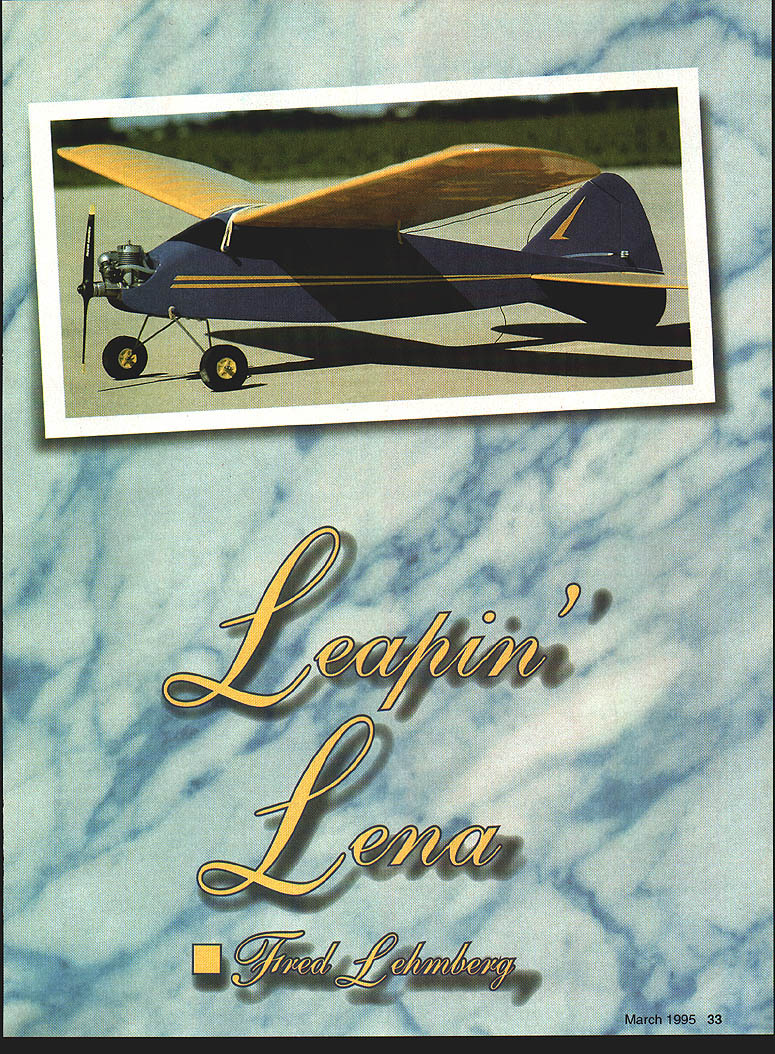
Leapin' Lena
Fred Lehmberg
It seems that every sport, hobby, or political movement has a period called the Golden Years. I believe it was Hal deBolt who gave this name to the nostalgic years we include in the era of RC model aircraft catalogued and perpetuated by the Vintage Radio Control Society.
The aircraft presented here appeared in the 1950s and was guided by those early RC systems of questionable reliability that moved the control surfaces by rubber-powered escapements or energy-gulping actuators (the latter electromechanical devices were to become part of the "Galloping Ghost" control system). These craft had a very low mean-time-between-failures. It was this uncertainty of performance, however, that gives aircraft of this era their romantic appeal to modelers who flew and crashed them so many years ago. Many of these models were of excellent design and would be great models for today's virtually faultless RC equipment.
Leapin' Lena was a sturdy little bulldog that lived through many equipment malfunctions and pilot errors and required little repair to return to flight-ready status. It is the third model of a development project to produce a stable and aerobatic aircraft. It was kitted in 1952 by Model Tech Specialties on the East Coast (Charlie Underhill, Eddie Steffenhagen, and myself). In the late 1980s it was again kitted by Lehmberg Enterprises in Oxnard, California. As of this writing it is no longer manufactured as a kit by anyone.
Back in the '50s Leapin' Lena did well in competition all over the country. Bernie Shapiro of Central Islip, New York, was a fantastic flier with the simple escapement; he could execute a snap roll without elevator using this device, requiring the pilot to recall the direction of his last turn!
In the late '80s Lena was being built and flown in Australia. Merv Buckmaster, editor of the magazine Airborne, liked the design very much: "Fred claims his creation to be a trainer and sport flier, designed for performance, prefabricated for simplicity. There is nothing warped about those claims! If I weren't an Old-Timer myself, I could indulge in a little adolescent exuberance and call the Leapin' Lena a Little Ripper!"
Randy Randolph of Dallas, Texas, obtained a kit shortly before Lehmberg Enterprises terminated production and wrote a neat review. The review was returned unpublished; Randy later sent the material to me and permitted use as follows:
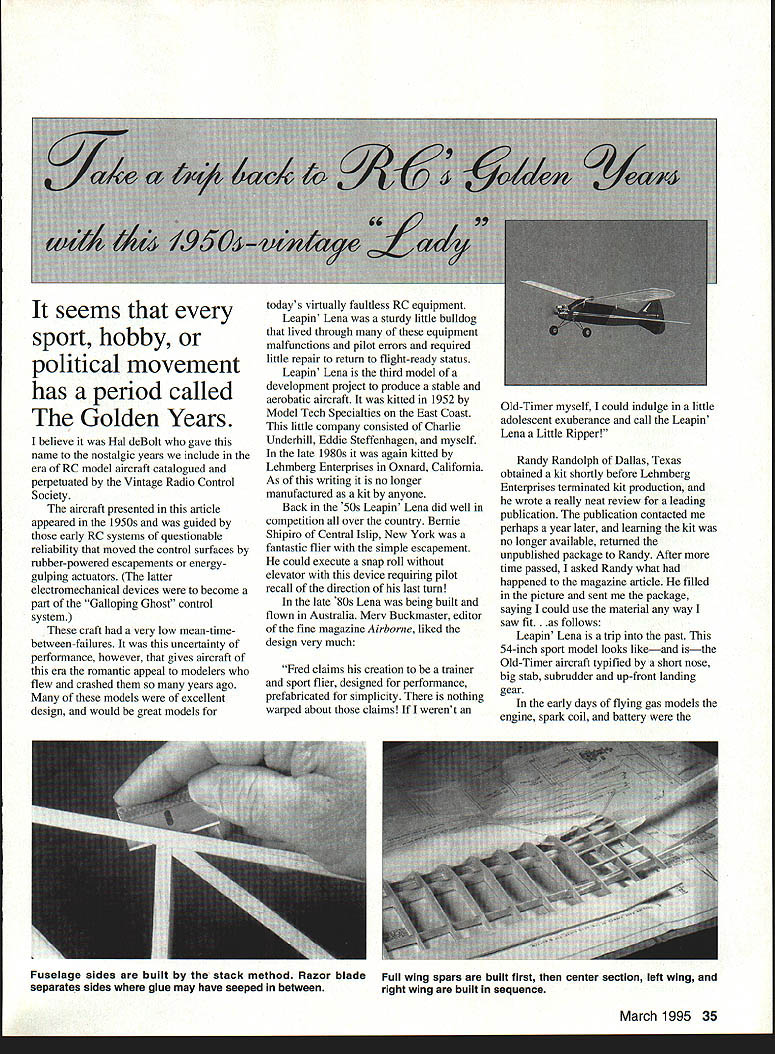
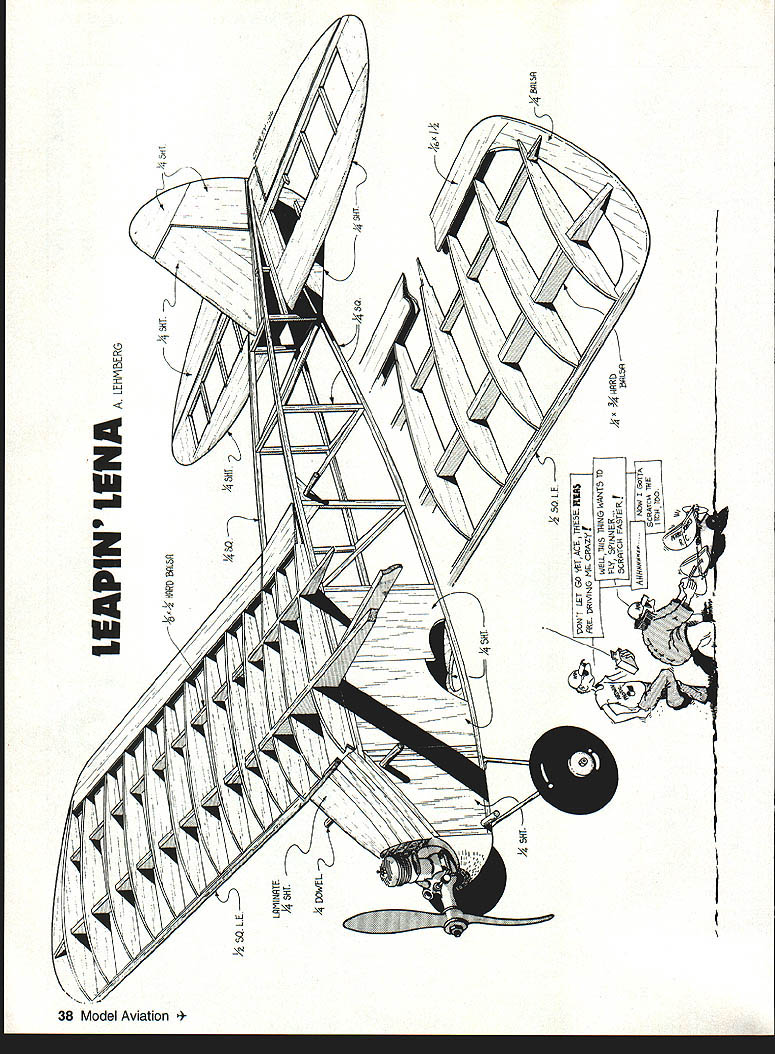
Leapin' Lena is a trip into the past. This 54-inch sport model looks like—and is—the Old-Timer aircraft typified by a short nose, big stab, subrudder and up-front landing gear.
Construction
Building Leapin' Lena will be a learning experience for modelers accustomed to step-by-step manuals. The following describes the recommended build sequence and techniques.
- Build two fuselage sides first. Place the plan on a building board (soft acoustic construction board is good and inexpensive). Rub the fuselage side view with furniture oil or cooking oil to prevent sticking.
- Build the side, holding strips in place and pinning with T-pins. Include slots for elevator and rudder pushrods — one per side. Take time to make good, tight wood-to-wood joints.
- Use cyanoacrylate (CyA) glue (Pacer's ZAP drop-joint is recommended). It bonds quickly and firmly. Because CyA fumes can irritate eyes and nose, take appropriate precautions.
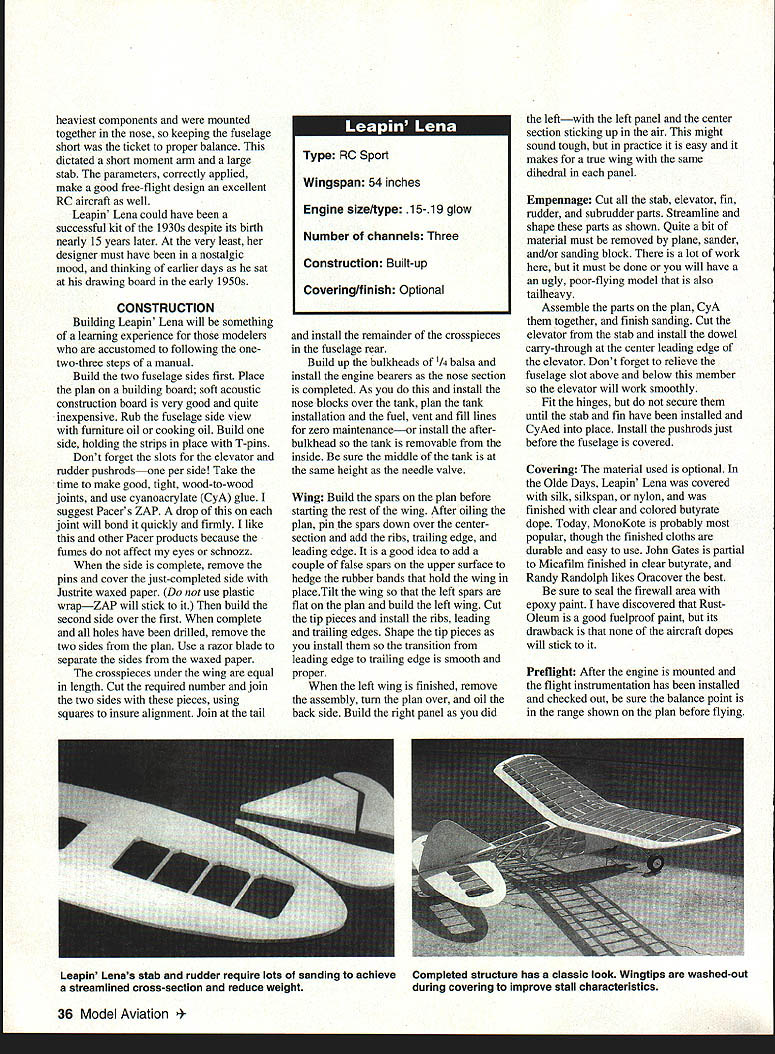
- After one side is complete, remove the pins and cover the completed side with Justrite waxed paper or plastic wrap so ZAP will not stick. Build the second side over the first. When complete and all holes have been drilled, remove the two sides from the plan and use a razor blade to separate the sides from the waxed paper.
- Cut crosspieces and under-wing supports to equal length. Cut the required number and join them to the two side pieces, using squares to ensure alignment.
- Join the tail and install the remainder of the crosspieces at the rear of the fuselage.
- Build up bulkheads from 1/4" balsa and install the engine bearers; the nose section is then completed.
- As you install the nose blocks, fit the fuel tank per the plan. Install fuel vent and fill lines. The tank can be installed for zero maintenance or installed after the bulkhead as a removable unit inside the fuselage—be sure the middle of the tank is at the same height as the needle valve.
Wing
- Build the spars on the plan before starting the rest of the wing.
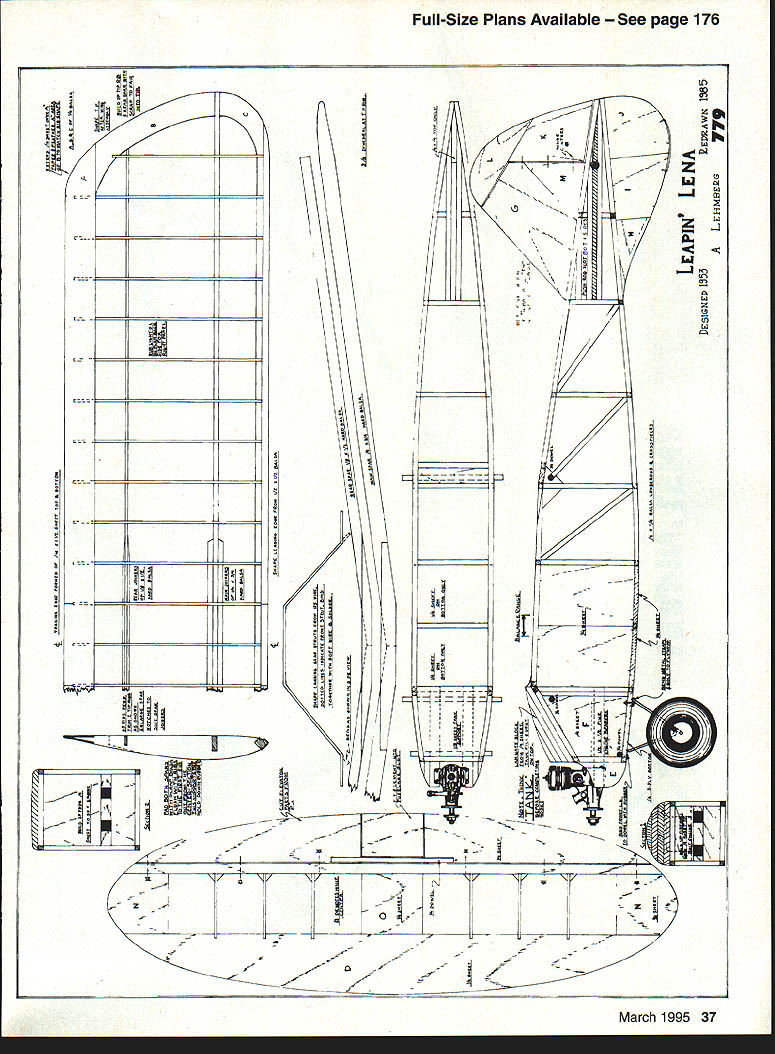
- After gluing the spars down over the center section, pin them and add the ribs, trailing edge, and leading edge.
- Add a couple of false spars on the upper surface to take the rubber bands that hold the wing in place.
- Fit the wing so that the left spars are flat on the plan and build the left panel first. Cut and install tip pieces, ribs, leading and trailing edges; shape the tip pieces as you install them so the transition from leading edge to trailing edge is smooth.
- When the left wing is finished, remove the assembly, turn the plan over, oil the back side, and build the right panel in the same manner with the left panel and center section up in the air. This ensures equal dihedral in each panel.
Empennage
- Cut all stab, elevator, fin, rudder, and subrudder parts. Streamline and shape these parts as shown on the plan.
- Remove quite a bit of material by plane, sander, and/or sanding block—this is essential for good appearance and flight characteristics, and to avoid a tail-heavy model.
- Assemble the parts on the plan, CyA them together, and finish sanding.
- Cut the elevator from the stab and install the dowel carry-through at the center leading edge of the elevator. Relieve the fuselage slot above and below this member so the elevator will work smoothly.
- Fit the hinges but do not secure them until the stab and fin have been installed and CyAed into place.
- Install the pushrods just before the fuselage is covered.
Covering
- Covering material is optional. In the Olde Days, Lena was covered with silk, silkspan, or nylon and finished with clear and colored butyrate dope.
- Today, heat-shrink coverings such as Monokote are popular; finished cloths are durable and easy to use. John Gates favored Micafilm finished in clear butyrate; Randy Randolph preferred Oracover.
- Be sure to seal the firewall area with epoxy paint. Rust-Oleum is a good fuelproof paint, but dopes will not adhere well to it, so plan accordingly.
Specifications
- Type: RC Sport
- Wingspan: 54 inches
- Engine size/type: .15–.25 glow (a .10 or .15 will fly Lena with reduced climb rate)
- Number of channels: Three
- Construction: Built-up
- Covering/finish: Optional
Preflight and Trim
- After the engine is mounted and the flight instrumentation installed and checked, confirm the balance point is in the range shown on the plan before flying.
- It is common to wash out both wing tips a few degrees (trailing edge raised, leading edge lowered). This can be done using a heat gun on the top surface and twisting the wing. Check on a table top to ensure both panels match; this improves stall characteristics.
- I like to set the controls so that the model is neutral on throttle changes; test trims on the ground where possible.
First Flight (Randy Randolph)
"Lena is a Lady! My version was powered by a very good Schnuerle-ported O.S. .25 because a .25 was recommended on the plan. Believe me, a .10 or .15 would fly Leapin' Lena with a very large reduction in the fuel bill and a very slight reduction in performance—and that in only the rate of climb.
Even though the landing gear is well forward, the takeoff roll is dead straight, with only a little initial correction needed. Turns are smart, with none of the tail wag that is typical of rudder-only airplanes. (Under no conditions should ailerons be used or dihedral reduced on an airplane of Leapin' Lena configuration.)
Rolls are easy and almost axial if down elevator is applied at the proper time. Loops are round and smooth, and will not snap, even with the balance point well aft in the designated area.
This airplane will fly herself. Throttle back and Lena will find a comfortable glide and make her way back to earth in a most dignified fashion. Leave her alone and she will settle in to a nice three-point landing.
On the very first flight it took fifteen seconds to trim Lena and hand her over to the next guy in line, who flew her in close for an 'in-flight' picture. Before that flight ended three more people, including a very new pilot, a Scale aficionado and a Racing expert, took the box and agreed that 'Lena is a very sweet date.' Yes, Leapin' Lena is definitely a lady."
Contact
Anyone wishing additional detail on this aircraft is invited to write the author at:
21337 Oak Park Lane Anderson, CA 96007
A SASE is greatly appreciated and will ensure an answer.
Transcribed from original scans by AI. Minor OCR errors may remain.

