
Learn to Fly RC
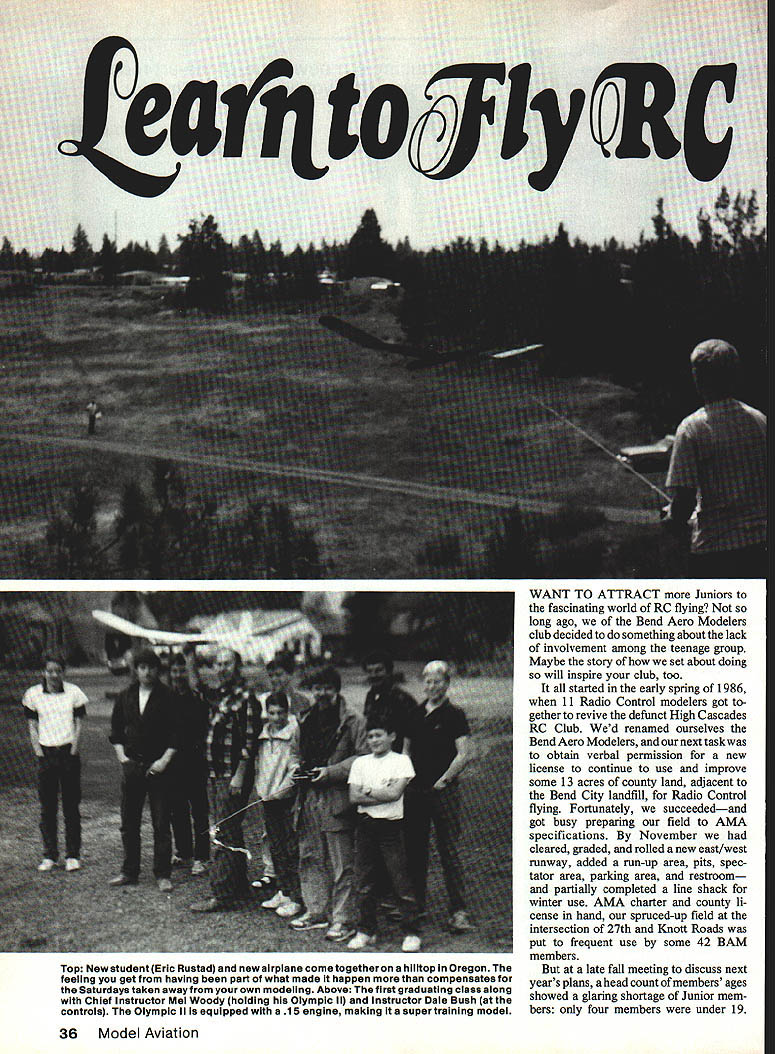
WANT TO ATTRACT more Juniors to the fascinating world of RC flying? Not so long ago, members of the Bend Aero Modelers club decided to do something about the lack of involvement among the teenage group. Maybe the story of how we set about doing so will inspire your club, too.
Reviving a club and preparing a field
It all started in early spring 1986, when 11 radio-control modelers got together to revive the defunct High Cascades RC Club. We renamed ourselves the Bend Aero Modelers (BAM), and our next task was to obtain verbal permission and a new license to continue to use and improve some 13 acres of county land adjacent to the Bend city landfill for radio-control flying. Fortunately we succeeded—and got busy preparing our field to AMA specifications.
By November we had cleared, graded, and rolled a new east/west runway, added a run-up area, pits, spectator area, parking area, a restroom and a partially completed line shack for winter use. AMA charter and county license in hand, our spruced-up field at the intersection of 27th and Knott Roads was put to frequent use by some 42 BAM members.
At a late-fall meeting to discuss next year’s plans, a head count of members’ ages showed a glaring shortage of junior members—only four members were under 19. As AMA members, we had read about and were impressed with the need for young people to become interested in model aviation. We clearly felt something had to be done.
Partnering with Parks & Recreation for a class
The town of Bend (population about 18,500) is fortunate to have a strong Bend Metro Parks & Recreation (BMPR) District offering a wide array of recreational classes. Under the energetic leadership of BAM president Mel Woody, we approached BMPR with the suggestion that a Radio Control Modeling class be included in the winter 1987 schedule — and received an enthusiastic yes.
A steering committee was formed at the December meeting. Nine members volunteered to share instruction duties under the leadership of Dave Kephart and the curriculum was hammered out.
- Class: six Saturday sessions, February 7 through March 14, 9:00 a.m.–2:00 p.m.
- Model: Goldberg Gentle Lady glider
- Fee: $32.00 (included the kit, glue, and covering materials)
- Note: Students would have to purchase their own engine and radio upon completion of the class
BMPR published the class in its winter program booklet as follows:
"Learn to Fly Radio Control Airplanes: Members of the Bend Aero Modelers Club will take students through step-by-step model plane construction, flying and ground school. Materials and plane included in the fee. Students will have to purchase their own engine and radio upon completion of the class."
Curriculum and outreach
The planned curriculum for the six Saturday sessions:
- Introduction and orientation to RC; show-and-tell of an RC glider; videos on modeling
- Kit introduction and building preparation (parts identification, sanding)
- Building and wing construction
- Covering (iron-on coverings) and finishing techniques
- Radio installation and ground school on RC flying and aerodynamics
- Flight testing, flying, and graduation with BAM student RC license
We worked with the Bend-LaPine school district superintendent, Mr. Bill Worrell, who circulated a memo to the junior and senior high schools and recommended dropping the age limit from 15 to 12 if accompanied by a parent. Advance publicity helped: by opening day we had 11 students—well over BMPR’s minimum of six.
Suggested materials students were asked to bring:
- X-Acto (razor) knife
- Sandpaper
- Cutting board
- Sack lunch for each class
Mel Woody ordered the kits and BAM was fortunate to receive donated covering material and CA (cyanoacrylate) glue. How-to videos from manufacturers were also obtained.
The students and instructors
Our students ranged from age 10 up to adults, including some BAM members:
- Mike Owen, age 10 (attended with his father Ken)
- Matt Smith, age 12
- Lars Hens, age 14
- Erik Rustad, age 15
- Case Turner, age 15
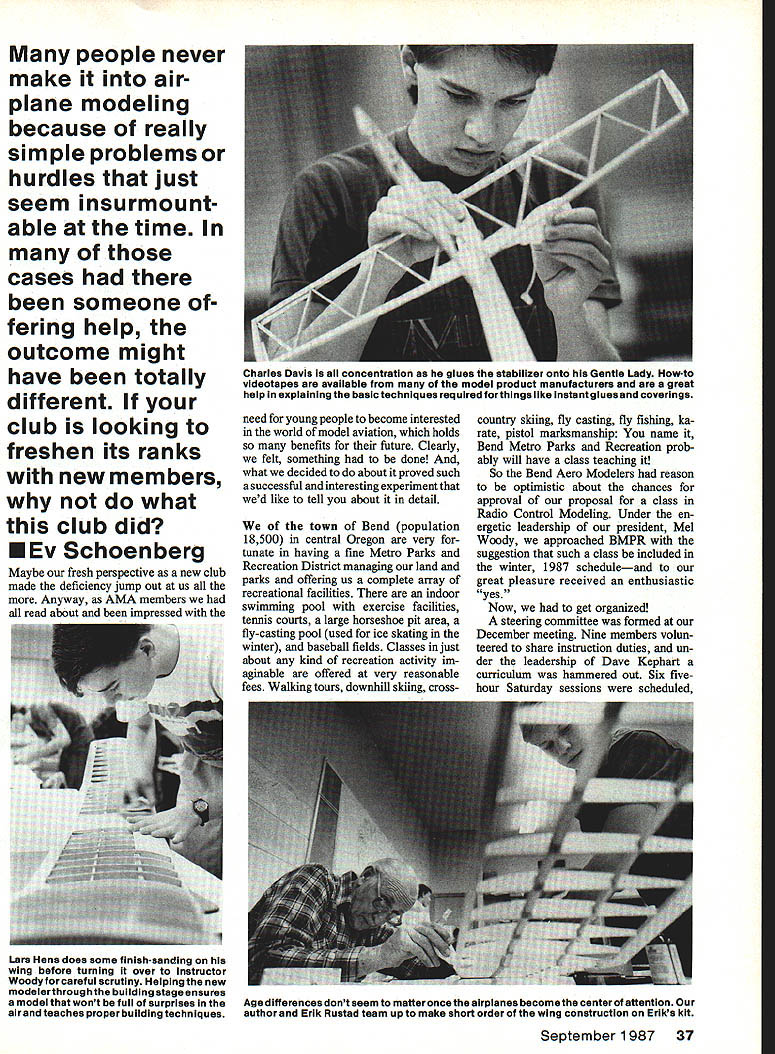
- Charles Davis, age 16
- David Jones, age 29 (BAM member)
- Jeff Jordan, age 30
- Dave McCuller, age 38
We had thus hooked six juniors and several adults eager to learn.
Class sessions — highlights and progress
Day 1 — Orientation
- Overview of the hobby’s lifelong benefits, introduction to radios, batteries and charging, and the Academy of Model Aeronautics.
- Videos on RC flying and model construction.
- Two instructors brought power-podded RC gliders to preview the craft students would build.
Day 2 — Kit preparation
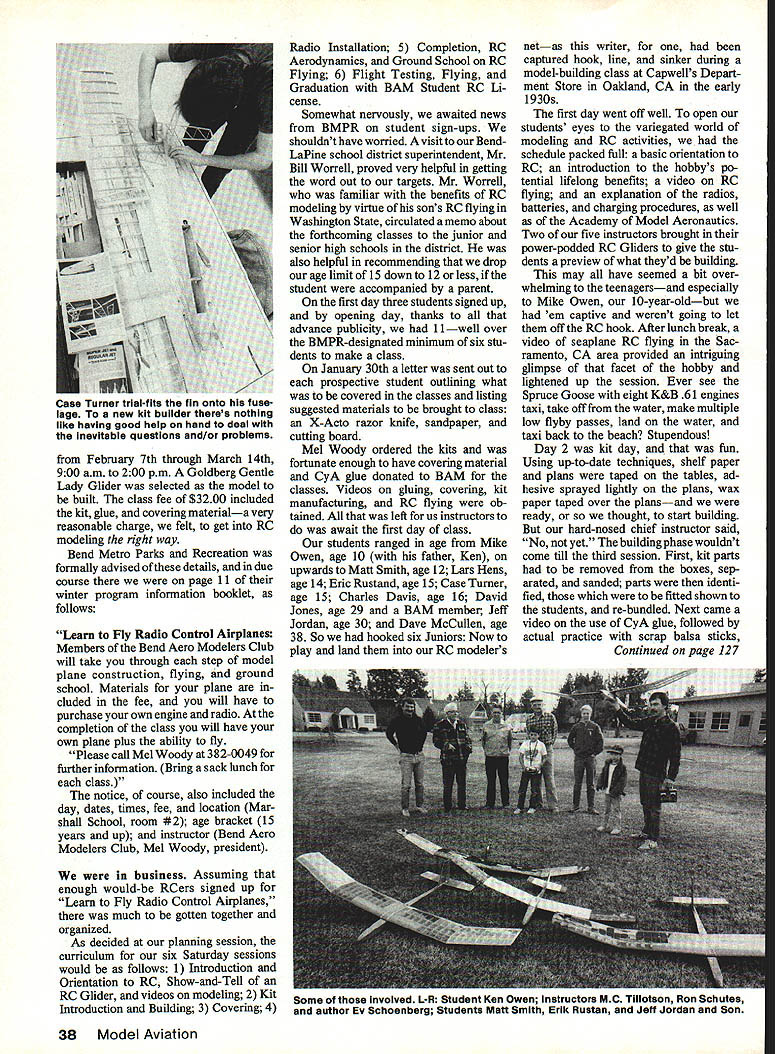
- Kits were removed from boxes, parts separated and sanded, and components identified.
- Students viewed a video on CA glue and practiced gluing on scrap balsa.
- Building was deferred to allow proper preparation.
Day 3 — Building
- Students began assembly using proper jigs and techniques.
- By the end of the session most students had empennages and wing panels in progress or completed.
- Several students planned to continue construction at home.
Day 4 — Wing joining and trueing
- Radio installation was postponed due to a kit delay, so we focused on joining wing panels and trueing ribs.
- Older and younger members worked together—an example of intergenerational mentoring.
- A video on MonoKote (covering) prepared students for the next session.
Day 5 — Covering and finishing
- A Carl Goldberg Co. video arrived, providing inspiration and tips.
- A photographer from the Bend Bulletin documented the class for a later story.
- Wings were sanded, balanced, and inspected; fuselages were assembled.
- Nose-cone carving proved challenging for some; one student suffered a minor nick.
- First attempts at iron-on covering often looked poor at first; a heat gun/blow-dryer tightened coverings to a professional finish.
- Seven wings were covered by quitting time; some students stayed after hours to finish.
Radios and final assembly
- Radios (Futaba Conquest systems) arrived before the last session and were checked by instructors.
- A servo-link issue surfaced: Quik Links positioned too high in the small fuselage, so students were taught to form Z-bends in music wire pushrods.
- Battery pack shapes (flat vs. square) required creative rework by students to fit battery compartments—good experience in troubleshooting final-assembly issues.
- Switch harnesses and hook installations completed the final assembly work.
Final flights and conclusion
- A scheduling hiccup prevented the official flight tests from being photographed by the local paper on the day of the tests, but the Bulletin later ran the story and photographed students’ first flights.
- In spring 1987, many Gentle Lady gliders were flown at the BAM field near 27th and Knott; chief instructor Mel Woody and other veterans watched proudly as students flew their first models.
Lessons learned and closing
Many people never make it into airplane modeling because of seemingly small hurdles that appear insurmountable. Having patient, experienced people offer help makes all the difference. If your club is looking to freshen its ranks with new members, running a structured build-and-fly class in cooperation with a parks and recreation program can be an effective approach.
As chief instructor Mel put it at the end, "We landed 'em. Now for the next school."
Transcribed from original scans by AI. Minor OCR errors may remain.

