
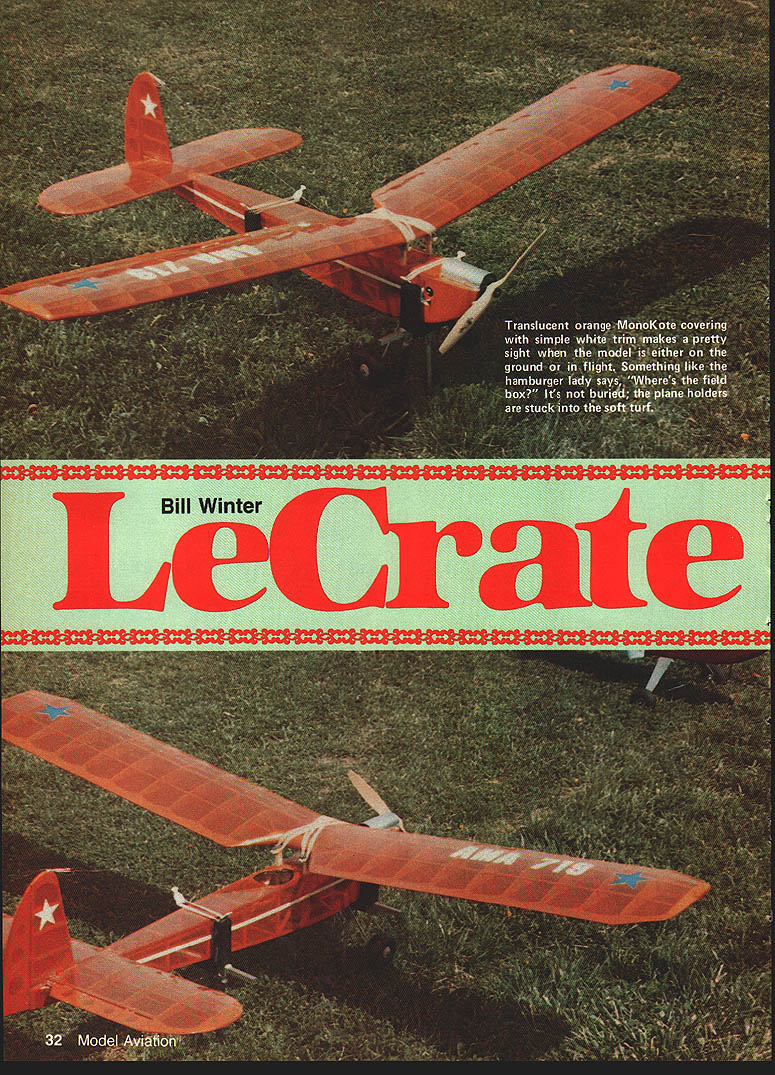
LeCrate
Bill Winter
I am well pleased with LeCrate, my first electric airplane design. It has been thoroughly tested in both parasol and cabin versions, and with a variety of power systems. It is a good aircraft and, because I received so much help from many good people—the manufacturers, columnists like Mitch Poling, and perceptive inputs from pioneers such as Heinz Koerner, Bob Kopski, Gus Munich, and Don Srull—I have confidence in presenting it to the public. With such a treasure trove of information behind me, an old free-flight, rubber and gas flier (36 years of RC sport flying) has no excuse for failing to attain a specific performance envelope.
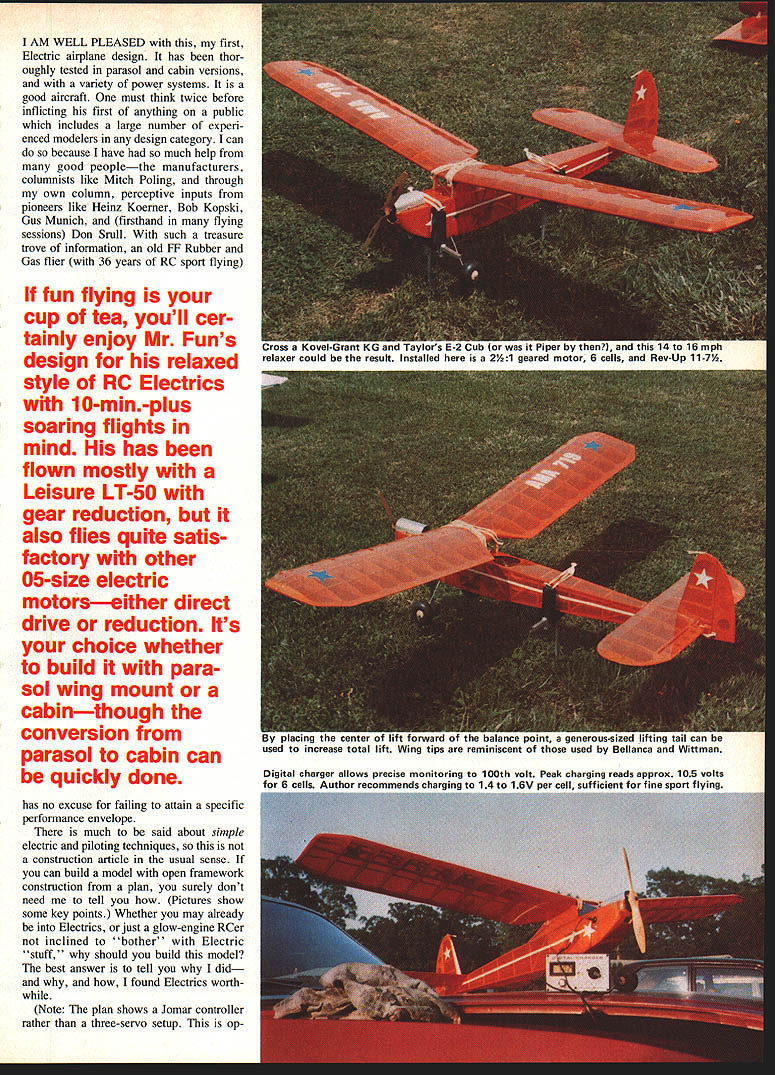
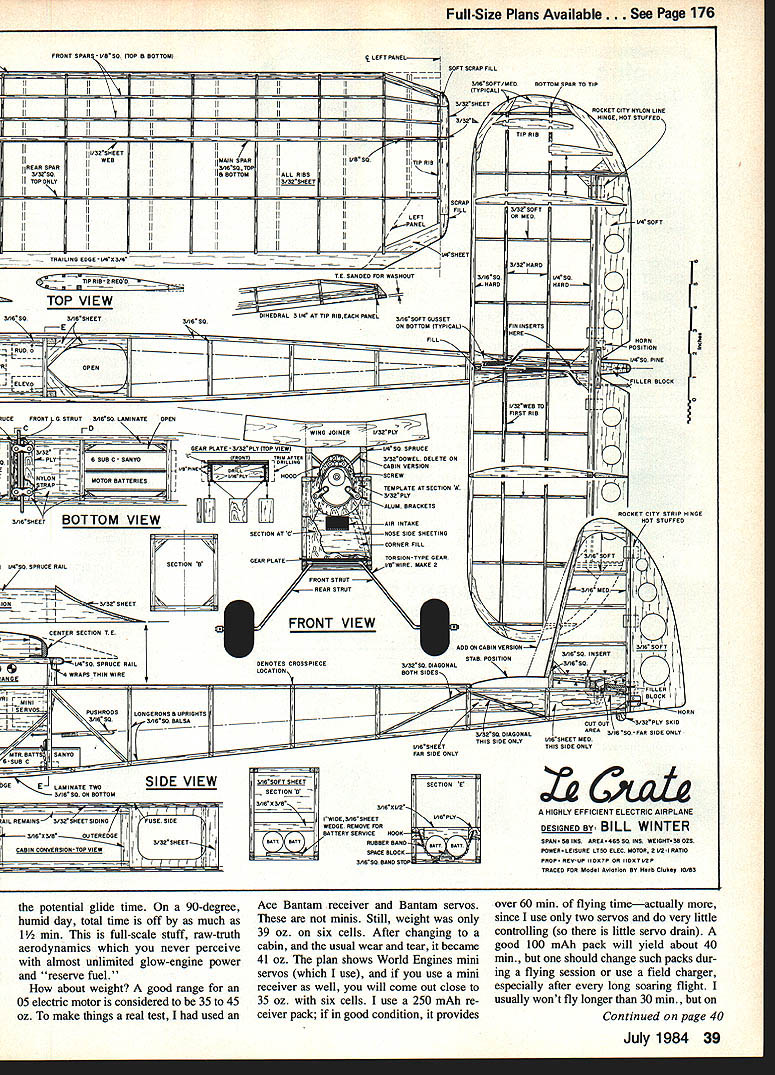
If relaxed, fun flying is your cup of tea, you’ll enjoy this design. It was flown mostly with a Leisure LT-50 with gear reduction, but it also flies quite satisfactorily with other .05-size electric motors—either direct drive or reduction. You can build it as a parasol or a cabin; conversion from parasol to cabin is quick. The plan shows a Jomar controller rather than a three-servo setup; this is optional.
Electric flight is a pleasant addition to glow power: it allows flying in ways and places that might otherwise be difficult or impossible. Electric flight is near-silent, requires less field gear if you can park the car nearby, and generally is simpler to operate. But there are still important considerations: energy limits, choice of motor/prop/battery combinations, and the need to match the design to the kind of flying you prefer.
Depending on the design and propulsion, an electric model can be configured for short, powerful climbs and short flights, or for long, gentle soaring flights of five to ten minutes (or longer). I have had 30-minute soaring flights from out-of-the-way field-flying sites—schoolyards, athletic fields, occasional parking lots, and small airports. People rarely notice the quiet electric model; it’s unobtrusive and friendly.
Design objectives
I like to watch planes fly on their own. That requires Free Flight stability, maximum motor run time, and an excellent glide. LeCrate was designed to:
- Climb steadily for at least five minutes to reach altitude for lift searching.
- Provide wing loading that supports floating and slow circling for thermaling, without causing fast approach speeds.
- Deliver duration capability of 10 minutes or more in normal conditions.
- Keep drag low enough that the prop can unload in the air and not overwork the battery.
- Fly slowly enough (relatively) to minimize drag, by using generous area and minimum gross weight.
I chose a 58 in. span, which by chance produced the same area as the Electric Sparky—460 sq. in. The plane uses a lifting-type stabilizer with an aft center of gravity, roughly a 13% airfoil, to enhance glide performance. A parasol configuration was chosen to be interesting and to allow automatic takeoffs or easy hand launches from high grass and confined sites.
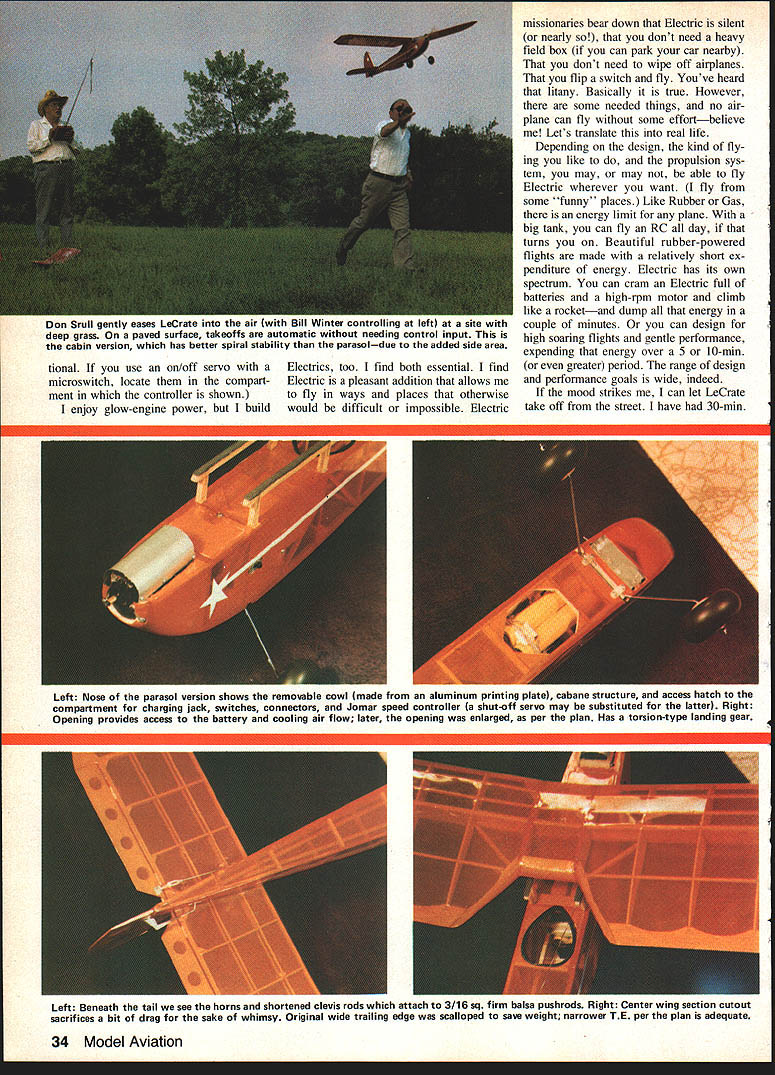
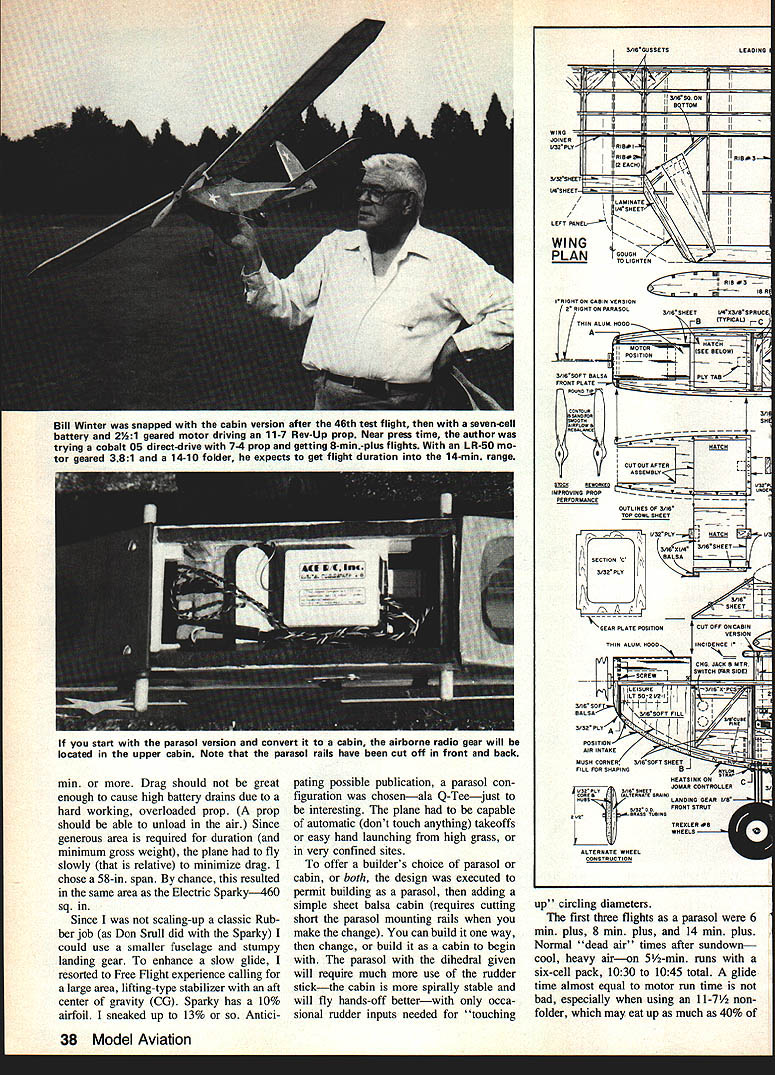
The design permits building as a parasol and later adding a simple sheet-balsa cabin (which requires cutting short the parasol mounting rails). The parasol version is livelier and requires more rudder; the cabin version is more spirally stable and flies more hands-off.
First flights (parasol): roughly 6+, 8+, and 14+ minutes. Normal dead-air times after sundown with six-cell packs were about 10:30 to 10:45 total on 5½-minute motor runs.
Construction highlights
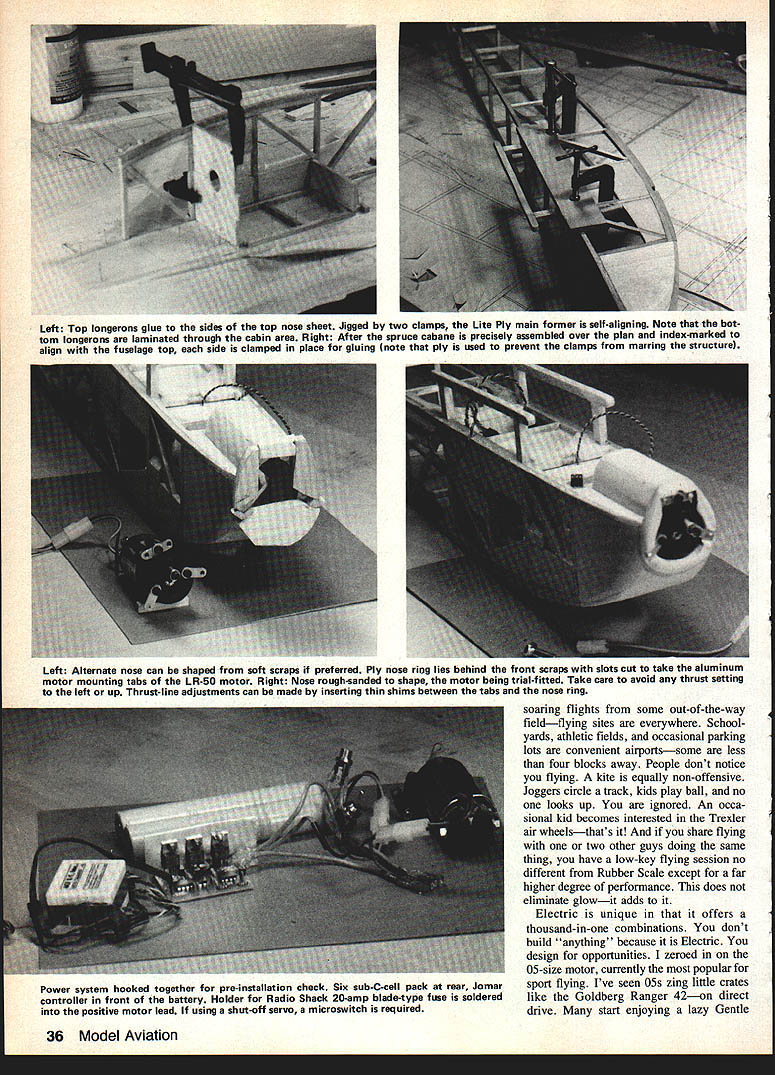
- Longerons are laminated through the cabin area; the jigged main former is self-aligning.
- Use light plywood and lite‑ply for former locations; assembly is straightforward.
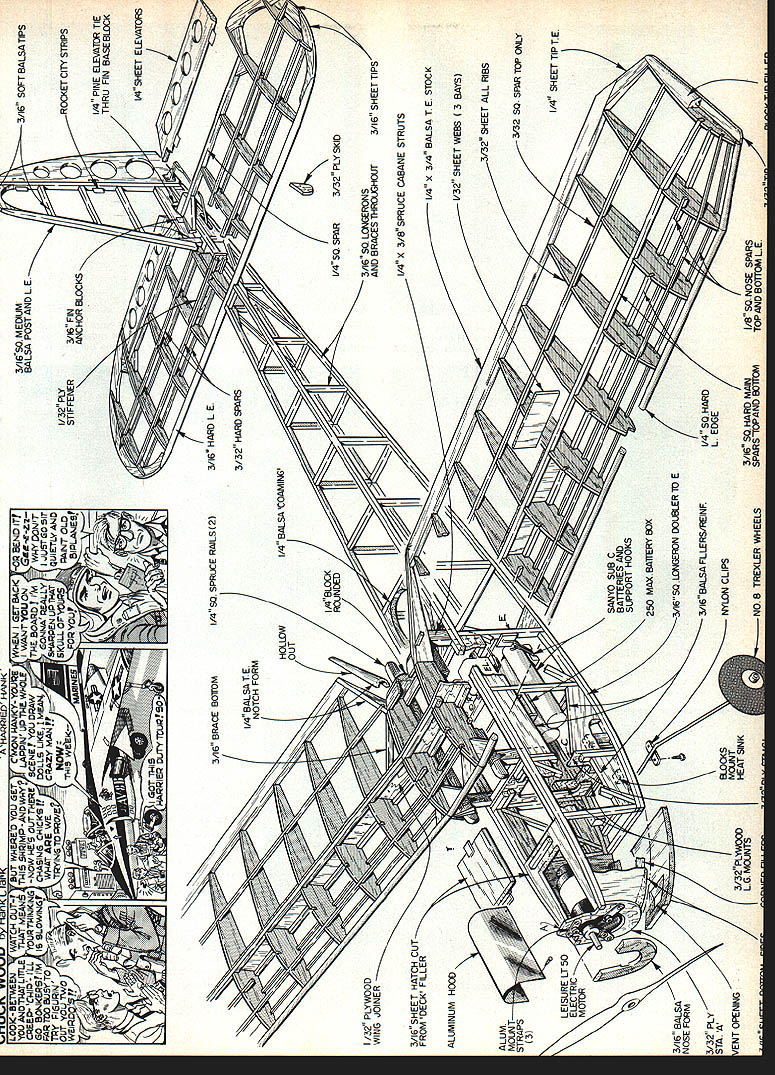
- Cabane is spruce and must be precisely assembled over the plan and index-marked for alignment; use ply pads where clamps could mar parts.
- The torsion-type landing gear is simple and rugged.
- Horns are shortened; clevis rods attach to 3/16" sq. firm-balsa pushrods.
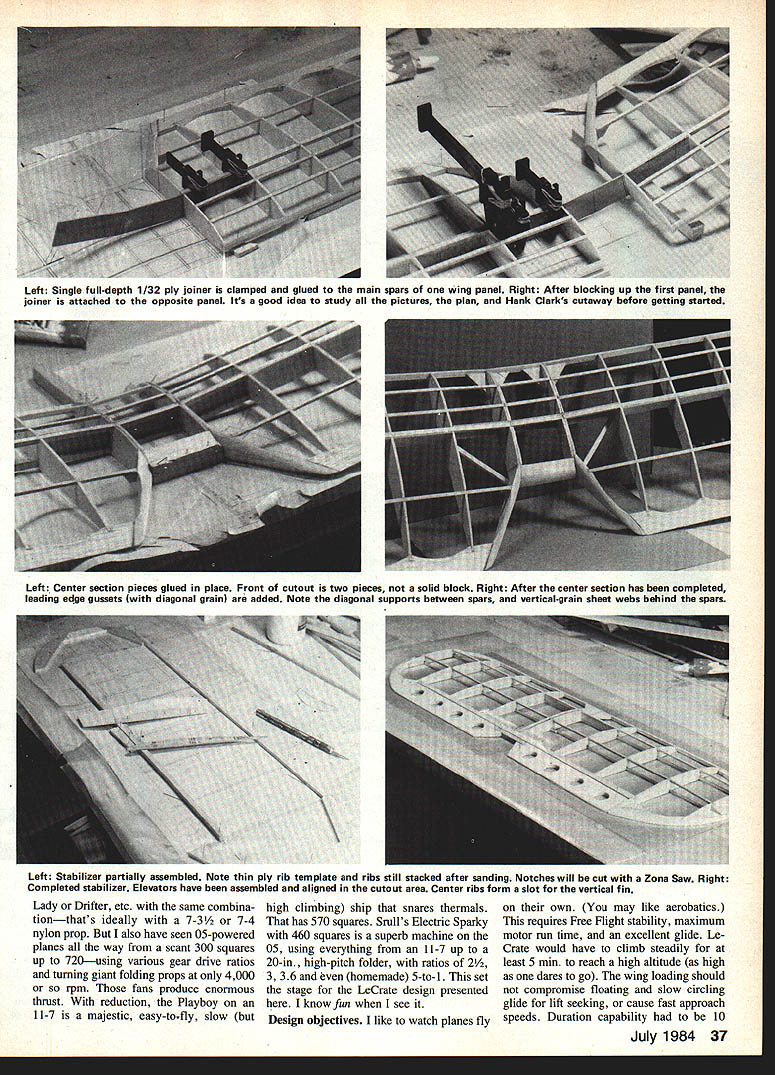
- The center wing section cutout is cosmetic but causes some turbulence; the original wide scalloped trailing edge saved weight, but the narrower trailing edge shown on the plan is adequate.
- If you start with the parasol and later convert to a cabin, locate the on/off switch, charging jack, and connectors in the cabin compartment.
- The plan shows World Engines mini servos; if you use minis and a mini receiver, you can achieve a lower gross weight.
When built lightly and properly, LeCrate is durable. Mild crash damage usually requires only minor repairs; the power pack can act as a battering ram in impacts.
Weight, batteries, and electrical
- A good range for an .05 electric installation is 35 to 45 oz. gross weight.
- Battery-to-gross-weight percentage is crucial:
- 20% battery weight is the minimum for reasonable performance (a bit "doggy").
- Optimum for LeCrate is 25–30%.
- Sailplane-type designs might reach 35–40%.
- Example: At 35 oz. gross, 30% battery is about 10½ oz.; at 45 oz., 30% is 13½ oz.
- I used Ace Bantam receiver and Bantam servos initially (not miniaturized parts) and came out at 39 oz. with six cells; after converting to a cabin and normal additions, about 41 oz.
- I use a 250 mAh receiver pack that will provide over 60 minutes of radio time in light-control setups; a good 100 mAh pack yields ~40 minutes but should be monitored or charged in the field.
- Install a fuse in the main power circuit to protect against radio failures and prevent losing the entire installation.
Battery charging notes:
- I recommend six-cell packs for this plane unless you experiment carefully with big folding props.
- Bring cell voltage up to 1.4–1.6 V per cell; peak charging shortens battery life unless followed by trickle charges to equalize cells.
- Charging seven cells may need special charger adjustments and careful monitoring to avoid damage.
Motor and prop
I usually use the Leisure LT-50 (.05) with a 2½-to-1 reduction gearbox and a six-cell Sanyo Sub-C pack. Typical prop choices and observations:
- Rev-Up 11-7½ works well. Also flown with 11-7¾, 11-7, and deBolt-reworked Rev-Up 11-7.
- deBolt rework: remove material around hub, streamline root, undercut near hub, thin blades, sharpen edges, taper outer tip slightly—this can unload the prop and improve climb.
- Limit motor run on six cells to 5½ minutes. Time the run; at high altitude it is hard to detect power fade visually.
- A 5-minute motor run is generally safe, leaving reserves for approach or go-around.
- With six cells, climbs and glides are well balanced; the big freewheeling prop dampens trim sensitivity and helps long glides.
Motor/prop options discussed:
- Direct-drive Astro Cobalt .05 on a 7-4 nylon prop (7x4) hums on seven cells and produces solid power and climb; brushes handle heavy drains well.
- Super Ferrite motors are promising and worth considering.
- Astro's 05 and 075 are similar; ordering six or seven cell versions gives different configurations.
- Using gear or belt reduction and high-pitch folders, experienced builders can obtain significant duration gains (runs exceeding 13 minutes have been achieved with optimized reduction and props).
Pilot technique and trimming
- For takeoff and climb, set a couple clicks of up-trim before launch; an occasional tap of up-stick may help after launch.
- Once up to speed, climb is steady, often hands-off.
- I prefer large left climbing circles before heading straight upwind; leaves turbulence interaction less problematic.
- As altitude builds, reduce up-trim slightly after a few minutes to extend motor run.
- Use circles under power to locate lift; often you will find lift before power runs out.
- For lift searching, trim rudder slightly to the right to confine the plane to a desired sector; right glide turns have worked better for me to find lift.
- In lift, fly a fairly fast glide (not overly slow) with moderate bank, and avoid diving around downwind sides of the circle.
- With good trim, the plane may fly hands-off in lift (on the cabin version you can even set the transmitter down).
CG and trim observations:
- LeCrate is surprisingly insensitive to trim with a big freewheeling prop.
- I saw no duration differences with CG at front or rear positions shown on the plan, but front CG requires more up-trim for glides.
- At the rear CG position, less trim and stick input may be required.
- I experimented with seven cells and moving CG 3/8" aft of the aft position on the plan; that suggested a perfect CG may lie aft of the 50% chord point for this setup.
Takeoff and landing technique:
- When down to about 200 ft., glide back and forth at 90° to the line of sight, keeping the nose slightly crabbed into wind and never turning downwind.
- At about 100 ft., move onto a wide downwind leg, then a continuous curved approach to a low final to prevent overshooting; add a touch of power as needed for spot landings.
Jomar controller
- The Jomar controller replaces the third servo (motor on/off) with a controller that provides smooth motor control for on/off, altitude control, touch-and-goes, and fine rpm adjustments during approaches.
- It reduces gear strain from bang-bang on/off power when driving big props.
- Use the specified diode across the motor as directed.
Seven-cell and direct-drive considerations
Seven cells:
- Provide higher climb speed and more solid control feel, but I observed no duration improvement on LeCrate and sometimes slightly less.
- Seven cells increase freewheeling rpm and can increase glide speed (undesirable for maximum duration) unless you install a folding prop.
- With seven cells, I shut down at about 5 minutes (I start to get concerned at 4½ minutes) to avoid overheating batteries.
- If using big non-folding props, expect more sink with seven cells compared to six.
Direct-drive Cobalt .05:
- The 7-4 prop on seven cells produces strong, solid power and a crisper, faster glide because of reduced drag from the smaller prop.
- Without the big freewheeling prop, damping effects disappear and controls become more responsive; more precise flying is needed to avoid partial stalls.
- First tests on direct-drive 05 produced about 8-minute totals on two initial hops—respectable given the seven-cell weight.
Using high-reduction, large folding props:
- Can yield large thrust and excellent climb while maintaining longer runs at lower motor rpm.
- With the right props and gearing (as Don Srull has demonstrated), runs can exceed 13 minutes.
Notes, tips, and final recommendations
- If you want the best glide, avoid unnecessary cutouts or turbulators. The center section cutout is cosmetic but introduces turbulence; consider a straight trailing edge across the center section.
- Blend top longerons into a razor-back or smoother aft cabin profile to reduce drag and improve airflow.
- Trexler air wheels are high-drag; the plan shows a suggested lower-drag wheel—use it for better performance.
- If you use large folding props, extend landing leg lengths as needed.
- With big props and seven cells, use a three-position switch or a speed controller to avoid abrupt on/off that can stress reduction drives.
- Stick to lite-ply and the specified joiner thickness (1/32" ply). Do not overbuild unnecessarily.
- Install a fuse in the power circuit even if you have only three servos—this protects your installation in case of radio failure.
- If you have exotic questions about electrics, consult the columnists and experienced builders (Don Srull, etc.); they’ll give practical, tested answers.
If you have questions about LeCrate or the equipment I used, you’ll get quick answers. I designed this to add electric flying to my life without displacing glow—now I enjoy both.
Transcribed from original scans by AI. Minor OCR errors may remain.

