
LET THE SHOW BEGIN
Duke Iden
HERE WE ARE in the middle of the AMA Air Show Team season. Some 36 AMA‑sanctioned show teams are performing across the country, bringing excitement and entertainment to the nonmodeling public as they promote model aviation. I'll bet you're wondering what we've been up to since I wrote in the August issue about show team folks who shoot spot landings on top of power poles and into trash cans.
Inner‑city outreach
The fine people in the Lone Star Squadron of Richardson, Texas, are involved in a project designed to show inner‑city children the wonders of flying models. Sponsored by the Mobil Oil Outreach Program, the project aims to encourage children to stay in school and prepare for success in life. Can you think of a better way to combine learning and fun than through exposure to model aviation?
What other hobby or sport uses:
- blueprint reading
- math
- electronics
- physics
- art
- handicrafts of all sorts
- and just about any other discipline or subject you can think of?
If the children who've participated in this special program don't jump into modeling tomorrow, some of them probably will in the future. Because a group of folks took the time to share their hobby, one of these youngsters could even become the next Burt Rutan.
Banner towing
Laverne Chandler kicked off the show by flying a model towing the Lone Star Squadron club banner. Would you like to try something like that for a special club event? Watch for a feature on how to make and tow a banner.
Smithsonian cooperation
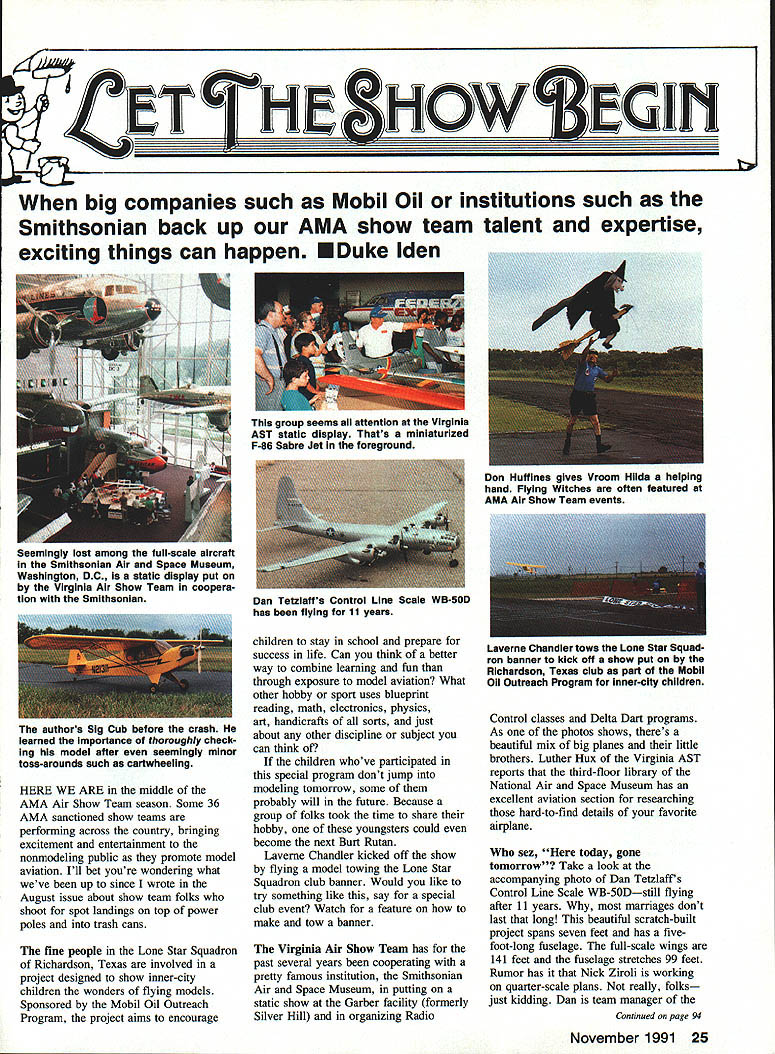
The Virginia Air Show Team has, for the past several years, been cooperating with a pretty famous institution—the Smithsonian National Air and Space Museum—in putting on a static show at the Garber facility (formerly Silver Hill) and in organizing radio‑control classes and Delta Dart programs. As one of the photos shows, there's a beautiful mix of big planes and their little brothers.
Luther Hux of the Virginia AST reports that the third‑floor library of the National Air and Space Museum has an excellent aviation section for researching those hard‑to‑find details of your favorite airplane.
Durability: Control Line Scale WB‑50D
Who says, "Here today, gone tomorrow"? Take a look at the accompanying photo of Dan Tetzlaff's Control Line Scale WB‑50D—still flying after 11 years. Why, most marriages don't last that long!
This beautiful scratch‑built project spans seven feet and has a five‑foot‑long fuselage. The full‑scale wings are 141 feet and the full‑scale fuselage stretches 99 feet. Rumor has it that Nick Ziroli is working on quarter‑scale plans. Not really, folks—just kidding. Dan is team manager of the Circlemaster AST in Sussex, Wisconsin.
Safety first
Safety is number one. When you have show teams performing before hundreds and even thousands of people, safety is primary. Sometimes these lessons are learned away from the show and at the practice field.
The pretty 1/6‑scale Sig Cub shown in one of the photos belonged (note past tense) to yours truly. While the Cub had yet to fly at an air show, that was in the offing.
The little yellow O.S. .40 four‑cycle‑powered ship, one of my favorites, had made some 30 flights when it cartwheeled several times in nasty crosswinds before two successful takeoffs. Then, during a slow roll, the wings suddenly snapped right in the center, and the model streamed straight into the hard, drought‑baked ground while two wing panels fluttered to earth.
That drove home a safety lesson: check your aircraft thoroughly, even after a seemingly minor toss‑around. I had checked the wings and various other important parts after the cartwheels, and all appeared to be in order—struts secure at all points, landing gear unscathed, tail section solid, no flex in the wings, etc.
Had I taken the time to remove the wings from the cabin and examined the center section, however, I would have found a fracture—probably very small—in the front center section where the cabin struts were attached to the front of the wing to the fuselage. That's where the structural failure apparently occurred. It's only my good luck that I was flying out in the middle of a field rather than at a show.
About three years ago, another mishap did occur at a show—and it was a very close call. During the finale, with six or seven models aloft, two pilots holding their transmitters came to within less than 15 feet of each other. Suddenly, one of the models went out of control and smashed into a lawn chair. Fortunately the chair was empty, but it had been vacated only a few seconds earlier—by the young son of the flier of the wayward plane.
Third‑order intermodulation interference, or 3IM, caused the accident. Now I'm no electronics wizard, and charging batteries can confuse me. But I've learned one thing: never stand less than 15 feet from the next person holding a transmitter.
Oh, by the way: does anyone have a line on where a guy can pick up a crankcase for an O.S. .40 four‑cycle? I cracked mine.
Seasonal acts
AMA show teams that include a Flying Witch act—and many do—have a built‑in seasonal motif as Halloween approaches. So it only seemed appropriate to show you a photo of Don Huffines launching one of these, er, charming old hags.
Wherever you fly—in a show, at the field, or in your own backyard (you lucky dog)—remember one thing: flying model airplanes is fun—even when the wings come off.
Transcribed from original scans by AI. Minor OCR errors may remain.

