
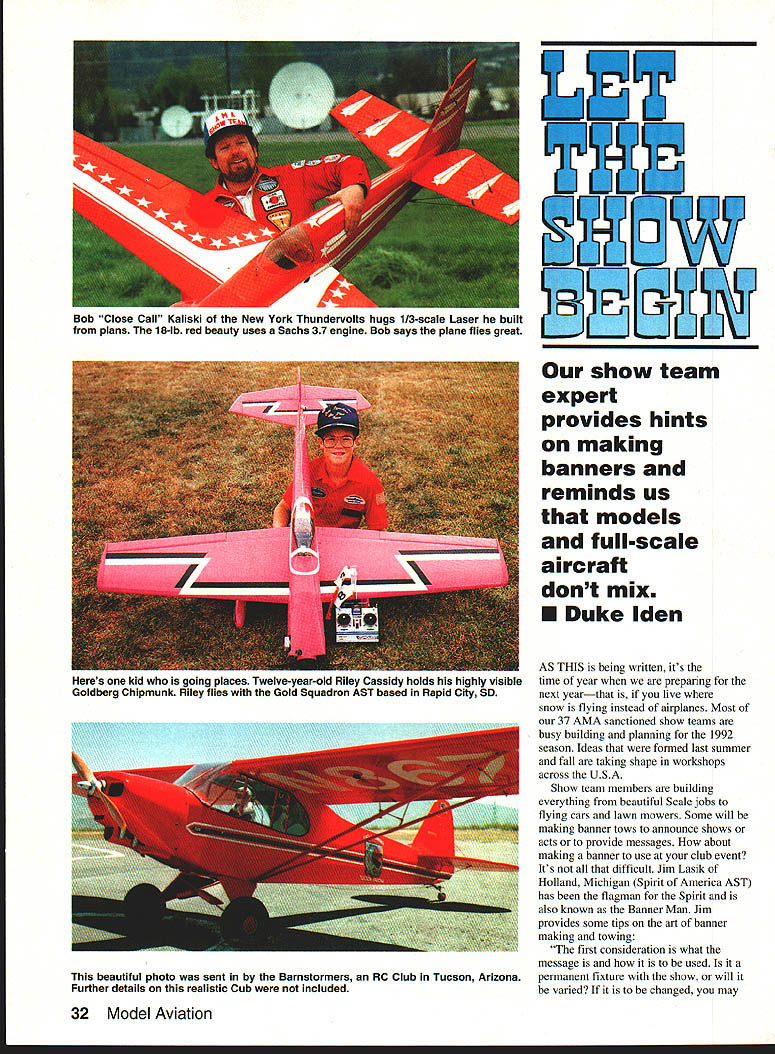
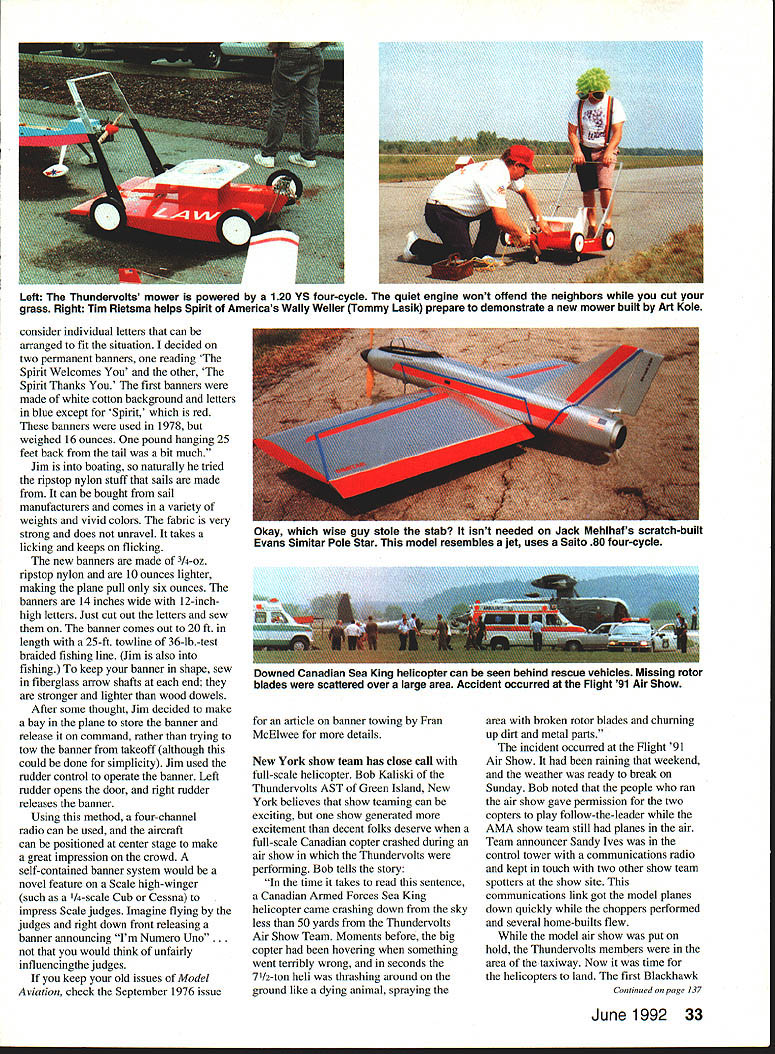
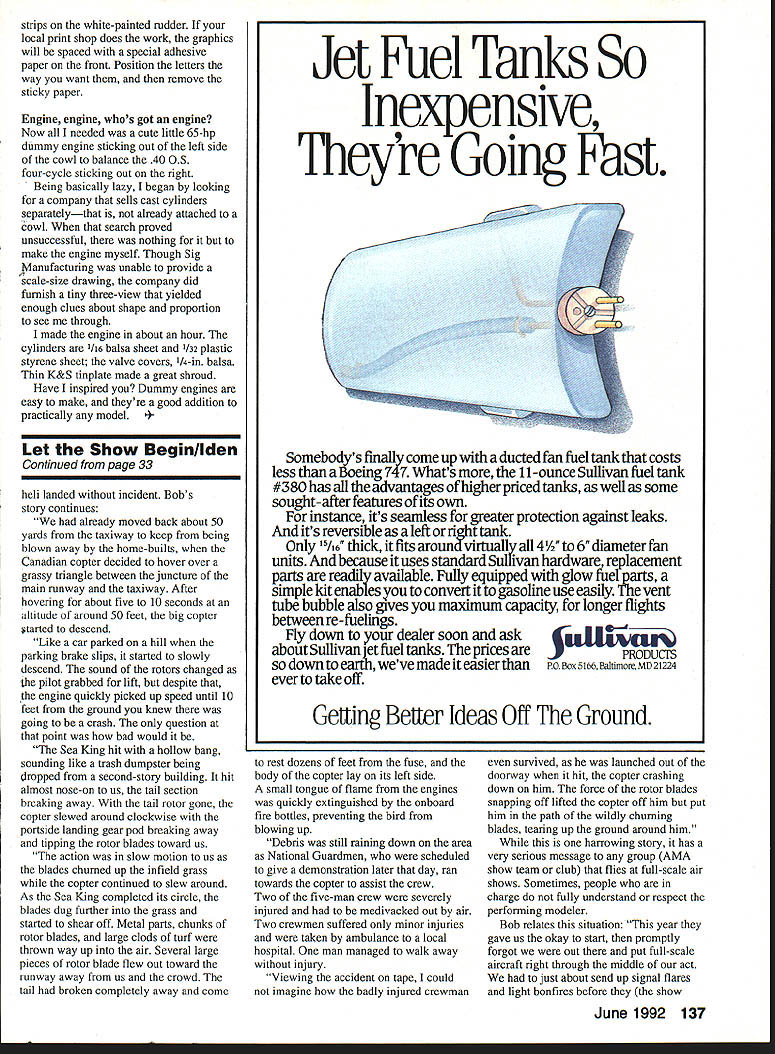
Let the Show Begin
Duke Iden
Our show-team expert provides hints on making banners and reminds us that models and full-scale aircraft don't mix.
As this is being written, it's the time of year when we are preparing for the next season—that is, if you live where snow is flying instead of airplanes. Most of our 37 AMA-sanctioned show teams are busy building and planning for the 1992 season. Ideas that were formed last summer and fall are taking shape in workshops across the U.S.A.
Show team members are building everything from beautiful scale jobs to flying cars and lawn mowers. Some will be making banner tows to announce shows or acts or to provide messages. How about making a banner to use at your club event? It's not all that difficult. Jim Lasik of Holland, Michigan (Spirit of America AST) has been the flagman for the Spirit and is also known as the Banner Man. Jim provides some tips on the art of banner making and towing:
"The first consideration is what the message is and how it is to be used. Is it a permanent fixture with the show, or will it be varied? If it is to be changed, you may consider individual letters that can be arranged to fit the situation. We decided on two permanent banners reading SPIRIT WELCOMES and SPIRIT THANKS. The first banners were made of white cotton with blue letters, except SPIRIT in red. The banners used in 1978 weighed 16 ounces — about a pound — and hanging 25 feet back on the tail was a bit much.
"Jim, being a boater, naturally tried ripstop nylon used for sails. It can be bought from sail manufacturers and comes in a variety of weights and vivid colors. The fabric is very strong, does not unravel, takes a licking and keeps on flicking. The new banners were made of 3/4-oz ripstop nylon — 10 ounces lighter — making the plane pull only six ounces. The banners are 14 inches wide with 12-inch-high letters. Just cut out the letters and sew them on. The banner comes out 20 ft. in length. The 25-ft. towline is 36-lb.-test braided fishing line. Jim also uses fishing line to help keep the banner shape and sews fiberglass arrow shafts to the ends — stronger and lighter than wood dowels.
"After some thought, Jim decided to make the banner release controlled by the plane rather than trying to tow the banner during takeoff, although that can be done. For simplicity Jim used rudder control to operate the banner. Left rudder opens the door; right rudder releases the banner. Using this method, a four-channel radio can be used. The aircraft can be positioned center stage to make a great impression on the crowd. A self-contained banner system would be a novel feature on a scale high-winger such as a 1/4-scale Cub or Cessna and would impress scale judges. Imagine flying right down in front of the judges and releasing a banner announcing 'I'm Numero Uno' — you would think that might unfairly influence the judges. For more on banner towing, check the September 1976 issue of Model Aviation for an article by Fran McElwee."
New York show team has close call with full-scale helicopter
Bob Kaliski of the Thundervolts AST of Green Island, New York believes that show teaming can be exciting, but one show generated more excitement than decent folks deserve when a full-scale Canadian helicopter crashed during an air show in which the Thundervolts were performing. Bob tells the story:
In the time it takes to read this sentence, a Canadian Armed Forces Sea King helicopter came crashing down from the sky less than 50 yards from the Thundervolts Air Show Team. Moments before, the big copter had been hovering when something went terribly wrong, and in seconds the 7-1/2-ton helicopter was thrashing around on the ground like a dying animal, spraying the area with broken rotor blades and churning up dirt and metal parts.
The incident occurred at the Flight '91 Air Show. It had been raining that weekend, and the weather was ready to break on Sunday. Bob noted that the people who ran the show gave permission for the two copters to play follow-the-leader while the AMA show team still had planes in the air. Team announcer Sandy Ives was in the control tower with a communications radio and kept in touch with the two other show-team spotters at the show site. This communications link got the model planes down quickly while the choppers performed and several home-builts flew.
While the model air show was put on hold, the Thundervolts members were in the area of the taxiway. Now it was time for the helicopters to land. The first Black Hawk helicopter landed without incident. Bob's story continues:
"We had already moved back about 50 yards from the taxiway to keep from being blown away by the home-builts, when the Canadian copter decided to hover over a grassy triangle between the juncture of the main runway and the taxiway. After hovering for about five to 10 seconds at an altitude of around 50 feet, the big copter started to descend.
"Like a car parked on a hill when the parking brake slips, it started to slowly descend. The sound of the rotors changed as the pilot grabbed for lift, but despite that, the engine quickly picked up speed until 10 feet from the ground you knew there was going to be a crash. The only question at that point was how bad would it be.
"The Sea King hit with a hollow bang, sounding like a trash dumpster being dropped from a second-story building. It hit almost nose-on to us, the tail section breaking away. With the tail rotor gone, the copter slewed around clockwise with the portside landing gear pod breaking away and tipping the rotor blades toward us.
"The action was in slow motion to us as the blades churned up the infield grass while the copter continued to slew around. As the Sea King completed its circle, the blades dug further into the grass and started to shear off. Metal parts, chunks of rotor blades, and large clods of turf were thrown way up into the air. Several large pieces of rotor blade flew out toward the runway away from us and the crowd. The tail had broken completely away and come to rest dozens of feet from the fuselage, and the body of the copter lay on its left side.
"A small tongue of flame from the engines was quickly extinguished by the onboard fire bottles, preventing the bird from blowing up.
"Debris was still raining down on the area as the National Guardmen, who were scheduled to give a demonstration that day, ran towards the copter to assist the crew. Two of the five-man crew were severely injured and had to be medevaced out by air. Two crewmen suffered only minor injuries and were taken by ambulance to a local hospital. One man managed to walk away without injury.
"Viewing the accident on tape, I could not imagine how the badly injured crewman even survived, as he was launched out of the doorway when it hit, the copter crashing down on him. The force of the rotor blades snapping off lifted the copter off him but put him in the path of the wildly churning blades, tearing up the ground around him."
While this is one harrowing story, it has a very serious message to any group (AMA show team or club) that flies at full-scale air shows. Sometimes, people who are in the audience do not fully understand or respect the performing modeler.
Bob relates this situation: "This year they gave us the okay to start, then promptly forgot we were out there and put full-scale aircraft right through the middle of our act. We had to just about send up signal flares and light bonfires before they realized that models and full-scale don't mix."
So, the bottom line: if your group is asked to perform at a local air show, check the site in advance, see where you will be flying, learn whether the airport will be shut down while you're flying, have spotters on hand while you fly, and demand at show time that prearranged safety standards be adhered to while the show is in progress. If any of the parties involved do not agree with these stipulations, refuse to do the show.
That's some pretty heavy stuff, so to close here's something that may inspire you to change careers and become a full-scale pilot. This piece was written by a fifth-grade student at Jefferson School in Beaufort, South Carolina. It was first published in the South Carolina Aviation News. It's a classic.
Why I Want to be a Pilot
"When I grow up I want to be a pilot because it's a fun job and easy to do. That's why there are so many pilots flying around these days.
"Pilots don't need much school. They just have to learn to read numbers so they can read their instruments.
"I guess they should be able to read a roadmap too.
"Pilots should be brave so they won't get scared if it's foggy and they can't see, or if a wing or motor falls off.
"Pilots have to have good eyes to see through the clouds, and they can't be afraid of thunder or lightning because they are much closer to them than we are.
"The salary pilots make is another thing I like. They make more money than they know what to do with. This is because most people think that flying a plane is dangerous, except pilots don't because they know how easy it is.
"I hope I don't get airsick because I get carsick and if I get airsick I couldn't be a pilot and then I would have to go to work."
Well, show-team fans, keep your nose up and your wings on. Till next time.
Transcribed from original scans by AI. Minor OCR errors may remain.

