
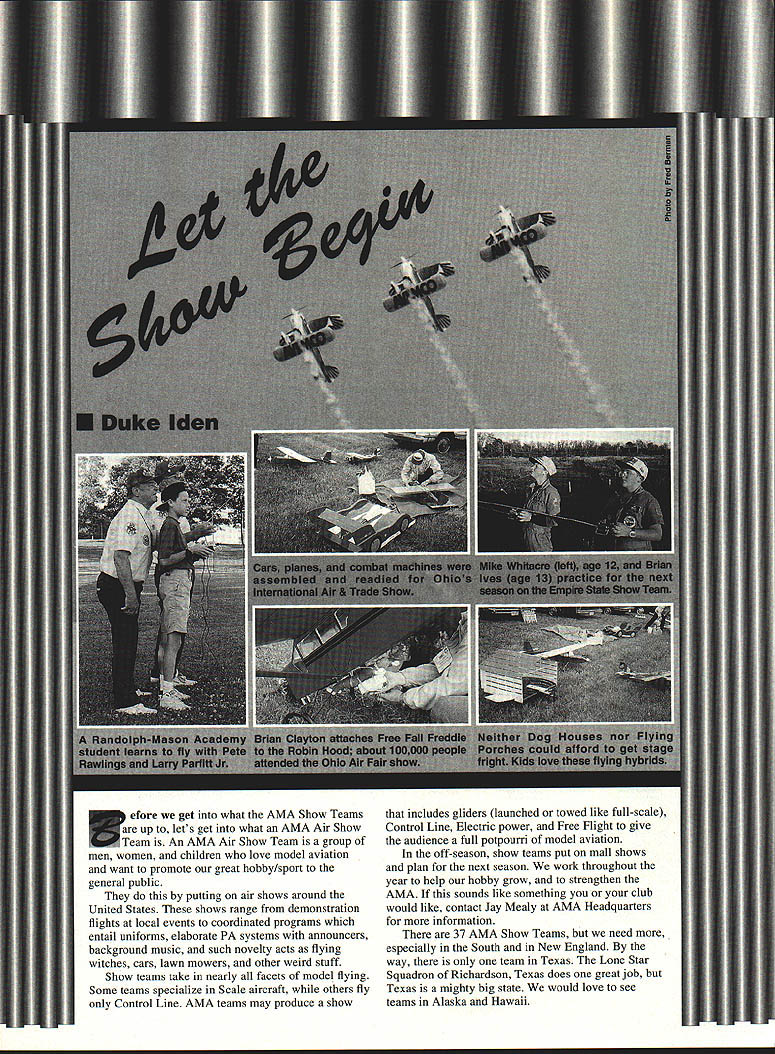

Let the Show Begin
Duke Iden
Before we get into what the AMA Show Teams are up to, let's define what an AMA Air Show Team is. An AMA Air Show Team is a group of men, women, and children who love model aviation and want to promote our great hobby and sport to the general public.
They do this by putting on air shows around the United States. These shows range from demonstration flights at local events to coordinated programs that include uniforms, elaborate PA systems with announcers, background music, and novelty acts such as flying witches, cars, lawn mowers, and other unusual attractions.
Show teams encompass nearly all facets of model flying. Some teams specialize in scale aircraft, while others fly only control line. AMA teams may produce shows that include gliders (launched or towed like full-scale), control line, electric power, and free flight to give the audience a full potpourri of model aviation.
In the off-season, show teams put on mall shows and plan for the next season. We work throughout the year to help our hobby grow and to strengthen the AMA. If this sounds like something you or your club would like to do, contact Jay Mealy at AMA Headquarters for more information.
There are 37 AMA Show Teams, but we need more, especially in the South and in New England. By the way, there is only one team in Texas. The Lone Star Squadron of Richardson, Texas, does one great job, but Texas is a mighty big state. We would love to see teams in Alaska and Hawaii.
The International Air and Trade Show (Dayton Air Fair)
The International Air and Trade Show—or Dayton Air Fair—is internationally known. In odd-numbered years it is called Air Fair, and in even-numbered years it takes on an international flavor. Team #106, the Buckeye Aero Squadron, performs there where some 180,000 people gather to be amazed at what is flying.
Buckeye Squadron's Dwight Doench describes what it's like to fly at this July event:
"Pilots are forced to fly in-line with their aircraft, as opposed to the more conventional perpendicular approach used by RC fliers. Depth perception becomes extremely critical when flying this unorthodox pattern. It tests both a pilot's technical flying skill as well as his poise under the nerve-wracking pressure these mega-sized air shows produce.
"Look at it this way: you have more than 100,000 spectators on your left and civilian and military aircraft on your right. Fliers will tell you it's like flying down a tunnel."
Show team manager Bill Collins adds:
"Everything changes at Air Fair, and I mean everything. The FAA restrictions are enforced on the team while performing, and the crowd's safety and the media are all considered.
"On top of that, we have all sorts of civilian, military, and historical aircraft parked around the fringe of the show center. Air Fair gives both young and old pilots gray hairs."
Do you see the fun and challenge in being on an AMA Show Team?
Kids and Show Teams
Kids are our greatest natural resource. They have to be grown in soil fertile with values, morals, and a sense of achievement. What better way to instill achievement than through successfully flying a radio-control model?
Pete Rawlings and Larry Parfitt Jr. are two members of the Virginia Air Show Squadron (team #127 in Arlington, Virginia) and are working hard to develop this great resource. Using a buddy-box system, they spend hundreds of hours each year introducing RC to teenagers.
Both men are retired Air Force colonels and belong to AMA Gold Leader clubs. Larry is with the Northern Virginia RC Club and Pete belongs to the Fauquier Area Modelers.
The Virginia show team has been conducting several shows a year at the Randolph-Macon Academy, putting teens in touch with model aviation. It is a real trip to fly in and out of a baseball field surrounded by trees. Guys, keep up the good work.
To the North
Young people are also active on the Empire State Show Team (team #127), the only show team in New York. Twelve-year-old Mike Whitacre and 13-year-old Brian Ines are doing more than just flying trainers, although that is how they started.
Team manager D. L. Whitacre explains:
"The boys have started out on our show team by flying a 'trainer demonstration' to show the crowd where you start. Brian has also shown that trainees can do more than 'train' by flying an aerobatic sequence with a trainer.
"Mike has most recently demonstrated a short intermediate acrobatic sequence with a Sig Kommander. This has helped both boys to increase their potential and smooth their performances, continuing their flying with a VK Cherokee and Kommander.
"Another young man, John Summers, is now starting on a trainer sequence for next year's shows. During this year, Mike has progressed to a Sig Clipped-Wing Cub, powered by a Q35 and a Nosen P-51. Brian is flying the Kommander and a Gilson O.D.B. biplane pulled by a G-62. For next year, they are planning on flying Sig King Kobras in loose formation."
Follow the example of these youths. They are not only meeting a challenge, they are a part of something. They are promoting model aviation and growing up with a sense of accomplishment. We wish all the kids the best and hope to find more big kids to work with them.
Transcribed from original scans by AI. Minor OCR errors may remain.

