
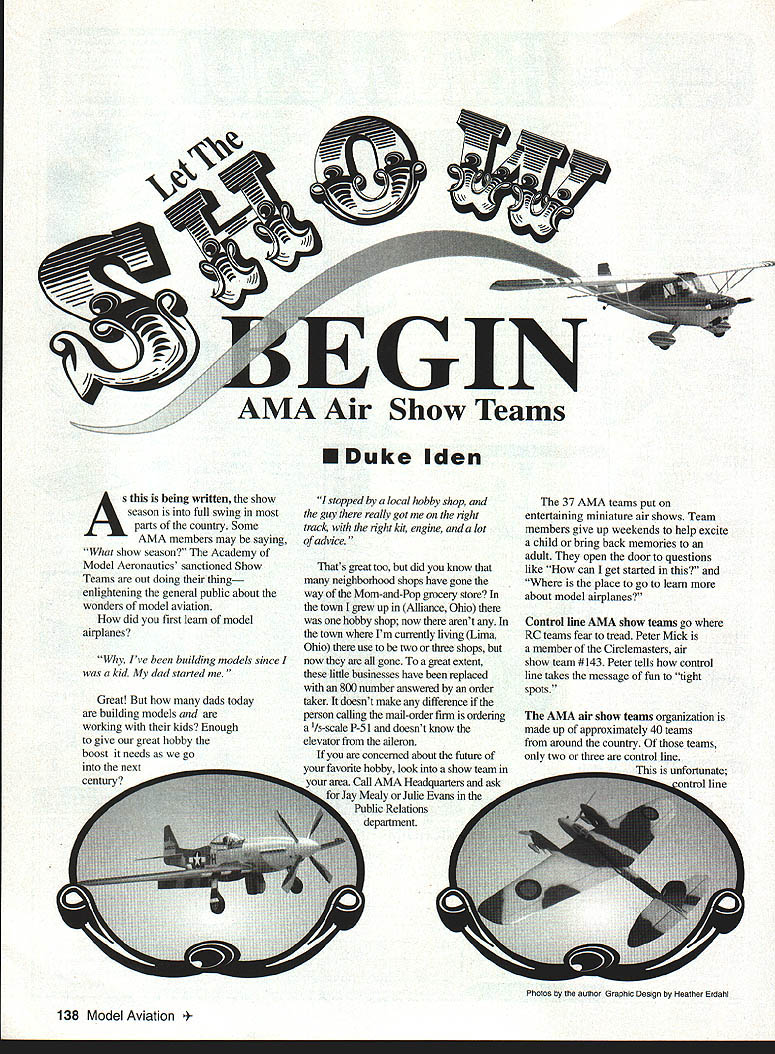
Let The Show Begin: AMA Air Show Teams
Duke Iden
As this is being written, the show season is into full swing in most parts of the country. Some AMA members may be saying, "What show season?" The Academy of Model Aeronautics' sanctioned show teams are out doing their thing—enlightening the general public about the wonders of model aviation.
How did you first learn of model airplanes?
"Why, I've been building models since I was a kid. My dad started me."
Great! But how many dads today are building models and working with their kids? Enough to give our great hobby the boost it needs as we go into the next century?
"I stopped by a local hobby shop, and the guy there really got me on the right track, with the right kit, engine, and a lot of advice."
That's great too, but did you know that many neighborhood shops have gone the way of the mom-and-pop grocery store? In the town I grew up in (Alliance, Ohio) there was one hobby shop; now there aren't any. In the town where I'm currently living (Lima, Ohio) there used to be two or three shops, but now they are all gone. To a great extent, these little businesses have been replaced with an 800 number answered by an order taker. It doesn't make any difference if the person calling the mail-order firm is ordering a 1/5-scale P-51 and doesn't know the elevator from the aileron.
If you are concerned about the future of your favorite hobby, look into a show team in your area. Call AMA Headquarters and ask for Jay Mealy or Julie Evans in the Public Relations department.
AMA show teams: purpose and reach
The AMA air show teams put on entertaining miniature air shows. Team members give up weekends to help excite a child or bring back memories to an adult. They open the door to questions like "How can I get started in this?" and "Where is the place to go to learn more about model airplanes?"
The AMA air show teams organization is made up of approximately 40 teams from around the country. Of those teams, only two or three are control-line. This is unfortunate; control-line flying brings the message of fun into tight spots.
Control-line AMA show teams go where RC teams fear to tread. The Circlemasters, air show team #143, based in Sussex, Wisconsin, has done just that. On many occasions air show teams have put on complete shows in areas that would be too small for an RC aircraft's takeoff roll. When you consider the concept behind the AMA air show organization is introducing model aviation to the public, what better way is there to accomplish this goal than to put on safe shows at school playgrounds, shopping mall parking lots, or baseball diamonds, without the extra safety concerns associated with RC flying?
The Circlemasters' one-hour routine
To show the public the many facets of the control-line sport, the Circlemasters air show team has established a one-hour routine that typically includes:
- Mass fly
- Five or six throttle-controlled profile S.E. 5 biplanes in the circle at one time.
- Stunt pattern
- Performed by one of the team's more proficient stunt pilots: Jim Krueger flying a twin-engined Mosquito, or Mike Wood flying a Sig Magnum. These pilots wear remote mics that feed the sound system and call the pattern as they fly, explaining the sequence to the audience.
- Combat (mild form)
- Generally two Sig Twisters or two Sig Skyrays running .35 engines. For safety, speed is kept to the normal stunt level; inverted flight and loops are prohibited. Despite the mild rules, this is the crowd favorite.
- Special throttle-hover demonstration
- Team manager Dan Tetzlaff flies a specially equipped throttle-controlled S.E. 5 that can hover on its prop without forward airspeed and perform at steep angles, often drawing audible amazement from the crowd.
- Scale flights
- Varying from Dan Tetzlaff's four-engined B-50 bomber to Art Weber's Citabria or P-51.
- Finale
- A repeat of the Combat event and the S.E. 5 mass fly conclude the formal part of the show.
The formal show lasts about one hour.
Community outreach and instruction
Although the formal part of the show is over, the team isn't done. They invite interested members of the audience to try their hand at flying one of the training airplanes. Instructors Jim Krueger and Mike Wood have helped beginning fliers experience the thrill of piloting a model aircraft. The pilots have ranged from four-year-olds to senior citizens!
The Circlemasters feel they have accomplished a lot with small airplanes on small sites: providing clean, safe entertainment; educating the public about model aviation; and enjoying themselves in the process.
Control liners: with this example from the Circlemasters, can you see what you could do to boost your club, increase awareness, and enjoy yourself with an AMA show team program?
AMA would like to hear from you.
'Til next time, break a leg!
Transcribed from original scans by AI. Minor OCR errors may remain.

