
Let's Talk About Airplane Design
Bradford W. Powers
Why does an airplane behave as it does? What can you do to make your model fly better or more efficiently? These are very large subjects, so don't expect all the answers in one fell swoop. Our author makes a beginning here, and it will be followed by more articles on an irregular schedule... with as little mumbo-jumbo as possible.
After a year or so of building and flying models, many modelers begin to develop a healthy curiosity about the principles that underlie successful designs. Unfortunately, clear, accurate, and digestible information about aerodynamics and the many other aspects of airplane design is difficult to find. For example, I have several books on the subject, yet only half of them are really useful. The others are written in an esoteric fashion by prima donnas who seem more interested in displaying their facility with differential equations than in down-to-earth discussions that might enlighten the reader. I believe that there is no idea in human knowledge that cannot be explained so that a bright 12-year-old can understand it if presented in a simple, forthright manner.
As we pointed out in the January 1978 MA article "About the Size of It," models and their full-scale counterparts are really brothers under the skin. Principles that apply to full-scale airplanes are equally applicable to models.
The design of airplanes, buildings, typewriters, violins, or dog collars generally involves three things. First, there needs to be a clear understanding of the problem to be solved. To have this understanding is usually to be halfway toward a solution. Second, it's necessary to have a fund of knowledge of physical or other principles to be drawn upon in order to create a good, workable design. Often knowing what cannot be done is as important as knowing what can. In this and future articles we will try to point out some of these principles.
Finally, the salt of sensitive good taste, which we sometimes call "artistic ability," when generously sprinkled, can make the difference between something ordinary and something brilliant. However, so-called artistic ability is not an end in itself. Art alone can produce pretty nonsense, while logic alone often produces mediocrity. But a nice blend of engineering and esthetics can produce airplanes like the French Mirage and Concorde; to me they are just as much works of art as Michelangelo's Pieta or Picasso's Guernica.
From time to time we will try to cover some of the essentials of such things as aerodynamics, structure, layout, lofting... and myths and fallacies also... that should enable budding designers to work purposefully and intelligently. When a quarter-scale model representing a sizable expenditure of both time and dollars meets disaster, it is sad indeed, particularly if the problem was a poor choice of CG location, flutter, or some other cause which could have been foreseen and avoided.
Here are 20 multiple-choice questions. Let's start by reviewing what we already know by checking the answers you believe are the right ones... and then finish the article.
- Tracking (directional stability on the ground) while taxiing or taking off is best when the main wheels are:
- a. Set parallel to one another.
- b. Toed-in slightly.
- c. Toed-out slightly.
- The tendency to ground loop to the left, especially on tail-draggers, is due to:
- a. P-factor.
- b. Torque.
- There is no such thing as:
- a. Torque... just P-factor.
- b. P-factor.
- On twin-engine designs, counterrotation of the propellers is:
- a. Desirable.
- b. Undesirable.
- Successful climb-out after takeoff is due to:
- a. Excess power available.
- b. Up elevator.
- c. Lots of wind.
- On Free Flight models, the use of pendulums hooked up to activate the ailerons will:
- a. Guarantee automatic recovery from a bank, thus assuring straight and level flight.
- b. Guarantee a spiral dive and disaster.
- A well-designed and properly trimmed airplane wants to:
- a. Fly straight and level.
- b. Fly at constant speed into the relative wind.
- c. Fly in a circle.
- A biplane is:
- a. More efficient than a monoplane having the same wing area.
- b. Less efficient than a monoplane having the same wing area.
- Longitudinal stability (the tendency to maintain level flight) depends on:
- a. Downthrust.
- b. CG location.
- c. Elevator area.
- Lateral stability involves:
- a. Dihedral on low-wing designs with straight wings.
- b. Dihedral on all designs.
- A fuselage by itself, without a tail:
- a. Is directionally unstable.
- b. Is directionally stable if its center of lateral area is reasonably well aft of the CG.
- c. Wants to fly sideways.
- Spiral dives are caused by:
- a. Inadequate fin area.
- b. Excessive fin area.
- c. Inadequate dihedral.
- "Dutch Roll" is caused by:
- a. Inadequate fin area.
- b. Excessive dihedral.
- c. Gyroscopic effects.
- Lift is generated by an airfoil because:
- a. A mass of air is deflected downward.
- b. There is negative pressure over the upper surface and positive pressure over the lower surface.
- The weight, power, speed, etc., of a scale model have a real relationship to the weight, power, speed, etc., of the full-scale prototype.
- a. True.
- b. False.
- The equation for lift is L = CL q S.
- a. This is an abstruse formula of no practical value.
- b. A half-hour's study of this equation will give a modeler a very useful tool to use in designing his own models.
- Swept and highly tapered wings should have:
- a. Washout.
- b. Washin.
- Reynolds' Number has to do with:
- a. Size.
- b. Speed.
- c. Viscosity.
- d. Density.
- e. Drag.
- In level flight the horizontal tail normally carries:
- a. An up load to lift the aft portion of the airplane.
- b. A down load to keep the nose up.
- c. No load, because most stabilizers have zero incidence.
- On most full-size airplanes, the wing is set at some angle of incidence, yet many models have the wing set at zero incidence.
- a. Therefore, incidence is not necessary.
- b. If both wing and stabilizer are set at zero incidence, the airplane will not fly without up elevator.
Answers and Discussion
1.
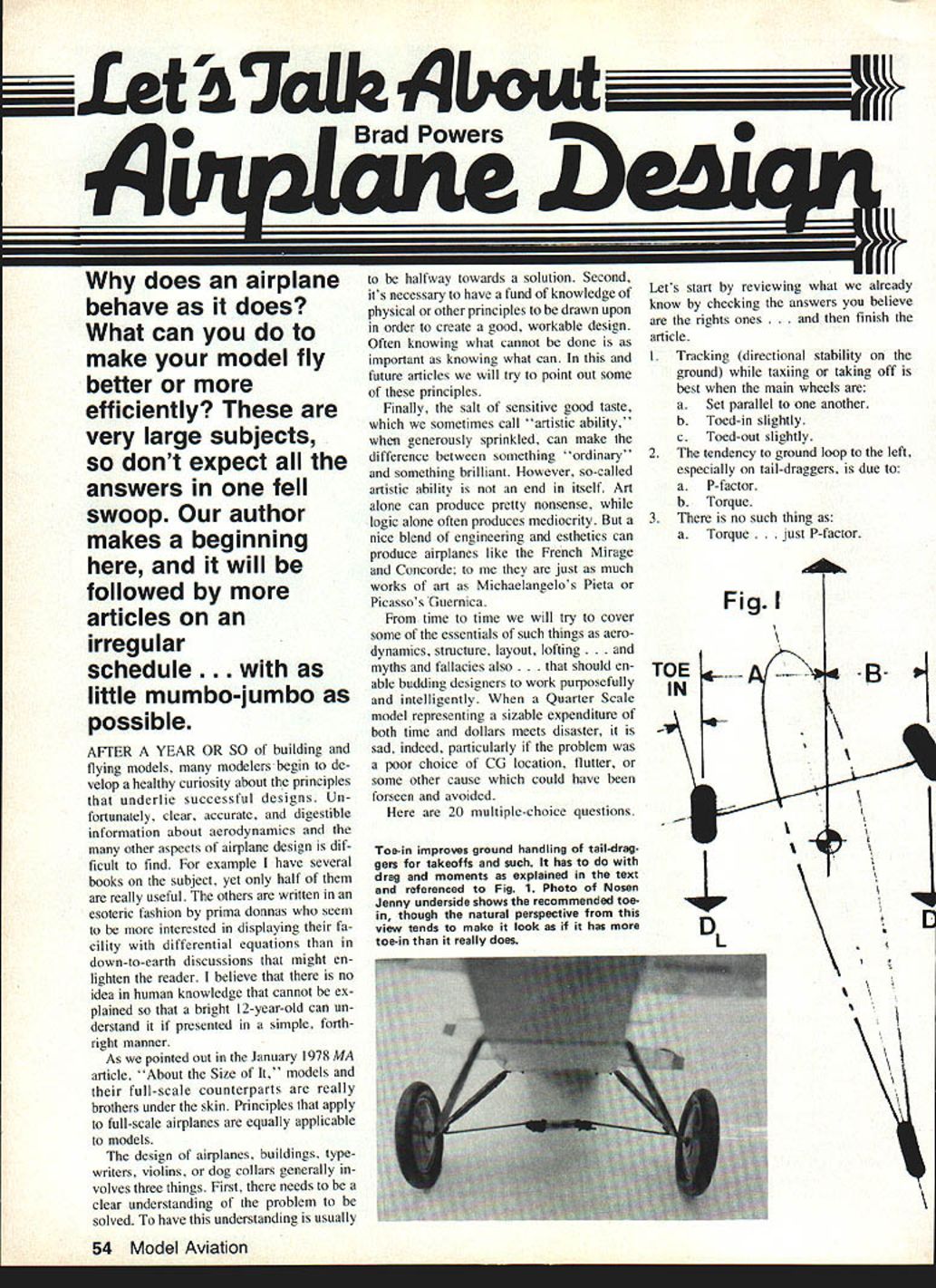
b. The tail-dragger arrangement is inherently unstable because the main wheels are ahead of the CG. Tail wheels and skids provide a degree of stability but are not very effective because they are very lightly loaded and are up and off the ground almost immediately at takeoff, so the main wheels should be toed-in.
As shown in Figure 1, when the airplane begins to yaw (usually to the left because of propeller torque), the drag of the left wheel combines with a greater moment arm (A) than does that of the right wheel with its smaller arm (B), producing a net moment tending to increase the yaw to the left and cause a ground loop. By toeing-in the wheels, the drag on the left wheel is reduced while that of the right wheel is increased. This increases the favorable restoring moment of the right wheel while decreasing the adverse moment of the left wheel. Under no circumstances should the main wheels be toed-out.
2.
b. Torque. Propeller torque can be considerable at low speed. It loads the left wheel and unloads the right wheel, causing the airplane to want to turn left. This should be countered by the application of right rudder (as well as the toe-in mentioned above). Application of ailerons to counter torque at takeoff can induce a stall or snap roll. More on this in a future article.
3.
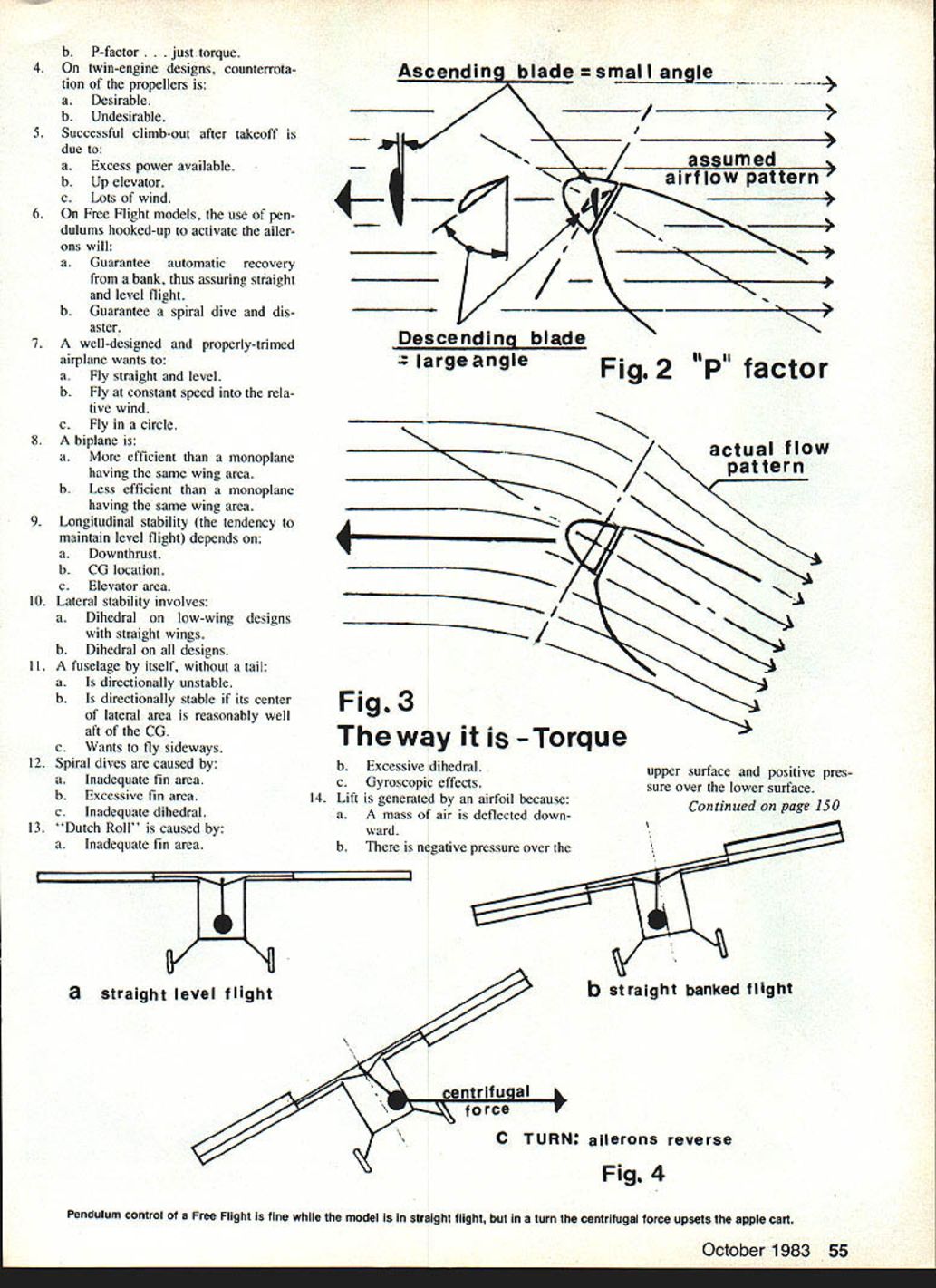
b. There is no such thing as P-factor as commonly described. P-factor is said to be the difference in angle of attack between the ascending left propeller blade and the descending right blade when the line of flight at high angles of attack near the stall is not the same as the thrust line of the prop, as shown in Figure 2.
As shown in Figure 3, a propeller spinning even moderately fast tends to equalize the flow and pressure across its diameter so that any disparity in angle of attack between the ascending and descending blades is equalized.
Even a small imbalance between the lift of one blade compared to the other can cause destructive vibration. A fixed-pitch propeller produces maximum torque when the airplane is at rest or moving very slowly, as at takeoff and at the stall. In high-speed flight, the propeller is operating at its best lift-to-drag, so rpm increases and the drag (torque) is at a minimum and the propeller unloads. In the case of helicopters, where the rpm is low and the line of flight is close to that of the rotor disc, the disparity in blade angle between the advancing and receding blades becomes a factor to contend with. But this is not the same thing as P-factor. More on torque in a future article.
4.
a. Torque is additive. If two engines are turning in the same direction, the torque will be twice that produced by one engine. If rotation is reversed on one engine, the torque cancels out and the airplane is free of its effects. If rotation is arranged so the propellers swing "up and out" with respect to the fuselage, the spanwise lift distribution is enhanced and any asymmetry disappears.
5.
a. Climb is the result of the application of power. If sufficient excess power is not available, applying elevator can slow the airplane down and cause it to stall.
6.
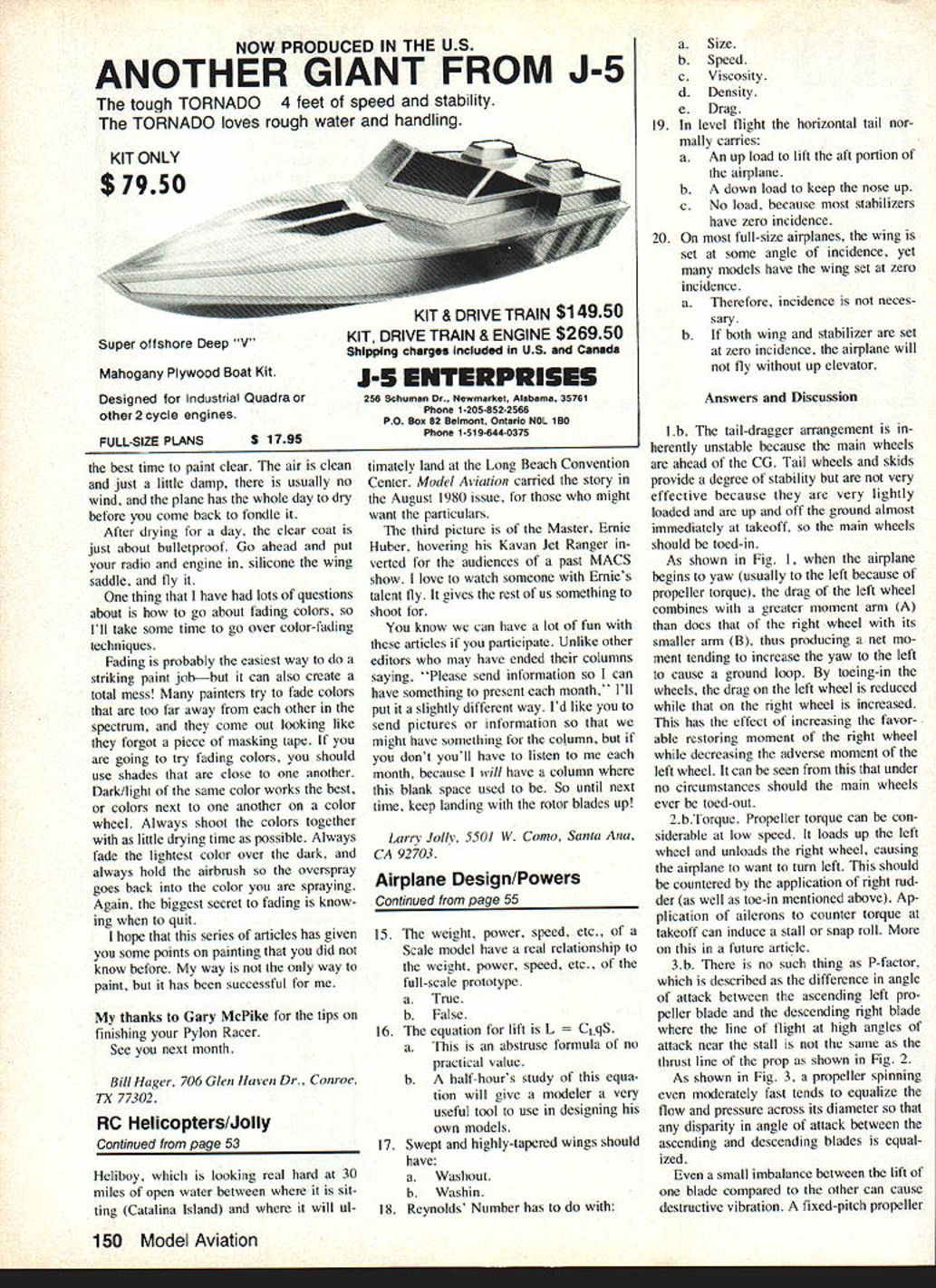
b. A pendulum will work fine as long as straight flight is maintained, since it wants to hang down under this condition (see Figures 4a and 4b).
Sooner or later the relative wind will change and initiate a turn. When it does, centrifugal force will throw the pendulum away from the center of the turn, causing an irreversible spiral dive (see Figure 4c).
7.
b. An airplane wants to fly at the angle of attack (speed) for which it is trimmed by the horizontal tail. It also wants to turn into the relative wind.
8.
b. A biplane is inherently less efficient than a monoplane because of mutual interference, where the pressures between the wings are unfavorable. The upper wing loses positive pressure on its underside, and the lower wing gains pressure over its upper surface.
9.
b. Longitudinal stability is a function of CG location. The CG must always lie forward of the neutral point. (See April 1980 MA, "Let's Talk About the CG.")
10.
a. Lateral stability is largely provided by dihedral on low-wing monoplanes with straight, unswept wings. High-wing monoplanes have an effective dihedral due to the high placement of the wing, so little or no geometric dihedral is required. Swept wings and delta wings also have effective dihedral due to the sweep of the leading edge. In fact, some highly swept wings require negative dihedral (anhedral) when placed high on the fuselage, as on the British Harrier.
11.
a. A fuselage must have a tail. Otherwise, it does indeed want to set itself perpendicular to the airstream and fly sideways.
12.
b. and c. Spiral dives are caused by excessive fin area coupled with insufficient dihedral. We will go into this at length in a future article.
13.
a. and b. Dutch roll is caused by insufficient fin area together with excessive dihedral. The small fin allows the fuselage to yaw, and the dihedral overcompensates to cause lateral oscillations.
14.
a. and b. A mass of air accelerated downward reacts to produce the upward force called lift. The curved path of the airstream over the wing manifests this lift in the form of increased velocity and lower pressure over the upper surface and decreased velocity and increased pressure over the lower surface, thus distributing the lift over the wing.
15.
a. True. There are precise relationships between large and small things having the same configuration and means of operation, as pointed out at the beginning of the article.
16.
b. The use of the lift equation will be the subject of the next article. It is not nearly so formidable as it looks, and it is useful in understanding how wing area, weight, speed, etc., are interrelated.
17.
a. Washout, together with an increase in camber at the wing tips, is desirable to prevent tip stall.
18.
All of the above. Reynolds' Number has to do with size, speed, viscosity, density, and therefore affects drag. (See "Let's Talk About Reynolds' Number," February 1979 MA.)
19.
b. A stable airplane has its CG forward of the neutral point, which is the center of total lift of the whole airplane. Therefore, there must be a down load on the horizontal tail to keep the nose up. This has the effect of moving the net lift forward to the CG.
20.
b. For maximum range on a real airplane, the wing incidence is normally set at the angle for maximum L/D (lift-to-drag). For most airfoils, this is about three degrees. The downwash from the wing is usually adequate to trim the airplane for level flight at cruising speed by producing a down-load on the tail when the tail is set at zero incidence.
On Pattern models having symmetrical airfoils, where it is desired to have no surprises while flying upside down, there is something to be said for setting both the wing and tail at zero degrees. When this is done, the airplane will not fly, however, unless some up-elevator is applied to trim the wing to a positive angle of attack. Thus, the airplane can only maintain level flight when the fuselage is in the attitude of a slight climb. This would suggest that maybe Pattern jobs should be designed with flaps that can be deflected either up or down to provide positive incidence in the form of camber in either normal or inverted flight. Maybe they do it already. I haven't progressed to Pattern flying yet.
How well did you score? Don't hesitate to write if you have questions or polite comments:
Bradford W. Powers 5470 Castle Hills Dr. San Diego, CA 92109
Transcribed from original scans by AI. Minor OCR errors may remain.

