
Letters to the Editor
All letters will be carefully considered, those of general interest used. Send to Model Aviation, 815 15th St., N.W., Washington, D.C. 20005.
Miss America's Roots
You wondered how I felt when I saw the cover and the fourth page in the February issue of the Model Aviation. Well, my first thought was that it was about time I cleared up the "designer" credit for Miss America. (It was named by Scientific.)
If you have a reprint of the 1937 Year Book, you will notice that on page 52 I have a note "by F. Zaic, influenced by C. Schmaedig design." This note did not appear in the original 1937 Year Book. The title block simply stated that it was a commercial kit by Scientific.
When Mr. Frisoli asked me to design a model for his company, I agreed to do so with the understanding that my name would not appear on the plans or any other literature, including advertising. Why I was asked to design a gas model kit for them, I don't know. I had not made a gas model until then. But as a matter of history, no one in particular knew much about gas model design as most of the builders were "flying" their first effort. So that my design could be as good as theirs. (We did not use much dihedral because we would lose too much lift!) Luckily, by sheer coincidence, Carl Schmaedig was living with me at that time.
Anyway, it happened that Carl had finished and flown a nine foot gas model which behaved nicely. (It was featured in Model Craftsman, March-May, of 1936.) It looked good in appearance, and I used it as a basis for layout of an eight foot model. I simplified the construction, made the cabin more pronounced and changed some curves. I suppose, the way models are "designed" this would be considered as "original" designing, but it is not to my way of thinking. As a matter of record, Carl made the original Miss America after school hours as part of his "keep." It was on the light side. Bamboo papered with two coats of clear.
For the test flight we took the model to the Holmes airport. It was powered by a brand-new, no-run-in Baby Cyclone. (There was no place to run it in the city.) I don't remember how much time we spent trying to make the Baby run. It would blurp after we primed it and then conk out. At first we were careful to limit the gas in the tank, but after a while we did not even think about it. Just make the Baby run! Well, it finally caught good and solid, and we shoved the model into the light breeze. It took off quite rapidly and had a good steady climb. We waited for the Baby to stop, but it kept going, and going, and going. We tried to keep up with it but it was of no use. We could hardly see it as it disappeared over the house. As far as I can remember, the model was gone, although Carl wrote that we got it back. But if we did, why did Carl have to make another to comply with our agreement? And I don't remember having a model that looked like Miss America around the shop. Be as it may, the price quoted to Scientific for the project, a complete model with working drawings, was $50.00. For this sum, we made two models and lost one Baby Cyclone. But then, Carl's time was almost free. I cut the balsa wood which was 12¢ per board foot at that time. And my two small rooms were $16.00 per month, and my food averaged 50¢ per day — so we did not feel that we were victims of circumstances. I hope that this will clear up the origin of Miss America.
Frank Zaic Northridge, CA
The $50 payment Frank mentions was a princely sum compared with what some other designers accepted. One famous designer still with us today received a pair of air wheels in payment for a giant-sized gassie. Scotty Murray was paid $3 for one of his designs.
Long and Short of it
First, some applause for the decision to issue Model Aviation (long overdue, I admit). I remember the hullabaloo created when the decision was made, but time has shown that the time was right. I enjoy Model Aviation very much, and it is one of the reasons I belong to A.M.A.
Now, some comment on the article on scale models by John D. Preston in the January 1978 issue of MA. The article was informative and enjoyable, and I agree with most of his ideas. The one exception is John's comments on short tail moment arms on the Fokker Dreidekken and the Monocoupe.
Actually, both of the aircraft have favorable tail moment arms when measured in wing chord lengths aft of the center of gravity to the horizontal tail surface.
One of the primary reasons that types of aircraft have such horrible landing ground handling characteristics is very short nose moment arms. In addition, tail draggers with short nose moment arms cause engine torque to have lesser effect on landing ground handling control. Rotary engine powered radial engined powered aircraft share characteristic WW aircraft bag build British SE-S Notice nice long nose moment arm adequate dihedral ample tail surface area design can made fly well rubber po wered free flight.
I hope these comments have added a little to help in the building and flying of scale model aircraft.
Roy D. Strader South Bend, IN
Ground handling characteristics vary greatly according to many aircraft features, a number of them not mentioned. Narrow tread is one—on WW I aircraft there was not much cross-wind problem because takeoffs and landings could be made in any direction, into the wind, on aerodromes of the day. An example of ground handling variations in a related design can be found in the Aeronca Chief, the Champ, and the Scout—a kind of blend of the two. Wheel landings in the Chief required good forward pressure, or the tail would drop abruptly to the runway; the Champ made effortless wheel landings simply by not holding full back stick; and the Scout was a ground looping demon. Early free flighters who used long, forward gear to protect props eventually moved the gear back to improve takeoffs.
A Nosen Citabra
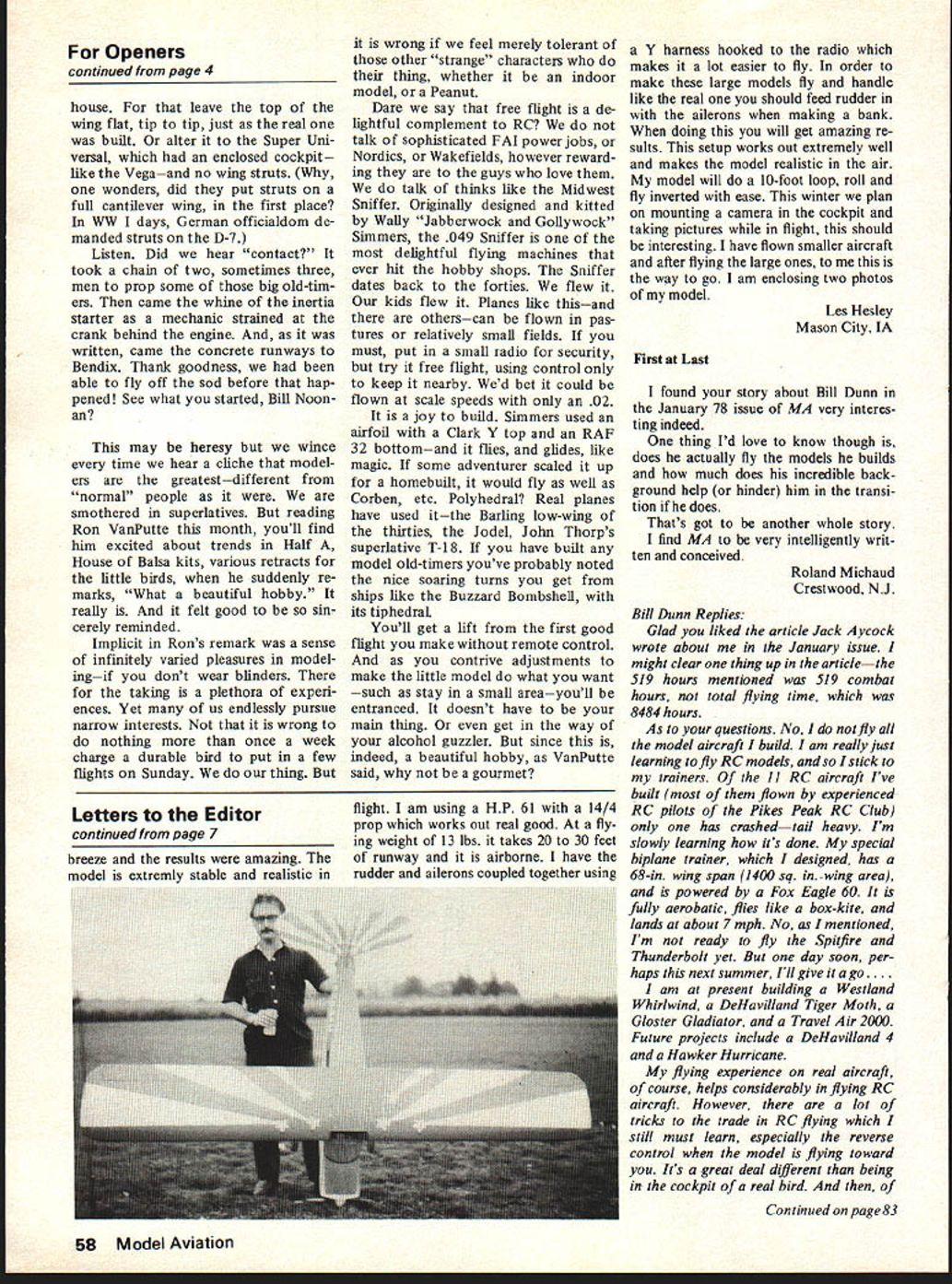
I had read many articles on one quarter scale models and every one has fascinated me while reading them. So I had to get a model and find out how they flew and handled in the air. It took me three months to assemble the kit and get it ready for the test flight. We test flew it in a 15 mph
Continued on page 58
Letters to Editor
continued from page 58
Of course, an RC model can do all sorts of aerobatics that a real aircraft can not do...
The Size of It
I am writing to say thanks for the excellent article, "About the Size of It," by Bradford Powers that appeared in the 1/78 edition of your magazine. Mr. Powers presented his material in a clear and interesting manner, but yet supplied enough of the background equations and logic to make the article of value for practical application. Please, let us see many more articles by this author, and others, on the subject of model aerodynamics.
David G. Zwolak Cincinnati, OH
Dream Site
I am one of 30 members of the Centour Radio Club of East Liverpool, Ohio. The club has picked up about 8 new members in the last 6 months.
In May we had no field to fly from. I wrote to the head of Parks in Ohio. I asked for his permission for our RC club to use part of the vast 22,000 acres Ohio Beaver Creek State Park. Old mills that ground flour by water over 100 years ago, rolling hills, etc. The park manager, a former Navy carrier pilot, escorted us about 5 miles. He gave us a nice field with about 25 acres to fly from. They put log chains across the entrance and told us to keep it locked up to avoid the pot parties, that they had trouble with before.
We got all members keys for the padlock. We all have had a nice place to fly, 1 mile from the nearest house.
Edwin H. Orr East Liverpool, OH
Well, I'll be...
For what it's worth may I offer the following. Two years ago was test flying a Wakefield with an al. tube and no file to put in up down R/L thrust but did have a rudder tab. Because the aircraft was power stalling I thought "well, put some right tab on the rudder." Wind came up and same next Sunday. Following Sunday full power flights but some into the ground! Why?
After considerable thought about the attitude of the model powering up through the air I realized: I was flying R/R with the rudder tab set to the right. As the aircraft rolled to the right the vertical tail slowly became the stab! What does a aircraft do with down elevator—dive!
The comments I've rec'd from very good modelers is "Well I'll be," etc.
Don Eggersperger Redondo Beach, CA
Transcribed from original scans by AI. Minor OCR errors may remain.

