
Letters To The Editor
Torque Reaction
In the January 1986 AMA magazine (page 57) there are three pictures of a beautifully built D-18 Beech. In the caption there is a fallacy which seems to be accepted by most RCers. The middle of the caption states: "Clearly visible in this take-off shot is the deflection of the twin rudders to compensate for torque-induced yaw." Way back Mr. Newton said for every action there is an equal and opposite reaction.
Torque is commonly thought of as the tendency to produce rotation. The propeller is rotating clockwise (as viewed from the cockpit), driven by a crankshaft that spins about the airplane's roll axis. The only reason the running engine turns the prop is because we have restrained the engine from rotating by fastening it to the airframe. That same torque is transmitted to the airframe in the opposite direction—counterclockwise—about the crankshaft.
Therefore, torque (according to Newton) produces a left-roll tendency on the airframe. On the ground this roll force is transferred to the runway surface as an increased load and subsequent drag on the left wheel. The difference in drag between the right and left wheels is the only yaw force that torque exerts on takeoff.
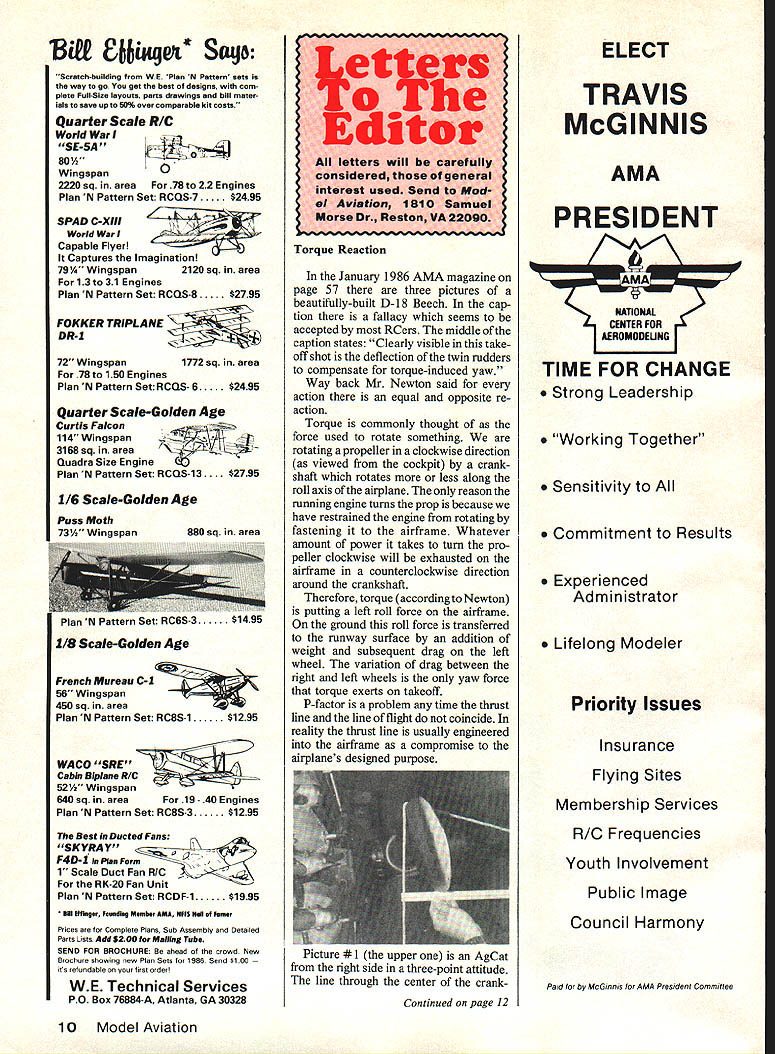
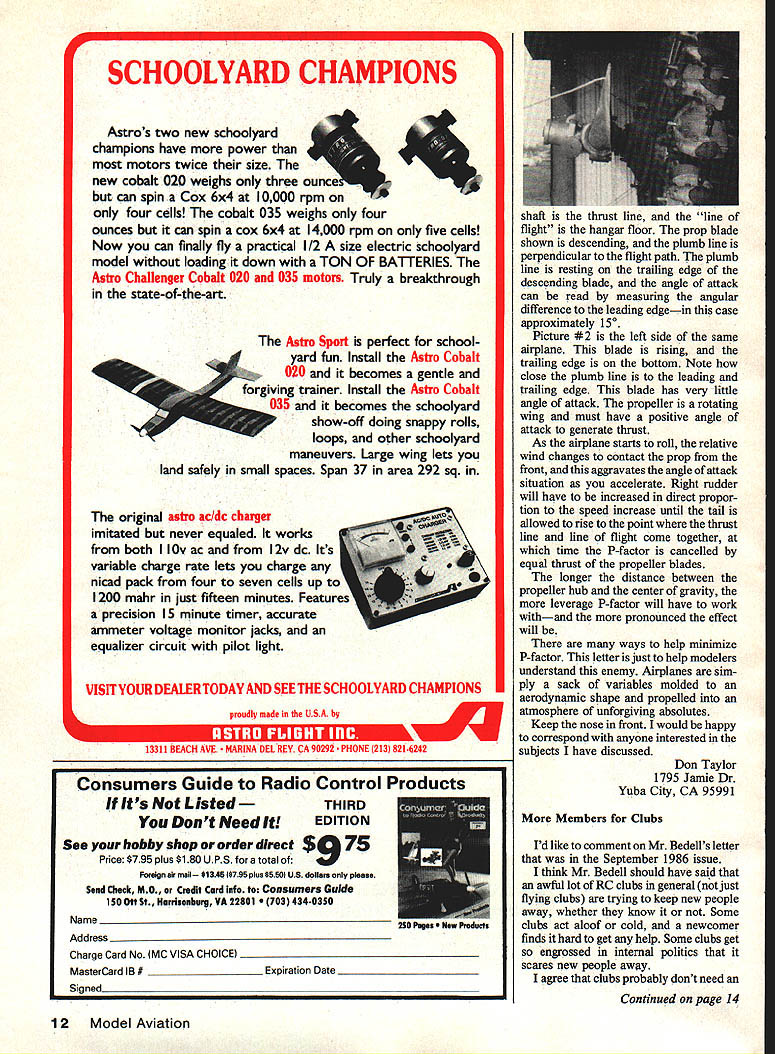
P-factor is a problem any time the thrust line and the line of flight do not coincide. In reality the thrust line is usually engineered into the airframe as a compromise to the airplane's designed purpose. In the picture, the propeller shaft is the thrust line, and the "line of flight" is the hangar floor. The prop blade shown is descending, and the plumb line is perpendicular to the flight path. The plumb line rests on the trailing edge of the descending blade, and the angle of attack can be read by measuring the angular difference to the leading edge—in this case approximately 15°.
Picture #2 is the left side of the same airplane. That blade is rising, and the trailing edge is on the bottom. Note how close the plumb line is to the leading and trailing edge. This blade has very little angle of attack. The propeller is a rotating wing and must have a positive angle of attack to generate thrust.
As the airplane starts to roll, the relative wind changes to contact the prop from the front, and this aggravates the angle-of-attack situation as you accelerate. Right rudder will have to be increased in direct proportion to the speed increase until the tail is allowed to rise to the point where the thrust line and line of flight come together; at that point the P-factor is canceled by equal thrust of the propeller blades.
The longer the distance between the propeller hub and the center of gravity, the more leverage P-factor will have to work with—and the more pronounced the effect will be.
There are many ways to help minimize P-factor. This letter is just to help modelers understand this enemy. Airplanes are simply a sack of variables molded to an aerodynamic shape and propelled into the atmosphere of unforgiving absolutes.
Keep the nose in front. I would be happy to correspond with anyone interested in the subjects I have discussed.
Don Taylor 1795 Jamie Dr. Yuba City, CA 95991
More Members for Clubs
I'd like to comment on Mr. Bedell's letter that was in the September 1986 issue. I think Mr. Bedell should have said that an awful lot of R/C clubs in general (not just flying clubs) are trying to keep new people away, whether they know it or not. Some clubs act aloof or cold, and a newcomer finds it hard to get any help. Some clubs get so engrossed in internal politics that it scares new people away.
I agree that clubs probably don't need an initiation fee. The new member could use that money to join the AMA or help offset the first month's dues.
Sure, some areas of the country have more RC flying clubs than others, but it's partly a case of interest. You can't make a person fly if he is not interested. If there are no clubs in someone's area, perhaps that person should start one.
Let's look at the club I belong to, for instance. Once a person finds out about us through one of our public awareness fly-ins, a hobby shop, or even word of mouth (we are also at the local county fair showing RC videotapes and handing out AMA literature), we will fill him in on all the points of the hobby. We don't turn anyone away who wants to join. We help him as much as possible, explaining what it takes to learn to fly and what he'll most likely need.
The cost factor is a big question to any newcomer, so we break it down to the minimum so that he and his wife know it won't break the bank. Remember that most hobbies or sports cost money; it is up to you to decide how much to spend past the minimum.
We'll invite him to the club's field, which is right off a main road and visible to everyone who drives by (many see us flying and stop to watch). We want newcomers to see what's physically involved and to introduce him to club members. The newcomers will also be invited to a club meeting so he can talk with more modelers, watch videotapes, and partake in the social activities.
If he decides to join, we'll help him build and set up his plane. Then we'll teach him to fly in a safe manner. He'll earn a solo certificate, and some day he will turn around and help another newcomer enjoy the field of RC flying.
Remember that even if a person doesn't join your club, the public awareness aspect of all this is vital to the continuance of our great hobby.
The point to all of this is that clubs are made up of people, and it's up to these people to decide which way the club will go.
Frank Miccio Salem County RC MAC Pennsville, NJ
Flip Stiks
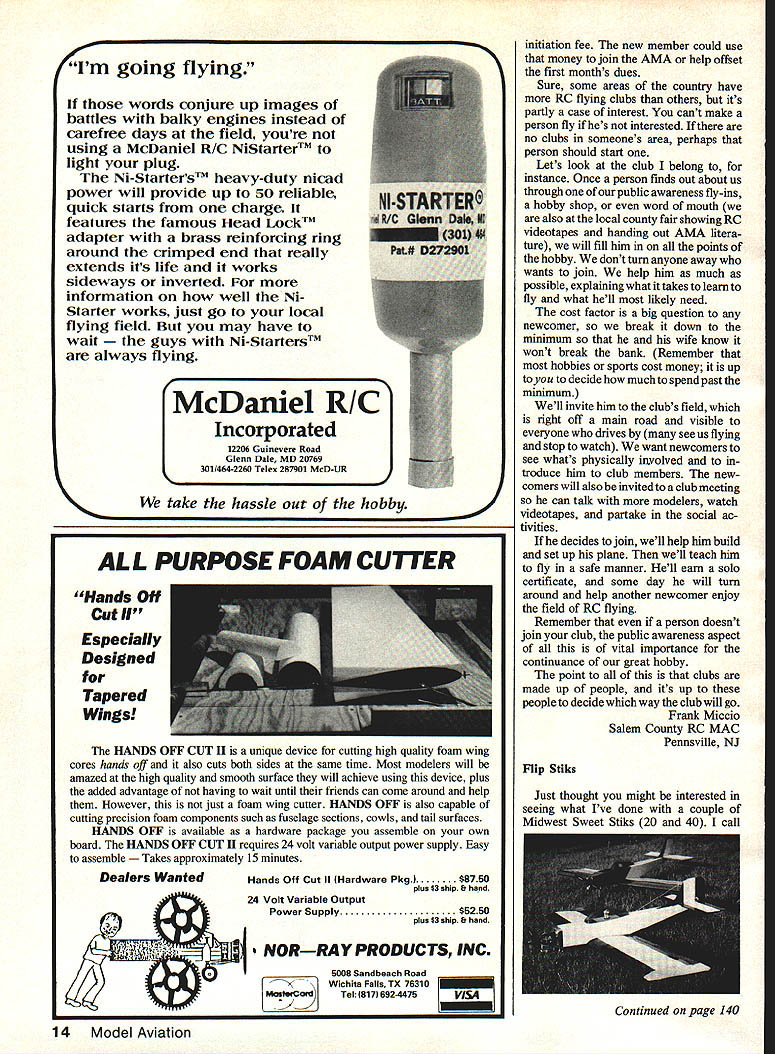
Just thought you might be interested in seeing what I've done with a couple of Midwest Sweet Stiks (20 and 40). I call them Flip Stiks, and with a couple of minor additions, they are built almost completely from the original kits. Only a few minor changes are required.
They both fly great. The 20 has an O.S. .25FSR; it is set up right and requires full attention when flying. The 40 (with a K&B) flies like a Caddy. It has a center flap and built-in bomb release. Side-mounted on the Flip Stik, the K&B puts out only 73 dB compared to 85+ on regular Stiks.
They will do about anything you want in the air and are a lot of fun. Everyone asks what they are—and then they don't believe it.
I'm finishing my second .40-size Flip Stik now. I think one of my students is going to build one for our fun-fly events.
C.W. "Red" Huntoon Howell, MI
Transcribed from original scans by AI. Minor OCR errors may remain.

