
Letters To The Editor
All letters will be carefully considered; those of general interest will be used. Send to Model Aviation, 1810 Samuel Morse Dr., Reston, VA 22090.
Condition Corrected
Arthur Di Stasi, Glen Mills, PA
My Sig Kadet Mk II had been flown several times after completion and performed beautifully. While in flight one day the airplane shuddered rather violently, went out of control, and landed in a corn field. After repairing the damage and checking the radio system, it flew successfully again. On a subsequent flight the same shuddering occurred, but with partial control remaining for a decent landing.
A radio check on the ground with the engine off proved the radio operation to be normal. With the engine running, however, the servos went berserk when the airplane was held in several different attitudes. I concluded the radio was at fault when subjected to engine vibration and thought it would have to be sent back to the factory.
All components were removed from the airplane, including the battery (which seemed to have been jammed up against the firewall). On close inspection I noticed the battery's outside protective covering had worn away, exposing the shiny metal case. The battery had been rubbing against one of the engine-mount screws projecting through the firewall. That contact was causing the erratic controls. Condition corrected and case closed.
Thanks for Waco D
G. James Alaback, San Diego, CA (photo by Randy C. Barnes, Hamilton, OH)
Thank you for the splendid drawing and accompanying article on the Waco D in the May 1987 Model Aviation. Harry Robinson and Don Berliner did masterful work. The Model D is, in my opinion, the most beautiful of all Wacos, and it is wonderful to see such detailed information now available on this modeling subject.
I was able to see the only civilian version of this airplane at Hamilton, OH, in 1984. Enclosed is a photograph (taken by Randy C. Barnes) showing it as it appears today; it closely matches the original Kessler picture used in your article.
Also, your March 1986 article and drawing of the Piper Skycycle was another outstanding presentation of a less well-known subject. Dan Williams of our San Diego Scale Staffel club has developed and is now flying a beautiful rubber-scale model based on that article and drawing.
Three-view drawings are the foundation for scale modeling and are inspirational for many semiclassic or sport models. I hope you will continue to publish these drawings and articles frequently.
Commodore Notes
S.B. Steincamp, Aurora, CO
Notes on weight and finish: silk and dope. I used an O.S. Max .20 four-stroke engine with a 9x6 Master Airscrew prop. The original Commodore had a wingspan of 71 in. The bare-bones picture shows a Max .40 FS engine, while the finished plane uses a .20 FS. It flies very well. One word of warning: keep elevator throw to a minimum.
Thanks for Heron
Everett B. (Bud) Moore, Jr., Winter Park, FL
Thanks to Bill Winter for designing and to you for publishing the plans for the Heron Electric in the March issue. I have seldom been so satisfied with the accuracy of plans, the descriptive construction notes, and—most important—the flying capabilities of the model. It flew beautifully right off the drawing board; the CG was right on the money.
I ordered the plans the day I received my copy of the magazine and had the model completed quickly. The only delay was locating the Robbe motor and prop accessory set; my local hobby shop had to special-order it. I made the extension shaft from a piece of 1/2" music wire, filed the notches, and have been flying without a prop nut because I don't have a die to thread the shaft. The setscrews have held so far, but I will thread the shaft or have it threaded for safety.
On the initial flight, with eight 1,200 mAh sub-C cells, I achieved three climbs to winch altitude or above and had enough power to ROG on the third climb (the first flight was hand-launched). I estimate the first flight at at least 20 minutes total, including the three powered climbs plus thermaling. I plan to try the bird with a seven-cell pack. I'm AMA member No. 1599 and primarily fly sailplanes and electrics; this model has given me immense satisfaction. I've already cut out about half the parts for a second ship. Designer Bill Winter is one of the real people in model aviation.
Heron: Radio Suppression Warning
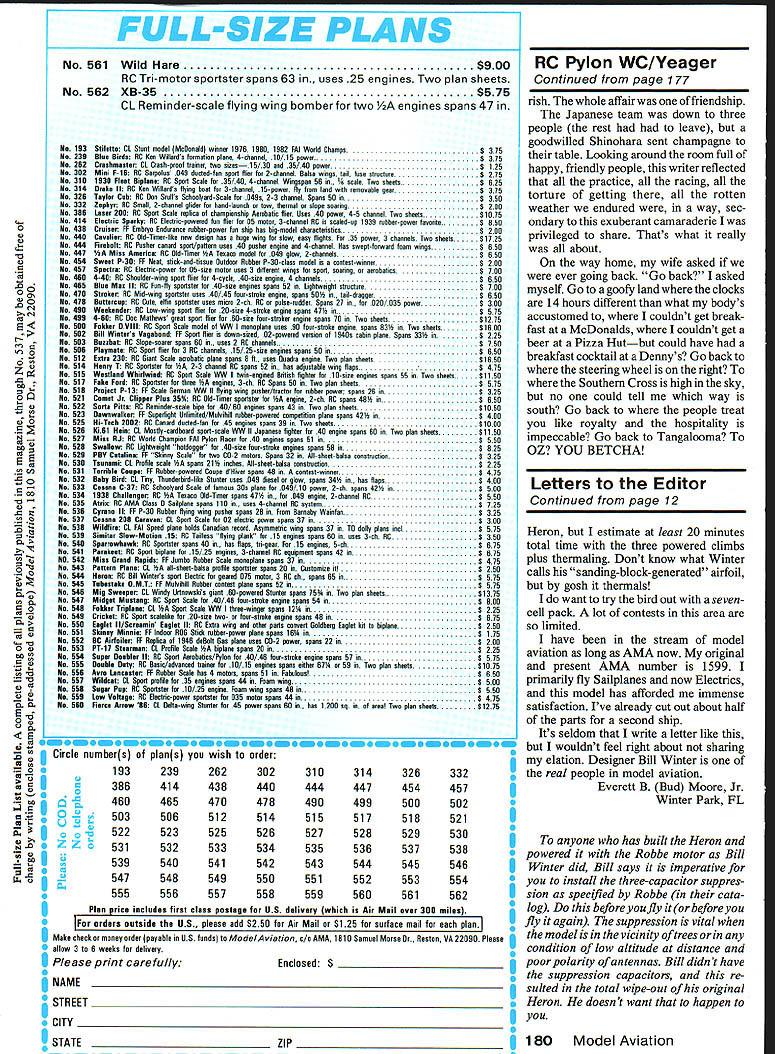
To anyone who has built the Heron and powered it with the Robbe motor as Bill Winter did: Bill says it is imperative that you install the three-capacitor suppressor specified by Robbe in their catalog. Do this before you fly (or before you fly again). The suppression is vital when the model is near trees or at low altitude, at distance, or when antenna polarity is poor. Bill didn't have the suppression capacitors and this resulted in the total loss of his original Heron. He doesn't want that to happen to you.
Transcribed from original scans by AI. Minor OCR errors may remain.

