
Letters To The Editor
All letters will be carefully considered; those of general interest will be used. Send to Model Aviation, 1810 Samuel Morse Dr., Reston, VA 22090.
Can't Cope
I wish to express my thanks to Model Aviation for the pleasant years that I have spent as an advertiser and as a reader. The latter will continue; the former has drawn to a close.
After 20 years as a mail-order and hobby shop, Hobby Hideaway is discontinuing business. We remain, as our heading indicates, in research and development. The decision to leave the field of service to our many customers and friends was thrust upon us.
The Illinois Internal Revenue Service has decreed that all mail-order businesses will now collect, pay, register, and file statements of collected sales taxes for five nearby states. Two of these states border Illinois; two are a state away. This is more than this small retail unit can cope with.
Again, thank you for the years that have brought new diesel enthusiasts and friends to us at Hobby Hideaway.
Dave Shipton Delavan, IL
Beautiful HE 45 Drawing
Just a few brief words to compliment Connie McClure on the beautiful three-view drawings of the HE 45 shown in the July issue of Model Aviation. These are in the tradition of Wylam, Nye, and Westburg.
I hope this is just the first of many.
Clark H. Hahn Stockton, CA
Three-Blade Conversion?
I would like to know if there is a formula or conversion table to change from a two-bladed prop to a three-bladed one.
I am using an 11-7 prop on an Eagle 63 powered by an O.S. .48. If I could use a three-bladed prop, I'm sure I wouldn't cut so much grass.
Robert Block RR #1 Jefferson City, MO 65101
Swamp Box Located
Recently you ran my letter requesting information on the source for the Swamp Box. It turns out it was in the December 1964 Model Airplane News. Some readers had asked me and AMA Museum Curator Hurst Bowers about where the plans might be.
This design was a cabin type for a .10 engine—my last escapement model for the Babcock Digital System (which I had incorrectly remembered as being an early Ace proportional). This odd system featured a 3,500-cycle multivibrator in the control box which sent out pulses on a time basis as the control stick was moved about—for elevator, rudder, and engine (I had no elevator on the Swamp Box).
At this writing in early May, responses from MA readers have passed 70 in number. I have received phone calls and full-size plans. Even a grizzled veteran like myself is impressed by such an outpouring and the effectiveness of MA in reaching people. It seems all the more remarkable because so many people knew about a 19-year-old nothing-special airplane. Some learned to fly with the Swamp Box. Some still fly it. A few are building new ones. In all these years before this I did not receive a single letter about it! Many people have converted it to trike gear and .15 power.
It would seem that there is much hidden interest in all of these old planes by me and by many other contributors of bygone days. Most of these oldies are not quaint antiques or Old-Timers. For example, Bonner's Smog Hog remains one of the greatest-ever models for easy flying and sport aerobatics. It compares quite favorably with any of today's cabin model kits. The follow-on Astro Hog low-winger has been modernized as a popular Sig kit—pointing up the "gold in them thar hills" for those who search.
I should like to thank the many folks who wrote and phoned for this heartwarming interest and response.
Bill Winter Fairfax, VA
Editor’s note: Bill Winter mentioned to us in a more recent phone conversation another point of interest about the Swamp Box. The magazine plan was drawn by the late Lee Renaud, founder of Airtronics.
Goofy Parakeet
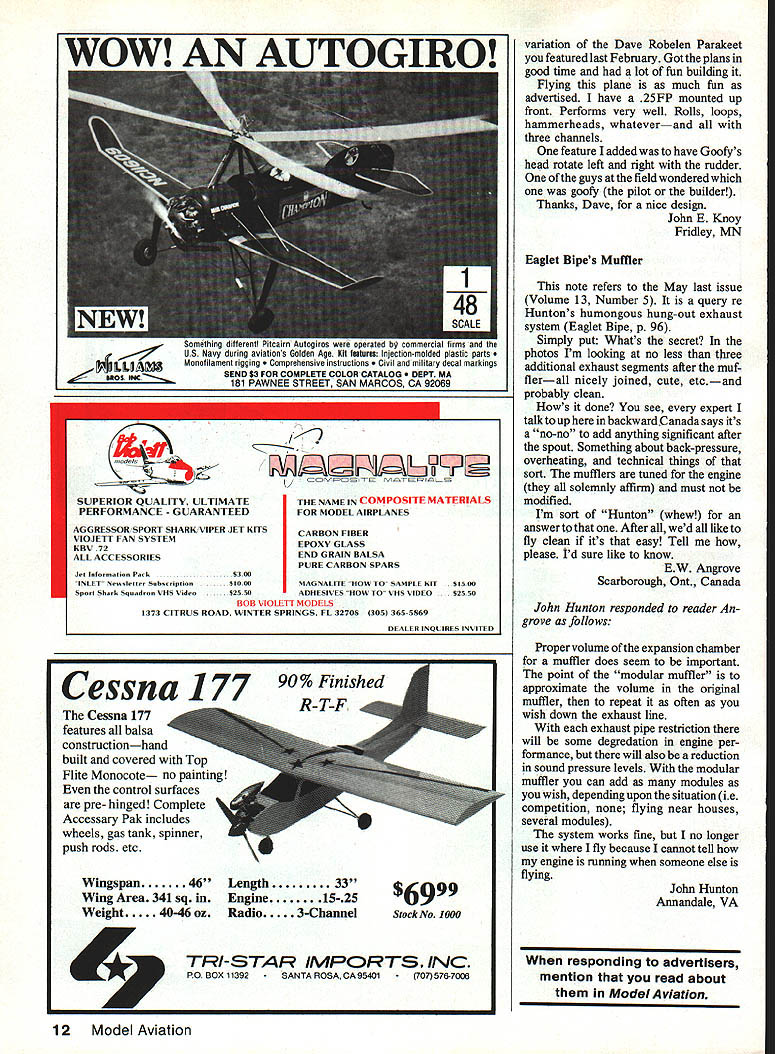
Just had to send you a photo of my variation of the Dave Robelen Parakeet you featured last February. Got the plans in good time and had a lot of fun building it.
Flying this plane is as much fun as advertised. I have a .25 FP mounted up front. It performs very well—rolls, loops, hammerheads, whatever—and all with three channels.
One feature I added was to have Goofy's head rotate left and right with the rudder. One of the guys at the field wondered which one was goofy (the pilot or the builder!).
Thanks, Dave, for a nice design.
John E. Knoy Fridley, MN
Eaglet Bipe's Muffler
This note refers to the May issue (Volume 13, Number 5). It is a query regarding Hunton's humongous hung-out exhaust system (Eaglet Bipe, p. 96).
Simply put: what's the secret? In the photos I'm looking at there are no less than three additional exhaust segments after the muffler—all nicely joined and probably clean.
How's it done? You see, every expert I talk to up here in backward Canada says it's a "no-no" to add anything significant after the spout. Something about back pressure, overheating, and technical things of that sort. The mufflers are tuned for the engine (they all solemnly affirm) and must not be modified.
I'm sort of "Hunton" (whew!) for an answer to that one. After all, we'd all like to fly clean if it's that easy! Tell me how, please. I'd sure like to know.
E. W. Angrove Scarborough, Ont., Canada
John Hunton responded:
Proper volume of the expansion chamber for a muffler does seem to be important. The point of the "modular muffler" is to approximate the volume in the original muffler, then to repeat it as often as you wish down the exhaust line.
With each exhaust pipe restriction there will be some degradation in engine performance, but there will also be a reduction in sound pressure levels. With the modular muffler you can add as many modules as you wish, depending upon the situation (i.e., competition—none; flying near houses—several modules).
The system works fine, but I no longer use it where I fly because I cannot tell how my engine is running when someone else is flying.
John Hunton Annandale, VA
Transcribed from original scans by AI. Minor OCR errors may remain.

