

Letters to the Editor
All letters will be carefully considered, those of general interest used. Send to Model Aviation, 815 15th St., N.W., Washington, D.C. 20005.
Mrs. Watson to Tower
Having been the wife of an avid modeler for 35 years, I am naturally utterly uninterested in anything to do with airplanes, even the larger ones. Strangely, though, the other day I picked up the latest issue of Model Aviation and found an article that really interested me. It was Ron Van Putte's article on aerodynamics in which he answered a letter from a reader, and reversed himself on a previous article in which he attempted to make "something simple" out of something very complicated.
Mr. Van Putte's arguments and explanations are very scholarly and quite convincing to the uninitiated. I would venture to say that the average lay person never knew there was so much yaw in the world.
I must point out to Mr. Van Putte, however, that he failed to cover all of the field's fascinating possibilities. Permit me to mention just a few, and to add my comments to this enlightening discussion.
Mr. Van Putte's references to adverse yaw, the moment of yaw, and later on, to proverse yaw, omitted another very important factor. There is the problem of inverse yaw, created of course by the gliding motion of the plane's undercarriage in the upper slipstream when the plane is being flown inverted. The factors of inverse yaw can be directly related to the speed of the engine, the wind knots aloft, the number of coats of dope (or other covering) on the fuselage, and other elements of a more minor nature.
Conversely, or sequentially, you cannot create inverse yaw without producing its counterpart, or outverse yaw. It doesn't take any imagination at all to figure that this interesting effect is a natural result of outside (outbound) loops, flown as a part of the more sophisticated pattern flying. A careful calculation should be made, by the pilot as he considers the span of circle, the distance to the nearest ground zero, the likelihood of severe vertigo as he tracks the plane with appropriate neck motions, and the number of loops he plans to attempt.
Stated algebraically, the equation would be something like this: OY = SC - D + V x L. The more loops attempted, of course, the greater outverse yaw, and of course the proper number should be inserted into the parenthesis in the equation.
Spins, Immelmanns, stall turns, top hats and the like require their own factoring, both for inverse and outverse yaw conditions.
I would not impose upon the editor's good nature any longer, although I would like to address one more remark to what might or might not have been a typographical error. When Mr. Van Putte mentioned a "pint" I was reminded of the old folk song about the drunken sailor, one of whose lines goes like this: Hey-Ho, and Up She Rises! And that, dear friends, is all I know about aerodynamics.
(Mrs.) Frank E. Watson Albany, GA
Tower to Mrs. Watson
Never thought that "yaw" could be so interesting a subject. With due respect for your having read Van Putte's column so diligently, we can't help wondering about whatever it was that held you spellbound. Your letter led to our quickly polishing off that "pint" you found in the fine type. Of course, you did not write the letter to impress the editor with your aerodynamic erudition—which is, to say the least, impressive. So we propose to use the missive in Letters to the Editor so that our many already puzzled readers may glimpse the light at the end of the tunnel.
Mrs. Watson to Tower
Occasionally something in the world of modeling hits me as worthy of my astute comments. Such was Van Putte's column. Yaw can be (as can most other things given the right treatment) amazingly interesting. I am most happy that you want to use my expositional material in your Letters to the Editor. When Model Aviation next hits the stands, very many more pints may be consumed, all in good fun, of course.
Wants Old Glider Plans
About the middle 40's I had plans for a gull wing glider. I never built it, but would like to know if plans to something that old are still available. I believe it had about a 100-in. wing—nice lines. Can you help.
John Heere Redwood City, CA
The model you describe might have been an old Cleveland Models kit. They had one called the Condor (we think) which might have had a gull wing. Try Cleveland Model & Supply Co., 1037AA Detroit, Cleve- land, OH 44102. Frank Zaic, Box 135, Northridge, CA 91324, sells a book on old gliders which is full of 3-views, some like the one you describe. Another glider, but with a 15-ft. span, was published in Air Trails during the war. John Pond, Old Time Plan Service, Box 3113, San Jose, CA 95156, may have it, or others.
Museum Disaster
The nation lost a tremendous national asset when the San Diego Aerospace Museum was consumed by fire. To those who love aviation, it was like losing a close personal friend.
I work at the San Diego Zoo, which shares the beauty of Balboa Park with the Museum. I have spent almost all of my lunch hours for the last two years in the remarkable Museum library, ably run by archivist Bruce Reynolds. I have wandered the exhibits, admiring and mentally cataloging details of the Sopwith Triplane, the Fokker E-III, the JN-4. I have photographed details of the only accurate flying replica of the Spirit of St. Louis. I have taken advantage of 1919 Jane's and most of the full set of volumes printed before
Letters to the Editor
Remove the landing gear and remove the canopy and streamline the cockpit area, reduce the size of the left cheek cowl to the minimum for air intake or remove it completely if possible. Then I'd reduce the flying surface area including the tail to the limits of controllability. I would use a light weight radio and battery pack and remove the engine control servo and anything else non essential to reduce the weight as the 5 lb. minimum weight would not apply. I'd set up the engine to run on 70% nitro methane and use a relatively large high pitched propeller. If doing all that wouldn't add more than 25 mph to that 187.55 mph, then I'd hold the wing on with rubber bands.
By George, maybe I'll do it. I think. When I get the time. Someday. Gene W. Sidwell Hollywood, CA
DeBolt did not write about high-speed flight of RC models. We assume that Gene is thinking of an account of the Houston Speed Trials, which Maynard Hill reported in April '77 MA. DeBolt did write on Form 1 props in the May issue that year. We do not know what the timing set up was during the flights Gene describes. Timing of world record speed attempts is a highly complex matter; witness Dick Weber's account of the Austrian glider 274.2 mph speed record flight (page 73 December 1977) and Hubert Bittner Jr.'s "Setting an RC Helicopter Speed Record," February 1978 MA. The errors that can accumulate with stopwatch timing at both ends of the traps can be tens of miles per hour with even a split second inaccuracy—hence FAI's tough requirements in order for a record to be accepted. But it is evident that Sidwell knows how to make a Form 1 or really fast in a straight line. Perhaps he can enthuse fellow Californians in setting up a Houston-type Speed Trials.
No Sooner Said Than Done
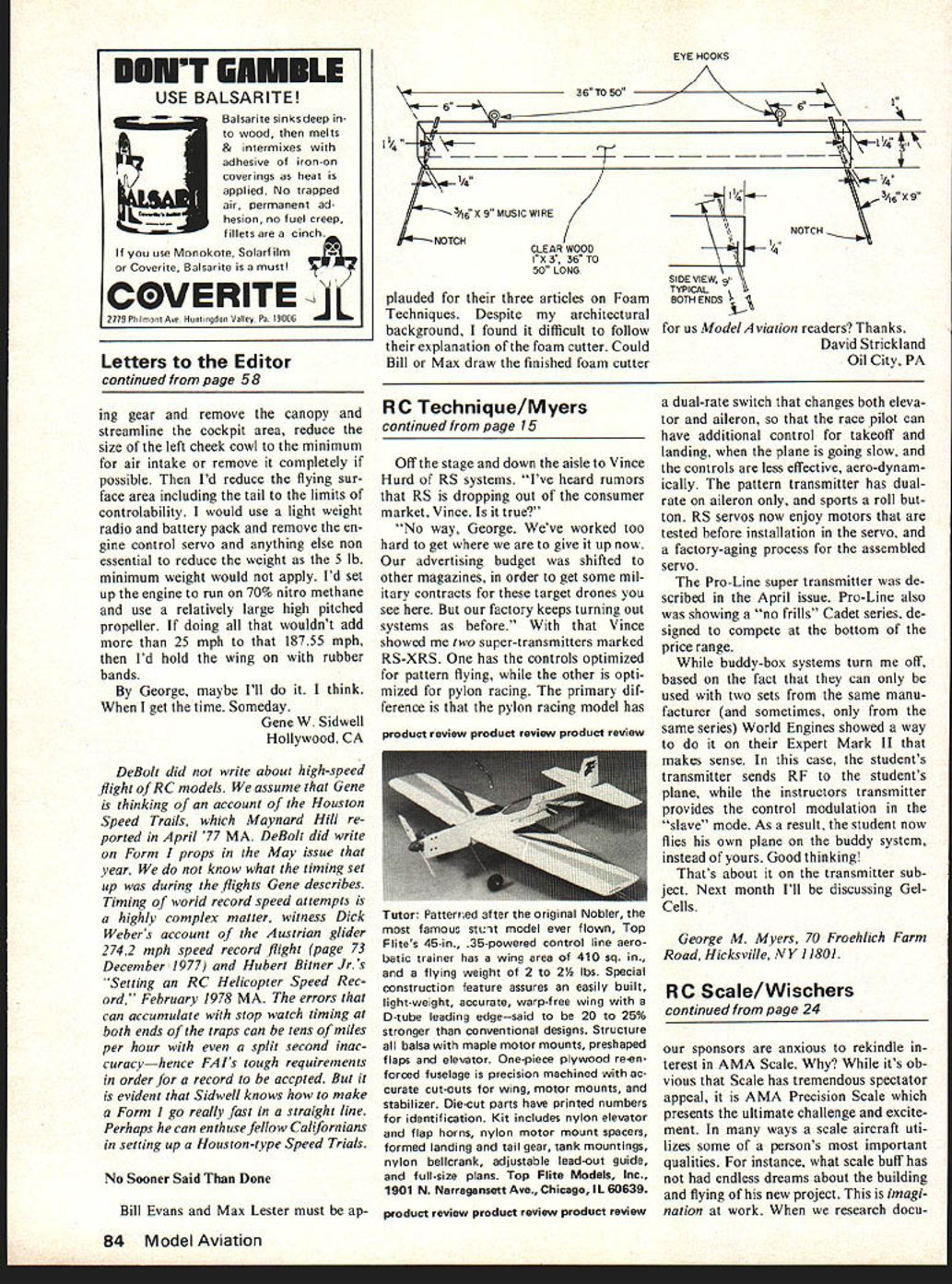
Bill Evans and Max Lester must be applauded for their three articles on Foam Techniques. Despite my architectural background, I found it difficult to follow their explanation of the foam cutter. Could Bill or Max draw the finished foam cutter for us Model Aviation readers? Thanks.
David Strickland Oil City, PA
Transcribed from original scans by AI. Minor OCR errors may remain.

