

Letters To The Editor
All letters will be carefully considered; those of general interest will be used. Send to Model Aviation, 1810 Samuel Morse Dr., Reston, VA 22090.
Is There Anything Really New?
After reading Bill Evans' article in the Oct. 1987 issue about the development of his Simitar design, I was surprised to note that he gave no credit to those who perfected the swept‑forward flying wing design for model airplanes some 45 years ago.
The Berryloid winner at the 1946 Nationals was a Control Line model by Tex Russell that was very similar in design to the Simitar. Tex, a rather famous modeler of the period, had been working on the design for several years prior to his Nats win. The airplane was called the Vampire and was published in the May 1947 issue of Air Trails magazine. It was a very popular airplane, and many were built and flown. Memory fails, but I believe it may have been kitted at one time.
A Free Flight version of the same configuration, called the Williwaw, designed by Bruce Wennerstrom, was published in the April 1948 issue of Model Airplane News. Bruce, also a famous modeler and designer, spent a number of years experimenting with the design while on Attu during WWII. The Free Flight version was very stable and easy to fly as either a tractor or a pusher. One even competed in the 1950 Nationals.
These two model designs, as well as others published in the early ’50s, were based on the semi‑success of a gentleman named Cornelius who had a full‑scale light airplane of this same arrangement in the 1930s. Cornelius also designed a well‑publicized glider/tanker, again the same layout, to be towed behind transport planes and bombers as a method of extending their range. It made a lot of magazine covers, but it just wasn't successful.
Even before Mr. Cornelius, the French were flying the same big fin‑rudder, swept‑forward flying wing design back in 1922. Could you call the biplane version an X‑wing?
Bill Evans is to be congratulated for promoting the design. Yet if he's been in modeling for 50 years, he must know it's not a new idea.
L. F. Randolph Dallas, TX
Editor's reply
We acknowledge the earlier work you cite—examples of the swept‑forward flying wing and similar layouts do exist in both models and full‑size designs. Re the X‑wing inspiration, our memory is that Bill was influenced by the movie Star Wars. He did not, however, mention many of the earlier airplanes or designers as stepping stones. Should he? We wouldn't pretend to say. When you get right down to it, every new airplane owes its debt to others—each one, in effect, is only a refinement of an earlier design. Whatever the case, no one can take away the fact that Bill Evans has done so much to make the flying wing concept practical and popular in R/C modeling—through his Simitar series and variants.
Soloed at Eight!
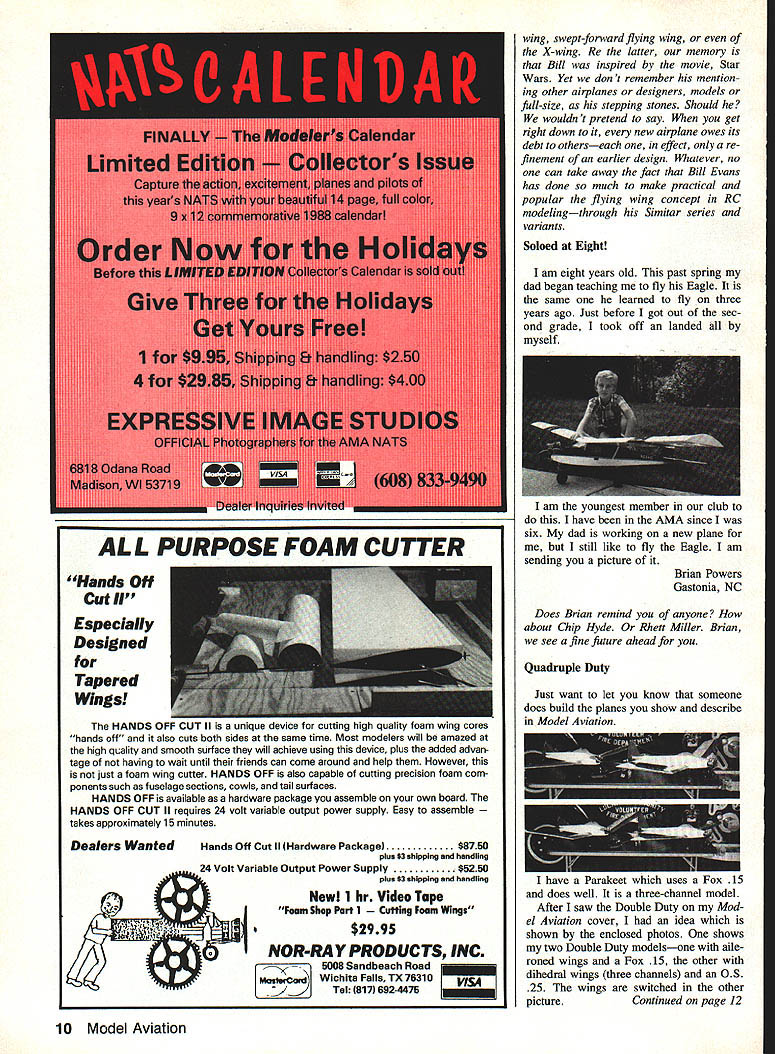
I am eight years old. This past spring my dad began teaching me to fly his Eagle. It is the same one he learned to fly on three years ago. Just before I got out of the second grade, I took off and landed all by myself.
I am the youngest member in our club to do this. I have been in the AMA since I was six. My dad is working on a new plane for me, but I still like to fly the Eagle. I am sending you a picture of it.
Brian Powers Gastonia, NC
Editor: Does Brian remind you of anyone? How about Chip Hyde or Rhett Miller. Brian, we see a fine future ahead for you.
Quadruple Duty
Just want to let you know that someone does build the planes you show and describe in Model Aviation.
I have a Parakeet which uses a Fox .15 and does well. It is a three‑channel model.
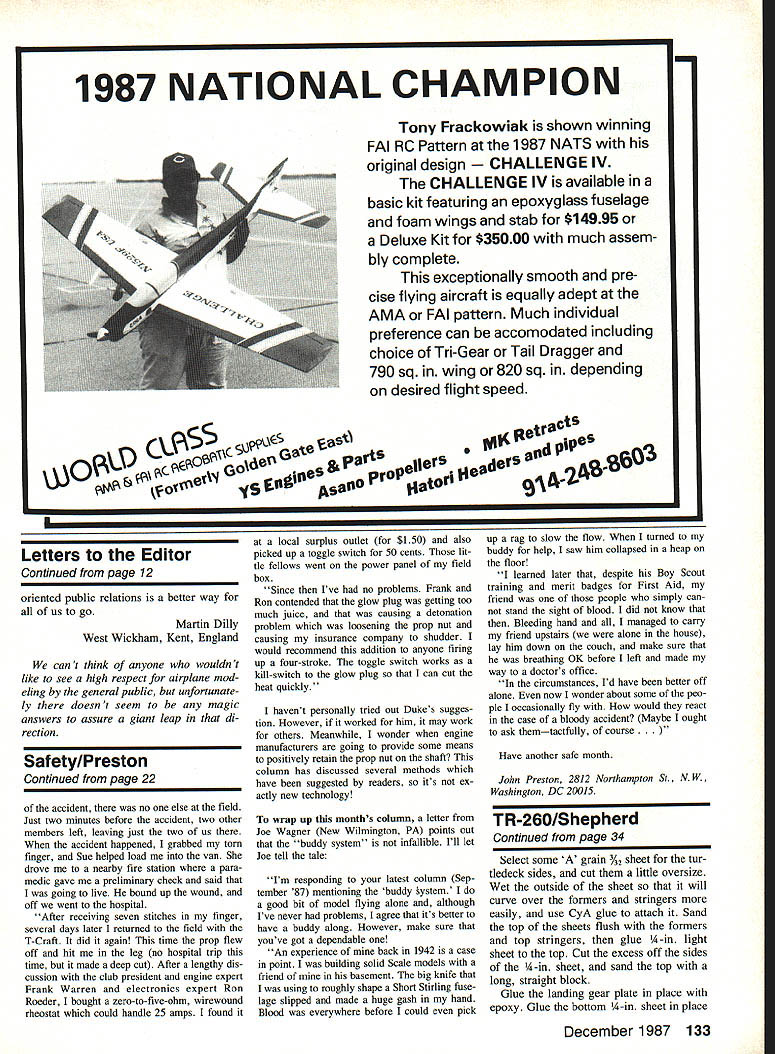
After I saw the Double Duty on my Model Aviation cover, I had an idea which is shown by the enclosed photos. One shows my two Double Duty models—one with altered wings and a Fox .15, the other with dihedral wings (three channels) and an O.S. .25. The wings are switched in the other picture.
Keep up the good work. Love that mag.
Phil Honeycutt Lucama, NC
On Noise—From England
May I comment on something in the September M/A? On the topic of noise, and typified by Jim Waterman's Guest Editorial, some AMA people seem in danger of losing sight of what I think we are really trying to achieve.
Surely the aim is to reduce public opposition to model flying, and not simply to clamp good mufflers on all our engines. Let us not confuse the two. In Britain I know several large flying sites where Free Flight powered aircraft have been flown since before the war. They had totally unmuffled engines that cut out after 10 seconds or so. Fitting mufflers, which we tried over here in the 1960s, only had the effect of making it almost impossible to tell when the engine had cut—bad news for the timekeepers.
However, we rarely had any noise complaints, because the sound lasted for a short time and was diminishing fast as the models climbed vertically. When the complaints did start, it was when R/C fliers, with well‑muffled engines running for 10 minutes at a time, began to share the sites. Result: lots of sites were lost—not only for R/C fliers (who only need about 50 acres or so) but for the Free Fliers, too (who must have 300 acres or more to fly over).
What is surely needed is much better public relations aimed at telling the public what the aims of our sport are. Much of the opposition to model flying comes from ignorance and a feeling that we are "playing with noisy toys" with no particular skill. Competition flyers provide the vital "end product" on which the public can focus and which improves their image of all of us. A steady supply of positive media stories on the local heroes of our sport—those who have won contests, or who may be practising to represent the country in World Championships—helps to counter the complainers. Waiting till a site is threatened is far too late—and I personally doubt whether many of the R/C flying items at local shows, fairs, and so on do much except boost the egos of the participants.
In Free Flight the one proven way of limiting complaints is built into the contest rules: keep the engine running time down. Control Line, too, is lucky in that, although the engine runs for longish periods, the altitude is low; thus the "annoyance cone" has a small base diameter.
What is important is horses for courses; we have tried a blanket muffler rule, and it does not work. Fitting all R/C models with a cutout to stop the engine after 10 seconds almost certainly would stop the public complaints, but might be unpopular with some fliers. (Editor: How's that for understatement?) I think that positive, excellence‑oriented public relations is a better way for all of us to go.
Martin Dilly West Wickham, Kent, England
Editor: We can't think of anyone who wouldn't like to see higher public respect for airplane modeling, but unfortunately there doesn't seem to be any magic answer to assure a giant leap in that direction.
Transcribed from original scans by AI. Minor OCR errors may remain.

