
Letters To The Editor
All letters will be carefully considered; those of general interest will be used. Send to Model Aviation, 1810 Samuel Morse Dr., Reston, VA 22090.
Intrepid, Not Enterprise!
I enjoyed Norm Rosenstock's article on Joe Raspante. All in all it was a beautiful job—with two exceptions, one minor and one major.
The minor point is simple. It's the Intrepid, not the Enterprise, that is anchored in New York. Unfortunately the Enterprise was scrapped some years ago, a sad loss to our country's naval history.
The major point concerns Raspante's Snow White and Al Holmes. Although you did run an excerpt from Al's article, you failed to give him the credit he deserves in bringing Snow White back to life.
Without Al's efforts in reconstructing the plans for this beautiful model, painstakingly from the skeleton of the original, the Snow White would only have remained a memory to those who knew of it and a beautiful myth to those of us not fortunate to have seen it with our own eyes. Thanks to Al, Snow White lives and flies again.
Leo F. McCarthy Suffern, NY
Trusty Eaglet
My name is Brian Weiss. I am 10 years old, and I'm the youngest Senior Pilot in the Levittown Aerobugs RC Flying Club. It all started when I was about five years old.
You see, my father used to build model airplanes when he was a teenager. He has always been interested in flying. About six years ago we built our first airplane, an RC glider. My father and older brother learned how to fly it. About a year later I started to fly the glider. Then one day we went to the Aerobugs Club and watched the flying. We talked to a whole lot of people. Finally we joined the club. We learned a lot about safety, building and flying tips, and checking batteries. Then we made a Senior Falcon and started to fly it. At this time I was six years old and still flying gliders.
A couple of months later we bought a pre-built power plane. It wasn't what you would call a nice airplane. We referred to it as The Crap Stick. I started flying it and got pretty good. I flew that for a while and learned a lot while doing so. It still was in one piece after about a year. My father then decided that I could have my own airplane. We got an Eaglet 50. After flying it for a year I started to do some stunts. Then I flew my first solo flight. I was about 8½ years old at that time.
On August 8, 1986 I got signed off for solo flight. I had to take off and land three times. In our club you become a Senior Pilot a year after you are signed off if you are still flying well. I became the youngest Senior Pilot in our club last August. Now I help out at the meetings and fun-fly events. I fly with the other guys and have a great time. More kids and their dads should share this great hobby.
I am sending you a picture of me and my trusty Eaglet. I would like to hear about more kids who fly RC airplanes.
Brian Weiss Bensalem, PA
Ouch!—Scorpion Tail Setting
Thanks for the nice layout on Manny Hamilton's Scorpion .60 as presented in the January 1988 issue of MA. There are, however, a couple of areas that have crept into the drawings that need to be corrected to ensure that anyone who builds a Scorpion ends up with a good flier.
The first problem that must be fixed is that the stabilizer appears to have negative incidence on the side view of the fuselage. As indicated in the text, all surfaces must be at 0° to the thrust line. There's every chance that a sport flier could wind the Loops-a-Lot event with the angle of incidence shown, but he'd be hard pressed to maintain level flight. The problem can be corrected by simply drawing the centerline on the fuselage side and then making sure the stabilizer mounting area is parallel to it.
The second problem, probably minor, is that the nice perspective cutaway drawing on page 27 shows the 3/8-in. sheet balsa top as being cross-grained. Obviously most people don't build directly from the cutaway, but there may be some who use it for reference, and I wouldn't want them to be misled. The grain on the top block should run the length of the fuselage as shown on the plan—to assure longitudinal strength of the formerless structure.
I hope that many of the sport fliers out there will build a Scorpion. It has been a most successful design for many intermediate fliers wanting some fun-fly action.
Larry Kruse Liberal, KS
Nolin's Serendipity
I've been reading the January 1988 issue of Model Aviation and am greatly impressed with Gerry Nolin's Easy B article. It is really super!
He clearly explains construction and flight-trim procedures. The photos illustrate many steps. Then the highly detailed plan shows not only the model but also the jigs and flight behaviors. The plan is a bit small, but with strong reading glasses I was able to see it all.
The cover photo and articles on the World Free Flight Champs were well done and interesting, also.
Clarence Mather Bishop, CA
From someone whose personal model building/flying talents are as great as Clarence Mather's, this is indeed high praise.
A Nats Thanks
Oh what fun it is to win! That just about sums it up for me regarding the 1987 National Model Airplane Championships held in Lincoln, NE. After persevering for eight years, 1987 proved to be the charmer.
Last year PAMPA (Precision Aerobatics Model Pilots Association) was instrumental in installing a new Advanced class in the Nats. This class was run right along with the rest of the CL Precision Aerobatics event for Open fliers—with the judges not knowing whether the flier was in the Master or Advanced class. In this way the judges weren't distracted. Only on the final day of qualifying did the pilots know who was in the Advanced class and who was in the Master class. The Masters went on to fly for the Walker Cup, and the top eight Advanced fliers battled it out for the top position in the group.
I was lucky enough to win the Advanced class for the first time. What a great thrill it was. I personally like this format at the Nats and look forward to seeing it used in the future.
My thanks to Jack Sheeks and Roland McDonald for sponsoring the awards and seeing that this new class was set in motion. Thanks also to George Higgins for running an outstanding event—and to all the unsung heroes: judges, tabulators, pit bosses, and all the other people who work so hard behind the scenes. Their collective work really makes it easy for the competitors.
Richard L. Houser Arlington, VA
Similarities?
While attending optometry school in Oregon, I was privileged to attend a lecture on alcoholism. During the lecture, it occurred to me that many of the signs and symptoms of being an alcoholic were remarkably similar to those encountered by some individuals trapped by the more serious side of RC flying. Since my flying partner sits next to me in class (what could be more natural?), we were able to work up an informative presentation that hopefully will steer away from disaster those who are predisposed to becoming an "R/Caholic" (short for "Radio Control-ic"). In short, examine the following signs and symptoms:
- Daily use
- Binges
- Compulsive behavior
- Loss of control, black-outs
- Inability to cut down or reduce
- Continued use in spite of adverse consequences
If you answered positively to four or more of the above and wish treatment, the possibilities may include biofeedback, aversion techniques (such as transmission jamming to create a sick feeling in the gut), abstinence (hopefully, it won't make the heart grow fonder), and support groups such as the RCA (Radio Controlics Anonymous). It takes one to two years to recover and five to eight years to build up a real immunity; even then the ex-pilot and his family start to feel the benefits of non-use.
With self-control and a knowledge of our limitations, I believe we can all enjoy our fantastic hobby until a ripe old age!
Bruce Breckenridge Dave Lotz Hillsboro, OR
RC Gyro-Glider
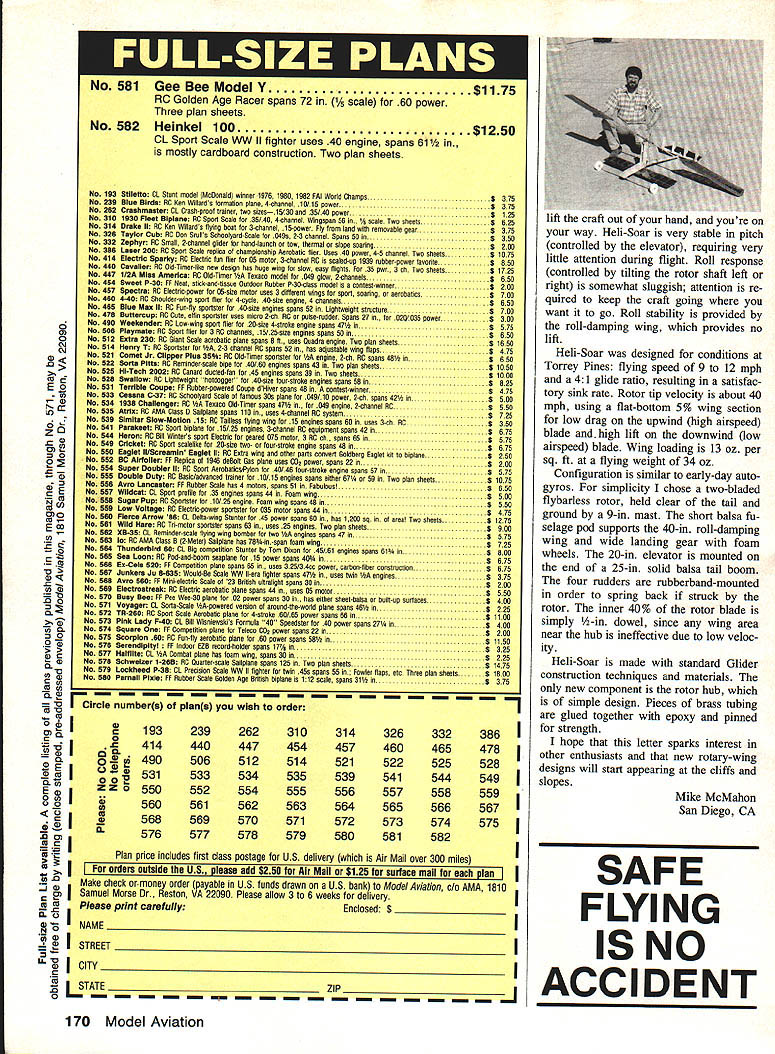
On November 7, 1987 I successfully flew my RC gyro-glider "Heli-Soar" at Torrey Pines cliffs in San Diego. To my knowledge this is the first soaring (altitude-gaining) flight demonstration by an RC rotary-wing glider. My hope is that this will open the world of rotary flight to the RC slope soarer.
The eight-foot-span rotor gyro-glider lifted easily into the 10-mph on-shore breeze. The flight lasted one and a half minutes, with a 50-ft. altitude gain and a smooth landing. This was a thrilling reward for two years of design, testing, building, and early spectacular crashes. My knees are still shaking!
Launching this unique machine is easy: you flip the rotor by hand and let the wind bring it up to speed. Then you let the wind lift the craft out of your hand, and you're on your way. Heli-Soar is very stable in pitch (controlled by the elevator), requiring very little attention during flight. Roll response (controlled by tilting the rotor shaft left or right) is somewhat sluggish; attention is required to keep the craft going where you want it to go. Roll stability is provided by the roll-damping wing, which provides no lift.
Heli-Soar was designed for conditions at Torrey Pines: flying speed of 9 to 12 mph and a 4:1 glide ratio, resulting in a satisfactory sink rate. Rotor tip velocity is about 40 mph, using a flat-bottom 0.5% wing section for low drag on the upwind (high airspeed) blade and high lift on the downwind (low airspeed) blade. Wing loading is 13 oz. per sq. ft. at a flying weight of 34 oz.
Configuration is similar to early-day autogyros. For simplicity I chose a two-bladed flybarless rotor, held clear of the tail and surrounded by a 9-in. mast. The short balsa fuselage pod supports the 40-in. roll-damping wing and wide landing gear with foam wheels. The 20-in. elevator is mounted on the end of a 25-in. solid balsa tail boom.
The four rudders are rubberband-mounted in order to spring back if struck by the rotor. The inner 40% of the rotor blade is simply 1/2 in. down, since any wing area near the hub is ineffective due to low velocity.
Heli-Soar is made with standard glider construction techniques and materials. The only new component is the rotor hub, which is of simple design. Pieces of brass tubing are glued together with epoxy and pinned for strength.
I hope that this letter sparks interest in other enthusiasts and that new rotary-wing designs will start appearing at the cliffs and slopes.
Mike McMahon San Diego, CA
Transcribed from original scans by AI. Minor OCR errors may remain.

