
Letters To The Editor
All letters will be carefully considered; those of general interest will be used. Send to Model Aviation, 1810 Samuel Morse Dr., Reston, VA 22090.
Simitars: Answer to the Call
Thanks for printing Gordon Stahl's "Call to Simitars" letter in the January 1988 issue. It was good to find out that someone has taken the initiative to organize a club (the Milwaukee Simitar Squadron) for those of us who are Simitar fans. I have contacted Gordon and now have a new Midwest friend to exchange photos and ideas pertaining to the 21st-century Simitar aircraft. We are even talking about putting out a Simitar Quarterly newsletter to spread the "good news" about the total-performance advantage of the Simitar design.
I built and flew my first Simitar about three years ago (Evans/Winter Slow Motion tail-dragger) and have since built about a dozen more Simitars for myself—and helped at least a half dozen others with theirs. I think the guys at our flying field finally are getting used to seeing aircraft without a horizontal stabilizer. Still, they often don't notice it's missing until the craft is airborne!
Occasionally I still encounter the fellow who's been in the sport for umpteen years and who can't help but offer his "word of knowledge" about the efficiency of tailless aircraft. Of course, he's never built and flown one, but nevertheless knows all about them. Funny.
Truly, building and flying a Simitar is believing! I would appreciate your printing my address so that I may establish contact with other Simitar pilots around the country.
Michael Tyler 5226 W. Acapulco Ln. Glendale, AZ 85306
One Thing Leads to Another
I found an object lesson in the January 1988 Model Aviation that should concern anyone who only reads the items of immediate interest.
The feature on the glow-plug heater wasn't something I expected to use in the near future, but I read it anyway. In the process I saw that this kind of installation would work well for ignition cutoff on a spark setup—using a normal on/off microswitch so the servo switches it off when low throttle trim is operated. This kind of use is not critical as the glow heater, because the servo only has to switch the current off, leaving it in that position until the ignition is switched off manually with an external switch.
It is generally known that a two-cycle engine run on spark ignition with gasoline can be run at almost half the fuel consumption of glow-plug operation. The gas fuel costs about half as much as straight glow fuel, so fuel cost of running a similar glow engine...
Eric Clutton Tullahoma, TN
Gotcha!
I read with much interest your December 1987 Letters to the Editor, especially the one entitled "Is There Anything Really New?" This letter, written by noted designer L. F. Randolph, expresses his surprise at another designer's failure to credit his sources for previous efforts on a particular design.
I believe every model designer should list his sources if known, just as do authors in other fields, scientists, etc. Let's face it: Most of us modify rudder shapes, move the wing location down or up, and call it a new design. Maybe it is time to be professional enough to begin giving due credit, especially those of us who relish having our designs published.
Mr. Randolph's early offering, the Passkey, and a recent one, Frisskey (January 1988 Flying Models), were both preceded by Dean Swift's King Foo (January 1975 Model Airplane News). The wing section, the heart of the design, is practically identical. Coincidence? Maybe. If not, consideration of his sources would have been a classy touch.
Darrell Bobzin W. Des Moines, IA
You're Welcome!
Our October 27 tribute to Buddy Rogers, star of the 1927 Academy Award–winning film Wings, was a great success. This was due, in large part, to the beautiful models which Col. Hurst Bowers and the Academy graciously loaned to us for our exhibit.
We had many favorable comments and inquiries about the Academy, including those of Mr. Rogers, who asked that I extend his personal thanks. I add to these my own feelings of gratitude to Col. Bowers and Mr. Geoffrey Styles, who helped with the loan arrangements. I also want to express admiration for the important effort to preserve these models that is being undertaken by your organization.
Robert Saudek The Library of Congress Washington, DC
Dead End?
Thanks for the coverage of our Hangar #13's 52d Reunion last September. As the rebuilder of the 1934 8-ft. "gas job" now on display in the AMA Museum in Reston, I'm very concerned about what I perceive as a coming dead end for model aviation.
Recently our original club advisor, Connie Hansen, sent me a packet of old model plans, memorabilia, and, most importantly, the original lectures delivered by and to our club members. The topics ranged from model-building techniques to aerodynamics and flying practice. This was circa 1930–1937.
I read and re-read those old Hangar #13 lectures: how to lay up and fit a fuselage, how to glue joints, how to apply tissue, how to carve a prop, etc. Combined with those were other lectures on piloting affairs, moment arms, CG location, CP travel, stability, plotting areas, and so on. Remember, these were pitched at kids from 11 to maybe 14 or 15 years old. We learned, we built models, and we flew.
I've been told: "That won't work today." More recently it was my privilege to talk about model planes to a young Scout troop, none over age 11. Before this session I drew up my own plans for a simple, 15‑in.–span, single-stick ROG and built it. As I started talking about the forces on it I examined the school gym; I flew a few other rubber-powered models into wall crashes, and the kids ate it up. They asked and answered some great questions, and we all had fun.
In contrast, a fellow builder who was there exhibited some handsome display models. He stated that the kits might cost $200 or more. I then countered that mine could be built for 25¢.
My point is that Model Aviation endlessly shows me grizzled members (I'm one) with expensive models, high-tech beyond belief, all bemoaning the lack of flying space. Kids don't need that. An empty playground, ball park, or cow pasture is fine. If the kid's first model, finger-wound, flies 75 ft., he's achieved. If his next model flies one minute, he's thrilled. If some of them learn to plot a Clark-Y or RAF-32 airfoil and design their own, it's a thousand times better than unwrapping a kit. Isn't it time that the (old) boys started reviving real model building—or don't we know how to plot an airfoil or CP travel either?
E. F. Lindsley Delafield, WI
Finder of Lost Models
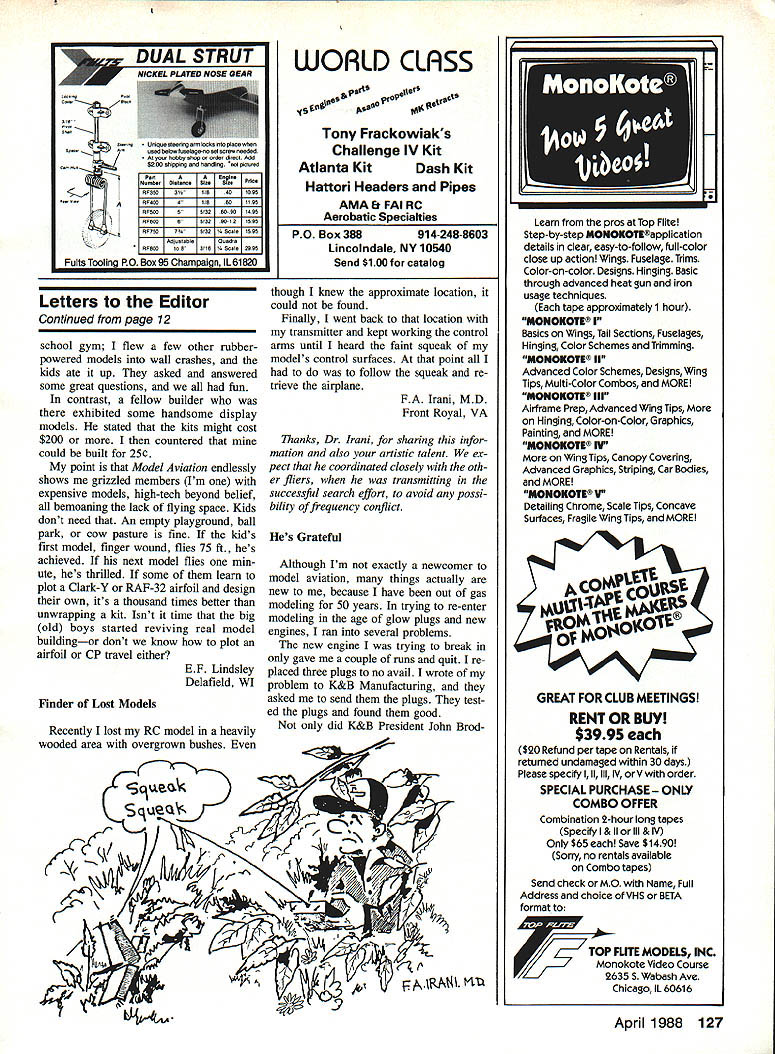
Recently I lost my RC model in a heavily wooded area with overgrown bushes. Even though I knew the approximate location, it could not be found.
Finally, I went back to that location with my transmitter and kept working the control arms until I heard the faint squeak of my model's control surfaces. At that point all I had to do was follow the squeak and retrieve the airplane.
F. A. Irani, M.D. Front Royal, VA
Editor: Thanks, Dr. Irani, for sharing this information and also your artistic talent. We expect that he coordinated closely with the other fliers when he was transmitting in the successful search effort, to avoid any possibility of frequency conflict.
He's Grateful
Although I'm not exactly a newcomer to model aviation, many things actually are new to me, because I have been out of gas modeling for 50 years. In trying to re-enter modeling in the age of glow plugs and new engines, I ran into several problems.
The new engine I was trying to break in only gave me a couple of runs and quit. I replaced three plugs to no avail. I wrote of my problem to K&B Manufacturing, and they asked me to send them the plugs. They tested the plugs and found them good.
Beck suggested that the two D-cells I had would give a few spurts of amperage, then pop out; he also phoned to explain my problem—and backed that up by sending an Eveready 1.5-volt battery which I couldn't obtain elsewhere.
Why is that battery so hard to find? You can bet I sent a letter to Union Carbide Corp. to ask why no No. 1–1/2-volt batteries were in the hobby shops—and no advertising in the modeling magazines. It's one item we surely need.
My second problem was with a Cox Black Widow .049 in which "Murphy" claimed one screw (it just vanished) that held the backplate and fuel tank to the engine. No magnet could find it.
I sent Cox Hobbies a letter requesting one screw for a Black Widow .049 and enclosed $1.00 cash. Several weeks later I received their current catalog, price list, and a packet of screws and parts for an .049 overhaul kit retailing for $1.05. No payment due.
Golly! This old veteran's heart goes out to those two American manufacturers in gratitude for the help they gave freely.
These two firms are representative of many in the aeromodeling field that really strive for a high level of customer satisfaction. Maybe that's because most of them are run by modelers for modelers. All of us consumers are really quite lucky, you know, to have so many quality things we can purchase to make our modeling easier and/or more enjoyable.
Transcribed from original scans by AI. Minor OCR errors may remain.

