
Letters To The Editor
All letters will be carefully considered; those of general interest will be used. Send to Model Aviation, 1810 Samuel Morse Dr., Reston, VA 22090.
Exactly As He Said
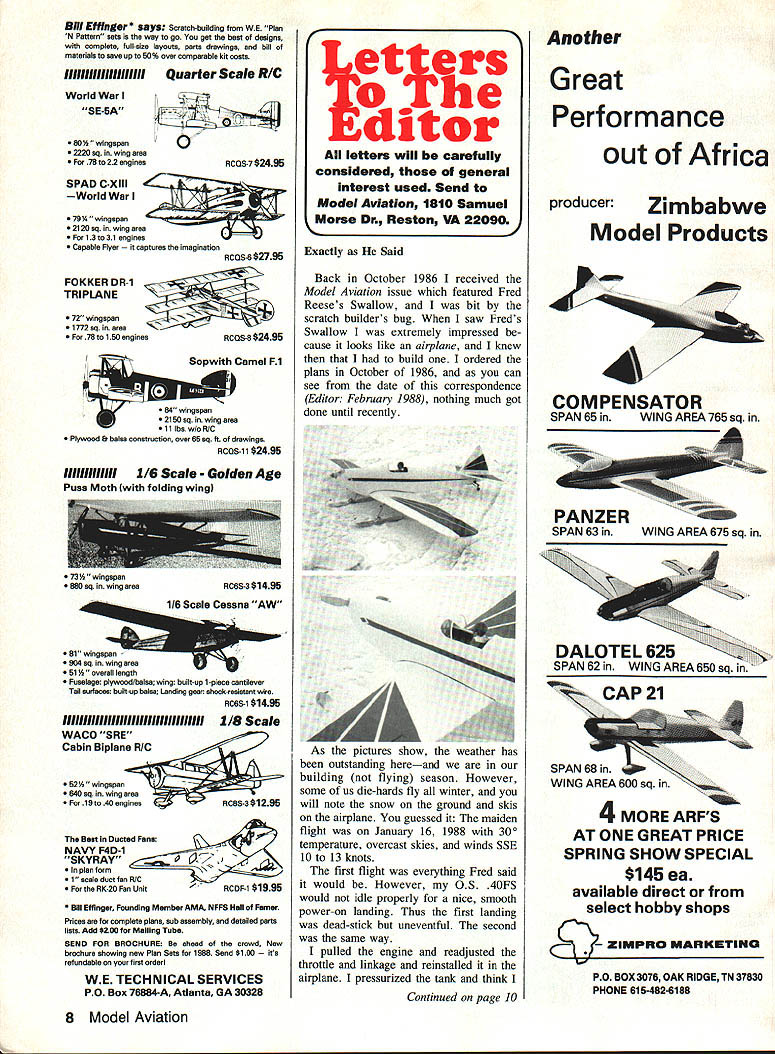
Back in October 1986 I received the Model Aviation issue which featured Fred Reese's Swallow, and I was bitten by the scratch-builder's bug. When I saw Fred's Swallow I was extremely impressed because it looks like an airplane, and I knew then that I had to build one. I ordered the plans in October of 1986, and as you can see from the date of this correspondence (Editor: February 1988), nothing much got done until recently.
As the pictures show, the weather has been outstanding here—and we are in our building (not flying) season. However, some of us die-hards fly all winter, and you will note the snow on the ground and skis on the airplane. You guessed it: the maiden flight was on January 16, 1988 with a 30° temperature, overcast skies, and winds SSE 10 to 13 knots.
The first flight was everything Fred said it would be. However, my O.S. .40FS would not idle properly for a nice, smooth power-on landing. Thus the first landing was a dead-stick but uneventful. The second was the same way.
I pulled the engine, readjusted the throttle and linkage, and reinstalled it in the airplane. I pressurized the tank and think I now have the problem worked out.
The Swallow flew exactly as Fred stated in the article. The ailerons are very responsive with the movement he suggested. Knife-edge flight was good, though it couldn't be sustained; that might be on account of the skis. Landings are much better now that the engine runs and idles properly.
I did not make any changes to Fred's design, except I like to cover my planes with fabric and dope. I used Solartex and butyrate dope. With the skis on the model it weighs 4 lb. 6 oz. With wheels instead, I think it will be about 3 lb. 8 oz. It has a CB Associates scale tailwheel.
The Swallow flies super. I have let a number of my friends fly it, and as Fred said in the article, it becomes very comfortable to fly in no time. A pat on the back to Fred Reese. Everybody should have a plane that flies like this one.
I thoroughly enjoy Model Aviation. This was the first project I built from MA, but surely not the last one.
John Bonebardo So. St. Paul, MN
MA Covers
What a pleasure it was to see Wakefield World Champion Bob White, along with Jim Quinn and others, on the cover a while back.
Although I am now actively involved in Control Line flying, the years 1969–75 were 100% Free Flight for me. At that time I was privileged to know two people who went out of their way to advise and assist with my contest efforts: Sal Taibi in Power and Bob White in Rubber. Largely as a result of Bob's on-the-spot suggestions on trimming, I lucked into winning Coupe d'Hiver on two occasions — out of many contests, that is — in West Coast contests.
Bob White's patience, easygoing good nature, and willing advice will always be remembered as some of the more enjoyable times in FF. May he continue to repeat as a long-overdue World Champion.
Mike Keville Lakewood, CA
RC Instructor at 11!
My name is Robert Deneau. I just turned 11 years old in January and have over 300 hours of flying time since soloing at the age of eight. I am an instructor in our club, the Volunteer State Model Aviators of Springfield, TN. I am the club's only Junior member.
I enjoy teaching adults to fly. I received my All-Season Flyer patch at age eight. I spend a lot of my time flying Sport Aerobatics, Pattern, and Racing aircraft. My favorite plane is a Super Hots with a SuperTigre .75.
I am also the club's Chief Test Pilot. When a new plane needs checking out, the builder gives me the call to put it through its paces. Because of my diversity in flying different models from sailplanes to scale, and having qualified as a full-scale pilot in a C-150, I look forward to joining the Civil Air Patrol when I am 12 and pursuing a career in aviation when I graduate from college. The enclosed picture is of me and a new club member I am instructing. The plane, not in view, is a Telemaster 40.
Robert Deneau Springfield, TN
Prop Balancing Tip
Since about 1954 when I began flying Control Line models, the great unsolved problem has remained: what is the right method for balancing props? We all learned early on that all new props were likely to be out of balance, that the extra vibration this generated could destroy models rapidly and prevent good engine runs, and that we could easily spot out-of-balance props with a simple static balancer device. The next step was always the mystery: what to do about it.
Trimming the heavy prop tip or scraping material from the back surface never seemed to be a good solution. Finally, I have figured out what everyone else must have known all along: just apply polyurethane varnish to the light prop blade to build up the weight.
I wipe varnish onto both sides, starting from the tip and guessing how much to use — and check it again on the balancer. Going a little bit too heavy with the varnished end is best, as it seems to get a tad lighter when dry. Flat-finish varnish will weigh slightly more than glossy, helpful to know if you have a severe imbalance problem.
This method is great for wood props and also can be used for nylon or fiberglass props. Make sure the varnish doesn't dry with sags or runs, which will distort the shape of the blade.
John W. Powell Bala Cynwyd, PA
Nicest People in the World!
I am writing this letter to say thank you to all of the wonderful people who enjoy the hobby of RC modeling. I have been flying for three years and have yet to meet a fellow modeler who has been anything other than helpful, supportive, kind, enthusiastic, etc. Our club is blessed with modelers of all abilities, such as Clayton Hansen and Chet Knowles, who built the prototype 1/2-scale Aeronca for Pica Models, as well as beginners who have never flown before. We're always glad to help bring another person into this great hobby. RCers are the nicest people in the world!
Enclosed is a picture of my latest bird, a Sig Kobra. It uses an Irvine .25 with a 9 x 4 prop and is covered with red and white Goldberg Ultracote, which was extremely easy to use. The radio is my very reliable Airtronics SR4R (my first radio). The idea for the covering scheme came from a picture in Model Aviation's RC Sport and Aerobatics column. The Kobra is a superb flier, and the covering scheme is very beautiful in the air.
Thanks for the great magazine, and thanks again to the best people in the world.
Adam D. Bryant Cedaredge, CO
Loves Pop Pop's J-3
Just thought I'd drop you a line or two. I am vice-president of the Lebanon Valley RC Club, Inc., in Pennsylvania.
Am sending you a picture of my grandson Kian and myself. As you can see, I am starting him off at an early age: 16 months. He sure does love Pop Pop's Goldberg J-3 Cub. I believe he could fly it now if I get the Cub up about 36½ inches high.
I thank you for a lot of good reading. Keep up the good work.
Ray V. Primaldi Willow Street, PA
Transcribed from original scans by AI. Minor OCR errors may remain.

