
Letters To The Editor
All letters will be carefully considered; those of general interest will be used. Send to Model Aviation, 1810 Samuel Morse Dr., Reston, VA 22090.
Simitars Assemble Again
Since printing my letter, "A Call to Simitars," a few months back, I've received approximately 200 letters, phone calls, and photos from Simitar enthusiasts around the U.S., Canada, and the Antilles Islands.
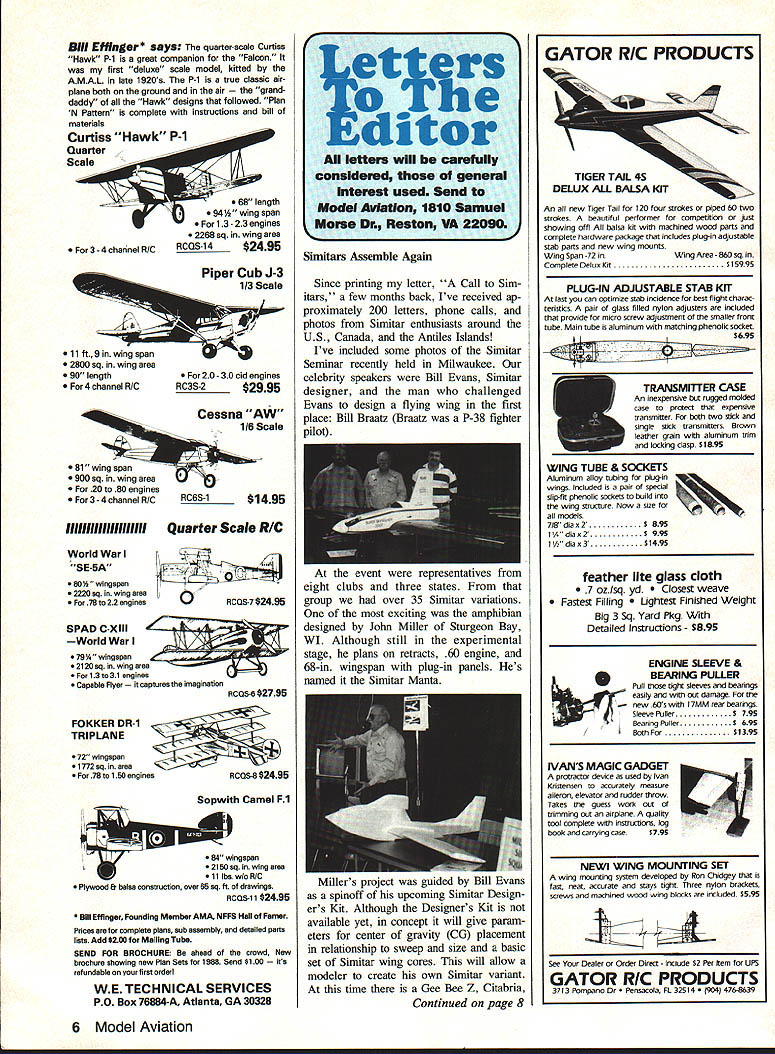
I've included some photos of the Simitar Seminar recently held in Milwaukee. Our celebrity speakers were Bill Evans, Simitar designer, and the man who challenged others to design a flying wing in the first place: Bill Braatz (Braatz was a P-38 fighter pilot).
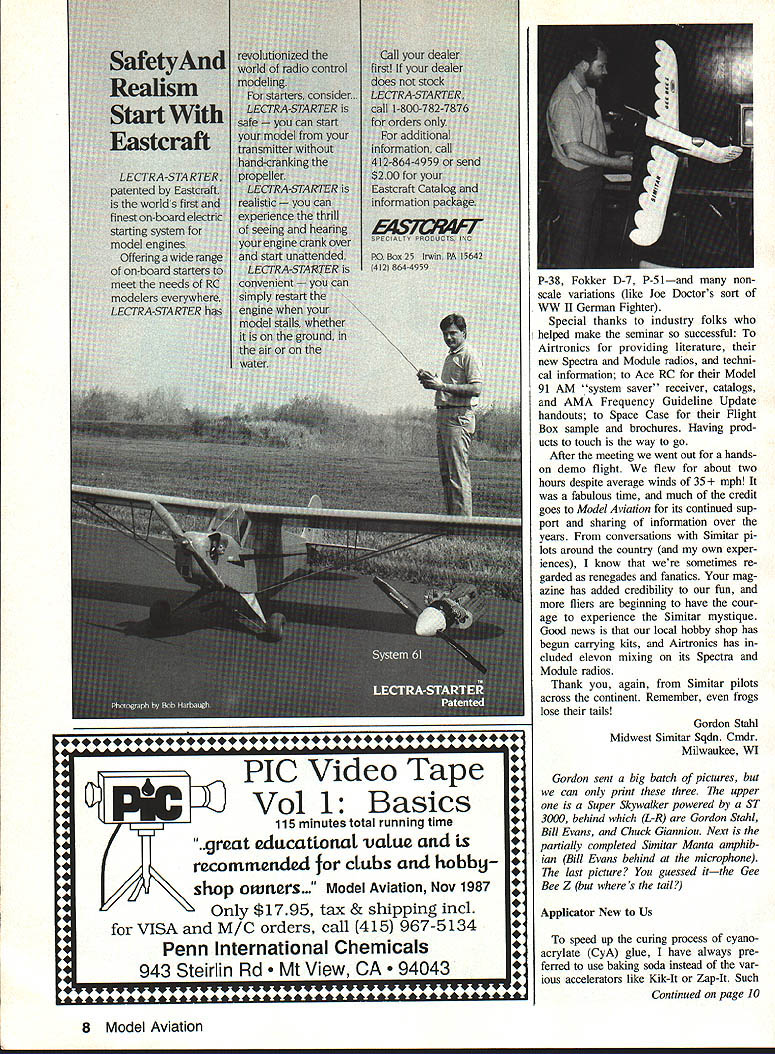
At the event were representatives from eight clubs and three states. From that group we had over 35 Simitar variations. One of the most exciting was the amphibian designed by John Miller of Sturgeon Bay, WI. Although still in the experimental stage, he plans on retracts, a .60 engine, and a 68-in. wingspan with plug-in panels. He's named it the Simitar Manta.
Miller's project was guided by Bill Evans as a spinoff of his upcoming Simitar Designer's Kit. Although the Designer's Kit is not available yet, in concept it will give parameters for center-of-gravity (CG) placement in relationship to sweep and size and a basic set of Simitar wing cores. This will allow a modeler to create his own Simitar variant.
Special thanks to industry folks who helped make the seminar so successful:
- Airtronics for providing literature, their new Spectra and Module radios, and technical information.
- Ace RC for their Model 91 AM "system saver" receiver, catalogs, and AMA Frequency Guideline Update handouts.
- Space Case for their Flight Box sample and brochures.
Having products to touch is the way to go.
After the meeting we went out for a hands-on demo flight. We flew for about two hours despite average winds of 35+ mph! It was a fabulous time, and much of the credit goes to Model Aviation for its continued support and sharing of information over the years. From conversations with Simitar pilots around the country (and my own experiences), I know that we're sometimes regarded as renegades and fanatics. Your magazine has added credibility to our fun, and more fliers are beginning to have the courage to experience the Simitar mystique. Good news is that our local hobby shop has begun carrying kits, and Airtronics has included elevon mixing on its Spectra and Module radios.
Thank you, again, from Simitar pilots across the continent. Remember, even frogs lose their tails!
Gordon Stahl Midwest Simitar Sqdn. Cmdr. Milwaukee, WI
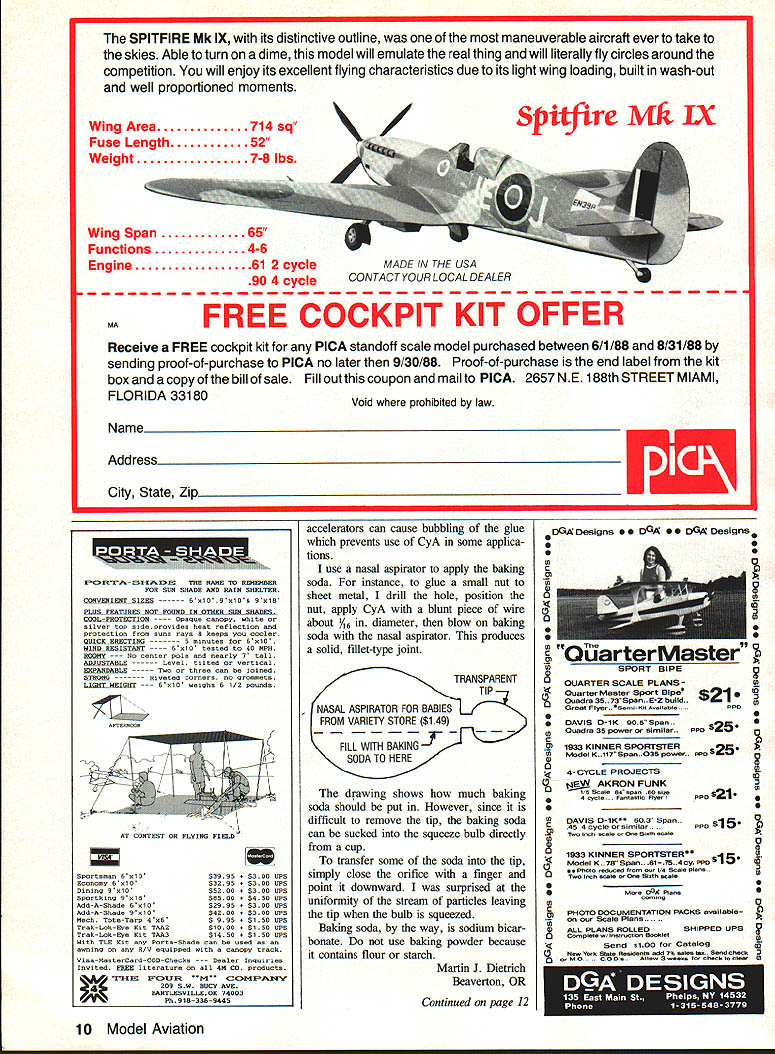
Gordon sent a big batch of pictures, but we can only print these three. The upper one is a Super Skywalker powered by an ST 3000; behind it (L–R) are Gordon Stahl, Bill Evans, and Chuck Giannini. Next is the partially completed Simitar Manta amphibian (Bill Evans behind at the microphone). The last picture? You guessed it—the Gee Bee Z (but where's the tail?).
Applicator New to Us
To speed up the curing process of cyanoacrylate (CYA) glue, I have always preferred to use baking soda instead of the various accelerators like Kit-K or Zap-It. Such accelerators can cause bubbling of the glue which prevents use of CYA in some applications.
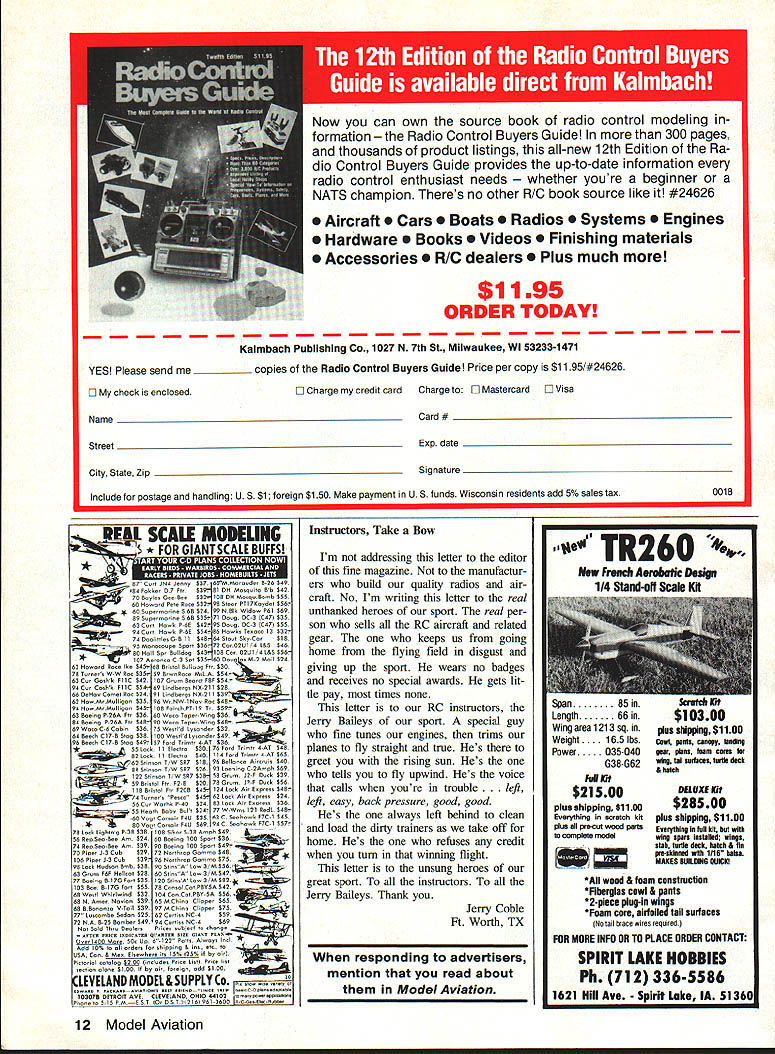
I use a nasal aspirator to apply the baking soda. For instance, to glue a small nut to sheet metal, I drill the hole, position the nut, apply CYA with a blunt piece of wire about 1/16 in. diameter, then blow on baking soda with the nasal aspirator. This produces a solid, fillet-type joint.
The drawing (not included here) shows how much baking soda should be put in. However, since it is difficult to remove the tip, the baking soda can be sucked into the squeeze bulb directly from a cup.
To transfer some of the soda into the tip, simply close the orifice with a finger and point it downward. I was surprised at the uniformity of the stream of particles leaving the tip when the bulb is squeezed.
Baking soda, by the way, is sodium bicarbonate. Do not use baking powder because it contains flour or starch.
Martin J. Dietrich Beaverton, OR
Instructors, Take a Bow
I'm not addressing this letter to the editor of this fine magazine. Not to the manufacturers who build our quality radios and aircraft. No, I'm writing this letter to the real unthanked heroes of our sport. The real person who sells all the RC aircraft and related gear. The one who keeps us from going home from the flying field in disgust and giving up the sport. He wears no badges and receives no special awards. He gets little pay, most times none.
This letter is to our RC instructors, the Jerry Baileys of our sport. A special guy who fine-tunes our engines, then trims our planes to fly straight and true. He's there to greet you with the rising sun. He's the one who tells you to fly upwind. He's the voice that calls when you're in trouble . . . "left, left, easy, back pressure, good, good."
He's the one always left behind to clean and load the dirty trainers as we take off for home. He's the one who refuses any credit when you turn in that winning flight.
This letter is to the unsung heroes of our great sport. To all the instructors. To all the Jerry Baileys. Thank you.
Jerry Coble Ft. Worth, TX
Transcribed from original scans by AI. Minor OCR errors may remain.

