
Letters To The Editor
All letters will be carefully considered; those of general interest will be used. Send to Model Aviation, 1810 Samuel Morse Dr., Reston, VA 22090.
More Than 30 Years Ago
This is just a note of appreciation for the ornithopter material you sent me. Were it not for you, I might never have known that there are other double-winged ornithopters out there, and I am most grateful.
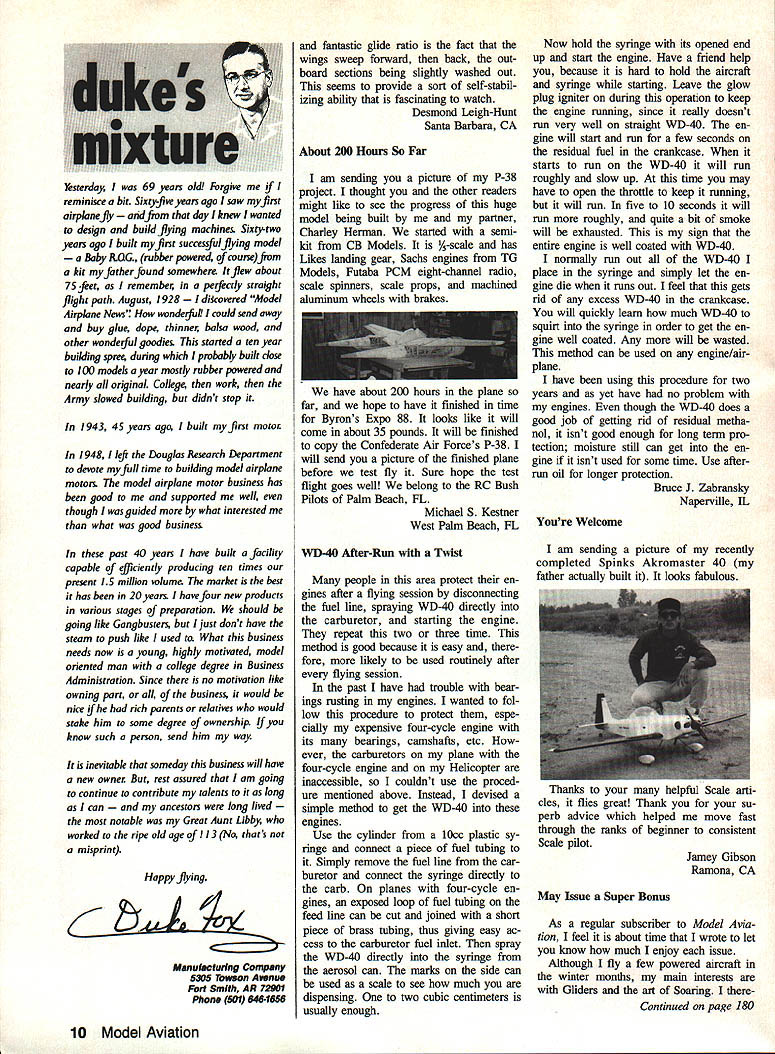
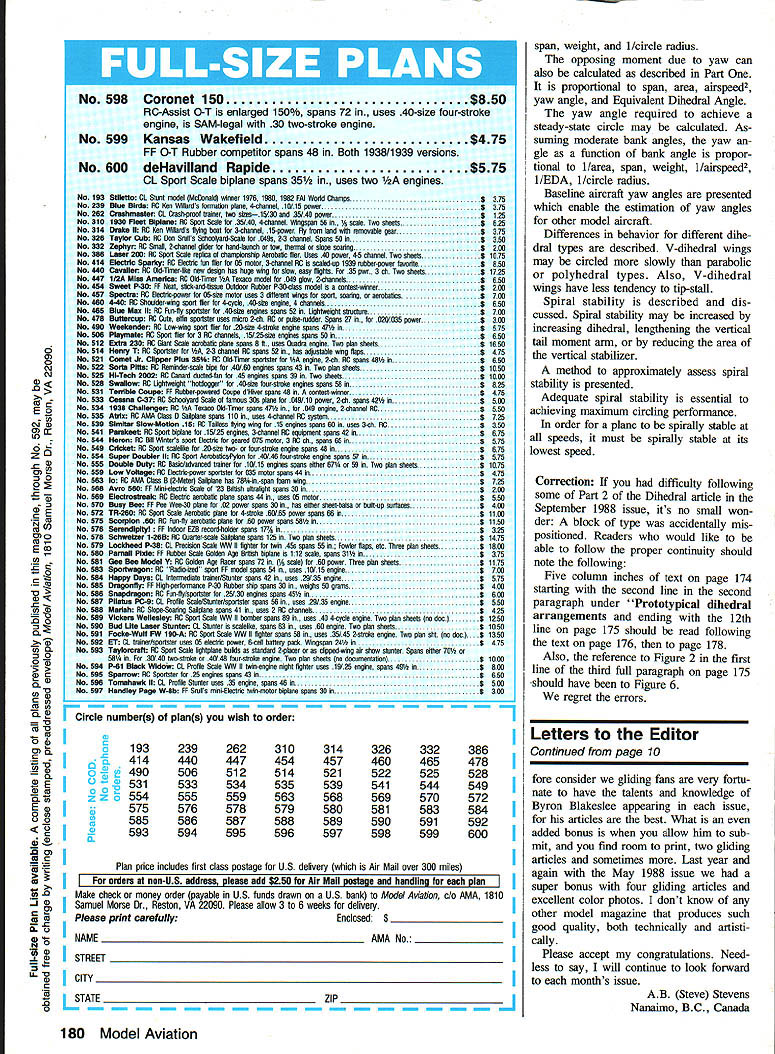
I don't know whether you have any interest in gliders, but I'm enclosing two recent pictures of a 9-ft. glider I designed and built more than 30 years ago. I have always wanted to put a radio-control unit in it but, for one reason or another, have not gotten around to doing so.
Several things make this glider rather unusual. The first (and most obvious) is that it has no vertical stabilizer. It's so stable, in fact, that it doesn't need a tail at all, but I put one on it to add some color—and also to help prevent it turning over when landing.
Contributing to its extraordinary stability and fantastic glide ratio is the fact that the wings sweep forward, then back, the outboard sections being slightly washed out. This seems to provide a sort of self-stabilizing ability that is fascinating to watch.
Desmond Leigh-Hunt Santa Barbara, CA
About 200 Hours So Far
I am sending you a picture of my P-38 project. I thought you and the other readers might like to see the progress of this huge model being built by me and my partner, Charley Herman. We started with a semi-kit from CB Models. It is 1/5-scale and has Links landing gear, Sachs engines from TG Models, a Futaba PCM eight-channel radio, scale spinners, scale props, and machined aluminum wheels with brakes.
We have about 200 hours in the plane so far, and we hope to have it finished in time for Byron's Expo 88. It looks like it will come in at about 35 pounds. It will be finished to copy the Confederate Air Force's P-38. I will send you a picture of the finished plane before we test fly it. Sure hope the test flight goes well! We belong to the RC Bush Pilots of Palm Beach, FL.
Michael S. Kestner West Palm Beach, FL
WD-40 After-Run with a Twist
Many people in this area protect their engines after a flying session by disconnecting the fuel line, spraying WD-40 directly into the carburetor, and starting the engine. They repeat this two or three times. This method is good because it is easy and, therefore, more likely to be used routinely after every flying session.
In the past I have had trouble with bearings rusting in my engines. I wanted to follow this procedure to protect them, especially my expensive four-cycle engine with its many bearings, camshafts, etc. However, the carburetors on my plane with the four-cycle engine and on my helicopter are inaccessible, so I couldn't use the procedure mentioned above. Instead, I devised a simple method to get the WD-40 into these engines.
Use the cylinder from a 10 cc plastic syringe and connect a piece of fuel tubing to it. Simply remove the fuel line from the carburetor and connect the syringe directly to the carb. On planes with four-cycle engines, an exposed loop of fuel tubing on the top of the carb can be cut and joined with a short piece of brass tubing, thus giving easy access to the carburetor fuel line. Then spray the WD-40 directly into the syringe from the aerosol can. The marks on the side can be used as a scale to see how much you are dispensing. One to two cubic centimeters is usually enough.
Now hold the syringe with its opened end up and start the engine. Have a friend help you, because it is hard to hold the aircraft and syringe while starting. Leave the glow plug igniter on during this operation to keep the engine running, since it really doesn't run very well on straight WD-40. The engine will start and run for a few seconds on the residual fuel in the crankcase. When it starts to run on the WD-40 it will run roughly and slow down. At this time you may have to open the throttle to keep it running, but it will run. In five to ten seconds it will run more roughly, and quite a bit of smoke will be exhausted. This is my sign that the engine is well coated with WD-40.
I normally run out all of the WD-40 I place in the syringe and simply let the engine die when the fuel runs out. I feel that this gets rid of any excess WD-40 in the crankcase. You will quickly learn how much WD-40 to squirt into the syringe in order to get the engine well coated. Any more will be wasted. This method can be used on any engine/airplane.
I have been using this procedure for two years and as yet have had no problem with my engines. Even though the WD-40 does a good job of getting rid of residual methanol, it isn't good enough for long-term protection; moisture still can get into the engine if it isn't used for some time. Use after-run oil for longer protection.
Bruce J. Zabransky Naperville, IL
You're Welcome
I am sending a picture of my recently completed Spinks Akromaster 40 (my father actually built it). It looks fabulous.
Thanks to your many helpful scale articles, it flies great! Thank you for your support and advice, which helped me move fast through the ranks from beginner to consistent scale pilot.
Jamey Gibson Ramona, CA
May Issue a Super Bonus
As a regular subscriber to Model Aviation, I feel it is about time that I wrote to let you know how much I enjoy each issue. Although I fly a few powered aircraft in the winter months, my main interests are gliders and the art of soaring. I therefore consider we gliding fans very fortunate to have the talents and knowledge of Byron Blakeslee appearing in each issue, for his articles are the best. What is an even added bonus is when you allow him to submit, and you find room to print, two gliding articles and sometimes more. Last year, and again with the May 1988 issue, we had a super bonus with four gliding articles and excellent color photos. I don't know of any other model magazine that produces such good quality, both technically and artistically.
Please accept my congratulations. Needless to say, I will continue to look forward to each month's issue.
A.B. (Steve) Stevens Nanaimo, B.C., Canada
Transcribed from original scans by AI. Minor OCR errors may remain.

