
Letters To The Editor
All letters will be carefully considered; those of general interest will be used. Send to Model Aviation, 1810 Samuel Morse Dr., Reston, VA 22090.
Engine History
"What's the name of an encyclopedia of the model airplane engines that I grew up with and flew in the 1930s, '40s, and early 1950s?" That was my question to Hurst Bowers, curator of the AMA Museum. Imagine my surprise and frustration when he replied he wasn't aware of such a publication! Hurst explained that, while AMA is constantly updating the history of model aviation through documents and conversation with well-known and not-so-well-known visitors whose names were legendary in the formative years, there's no AMA project to compile a narrative history of model airplane engines of the period. Am I the only person who would like to read about such engines, or are there others out there who also see a need for such an encyclopedia?
"Antique Gas Model Engines," by Arthur G. Suhr, provided a pictorial review of the great old-timers of 1934–1950. An occasional comment or brief story about a specific old-timer may appear in an AMA publication, Cloud Nine, or in a newsletter published by an individual club or member of the Model Engine Collectors Assn. Reprints of technical reviews of old-timers are just that—technical reviews without the warmth and enjoyment such engines provided us.
I would like to compile, in a single document, a narrative history of as many of the great old-time engines as I can. I would envision only a brief technical description, with emphasis on little-known facts and anecdotes about the designer, the engine design, and why things were done the way they were; manufacturing techniques and problems that might have occurred; and, in general, answers to such questions as the obvious design relationships of various engines with apparently different manufacturers' names.
Obviously such an undertaking requires the help of many others. Some engine designers are still alive, and perhaps someone can provide me with their addresses. Perhaps other readers can share with me their personal knowledge about a specific engine. Will the readers of this magazine support this project? If you can help or are interested in such a history, please advise me what type of material you can provide.
Send me your comments and recommendations along with a stamped, pre-addressed envelope in which I can send further information on what I hope to do. Don't send any material at this time.
Roger F. George 1113 Sheffield Ct. Altamonte Springs, FL 32714 (407) 862-3777
Really a BT-7
I am a little confused about the identification below the picture on page 86 of the October 1988 issue of Model Aviation: the lower right-hand picture of a model by Jim Hurley from New York of a Consolidated BT-9 biplane.
I was an instructor pilot at Randolph Field, Texas, and according to my memory and my old flight records, I flew a BT-9, BT-9A in August 1943 through December 1943. It was not a biplane but a low-wing basic trainer with fixed gear, two-speed prop, and closed canopy. I recall the airplane very well because it was the one used in the drawing picture "Wings" before WWII.
I know that the one I flew was a BT-9, and I have not heard of two Air Corps airplanes having the same numbers. I also flew an AT-9 at Maxwell Field.
Earl D. Caton Tampa, FL
We've subsequently found out that there was more than one error in our presentation of Bill Warner's report on the 1988 FAC Nats. For instance, the caption should not have said Jim Hurley; it was actually Jim Kaman of Hurley, NY—who, by way of Bill Warner, provided the following information.
Re the Consolidated biplane: I keep calling it the BT-9, but my documentation folder says BT-7, as does the Comet plan. I may have listed it on the registration form as the 9. It was also the PT (Primary Trainer) 11 and 12. It was also the Y1B (basic) T-6. Consolidated called it the Model 21C (and D?). I have a photo of it with the designation (just under the preceding) XB (basic) T-37, which is how I got the habit of calling it the BT-9. The North American B (basic) T-9 was indeed the fixed-gear version of the A (advanced) T-6. So take your pick: Not the BT-9? Not the BT-7? Not the PT-11? Or the 12? From PT-11 and 12 to BT-7? Sounds backwards to me, but would Ralph Kuenz lie? The folder says BT-7. Let's leave it at that.
Jim Kaman Hurley, NY
Airmaster Peanut Revisited
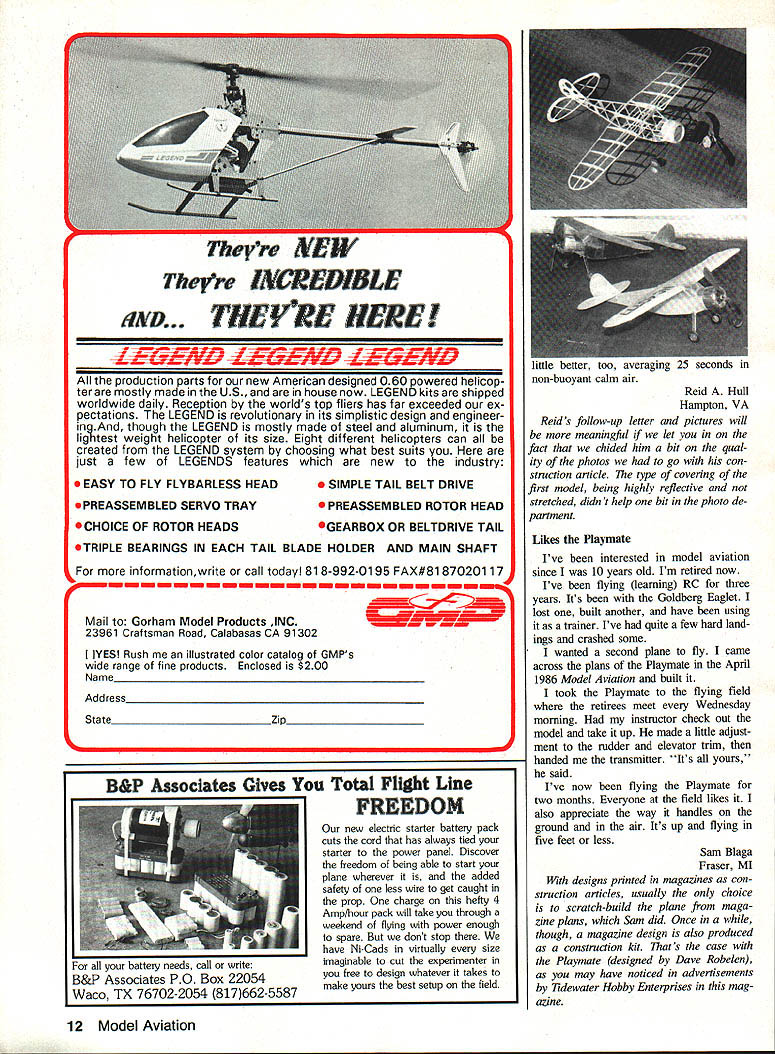
Enclosed are two somewhat better snapshots than those furnished at the time of the construction article of the Peanut Scale Cessna Airmaster design of mine which was printed in the May 1988 Model Aviation. My new model was built a bit neater, lighter, and covered with 1/4-mil Mylar. It flies a little better, too, averaging 25 seconds in non-buoyant calm air.
Reid A. Hull Hampton, VA
Reid's follow-up letter and pictures will be more meaningful if we let you in on the fact that we cabled him a bit on the quality of the photos we had to go with his construction article. The type of covering of the first model, being highly reflective and not stretched, didn't help one bit in the photo department.
Likes the Playmate
I've been interested in model aviation since I was 10 years old. I'm retired now. I've been flying (learning) RC for three years. It's been with the Goldberg Eagle. I lost one, built another, and have been using it as a trainer. I've had quite a few hard landings and a crash or two.
I wanted a second plane to fly. I came across the plans of the Playmate in the April 1986 Model Aviation and built it.
I took the Playmate to the flying field where the retirees meet every Wednesday morning. Had my instructor check out the model and take it up. He made a little adjustment to the rudder and elevator trim, then handed me the transmitter. "It's all yours," he said.
I've now been flying the Playmate for two months. Everyone at the field likes it. I also appreciate the way it handles on the ground and in the air. It's up and flying in five feet or less.
Sam Blaga Fraser, MI
With designs printed in magazines as construction articles, usually the only choice is to scratch-build the plane from magazine plans, which Sam did. Once in a while, though, a magazine design is also produced as a construction kit. That's the case with the Playmate (designed by Dave Robelen), as you may have noticed in advertisements by Tidewater Hobby Enterprises in this magazine.
Transcribed from original scans by AI. Minor OCR errors may remain.

