
Letters To The Editor
All letters will be carefully considered; those of general interest will be used. Send to Model Aviation, 1810 Samuel Morse Dr., Reston, VA 22090.
Vacation Flying Field
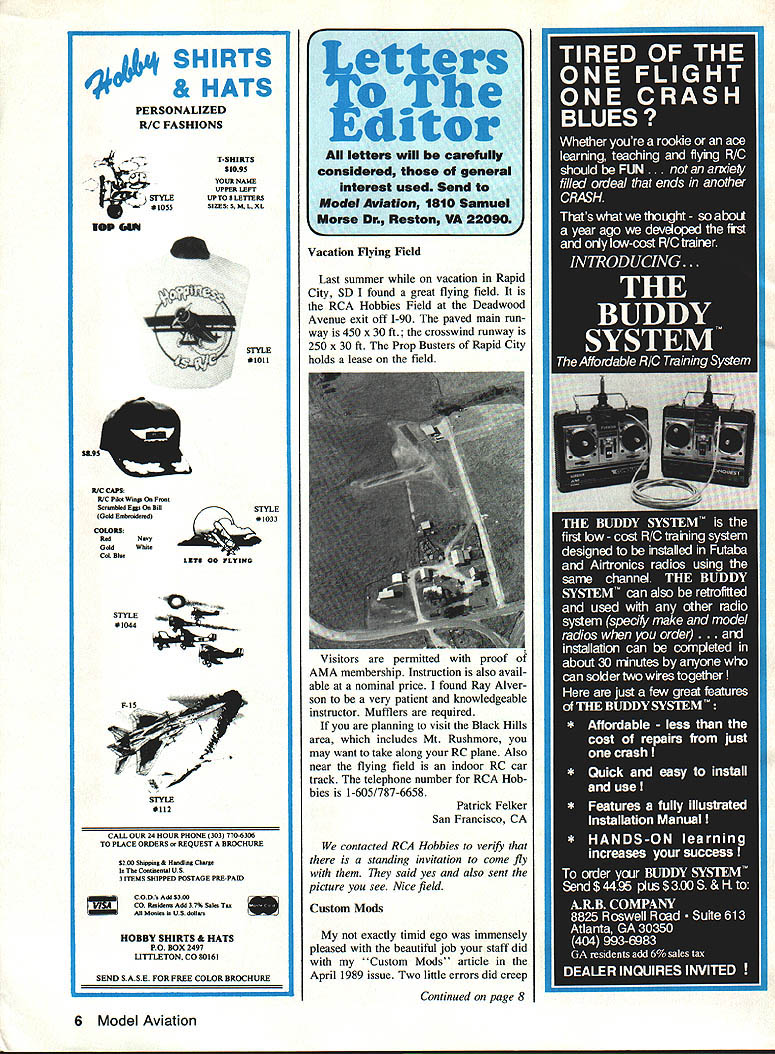
Last summer while on vacation in Rapid City, SD, I found a great flying field. It is the RCA Hobbies Field at the Deadwood Avenue exit off I-90. The paved main runway is 450 x 30 ft.; the crosswind runway is 250 x 30 ft. The Prop Busters of Rapid City hold a lease on the field.
Visitors are permitted with proof of AMA membership. Instruction is also available at a nominal price. I found Ray Alverson to be a very patient and knowledgeable instructor. Mufflers are required.
If you are planning to visit the Black Hills area, which includes Mt. Rushmore, you may want to take along your RC plane. Also near the flying field is an indoor RC car track. The telephone number for RCA Hobbies is 1-605-787-6658.
Patrick Felker San Francisco, CA
We contacted RCA Hobbies to verify that there is a standing invitation to come fly with them. They said yes and also sent the picture you see. Nice field.
Custom Mods
My not-exactly-timid ego was immensely pleased with the beautiful job your staff did with my "Custom Mods" article in the April 1989 issue. Two little errors did creep into the text, however.
Lest your readers think I am dabbling in the black arts, I have not yet devised a magical means of converting 6-32 threads into 4-40s (page 40). Interchange of socket-head hardware for slotted heads was made on an identical-size basis. The other: the fuel tank stopper problem was caused (not solved) by the reduced sealing pressure of the yielded inner washer against the rubber plug (page 143).
Fred Berman McKeesport, PA
Thank you for Fred Berman's exciting article, "Custom Mods," in the April issue. For many years I had thought it sacrilege to alter the designer's intent, doing so seeming to almost border on heresy.
There truly is a vast new world of model aviation out there for those who dare to alter, remodel, delete, or otherwise change a manufacturer's kit. At the same time one will quickly realize how satisfying it can be to build and fly your very own design concept without having to build it from scratch. The art of creatively altering and changing a model in which you've become tired and bored is very rewarding.
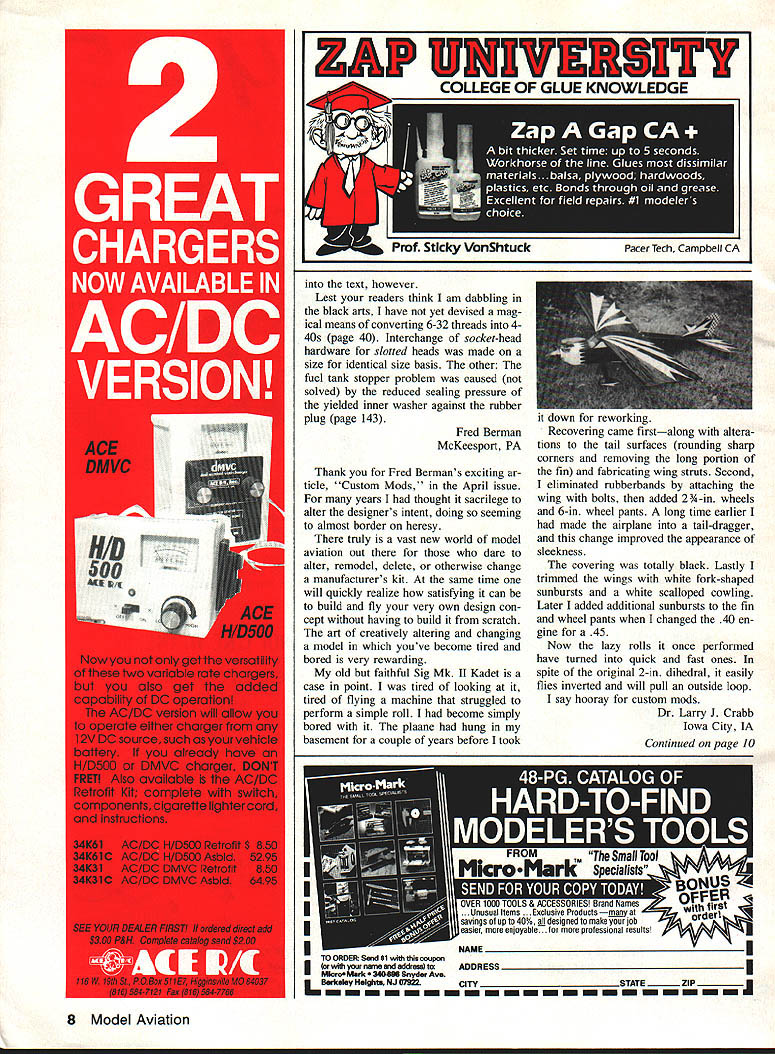
My old but faithful Sig Mk II Kadet is a case in point. I was tired of looking at a tired old flying machine that struggled to perform a simple roll. I had become simply bored with it. The plane had hung in my basement for a couple of years before I took it down for reworking.
Recovering came first—along with alterations to the tail surfaces (rounding sharp corners and removing the long portion of the fin) and fabricating wing struts. Second, I eliminated rubber bands by attaching the wing with bolts, then added 2 3/4-in. wheels and 6-in. wheel pants. A long time earlier I had made the airplane into a tail-dragger, and this change improved the appearance of sleekness.
The covering was totally black. Lastly I trimmed the wings with white fork-shaped sunbursts and a white scalloped cowling. Later I added additional sunbursts to the fin and wheel pants when I changed the .40 engine for a .45.
Now the lazy rolls it once performed have turned into quick and fast ones. In spite of the original 2-in. dihedral, it easily flies inverted and will pull an outside loop. I say hooray for custom mods.
Dr. Larry J. Crabb Iowa City, IA
Wasserkuppe Revisited
I just want to drop a note of thanks for Byron Blakeslee's great article on the Wasserkuppe in the May 1988 issue. I am currently stationed at Comiso Air Station in Sicily, Italy, and I had the opportunity to visit central Germany for a USAF mental health conference. Mr. Blakeslee's article gave me the impetus to take a few days' leave to visit the Wasserkuppe, a place I had always dreamed of seeing since I was a kid flying HL gliders in junior high school.
We took Mr. Blakeslee's advice and stayed in the little town of Gersfeld at the Hotel-Pension Rhonlust. What a delightful place. Although the weather was not ideal, there still was RC soaring activity on the hill, and we greatly enjoyed touring the new museum.
By the way, a young man at a concession stand on the hill said that Peter Riedel, author of Start in der Wind, is working on an English translation of the book, a history of soaring at the Wasserkuppe. For those of you who are interested in soaring and don't know German, this edition will certainly be a must read. I understand that the book might be ready by this summer, from what the concession salesman said.
At any rate, please convey my appreciation to Mr. Blakeslee for such a topnotch article. His travel tips made the trip more enjoyable, and his pictures captured the spirit and the special atmosphere of this historical site.
Maj. Warren C. Drew, USAF APO New York, NY
Max Kaufman: 1918-1988
My beloved father, Max Kaufman, passed away on November 28, 1988. Not only was he an avid aviation buff, he also was an established and successful architect, inventor, astronomer, and archaeologist.
He was one of the early pioneers in RC aircraft. He designed and built numerous scale airplanes, radios, and several engines (including twins), beginning in 1955.
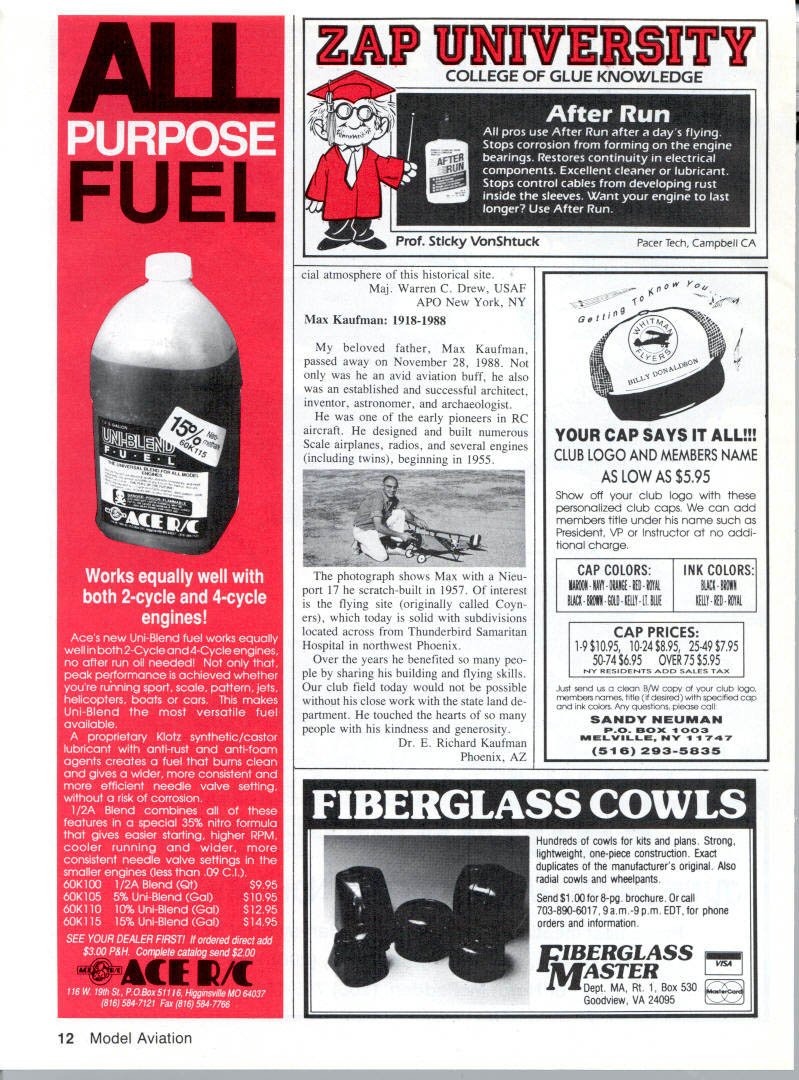
The photograph shows Max with a Nieuport 17 he scratch-built in 1957. Of interest is the flying site (originally called Conyers), which today is solid with subdivisions located across from Thunderbird Samaritan Hospital in northwest Phoenix.
Over the years he benefited so many people by sharing his building and flying skills. Our club field today would not be possible without his close work with the state land department. He touched the hearts of so many people with his kindness and generosity.
Dr. E. Richard Kaufman Phoenix, AZ
Transcribed from original scans by AI. Minor OCR errors may remain.

