
Letters To The Editor
All letters will be carefully considered; those of general interest will be used. Send to Model Aviation, 1810 Samuel Morse Dr., Reston, VA 22090.
FF Scale at Mile Square
Ah, guilt by association.
Please tell John Oldenkamp that I loved his comments on my Pussy Cat design in the April 1989 issue article, "FF Scale at Mile Square." But he attributed the Pussy Cat one-design event to the wrong organization.
The Flight Masters did not sponsor, organize, or run the event; it was the work of the Thermal Thumbers. Specifically, it was the work of Gary and Stan Buddenbohm and Dick Peterson, who jointly thought up the idea, publicized it, ran the contest, and paid the prizes out of their own pockets. It was not a complete coincidence that the Pussy Cat contest ran on the same day as the Flight Masters contest; I think it was planned that way.
These three guys do something like this every year. Last year's one-design event was for Thermic 20s. Dick Peterson is president of the Thermal Thumbers this year, and Gary Buddenbohm is vice-president. They really deserve recognition for their efforts.
Aside from this glitch, I thought the article was great. I enjoyed the fine pictures very much.
Dick Baxter Laguna Niguel, CA
Dick notes that he's an ex-president of the Thermal Thumbers and is also a member of the Flight Masters.
Corrections to "FF Scale at Mile Square"
Re "FF Scale at Mile Square" in the April 1989 Model Aviation: on page 98 at the top, Don Schlossburg's model was identified as a Piper Vagabond when, in fact, it is a Piper Super Cruiser. His wife's model is correctly identified on page 99 as a Vagabond.
Also, in the left photo at the top of page 99, the model in Don's hand was said to be a Chipmunk when it is actually a Jodel. Only the color schemes are similar; the only Chipmunk I know of painted like that was the late Art Scholl's.
Also, a bit of clarification is in order concerning the Alexander Bullet shown on page 44. The model is of the final version, the C-7, with the 165-hp Wright J-6 engine. This was the only version with fixed gear. The C-1, C-3, and C-5 were retractable and were also considered production models. The C-1, serial #2001, with the Kinner K-5 of 100 hp, was the prototype. The longer fuselage of the C-7 was to improve handling, and the fixed gear was provided to placate those who were afraid of the newfangled retracting gear. Retracts were available as an option.
James G. Smith Erial, NJ
Hangar 13 Reunion
Hangar 13 would be glad to hear from any "lost" former members and any acquaintances, competitors, or associates from the Golden Years of model aviation.
Details of the September 9 reunion can be had from Conrad Hansen, 424 Volusia Ave., Dayton, OH 45404.
Jim Enking Beloit, WI
It's a Beauty!
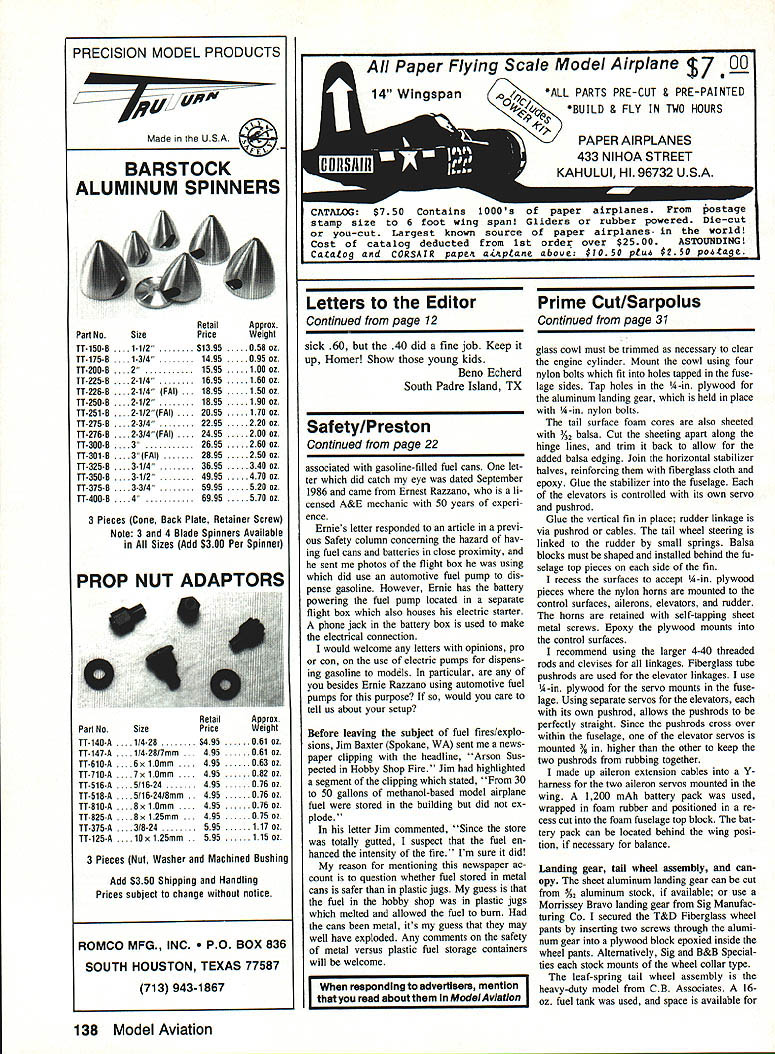
You might find the enclosed photograph of my model interesting enough to publish. It is my own design.
The fuselage is epoxy-fiberglass laid up in a mold, and the wing is expanded polystyrene (1 lb. per cu. ft.). Covering is 1/2-oz. ply and Monokote. The engine is a very old Enya .60 with a Perry P-30 pump to move the fuel from the C.G. Span is 48 in., and the fuselage is 62 in. Weight is 10 lb.
The wing halves were cut with a hot wire. First, the contour was cut (top view). A plywood root rib was temporarily glued to the foam with double-sided carpet tape (nothing is worse than a rib that moves during the cutting process). There is no wing tip, so there is no tip rib. A 1/8 x 3/8-in. hardwood strip was glued where the leading edge belongs. The hot wire was started parallel with the trailing edge; maintaining this orientation, the wire was moved all the way to the front of the wing. The wire rides on the root rib and the leading edge. Afterward a balsa leading-edge strip was added and rounded for aesthetic reasons.
I was truly worried whether this more-or-less flat-plate airfoil would deliver sufficient lift. Not to worry. It did, and it does. Only the sharpest eyeballs detect the absence of whatever dimension is missing from this airfoil, and one does not need to be a master sculptor to create the beautiful ogee-curved wing.
The silhouette overhead evokes many gratifying comments.
Martin J. Dietrich Beaverton, OR
Right on, Homer!
Hooray for Homer Gobson in your May issue! I, too, wondered about Bill Winter and Bill Evans when I read their article on the Simitar Slow Motion. I started with a .40 when I built mine and even considered a .60, but the .40 did a fine job. Keep it up, Homer! Show those young kids.
Beno Echerd South Padre Island, TX
Transcribed from original scans by AI. Minor OCR errors may remain.

